JAMSAT stand at the Tokyo Ham Radio Fair August 2014
The Japan AMSAT Association (JAMSAT) and students at the Nippon University are jointly developing a CubeSat called NEXUS which will have a 145 to 435 MHz (Mode-J) transponder and a 38 kbps data downlink.
JAMSAT CubeSat Board
Nippon University students have previously developed the SEEDS and SPROUT satellites. NEXUS is an achronym of “Next Education X (cross) Unique Satellite”, it will be 1U CubeSat with a mass of between 1 and 1.5 kg.
The NEXUS team hope to:
● Provide amateur radio communications via the 145/435 MHz transponder and SSTV
● Download pictures from the 640×480 pixel camera
● Operate the data downlink at 38400 bps QPSK
● Compare the performance of the data downlink when using AFSK, GMSK and QPSK modes
The launch is expected to take place on January 17, 2019.
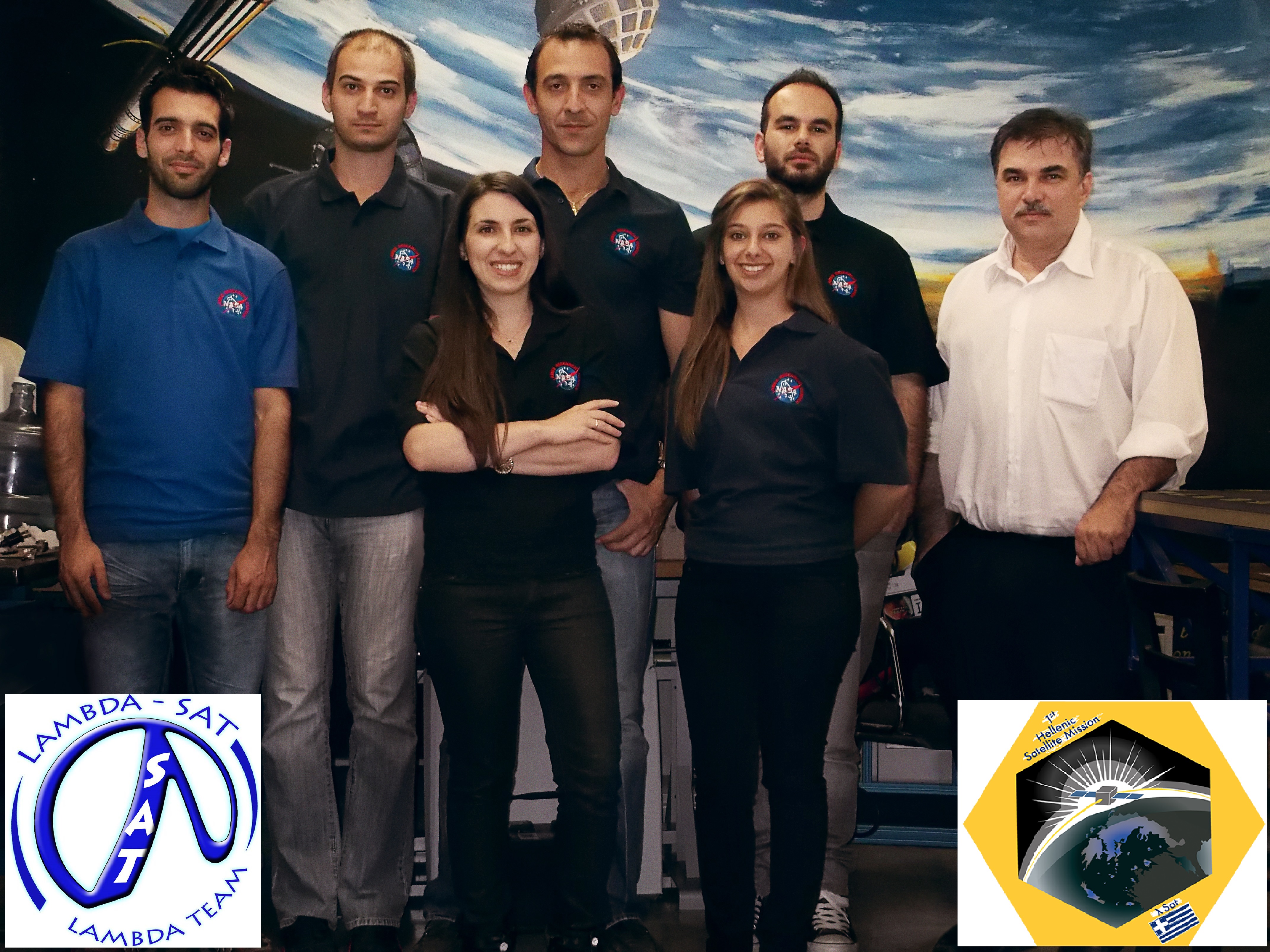
Some of the Lambda-Sat Team (right to left) Dr. Periklis Papadopoulos, Kostas Alexandrou, Eriana Panopoulou, Vaggelis Christodoulou, Maria Dimitrakopoulou, Charalabos Koulouris and Simos Kanis
Lambda-Sat was launched to the International Space Station (ISS) from the Wallops Flight Facility in Virginia on July 13, 2014, in an Orbital Sciences’ Antares rocket CRS-2/ORB-2.
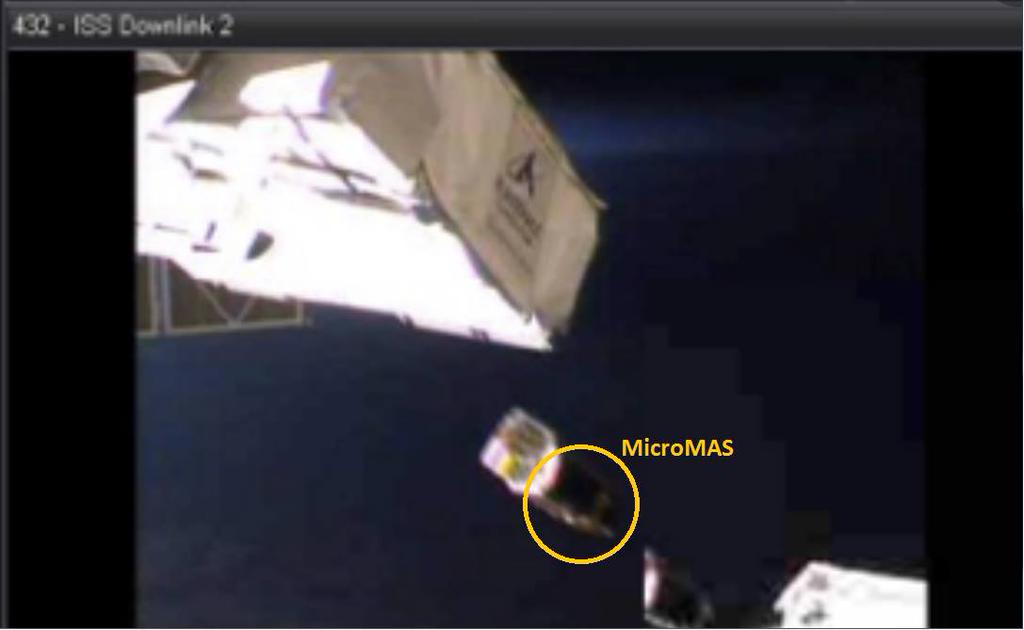
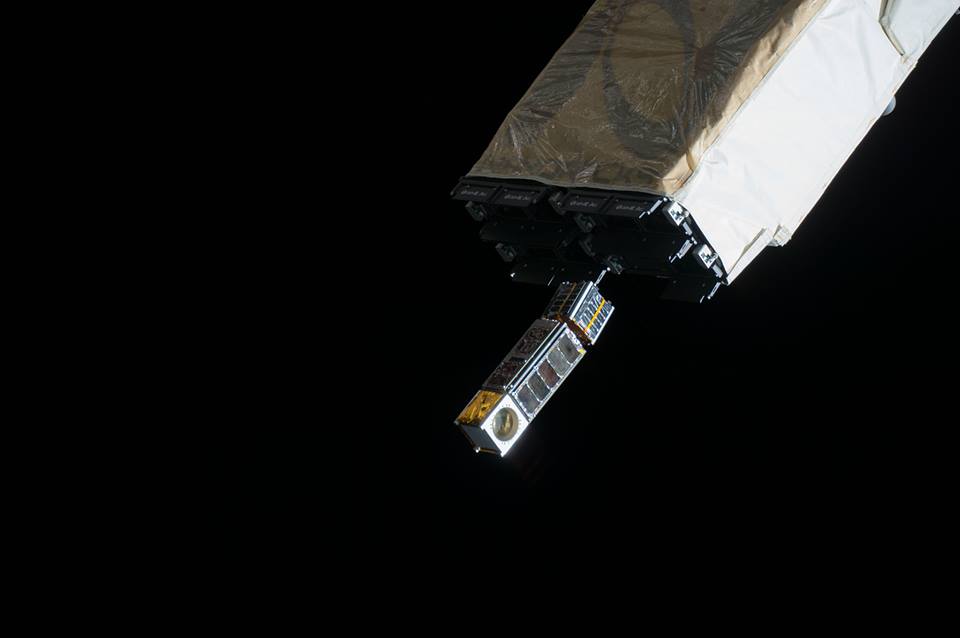
UPDATE: Deployment from the ISS took place on March 4, 2015 along with the MicroMAS CubeSat. This followed the deployment of two other CubeSats GEARRSAT and TechEdSat-4. On May 16, 2015 Lambda-Sat reentered the Earth’s atmosphere and burnt up. No signal was ever reported from Lambda-Sat.
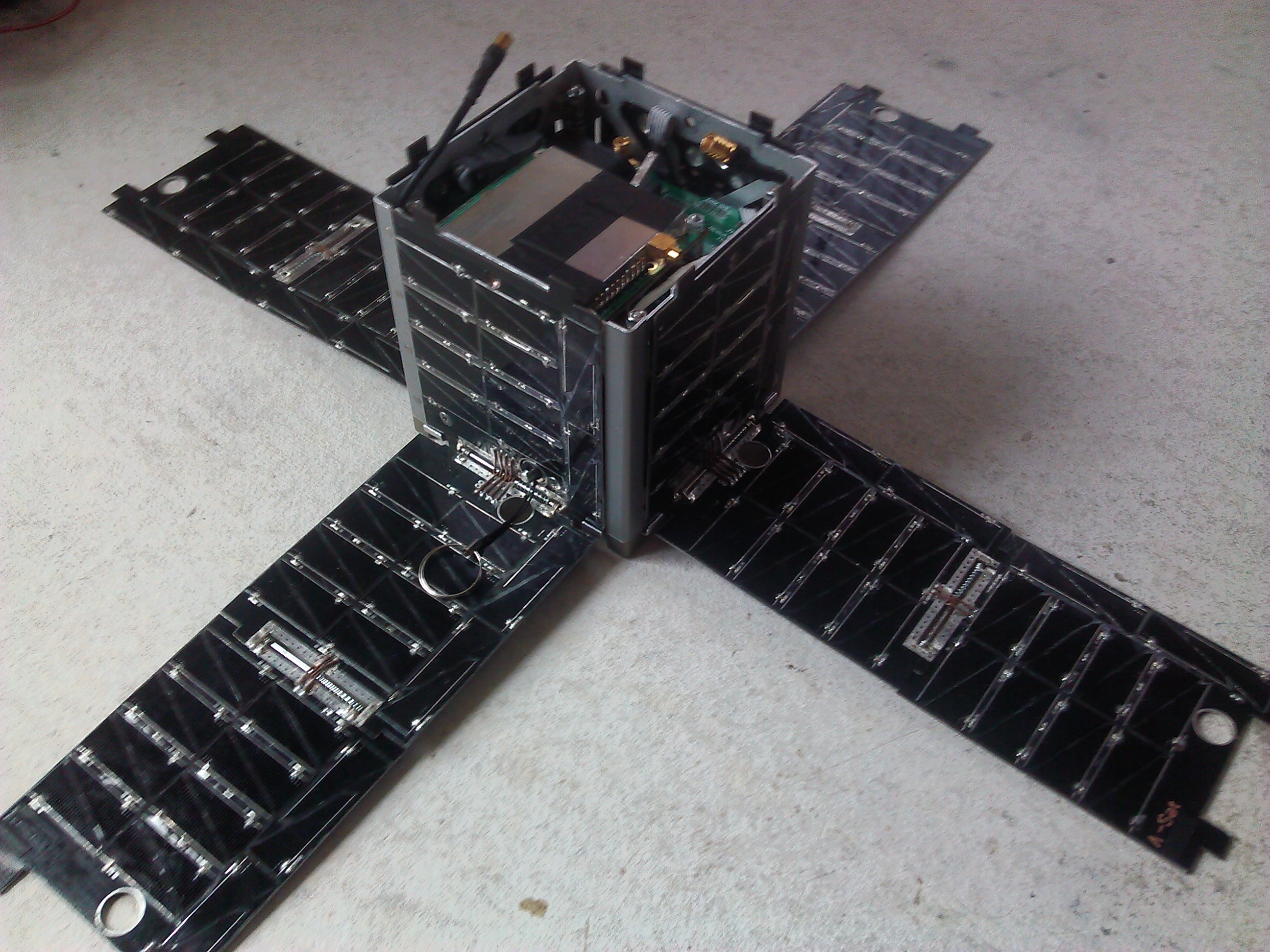
Lambda-Sat
The Lambda team encourages amateur radio operators around the world to listen for and report the Lambda-Sat signal. Frequency: 437.462 MHz Downlink: AX.25 Unnumbered Information (UI) packets at 1200 bps AFSK Transmission Power : 1W Call Sign KK6DFZ The Secretary of the Cyprus Amateur Radio Society (CARS) Nestor 5B4AHZ has written an article on Lambda-Sat, he says: The naming of the Λ-sat satellite came from the Greek letter L (Λ – lambda) a reminder of Hellas, Helios, the Greek word Thalassa for sea, the Greek word Lithos which directly translates to stone (meaning “Land of Light”).
LambdaSat and MicroMAS CubeSats deploying from ISS March 4, 2015
The Λ-sat was constructed entirely of Greek volunteers who worked feverishly, selflessly and without any personal gain. Members of Λ-sat contributed to the construction of the satellite system each with their knowledge in robotics, electronics, software development and telecommunications. The group consists of young people from Greece who traveled to Silicon Valley in California to participate in this project. “I want to motivate the youth in Greece to continue to dream,” says the original initiator of the project, Periklis Papadopoulos, Professor of Aerospace Engineering of the Federal University of California San Jose, which has been awarded from NASA for his contribution with the prize Turning Goals Into Reality (TGIR). As the professor states, “My goal is to demonstrate the capabilities of young people in Greece.” The professor believes that our country could be active in this area and this is not an economic issue, but a question of will alone (!). Submit reception reports of Lambda-Sat at http://lambdasat.com/?page_id=181 Lambda-Sat http://lambdasat.com/ Facebook https://www.facebook.com/lambdateam Article on Lambda-Sat by Nestor 5B4AHZhttp://www.cyhams.org/index.php/en/news-and-events/359-the-first-greek-microsatellite-is-a-fact
MicroMAS and Lambda-Sat deploying from ISS on March 4, 2015 – Image NASA / NanoRacks
Ofcom’s Ash Gohil and Paul Jarvis G8RMM at 2013 RSGB Convention
Ofcom staff will be among those giving presentations at the RSGB Convention which takes place October 10-12.
The Ofcom public consultation on Amateur Radio has been eagerly awaited for many months now and will hopefully have been released before the Convention.
The Society say there will be lots of space and a five lecture stream programme in the new Convention venue at the Kents Hill Conference Centre, Milton Keynes, MK7 6BZ.
Among the presentations are – UKHASNET, technology and methodology by James Coxon M6JCX – SDR Techniques by Simon Brown G4ELI – Digital modes start up by Mike Richards G4WNC – FUNcube CubeSat by AMSAT-UK – Amateur radio software developers forum by Michael Wells G7VJR – 146-147MHz: A New Frontier of Amateur Innovation? by John Regnault G4SWX – World War 1 Communications by Dr Elizabeth Bruton
Paul Stoetzer N8HM has announced a new award for contacts made via the AO-73 (FUNcube-1) amateur radio satellite
I am pleased to announce that I will be sponsoring a new award to promote activity on AO-73 (FUNcube-1). The requirements for this award are simple:
1. Work 73 unique stations on AO-73. 2. Contacts must be made on or after September 1, 2014. 3. There are no geographic restrictions on your operating location.
There will be no cost for this award (donations to AMSAT-UK and AMSAT-NA’s Fox program are encouraged though). No QSLs are required. When you complete the requirements, email your log extract including the callsign of each station worked, time GMT, and date to n8hm@arrl.net as well as the address where you’d like the award certificate sent.
On August 18, 2014 at 14:00 UT the Russia Cosmonauts on the International Space Station (ISS), Alexander Skvortsov and Oleg Artemyev, opened the hatches of the Pirs docking module and to start Extra Vehicular Activities (EVA).
Engineer Ing. Margarita Mondragon and Chasqui-1
One of their tasks was the deployment of the Peruvian satellite Chasqui-1, a research satellite designed to standard CubeSat dimension by the Peruvian National University of Engineering (Universidad Nacional de Ingenieria (UNI)) in collaboration with the Southwestern State University (SWSU) in Kursk.
Chasqui-1’s batteries were charged by the Russian Cosmonuats inside the ISS during August 14/15.The satellite was successfully deployed by Oleg Artemyev near the start of the EVA at 14:23 UT.
Chasqui-1 was developed with the intention of improving their satellite technology through the design and testing of a small satellite. Its facilities include two cameras, one in visible and the other in infra-red. Other facilities include communication in the amateur radio band and control systems for its power, thermal and embedded management of its components.
Peruvian CubeSat Chasqui-1
Chasqui-1 will provide a number of functions that include taking pictures of the Earth. From an academic perspective it will facilitate collaborations among various faculties and research centres of the university to train students and teachers with real world experience in satellites. It will also generate opportunities to work with other universities in the world which in turn will lead to technological advances in the aerospace industry of Peru.
The 437.025 MHz beacon (+/- 10 kHz Doppler shift) can transmit either 1200 bps AFSK AX.25 or 9600 bps GMSK. As of August 23 no signal from the beacon had been heard.
Chasqui-1 as a small dot against the Earth, seconds after Oleg Artemyev sent it spinning – Screenshot Jonathan McDowell
On August 19-20 there may be a relay of the Chasqui-1 signal transmitted from the ISS on 145.800 MHz FM using the callsign RS02S. This relay should provide a strong signal with reduced Doppler receivable even on handheld radios.
Many stations, who have their FUNcube Dongle Software Defined Radio (SDR) setup to automatically receive telemetry signals from FUNcube-1, will have noticed that they are now also seeing the telemetry from the FUNcube-2 sub-system which is flying on-board the UKube-1 CubeSat.
UKube-1 CubeSat (with FUNcube-2 sub-system) – Image credit Clyde Space
The FUNcube telemetry transmitter has been enabled on 145.915 MHz (+/- Doppler) as part of the commissioning program for UKube-1 which is presently underway.
Whilst the existing FUNcube-1 Dashboard does not correctly display the FUNcube-2 telemetry, it is forwarding the data correctly to the Warehouse and this is greatly appreciated by the team.
The FUNcube team are not yet able to release a FUNcube-2 specific Dashboard App, they are, however, working to provide a fully functional FUNcube-2 page on the Data Warehouse as soon as possible.
In the meantime please continue to listen and, where you are able, to keep the data flowing to the Data Warehouse – many thanks for your support.




 AMSAT-UK
You must be logged in to post a comment.