From Holiday Inn to Outer Space

David Bowman G0MRF giving one of his popular FUNcube satellite presentations

David Bowman G0MRF giving one of his popular FUNcube satellite presentations

On Friday, July 4, the Whitton Amateur Radio Group (WARG) will be hosting a presentation by David Bowman G0MRF on the subject of the FUNcube satellite.

David is a member of the AMSAT-UK team behind the successful development and launch of the amateur radio FUNcube-1 CubeSat which transmits telemetry for Educational outreach (STEM) and carries a 435/145MHz SSB/CW transponder. The presentation will have a live reception of the satellite as it passes over Europe.

The meeting is open to all, the doors open at 7 pm and the talk commences at 8:15 pm. Whitton Community Centre has good car parking and disabled access as well as the use of the bar. A small charge of £1.50 per person will be asked to cover room hire.

The venue is the Whitton Community Centre, Percy Road, Whitton, Middx, TW2 6JL

Directions can be found on the Whitton Amateur Radio Group site http://www.warg.info/

Delfi-n3Xt: 2405 MHz Downlink Test

Delfi-n3Xt Satellite

Delfi-n3Xt Satellite

Delfi Nanosatellite Program Manager, Jasper Bouwmeester PC4JB, has announced that the team plan to activate the Delfi-n3Xt satellite’s 2405 MHz downlink on May 13-17, 2014.

Dear all,

It has been a while since you heard from us. We are still having problems to receive our satellite since our transponder test. We now want to try something different: trying to activate our S-band transmitter and let it transmit at full power for a pass. If we are able to receive a signal from the S-band, we know that Delfi-n3Xt still has an operational receiver and we could potentially demodulate the S-band signal. But since we already know that the latter is difficult, the first focus is just to “see” the signal. Since the satellite is still tumbling, it is a matter of link budget and statistics if we are able to catch the signal. To increase our chanceswe would like to ask the help of radio amateurs in the neighbourhood with suitable equipment. Since we have to actively command the satellite we have planned the passes which are suitable for the Netherlands, Germany, Belgium and Northern France and the availability of operators from our side. According to a quick survey, you are living in the area in reach at the selected passes.
The question to you:

Do you have S-band (2405 MHz) reception functionality with a dish of at least 2.5 meter and tracking capability and willing to follow and record one or more passes for us?

If so, please let us know your location, the gain of your antenna and the passes you are able to follow. Off course you do not have to be actively present during the pass. You can just record it and send the recording later through http://www.wetransfer.com.

Delfi-n3Xt will send at 2405 MHz +/- 100 kHz. The latter is the worst case uncertainty band, but I expect it to be pretty close to the right frequency. If you have an SDR, you can best set it at +/- 1 MHz around the centre frequency. Off course you do not have to be actively present during the pass. You can just record it

The planned attempts are stated by the LOCAL time of commanding below. If successful transmission would be within the 10-20 minutes after the indicated time.

– Tue 13-05 ~11.25h local time
– Wed 14-05 ~12:00h local time
– Thu 15-05 ~22:10h local time
– Fri 16-05 ~11:35h local time
– Sat 17-05 ~12:10h local time

If you are able, your help is highly appreciated!

Vy 73,
Jasper PC4JB
Email: Jasper.Bouwmeester <at> tudelft.nl

Delfi-n3Xt http://www.delfispace.nl/operations/radio-amateurs

Delfi-n3Xt Communication Subsystem http://www.delfispace.nl/delfi-n3xt/comms

Future FUNcube missions – 2014 launch dates

UKube-1 on display at UK Space Conference in Glasgow

UKube-1 on display at UK Space Conference in Glasgow

The FUNcube team have received confirmation that UKube-1, which is hosting the FUNcube-2 payload, remains scheduled for a Soyuz launch on June 19. The team do not, as yet, have any lift-off times or TLE’s for this launch but we will make these available as soon as possible.

It is believed that, immediately after deployment and activation, UKube-1 will commence transmitting a CW beacon and that this will be later followed by an AX25, 1k2 BPSK beacon. Both beacons will be on 145.840 MHz. The FUNcube-2 payload, with its telemetry downlink for educational outreach, is expected to be tested later.

FUNcube-3 is the transponder only payload on the QB50 precursor CubeSat “QB50P1″. This mission is currently scheduled to launch “Not earlier than the second half of June” , on a Dnepr LV from Yasny. The initial beacon signals, from the main transceiver, are also expected to be AX25, 1k2 BPSK packets on 145.815 MHz. Again more information will be provided as soon as it becomes available.

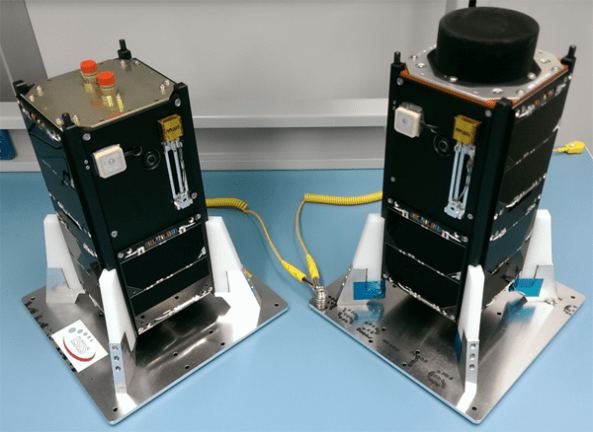
QB50p1 and QB50p2 - Image Credit ISIS

QB50p1 and QB50p2 – Image Credit ISIS

UKube-1 communications subsystem:
• 145.840 MHz Telemetry Downlink
• 2401.0 MHz S Band Downlink
• 437.425-437.525 MHz UKSEDS myPocketQub Downlink
• 145.915 MHz FUNcube beacon
• FUNcube 400 mW inverting SSB/CW transponder
– 435.080 -435.060 MHz Uplink
– 145.930 -145.950 MHz Downlink

QB50p1 communications subsystem:
• 145.815 MHz 1200 bps BPSK telemetry beacon
• FUNcube inverting 400 mW SSB/CW transponder
– 435.035 – 435.065 MHz Uplink LSB
– 145.935 – 145.965 MHz Downlink USB

FUNcube website http://www.funcube.org.uk/

FUNcube Yahoo Group https://amsat-uk.org/funcube/yahoo-group/

FUNcube Forum http://forum.funcube.org.uk/

Two QB50 satellites with ham radio payloads delivered

QB50p1 and QB50p2 - Image Credit ISIS

QB50p1 and QB50p2 – Image Credit ISIS

The QB50 project has reached another crucial milestone. The first two QB50 satellites have been delivered for shipment to the launch site after a successful flight acceptance test campaign. The satellites will form the QB50 Precursor mission that seeks to de-risk and validate key technologies of the QB50 main flight that will be performed in the coming years.

The launch is planned for June 19, 2014 from the Russian ICBM base at Dombarovsky near Yasny on a Dnepr rocket manufactured in Dnepropetrovsk, Ukraine. The satellites will be put into a 650 km Sun Synchronous Orbit (SSO).
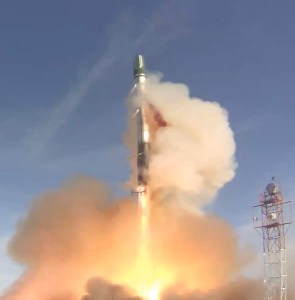
A Dnepr Launch - Credit ISC Kosmotras

A Dnepr Launch – Credit ISC Kosmotras

The following payloads were integrated into the ISIS satellite platforms:

QB50p1
• INMS Payload from MSSL, UK
• QB50 ADCS system from SSC, UK
• Thermocouple experiment from VKI, Belgium
• AMSAT-NL 435/145 MHz linear transponder (FUNcube-3) from AMSAT-NL, The Netherlands

QB50p2
• FIPEX Payload, University of Dresden, Germany
• QB50 ADCS system from SSC, UK
• Thermocouple experiment from VKI, Belgium
• AMSAT-Fr 435/145 MHz FM voice transponder from AMSAT Francophone, France

QB50p1 (FUNcube-3) has a VHF 9600 bps BPSK telemetry downlink plus a linear U/V transponder similar to that already flying on FUNcube-1 with an output of 400 mW.
• 145.815 MHz 9600 bps BPSK telemetry beacon
• Inverting SSB/CW linear transponder 400 mW PEP
– 435.035 – 435.065 MHz Uplink LSB
– 145.935 – 145.965 MHz Downlink USB

QB50p2 has  a VHF 9600 bps BPSK telemetry downlink plus a separate RF payload from AMSAT-Francophone which will comprise of a FM voice transponder with UHF uplink and VHF downlink. It will also transmit FX25 telemetry at 9600 bps.
• 145.880 MHz 9600 bps BPSK telemetry beacon
• 145.840 MHz 9600 bps FSK FX25

QB50p CubeSats

QB50p CubeSats

The project was executed to an unprecedented timeline. Formal Kick-Off was in October 2013 and all hardware from the different partners was delivered for integration into the satellites in January  2014. This means that two satellites were delivered in just over 6 months. Furthermore, with a precursor launch scheduled in June, launch and operations will commence within 9 months of project Kick-Off.

This fast-track project shows how successful a close cooperation between academic institutes and experienced companies can be. With ISIS’ experienced team of engineers that design and build nanosatellites on a regular basis (ISIS remains on track to delivering 1 satellite system per month in 2014), throughput times of nanosatellite projects can be shortened significantly.

The upcoming launch of the QB50 precursor satellites will also be the first satellites to be launched that were funded through the EU’s FP7 space technology programme, in which a number of innovative small satellites will be launched in the coming years to demonstrate new European space technologies.

The lessons learned from the QB50 Precursor development and operations have already led to many recommendations to further improve and streamline the QB50 main flight. All teams involved in QB50 stand to benefit from the experiences gained over the last months.

Source https://www.vki.ac.be/index.php/component/content/article/249-news/latest/467-isis-delivers-the-first-two-qb50-satellites-as-part-of-the-eu-fp7-qb50-project

ISIS http://www.isispace.nl/

QB50 http://www.qb50.eu/

QB50 Precursor Flight https://www.qb50.eu/index.php/precursor-flight

AMSAT-UK Colloquium announcement
https://amsat-uk.org/2013/07/20/qb50-amateur-radio-transponder-payloads-to-launch-2014/

KickSat Sprite deployment may not happen

KickSat

KickSat

An unexpected reset of the master clock on KickSat may mean that the deployment of the 104 Sprite satellites will not take place before the KickSat CubeSat burns up in the atmosphere.

Radio amateur Zac Manchester KD2BHC has posted this update:

First off, I’d like to sincerely thank all of you for your support over the past two years. KickSat has been a success up to this point because of you.

As those who’ve been keeping up with the telemetry data coming in from KickSat on our mailing list may have noticed, the packets we’ve been receiving have changed in the last couple of days. This was due to a hard reset of the “watchdog” microcontroller on KickSat – the sort of “reptile brain” of the satellite that manages turning on and off the rest of the subsystems and keeps the master clock. It appears the reset happened some time in the morning of Wednesday, April 30th. The reset doesn’t seem to be the result of power issues (the watchdog should run until the batteries reach 5.5 volts, and they’ve been holding steady around 6.5 volts). Instead, it seems the likely culprit was radiation.

KickSat Sprite satellites deployed - Image by Ben Bishop VK2FBRB

KickSat Sprite satellites deployed – Image by Ben Bishop VK2FBRB

One consequence of the watchdog reset on KickSat is that the spacecraft’s master clock was reset, thus also setting the deployment countdown for KickSat back to 16 days. That would put the deployment some time in the morning of May 16th. Unfortunately, it looks like KickSat will most likely reenter and burn up before the 16th. We’ve spent the last couple of days here at Cornell trying to think of every possible contingency, but it seems there aren’t very many options right now. KickSat’s uplink radio, which we could use to command the deployment, can’t turn on unless the batteries reach 8 volts, and it doesn’t look like they’ll reach that level in time.

KickSat 437 MHz Sprite Satellite

KickSat 437 MHz Sprite Satellite

While the situation looks a little bleak, there is still some hope that the batteries may recharge sufficiently to command the satellite. There is also a small chance that KickSat could remain in orbit until the 16th, at which point the timer would set off the deployment as originally planned. We’ll continue tracking KickSat over the next few days with the help of the ham community, so that we can keep track of its battery voltage and the Sprite deployment status. I’ll post updates here, as usual, but you can also see the latest data as it comes in on our mailing list.

Thank you again for your support. I promise that this won’t be the end of the KickSat project.

– Zac

Kicksat Wiki https://github.com/zacinaction/kicksat/wiki

KickSat mailing list https://groups.google.com/forum/#!forum/kicksat-gs

Kicksat Updates
https://www.kickstarter.com/projects/zacinaction/kicksat-your-personal-spacecraft-in-space/posts

Delfi-C3 celebrates 6 years in space

Delfi-C3_DO-64_Team

Delfi-C3 (DO-64) Team at the AMSAT-UK International Space Colloquium in Guildford

Delfi-C3 (DO-64) has celebrated its 6th birthday on April 28, 2014. The spacecraft is still operational, telemetry only, on 145.870 MHz USB

Delfi-C3Delfi-C3 has exceeded its mission lifetime by six times now, and on-board telemetry still does not indicate degradation in performance.

So far, our distributed ground station network (DGSN) has collected 2037513 frames as of today, received by 376 registered radio amateurs and many more on the guest account, using the free RASCAL software. This would not have been possible without your continued support.

Thank you!

Please note that the original team of students has long graduated, and Delfi-c3 operations are done by very few volunteers. We continue to monitor the live telemetry in our spare time.

73s

Wouter Weggelaar PA3WEG
Delfi-C3 ops-team

Receiving Delfi-C3 Transponder Signals at the AMSAT-UK Colloquium 2008

Receiving Delfi-C3 Transponder Signals at the AMSAT-UK Colloquium 2008