A chat with Bob Twiggs KE6QMD, father of the CubeSat

First-MOVE_Students_with_Bob_Twiggs_KE6QMD_2560

First-MOVE CubeSat students with Bob Twiggs KE6QMD

Radio amateur Bob Twiggs KE6QMD is interviewed by Stephen Clark in Spaceflight Now.

Read the interview at http://spaceflightnow.com/news/n1403/08cubesats/

The team behind the recently launched $50sat PocketQube programmed the satellite’s FM CW beacon to send “TNX KE6QMD” to thank their mentor Bob Twiggs KE6QMD.

$50sat Ham Radio Challenge
http://www.southgatearc.org/news/2014/february/$50sat_ham_radio_challenge.htm

LitSat-1 Transponder Test Successful

LitSat-1 CubeSat

LitSat-1 CubeSat

The 435/145 MHz SSB/CW linear transponder on the Lithuanian  amateur radio CubeSat LitSat-1, call sign LY1LS, was successfully tested on Sunday, March 9.

LitSat-1 was deployed from the International Space Station (ISS) on Friday, February 28 at 0730 UT by astronaut Koichi Wakata KC5ZTA.

Listen to the recording made by Mike Rupprecht DK3WN http://www.dk3wn.info/p/?p=42732

LitSat-1 Transponder - Mike Rupprecht DK3WN

LitSat-1 Transponder – Mike Rupprecht DK3WN

LitSat-1 frequencies:

Inverting linear transponder for SSB/CW communications
• Uplink 435.135-435.165 MHz
• Downlink 145.935-145.965 MHz

The team list a CW beacon but it appears the beacon was not active during the test.

AX.25 packet radio transceiver
• Uplink 435.550 MHz
• Downlink 145.850 MHz

LitSat-1 uses a modified version of the LE005-R2 CubeSat linear transponder developed by William Leijenaar PE1RAH http://www.leijenaarelectronics.nl/leijenaar_electronics_009.htm

Facebook LitSat-1 Lituanica80 https://www.facebook.com/Lituanica80

LitSat-1 Palydovas https://www.facebook.com/palydovas

President Congratulates Lithuanian Amateur Radio CubeSat Builders
https://amsat-uk.org/2014/01/12/president-congratulates-amateur-radio-cubesat-builders/

Satellite TLE Object ID’s

TLEsNico Janssen PA0DLO reports the process of producing Object ID’s for newly launched satellites has changed recently.

Writing on the AMSAT Bulletin Board (AMSAT-BB) he says:

It seems that the Joint Space Operations Center (JSpOC) has changed some of their policies lately. After the launch of multiple small satellites late last year it took a long time to get them all identified. Apparently they don’t want to leave all the TBAs in their database for a long time, so now they use a different approach: they randomly assign the names of all satellites of a launch to the observed objects and then wait for reactions from the users of the satellites to see if the assignments are correct.

This is how e.g. the Cubesats, that recently were launched from the ISS, got ‘identified’ only a few days after their launch. So of course now we find that some identifications are wrong.

Doppler measurements clearly show that the following IDs are correct:
Object 39568, 1998-067EM, is LitSat 1
Object 39569, 1998-067EN, is LituanicaSat 1.

I am trying to get these corrected.

In the past the policy was to assign the ‘A’ object to the main payload of a launch. Secundary payloads, like Cubesats, would then get ‘B’, ‘C’, etc. So if the main payload initially was linked to the wrong TLE set, this required some swapping of TLE sets some time after the launch. Now they have decided to prevent this confusion by simply leaving the main payload assigned to another object than ‘A’ if required. Therefore the GPM satellite now is assigned to 2014-009C and this will not change anymore.

Satellite TLE Lottery Begins https://amsat-uk.org/2014/03/01/satellite-tle-lottery-begins/

Satellite Tracking https://amsat-uk.org/beginners/satellite-tracking/

Two Close Calls For ZACUBE-1 CubeSat

ZACUBE-1, FUNcube-1 and HiNCube in the deployment pod - Image credit Wouter Weggelaar PA3WEG

ZACUBE-1, FUNcube-1 and HiNCube in the deployment pod – Image credit Wouter Weggelaar PA3WEG

The amateur radio ZACUBE-1 satellite, launched with FUNcube-1 on November 21, 2013, recently had two close encounters with space debris. The ZACUBE-1 team have issued this press release:

CPUT ZACUBE-1 TshepisoSat

CPUT ZACUBE-1 TshepisoSat

Week nine of the year will go down as quite an eventful week for ZACUBE-1 (TshepisoSat), literally dodging two bullets involving speeds in the kilometres per second range.

The first close approach notification arrived the morning of 25 February 2014 from the United States Joint Space Operations Center (JSpOC) through the The South African National Space Agency (SANSA) (A close approach notification is generated by the JSpOC to warn spacecraft operators when their spacecraft will come in close proximity to another object). The first order of business was the identification of the other object. In this case “SCC# 21422″. Our dance of death would be with the, now defunct, 2000 kg Russian built COSMOS 2151 launched in 1991. As ZACUBE-1 carries no propulsion system and with the COSMOS 2151 no longer functioning the only course of action was to closely monitor the situation.
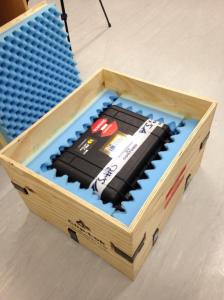
TShepisosat ZACUBE-1 prior to being shipped to the Netherlands

TShepisosat ZACUBE-1 prior to being shipped to the Netherlands

It was determined that the close approach event would occur over the Antarctic and a search was started for possible ground stations that could listen for signals from ZACUBE-1 directly after the event. Help arrived in the form of our friends from the California Polytechnic State University in San Luis Obispo, California, United States. The Cal Poly ground station would see ZACUBE-1 approximately 30 minutes after the event and be able to listen for its transmitted telemetry beacon signal. In preparation ZACUBE-1 would be tracked and checked on the last two passes over South Africa (22:50 SAST 26/02/2014 and 00:26 SAST 27/02/2014) a few hours before the event to ensure that everything was OK and then again by the Cal Poly station.

With everything checking out and all systems nominal on the last pass over South Africa all we could do was wait for news from California.

Great success! With Cal Poly confirming that ZACUBE-1 was alive and well. We were able to further confirm this on the first pass over South Africa.
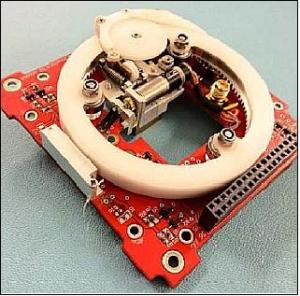
ZACUBE-1 TshepisoSat HF beacon antenna deployment unit - Image credit CPUT

ZACUBE-1 TshepisoSat HF beacon antenna deployment unit – Image credit CPUT

This would have been enough excitement for the week, but soon after verifying that ZACUBE-1 was OK we received our second close approach notification! This time involving a piece of debris from a METEOR 2-5 satellite. The plan would be much the same, but with the event taking place over Brazil we tried to make contact with some stations in Brazil. Unfortunately nothing was heard over Brazil, but we received notification of ZACUBE-1′s signal from the University of Florida and again from the California Polytechnic State University.

We would like to thank everyone that helped out during this time, hopefully I did not leave anybody out. The folks from Cal Poly, University of Florida, the Brazilian radio amateurs that tried on very short notice and SANSA.

ZACUBE-1 carries a UHF beacon on 437.345 MHz and an HF beacon on 14099 kHz used to characterise the Superdarn antennas at the Antarctic which study the ionosphere.

ZACUBE-1 information
http://www.cput.ac.za/fsati
and
http://www.amsatsa.org.za/

First image captured by TshepisoSat (ZACUBE-1)
https://amsat-uk.org/2013/12/15/first-image-captured-by-tshepisosat-zacube-1/

FUNcube-1 (AO-73) 100+ days in orbit

FUNcube-1 (AO-73) Spin Period

FUNcube-1 (AO-73) Spin Period

Last weekend FUNcube-1 (AO-73) reached the milestone of having been in space for 100 days – actually that should be clarified to mean “terrestrial” days as the spacecraft itself has been subjected to more than 1500 day/night cycles during this time.

FUNcube-1 (AO-73) - Image credit Wouter Weggelaar PA3WEG

FUNcube-1 (AO-73) – Image credit Wouter Weggelaar PA3WEG

We are very grateful to the 500+ stations who have been providing FUNcube-1 telemetry data to our Data Warehouse. We now have more than 1GB of data in the repository – this is an amazing effort and achievement from a spacecraft which is only transmitting at 1200bps. Thanks everyone and please keep it coming:)

From all the telemetry we can see that the spin rate decreased for a time but now is speeding up again. External temperatures span a range of 50C between the end of the sunlit phase and the end of the eclipse period. Even inside the spacecraft the temperatures range over 25C.

All the subsystems continue to work well and are “well in the green”.

Scintillation MapThe increased solar activity is certainly having an effect on the downlinked signal on many occasions. During such disturbances the signal appears to be being affected by ionospheric scintillation which distorts the BPSK stream and makes decoding much harder for some minutes at a time.  This effect is not just apparent near the magnetic poles as can be seen in this paper:  http://waas.stanford.edu/papers/IWG/sbas_iono_scintillations_white_paper.pdf

Users in the Northern hemisphere will have noticed that the evening passes in amateur mode are becoming shorter as the spacecraft enters sunlight again near the pole. This effect will increase as the season progresses and we will be testing a plan to change the operating schedule in a few weeks time. This test will involve placing the spacecraft into continuous amateur/transponder mode for a number of orbits – probably over a weekend.

Especially for educational users of FUNcube, we have placed all our schools outreach material on one page for easy reference. It can now all be found here: http://funcube.org.uk/education-outreach/

Southampton University Wireless Society WebSDR

LitSat-1

LitSat-1

The Southampton University Wireless Society (SUWS) Web-based software defined radio (SDR) has been used to receive signals from the new amateur radio LitSat-1 satellite.

The Lithuanian satellite LitSat-1 was deployed from the ISS on February 28 and the builders of the satellite have been able to use the SUWS WebSDR to receive the satellite when it is out of the range of Lithuania.

Noel G8GTZ, Martin G8JNJ and Phil M0DNY from the Southampton University Wireless Society, set up the WebSDR near Basingstoke in the UK. It currently supports parts of the 10 GHz, 1296 MHz, 432 MHz and 144 MHz bands and can be listened to from anywhere in the world.

The link is: http://websdr.suws.org.uk/

The 434 MHz receive capability is very popular for listening to High Altitude Balloon (HAB) signals.

A couple of notes when using the WebSDR:

– If tracking balloons please set your location in dl-fldigi to somewhere around 51.294, -1.131 so we don’t have any fake receiver lines on the map!

– Connection to the site is over a several km wifi link, so once you’ve found the signal, please switch off your waterfall view (Set to ‘blind’) to save bandwidth for others.

– The waterfall speed will also be automatically limited as the number of users increases.

Darius Kybartas LY3DA says that when listening for LitSat-1 on the WebSDR receiver enter your call sign or name in the “Your name or callsign” box and select a frequency of 145850 kHz with FM modulation.

LitSat-1 is very close to the International Space Station (ISS) so you can get a rough idea of when it will be in range of the UK based SUWS WebSDR by looking at the predictions for the ISS on the N2YO tracking website http://www.n2yo.com/ (use 51.294 North, 1.131 West for the coordinates).

LitSat-1 https://amsat-uk.org/2014/02/26/litsat-1-with-linear-transponder/