Amateur radio satellites deploy March 14

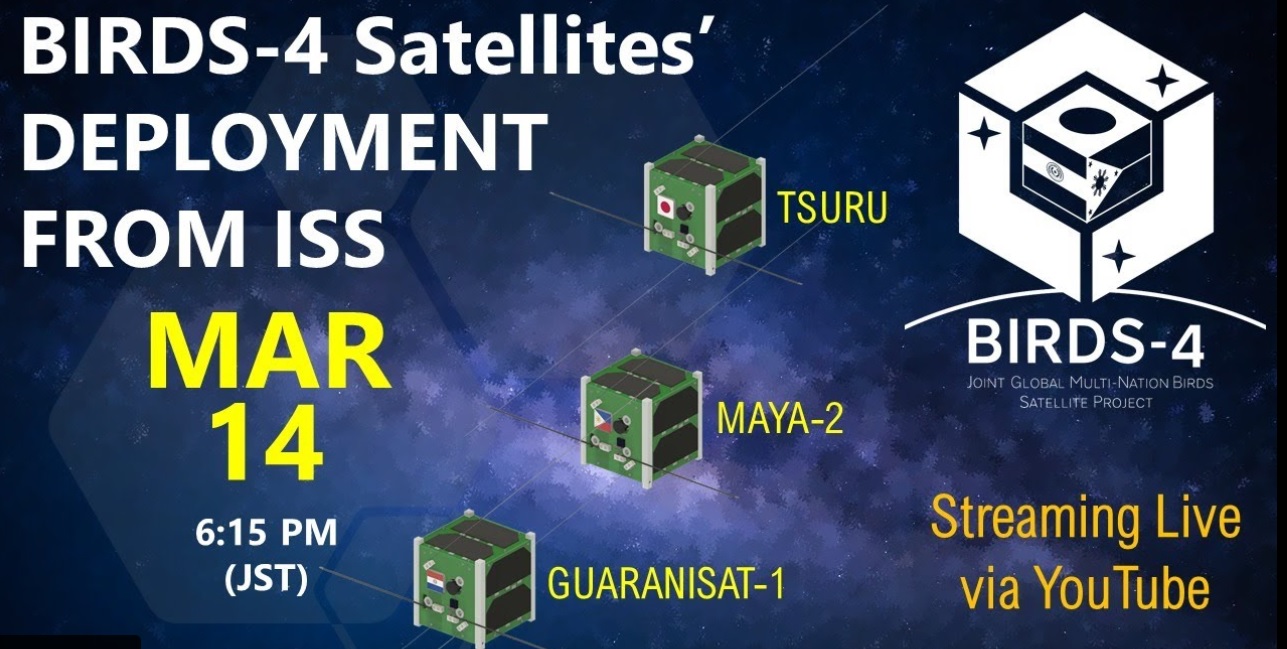
BIRDS-4 Satellite DeploymentEight satellites, all coordinated by the IARU Satellite Frequency Coordination Panel, are planned to be deployed from the International Space Station on Sunday, March 14.

ISS CubeSat deployment on March 14, 2021 - image by astronaut Soichi Noguchi KD5TVP

ISS CubeSat deployment on March 14, 2021 – image by astronaut Soichi Noguchi KD5TVP

The deployment should be streamed live on YouTube, watch from 09:15 GMT [UPDATE deployment now expected after 10:30 GMT]
https://www.youtube.com/watch?v=vLltILh8SLw

The CubeSats being deployed are:
• OPUSAT-II
• GuaraniSat‑1 (BIRDS‑4)
• Maya‑2 (BIRDS‑4)
• Tsuru (BIRDS‑4)
• RSP-01
• WARP-01
• TAUSAT‑1
• STARS-EC

It is understood the BIRDS-4 satellites are carrying digipeaters and TAUSAT‑1 has an FM transponder. Further information including the IARU coordinated frequencies are at http://amsat.org.uk/iaru/


First contact via UVSQ-Sat FM transponder

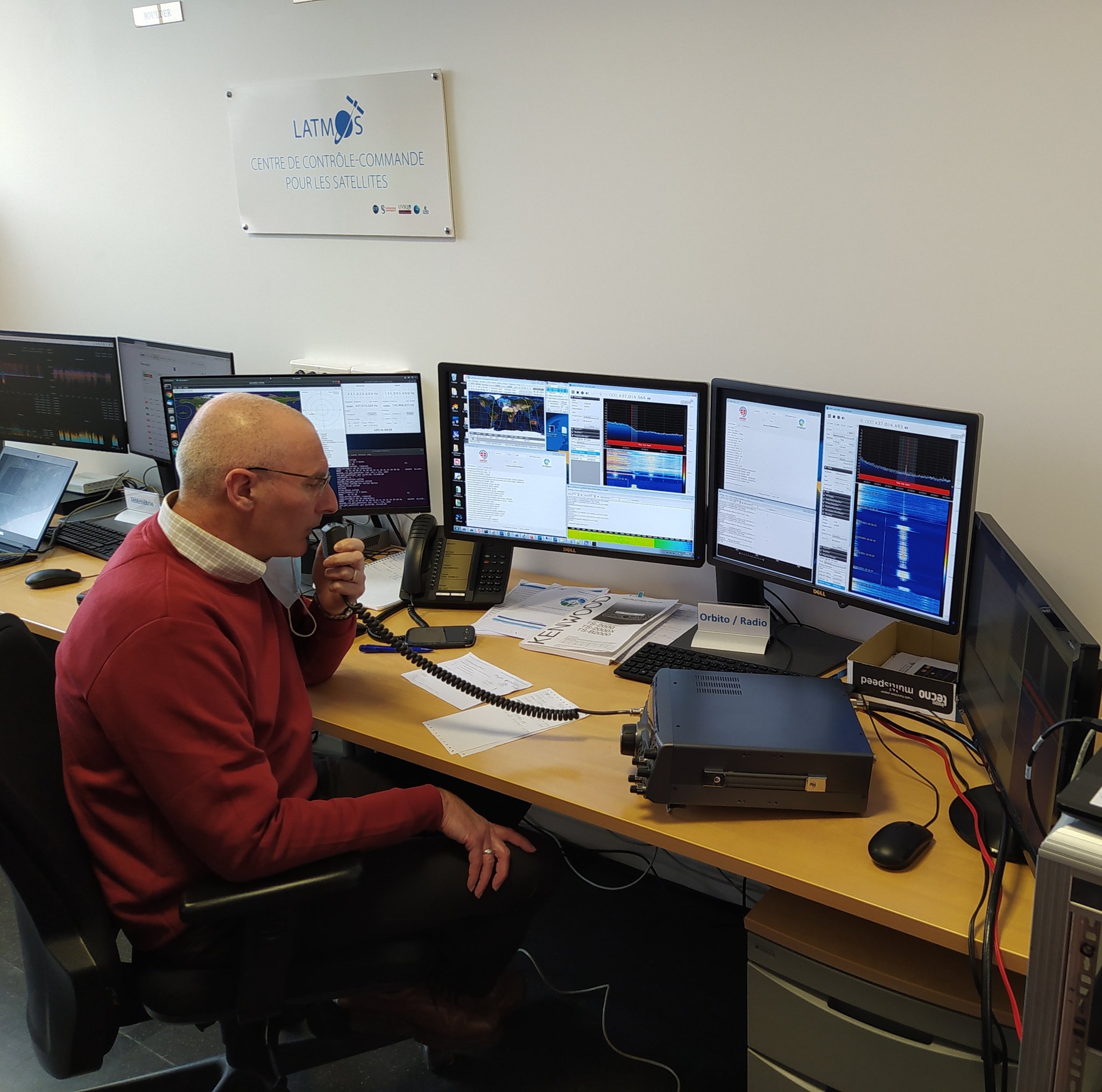
Michel Mahé F4DEY at the LATMOS Ground Station - Credit UVSQ-Sat

Michel Mahé F4DEY at the LATMOS Ground Station – Credit UVSQ-Sat

On Friday, March 5, 2021, the first contact was made via the FM transponder on the UVSQ-Sat CubeSat.

Michel Mahé F4DEY of the F6KRK Radio Club carried out the transponder test from the LATMOS ground station. The first contact was with Peter Goodhall 2M0SQL in Elgin.

After the contact Michel tweeted “Very happy to have been able to operate the Latmos station and do #F6KRKR/P validate the transponder #UVSQSat “on #space” after validation of the satellite at the Lab of #Latmos in October 2020!”

Peter tweeted “Fantastic to be QSO #1 on UVSQ-SATs FM transponder wish the @uvsqsat good luck in their commissioning and it being available more often :)”

UVSQ-Sat
http://uvsq-sat.projet.latmos.ipsl.fr/?ong=Ham-Radio
https://twitter.com/uvsqsat

Michel Mahé F4DEY https://twitter.com/F4DEY_78

Peter Goodhall 2M0SQL
https://www.2m0sql.com/
https://twitter.com/2m0sql

CHESS CubeSat Constellation to carry FUNcube transponders

CHESS CubeSat - Credit EPFL Spacecraft Team

CHESS CubeSat – Credit EPFL Spacecraft Team

In 2020, a project between AMSAT-UK, AMSAT-NL and Swiss universities started with the aim of equipping two Swiss satellites with a linear transponder for amateur radio.

CHESS - Three Unit CubeSat

CHESS – Three Unit CubeSat

With a linear transponder, several QSOs can take place simultaneously. The satellites can be operated in CW/SSB with the simplest equipment. The satellites also include features for classroom demonstrations and experiments. In numerous teleconference discussions, the technical possibilities could be sounded out and the realisation prepared.

The CHESS [Constellation of High Energy Swiss Satellites] project includes two satellites, which will be built simultaneously and later launched as a constellation. Both will provide a linear transponder for amateur radio use. The first satellite will have a nearly circular orbit at an altitude of 400 km. The second will have an elliptical orbit with an altitude of 350×1000 km.

The satellites themselves are a project of the École polytechnique fédérale de Lausanne (EPFL) with support from the Lucerne University of Applied Sciences and Arts (HSLU – Institute of Electrical Engineering IET), the University of Bern, the Valais University of Applied Sciences and Arts (HES-SO), the Haute École Neuchâtel and the Swiss Federal Institute of Technology ETH Zurich. The amateur radio payload is a project of AMSAT-UK/-NL.

On 18 December 2020, the successful system requirements review took place. The project coordination between CHESS and AMSAT lies with the Amateur Radio Association of the Lucerne University of Applied Sciences and Arts – Technology & Architecture, Horw.

The Swiss AMSAT Operators provide information about the CHESS project at https://www.amsat-hb.org/funcube-chess/

EPFL Spacecraft Team https://www.epflspacecraftteam.com/chess-1

CHESS - Three Board Stack

CHESS – Three Board Stack

AMSAT’s RadFxSat-2 / Fox-1E Launched

LauncherOne Drop Test July 2019 - Credit Virgin Orbit

LauncherOne Drop Test July 2019 – Credit Virgin Orbit

Virgin Orbit’s LauncherOne Launch Demo 2 mission carried AMSAT’s RadFxSat-2 / Fox-1E to orbit on Sunday, January 17, 2020.

On January 19 AMSAT issued this RadFxSat-2 / Fox-1E Status Update
https://www.amsat.org/radfxsat-2-fox-1e-status-update/

At 22:28 GMT, Jan 17, Virgin Orbit Tweeted:

Payloads successfully deployed into our target orbit! We are so, so proud to say that LauncherOne has now completed its first mission to space, carrying 9 CubeSat missions into Low Earth Orbit for our friends @NASA. #LaunchDemo2

RadFxSat-2, like RadFxSat / Fox-1B, now AMSAT-OSCAR 91, is a partnership opportunity between Vanderbilt University and AMSAT and will carry a similar radiation effects experiment, studying new FinFET technology.

RadFxSat-2 is the fifth and final Fox-1 satellite built by AMSAT. The RadFxSat-2 spacecraft bus is built on the Fox-1 series but features a linear transponder “upgrade” to replace the standard FM transponder in Fox-1A through D. In addition, the uplink and downlink bands are reversed from the previous Fox satellites in a Mode V/u (J) configuration using a 2 meter uplink and 70 cm downlink. The downlink features a 1200 bps BPSK telemetry channel to carry the Vanderbilt science data in addition to a 30 kHz wide transponder for amateur radio use. Telemetry and experiment data can be decoded using FoxTelem version 1.09 or later.

FoxTelem is available at https://www.amsat.org/foxtelem-software-for-windows-mac-linux/

Participation in telemetry collection by as many stations in as many parts of the world as possible is essential as AMSAT Engineering looks for successful startup and indications of the general health and function of the satellite as it begins to acclimate to space. AMSAT will send a commemorative 3D printed QSL card to the first station capturing telemetry from RadFxSat-2.

TLE’s of satellites on the launch are at https://www.amsat.org/tle/current/nasabare.txt

RadFxSat-2 / Fox-1E Frequencies:

Telemetry Downlink – 435.750 MHz 1200 bps BPSK
Inverting Linear Transponder Uplink – 145.860 MHz – 145.890 MHz
Inverting Linear Transponder Downlink – 435.760 MHz – 435.790 MHz

[ANS thanks AMSAT for the above information]

Source AMSAT News Service https://www.amsat.org/mailman/listinfo/ans
Video of EIRSAT-1 talk

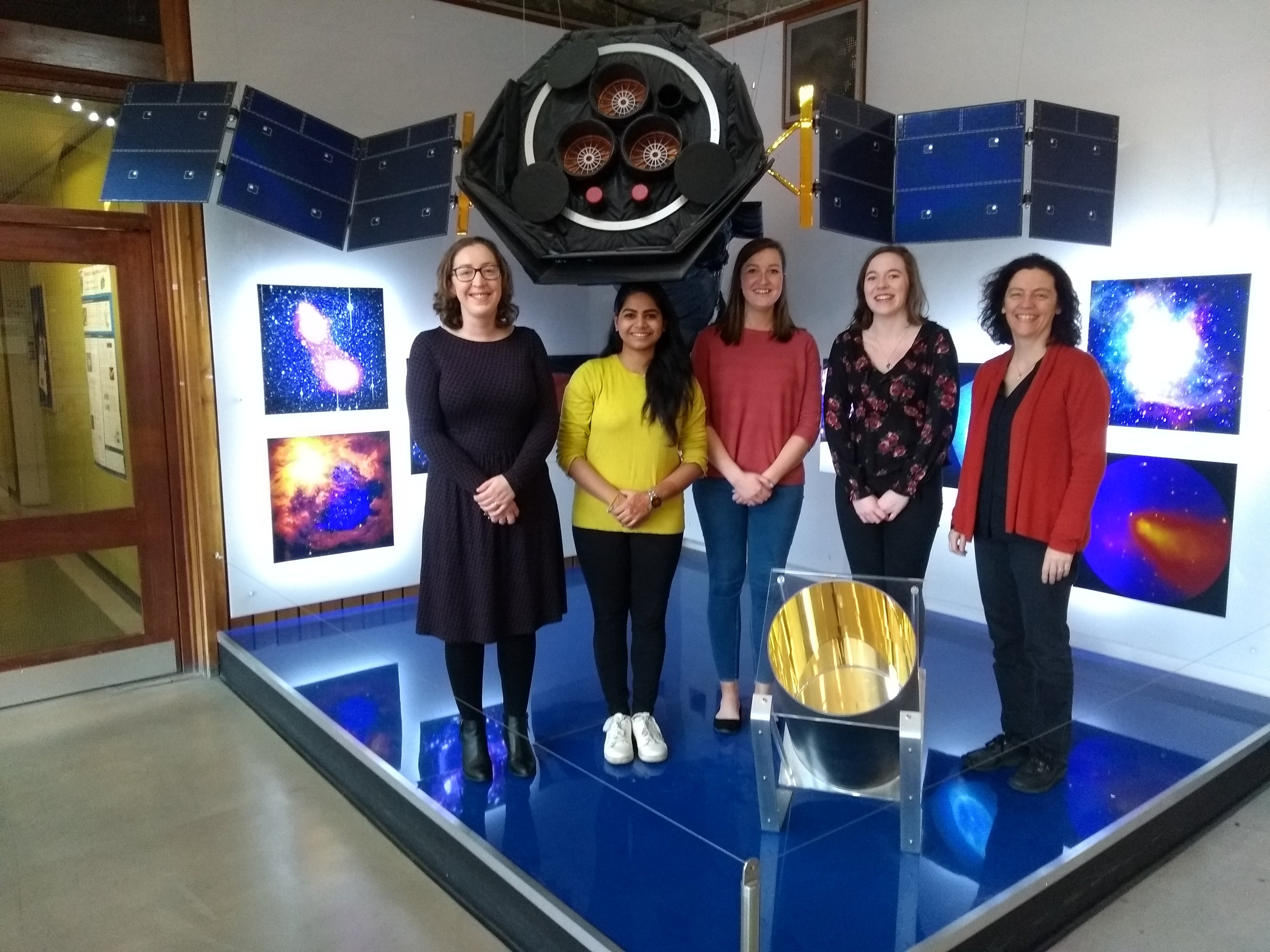
Some of the EIRSAT-1 Team

Some of the EIRSAT-1 Team

The EIRSAT-1 CubeSat, built by students at University College Dublin, is due for launch on the Vega rocket in early 2021 and you can help!

The South Dublin Radio Club was honored to host a talk by David Murphy EI9HWB and Fergal Marshall of the EIRSAT-1 team. In this video, they give a comprehensive technical run-through of the satellite’s payload, subsystems and onboard communications.

From an amateur radio and hobbyist point-of-view, there is a full run-through of the uplink and downlink schemes including detailed flow charts (including demodulation and decoding). For details go to 14:30

This followed by a detailed proposal as to how amateur radio operators can contribute to ground station operations via SatNOGs and gr_satellites GNU Radio. For details go to 34:05

EIRSAT-1 particularly wants help with signal acquisition just after launch… the riskiest part of the mission. They want help from amateur radio operators, listeners, scanners, makers, etc… to expand the mission’s ground segment.  For details go to 39:50

There is then a very informative Q&A.

Watch You can help Ireland’s first satellite, EIRSAT-1!

EIRSAT-1 – 437.100 MHz
https://www.eirsat1.ie/
https://twitter.com/eirsat1

South Dublin Radio Club https://twitter.com/SDRadioClub

Vega launch of three satellites with ham radio payloads

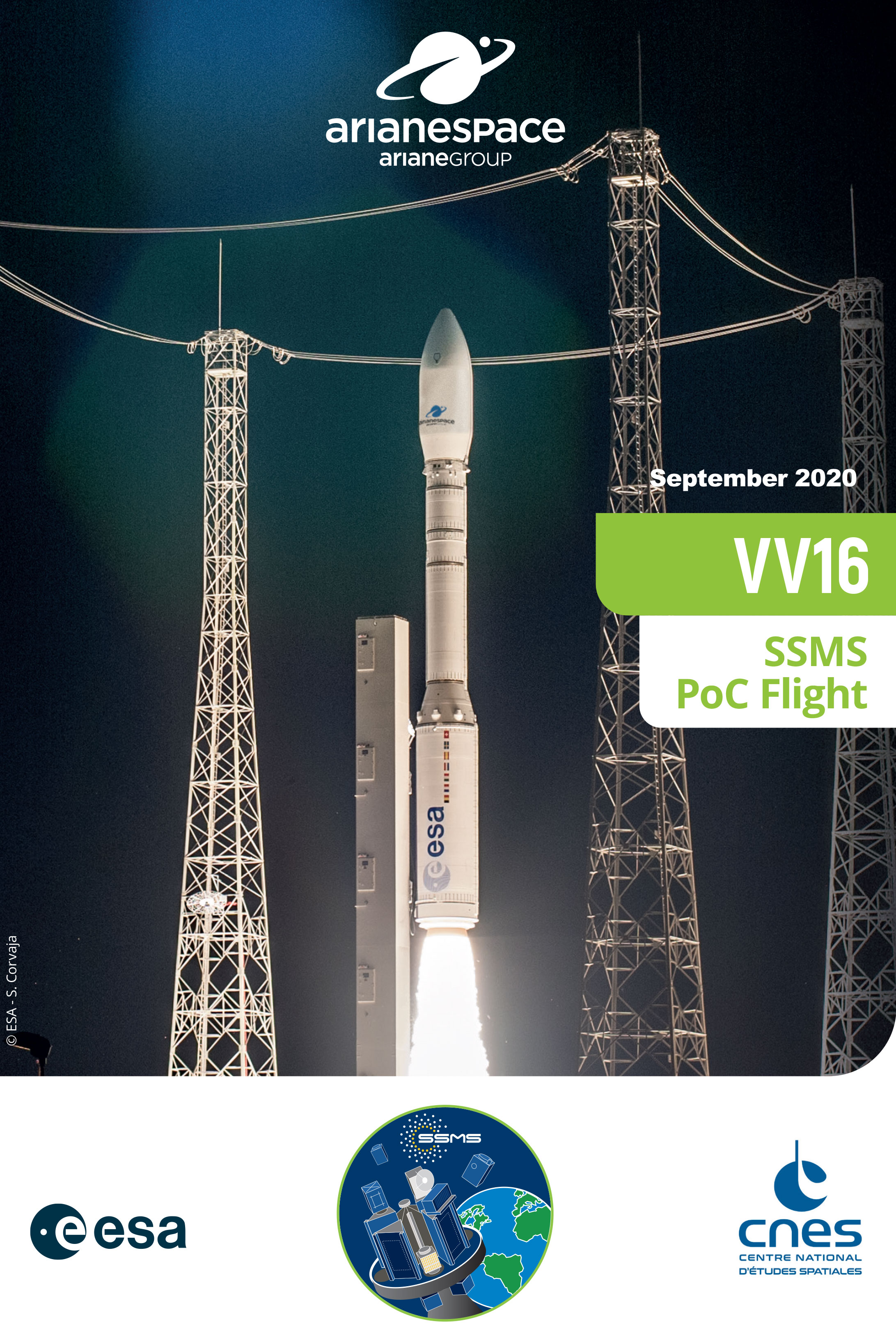
Vega VV16 launch

Vega VV16 launch

Three satellites with amateur radio payloads were on the Vega VV16 launch that took place at 01:51:10 GMT on Thursday, September 3, 2020.

Earlier on the AMSAT Bulletin Board Christophe Mercier had posted:

The Vega rocket (VV16) is scheduled to leave Kourou on 02 September 2020 at 3h36 CEST [launch was postponed until 01:51 GMT on Sept 3] with 53 satellites on board.

One of the satellites that will be leaving is the Amicalsat satellite built by the CSUG (Centre Spatial Universitaire Grenoblois). The measurements made by the satellite will be available to all. They will allow radio amateurs to use them for propagation predictions.

The project’s website (in English) has just been put online http://amicalsat.univ-grenoble-alpes.fr/

The Amsat-Francophone supported this project http://site.amsat-f.org/amicalsat/

A software (Linux & Windows) is provided for decoding the telemetry and sending it to the database (SatNogs). The user manual is available (in English) https://code.electrolab.fr/xtof/josast/-/blob/master/ApplicationAmicalsat/src/site/markdown/UserManual.md

UHF 436.1 MHz AFSK 1200 RS17S
S band 2,415.3 MHz GFSK 1000 kb/s
http://amsat-f.org/AMSATLIST/SatellitePage/UK/0Amicalsat.html

Reports are welcome. Thank you for your help.

The first 5 people who receive a frame from AmicalSat will receive a gift.
To submit your frame uses the satnogs SIDS or email satellite@adri38.fr

Two other satellites :

UPMSat-2
UHF 437.405 MHz AFSK 1200 UPMST2
http://amsat-f.org/AMSATLIST/SatellitePage/UK/0UPMSat-2%20.html

TTU100
Primary 435.450 MHz 1k2 and 9k6 and CW
Secondary 10465.000 MHz OPSK 62.5 kbs and 20 Mbs
http://amsat-f.org/AMSATLIST/SatellitePage/UK/0TT%C3%9C100%20(TT%C3%9CSat,%20MektorySAT%201,%20H%C3%A4marik)%20.html

73

Christophe Mercier
Amsat-F chairman

AMSAT Bulletin Board http://www.amsat.org/mailman/listinfo/amsat-bb

Vega Flight VV16 https://www.arianespace.com/mission/vega-flight-vv16/

Watch the Vega VV16 launch live at https://www.youtube.com/watch?v=IveCBs-cCTw