Delfi-n3Xt Update

Delfi-n3Xt Satellite

Delfi-n3Xt Satellite

The Delfi-n3Xt has a 435/145 MHz linear transponder and is on the November 21 Dnepr launch. Jasper PC4JB sends this update:

Dear radio amateurs,

We have made some changes to the webserver and the telemetry client to resolve some issues with the connection as stated before. It seems that the system is now improved, but we are not a 100% certain if it will be stable for long term. Unfortunately our resources and time are limited, so we have decided to go ahead with the systems as-is.

Attached is the new DUDe client, version 5.0. Please delete the previous version (4.7) in case you still have this on your computer. Thank you for your help and patience so far!

After orbit injection of Delfi-n3Xt, the satellite will first be idle for 25 minutes and then start deployment of about 5 minutes. The satellite will not transmit on the 145.870 MHz during eclipse, so the first time Delfi-n3Xt can theoretically be heard is about 8:38h UTC.

Attached are also the pre-launch TLE set which can be used in tracking programs. We will announce new TLEs on our website after launch as soon as they become available. After a few days, the satellite should appear in one of the regular automatically updated lists.

I am looking forward for a wonderful launch next Thursday, with many radio amateur satellites on board, and of course successful reception of Delfi-n3Xt!

73,

Jasper Bouwmeester PC4JB
Delfi Nanosatellite Program Manager &
Researcher Small Satellite Technology
Chair of Space Systems Engineering
Delft University of Technology

Telemetry reception http://www.delfispace.nl/operations/delfi-n3xt-telemetry-reception

Delfi-n3Xt http://www.delfispace.nl/operations/radio-amateurs

Dnepr satellites mounted on launcher

Dnepr Space Head Module

Dnepr Space Head Module

ISC Kosmotras report that on November 15, 2013, the Dnepr Space Head Module with the satellites was transported to the launch pad and mounted on the launch vehicle.

The final checkout and tests of the launch vehicle with the SHM are presently in progress. The launch is scheduled for November 21, 2013 at 11:10 Moscow time (07:10 UT).

Source ISC Kosmotras http://www.kosmotras.ru/en/news/145/

Frequencies of amateur radio satellites launching in November
https://amsat-uk.org/2013/11/13/three-amateur-radio-satellite-deployments-in-november/

Live TV coverage of satellite launches
https://amsat-uk.org/2013/11/17/tv-coverage-of-two-ham-radio-sat-launches/

Live TV coverage of two ham radio satellite launches

A Dnepr Launch

A Dnepr Launch

An estimated 34 satellites carrying amateur radio payloads are expected to be deployed this week.

Four will deploy from the International Space Station on Tuesday and Wednesday, November 19/20, the rest in two separate launches.

The first launch, a Minotaur-1 rocket from Wallops Island Virginia, will be sometime after 00:30 UT, Wednesday, November 20, the other will be a Dnepr from Dombarovsky near Yasny at 07:10:11 UT on Thursday, November 21.

Live TV coverage of the Minotaur-1 launch
http://www.ustream.tv/channel/nasa-tv-wallops

Live TV coverage of the Dnepr launch
http://live.cput.ac.za/live.html

ISS CubeSats Deploy Tuesday and Wednesday
https://amsat-uk.org/2013/11/16/iss-cubesats-deploy-tuesday-and-wednesday/

November Amateur Radio Satellite Deployments with frequency list
https://amsat-uk.org/2013/11/13/three-amateur-radio-satellite-deployments-in-november/

AMSAT-UK Logo

AMSAT-UK Logo

On launch days follow the chat on the #cubesat IRC channel see http://www.cubesat.org/index.php/collaborate/ground-operators

Minotaur-1 CubeSats
http://cubesat.org/index.php/missions/upcoming-launches/135-ors3-launch-alert

On the FUNcube-1 Dnepr launch day check the FUNcube Yahoo Group
https://amsat-uk.org/funcube/yahoo-group/

Live webcam at the FUNcube-1 Monitoring Station in Bletchley Park
http://www.batc.tv/ch_live.php?ch=3

FUNcube-1 Welcome to launch week!
https://amsat-uk.org/2013/11/17/welcome-to-launch-week/

For updates on all amateur satellite launches check the AMSAT Bulletin Board (AMSAT-BB) at
http://www.amsat.org/amsat-new/tools/maillist/

Welcome to launch week!

ZACUBE-1, FUNcube-1 and HiNCube in the deployment pod - Image credit Wouter Weggelaar PA3WEG

ZACUBE-1, FUNcube-1 and HiNCube in the deployment pod – Image credit Wouter Weggelaar PA3WEG

Well it has finally arrived. Little did we think, back in 2009 that we would not be launching FUNcube-1 until late 2013 but, at last, we are almost there.

Final gluing of FUNcube-1 bolt by Wouter Weggelaar PA3WEG – Image credit Gerard Aalbers

Final gluing of FUNcube-1 bolt by Wouter Weggelaar PA3WEG – Image credit Gerard Aalbers

The past four years have been spent trying to find a suitable launch opportunity, dealing with many legal and administrative issues, in addition to finalising the technical requirements for the spacecraft. We also then had to convert those requirements and ideas into reality.

The core FUNcube team comprises of just about a dozen of us – radio amateurs from the UK and the Netherlands together with software specialists from both countries. A few of us even have skills in both the analogue and digital domains!

We have met on numerous occasions for “face to face” meetings over weekends and held weekly Skype chats almost every Sunday evening. We have had highs and lows along the way but the end result – FUNcube-1 our tiny spacecraft is now sitting in an ISIPOD on the launch vehicle ready to take its chances in space on Thursday.
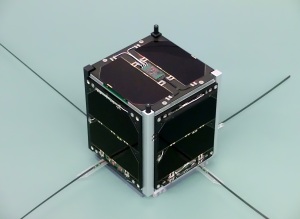
FUNcube-1 flight model - Image credit Wouter Weggelaar PA3WEG

FUNcube-1 flight model – Image credit Wouter Weggelaar PA3WEG

Many hours of evaluation and verification testing of both the Flight Model and also the earlier Engineering Model have been undertaken, so we are as confident as we can be that we have done the best job possible.

This mission could not have been carried forward without the efforts of the team members but neither could it have been completed without the tremendous support that it has received from individual radio amateurs and others and other AMSAT groups around the world.

Thursday, November 21, 2013 is our launch day and most of the team will be assembled at the National Radio Centre at Bletchley Park to staff a monitoring station for at least the first two days following the launch. The launch from Yasny takes place at 07:10:11 UT with live TV coverage available here. The first signals from FUNcube-1 should be heard in Southern Africa and then in Hawaii and then Alaska. After that, we hope to hear signals in the UK on a very low pass to the east around 08:50 UT.
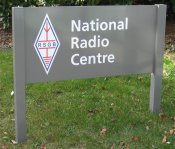
National Radio Centre We are very grateful to the RSGB for their support in allowing the use the NRC facilities which should be perfect for this operation.  Although it is not large enough to be able issue an open invitation to everyone to join us on the day, we will be trying to do our best to keep everyone in touch with what is happening.

We will be setting up a webstream from the NRC using the services of the BATC.tv server http://www.batc.tv/ch_live.php?ch=3  This should be available from around 07:00 UT on Thursday and will keep running for as long as we have something to show. As well as shackcam views it will also have a breaking news “tickertape” and some videos created during the development of the spacecraft.
AMSAT-UK FUNcube Mission Patch Rev4 20100609

AMSAT-UK FUNcube Mission Patch

Additionally we will maintain a presence on the #cubesat IRC channel which can be easily accessed by a web client from here: http://webchat.freenode.net/

Of course this website will also be kept up to date as possible and updates will be provided on AMSAT-BB.

So all we ask everyone to do now is to, download the FUNcube Dashboard, read the guidance notes, register with the Data Warehouse and hang on for an interesting Thursday. Oh and keep your fingers crossed.

Very many thanks for your support!

Team FUNcube

Live TV coverage of launch http://live.cput.ac.za/live.html

FUNcube Yahoo Group https://amsat-uk.org/funcube/yahoo-group/

Official opening of National Radio Centre https://amsat-uk.org/2012/07/11/official-opening-of-the-rsgb-national-radio-centre/

ISS CubeSats Deploy Tuesday and Wednesday

Pico Dragon CubeSat - Image credit VNSC

Pico Dragon CubeSat – Image credit VNSC

Four CubeSats carrying amateur radio payloads will be deployed from the International Space Station (ISS) by the JEM Small Satellite Orbital Deployer (J-SSOD). Three of them, Pico Dragon, ArduSat-1 and ArduSat-2 will be deployed on Tuesday, November 19, and the fourth Cubesat, TechEdSat-3p, will be deployed Wednesday.

The CubeSats:
Pico Dragon developed by the Việt Nam National Satellite Center (VNSC), University of Tokyo and IHI aerospace. 437.250 MHz CW beacon and 437.365 MHz 1200 bps AFSK AX.25 telemetry.
ArduSat-1 developed by NanoSatisfi. 437.000 MHz 9k6 MSK CCSDS downlink.
ArduSat-X developed by NanoSatisfi. 437.345 MHz 9k6 MSK CCSDS downlink .
TechEdSat-3 developed by interns at the NASA Ames Research Center. 437.465 MHz 1200 bps packet radio beacon transmitting 1 watt to 1/4 wave monopole. It plans to test an Iridium Satphone modem and has a deployment mechanism to de-orbit in 10 days.

They are 1U in size (10*10*10 cm) except for TechEdSat-3 which is 3U (30*10*10 cm).

As well as the ISS deployment next week also sees two mass launches of satellites on Minotaur-1 and Dnepr rockets. In total 37 satellites carrying amateur radio payloads are expected to be deployed next week. The frequencies of these satellites can be seen at
https://amsat-uk.org/2013/11/13/three-amateur-radio-satellite-deployments-in-november/

NASA http://www.nasa.gov/content/expedition-38-wraps-up-first-week-on-station/

Australian Foundation licensee Jonathan Oxer VK3FADO talks about the ArduSat satellites that he helped develop in this video
https://amsat-uk.org/2013/09/15/eevblog-ardusat-arduino-cubesat/

KySat-2: Calling all radio hams and space enthusiasts!

Archive image of KySat-1

Archive image of KySat-1

The KySat-2 CubeSat is scheduled for launch as part of the ORS-3/ELaNa-4 mission on November 20 at 00:30 UT.

To help track KySat-2, we have setup a web page to assist radio amateurs. To help decode packets from KySat-2, we have developed software radio amateurs can download and install.  Both are available here: http://ssl.engineering.uky.edu/amateur-radio-operators/

Initially, the software will support receive-only operation, but after spacecraft checkout, it is intended that the software will also support limited commanding.

We have also created an Advanced Satellite Orbit Tracking Tool to visualize KySat-2’s orbit in real-time: http://k2asot.engr.uky.edu/

For more information on general information on KySat-2, visit: http://kysat2.engr.uky.edu/ and http://kentuckyspace.com/

We appreciate any and all support!

Jason Rexroat KK4AJE
Space Systems Lab, University of Kentucky
Email: jason.rexroat at uky.edu

KySat-2 and other CubeSats launch November 20
https://amsat-uk.org/2013/11/12/kysat-2-in-november-cubesat-launch/

Frequency list for the three November amateur radio satellite deployments
https://amsat-uk.org/2013/11/13/three-amateur-radio-satellite-deployments-in-november/