FUNcube Forum

AMSAT-UK_Bevelled_LogoAMSAT-UK has announced a new FUNcube Forum to cater for the two FUNcube payloads that will be launched in the coming months.

FUNcube-1 is a complete educational single CubeSat project with the goal of enthusing and educating young people about radio, space, physics and electronics. It is planned to launch on a Dnepr from Dombarovsky near Yasny on November 21, 2013.

FUNcube-2 on UKube-1 comprises of a set of FUNcube boards that will fly as part of the UK Space Agency’s 3 Unit CubeSat UKube-1. It has identical goals and is expected to be launched on a Soyuz rocket from Baikonur in February 2014.

The FUNcube Forum is at http://forum.funcube.org.uk/

FUNcube-1 Launch: Date and time confirmed

FUNcube-1 flight model - Image credit Wouter Weggelaar PA3WEG

FUNcube-1 flight model – Image credit Wouter Weggelaar PA3WEG

The latest news about the launch date and time has just been confirmed by Kosmotras.

The launch date of RS-20B rocket (Dnepr) with a group of satellites (DubaiSat-2 cluster mission) from Dombarovsky missile area (Yasny Launch Base) has been established for November 21, 2013 at 07:10:11 UT. The back-up launch date is November 22, 2013 at 07:10:11 UT.

We will shortly be providing prelaunch TLEs and, in about 7/10 days, the Dashboard software that is needed to demodulate and display the telemetry information. More information about the Dashboard can found here http://funcube.org.uk/working-documents/

FUNcube Yahoo Group https://amsat-uk.org/funcube/yahoo-group/

FUNcube communication subsystem:
• Inverting SSB/CW transponder 300 mW PEP
– 435.150 – 435.130 MHz Uplink
– 145.950 – 145.970 MHz Downlink
• 145.935 MHz BPSK Telemetry 300 mW

FUNcube information sheets:
•  FUNcube_Project Information_aug2013
•  FUNcube_Educational_Outreach aug2013

FUNcube-1 Presentation PowerPoint Slides Released

FUNcube-1 flight model - Image credit Wouter Weggelaar PA3WEG

FUNcube-1 flight model – Image credit Wouter Weggelaar PA3WEG

The PowerPoint slides used in the FUNcube-1 presentation given by Dave Johnson G4DPZ at the RSGB Convention in October 2013 have now been made available.

It is hoped they will be used by others to support presentations they may give on FUNcube-1 to local clubs.

Download the PowerPoint slides from http://funcubetest2.files.wordpress.com/2010/11/funcube_oct2013fin.ppt

Dave G4DPZ recently announced he was willing to give talks to clubs in his area and a number of clubs immediately took him up on the offer. It is believed there are many other clubs across the country that would welcome a talk on the new FUNcube-1 satellite and AMSAT-UK would like to hear from anyone willing to give such talks.

FUNcube-1 Talk for Local Clubs https://amsat-uk.org/2013/10/25/funcube-1-talk-for-local-clubs/

FUNcube Yahoo Group https://amsat-uk.org/funcube/yahoo-group/

Balloon Test for EagleSat Engineering Model

Project Arapaima

Project Arapaima

A student team from Embry-Riddle Aeronautical University’s Prescott Campus recently flew a payload on a NASA balloon launched from the Columbia Scientific Balloon Facility in Fort Sumner, N.M. The High-Altitude Student Platform (HASP) flight gave 12 universities from across the nation the chance to conduct research and experiments.

After floating successfully for more than 10 hours at an altitude of 125,000 feet, the HASP gondola containing the payloads was recovered near Wickenburg, Ariz. Embry-Riddle student lead Zach Henney reports that the team is still analyzing the flight data but the results look promising so far.

The Embry-Riddle payload on the HASP flight was an early engineering model of the EagleSat, a small cube-shaped satellite (CubeSat) the students are developing to fly in Earth orbit in late 2015 through NASA’s highly selective CubeSat Launch Initiative. Among its objectives, EagleSat is designed to determine error rates in electronic parts exposed to space radiation. The Embry-Riddle students plan to launch an advanced EagleSat engineering model on next year’s HASP flight.

Embry-Riddle Aeronautical University CubeSat http://www.eraucubesat.org/

Facebook Project Arapaima https://www.facebook.com/ArapaimaProject

Press Release http://www.erau-news.com/news/2013/10/28/students-test-cubesat-payload-on-high-altitude-nasa-balloon-flight/

CubeSats Need Coordination Too

Space News reminds readers to coordinate and register CubeSat frequencies.

The SpaceNews Editor writes:

In the midst of the cubesat revolution that is opening up a whole new world of space applications to people and organizations of ordinary means comes a reminder from the International Telecommunication Union (ITU), which is responsible for regulating and coordinating radiofrequency transmissions of all types: The existing rules requiring ITU member states to register their satellite systems do not discriminate based on size.

That means, in a nutshell, that cubesats and other nanosatellites, like their larger operational cousins, must be entered into the ITU-managed database of satellite frequencies and orbital slots. Speaking at the International Astronautical Congress in Beijing, officials with the United Nations-affiliated ITU noted that cubesats draw on finite spectrum — however marginally — and have the potential to interfere with one another and with other systems. These officials urged ITU members to register cubesats and other microsatellites at least two years before launch.

Not only are cubesats proliferating, their missions are becoming increasingly complex. Most cubesats today operate in a frequency band set aside for so-called amateur radio services, which can accommodate low-data-rate transmissions. But as applications become more bandwidth intensive, operators will increasingly be forced to seek out spectrum in other bands. Moreover, though cubesats today typically are allocated bandwidth on a secondary-user basis, meaning they have to work around primary users, there is no reason such missions could not be granted primary-user status.

For cubesats operating in the amateur bands, the FCC relies on the International Amateur Radio Union (IARU) for frequency coordination — typically the operator must submit a coordination letter from the group with its license application. But the flood of activity threatens to overwhelm the small, volunteer organization: Of the cubesats slated to deploy through the remainder of the year, 40 are being coordinated by the IARU.

Read the full Space News story at
http://www.spacenews.com/article/opinion/37890editorial-cubesats-need-coordination-too

AMSAT-UK hosts the IARU Amateur Satellite Frequency Coordination pages at http://www.amsat.org.uk/iaru

Information on frequency coordination can be found at http://www.iaru.org/satellite.html

ITU Radio Regulations http://www.itu.int/pub/R-REG-RR/en
Articles 9 and 11 cover coordination and notification.  Resolution 757, is an effort to simplify the administrative procedure for small, short life projects, and Resolution 646 applies to some amateur-satellite service stations.

November Deployment for ISS CubeSats

Pico Dragon CubeSat - Image credit VNSC

Pico Dragon CubeSat – Image credit VNSC

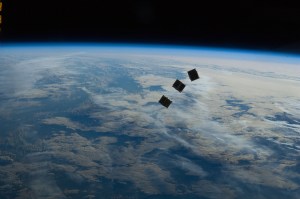
Four CubeSats carrying amateur radio payloads will be deployed from the International Space Station (ISS) by the JEM Small Satellite Orbital Deployer (J-SSOD).  Pico Dragon, ArduSat-1 and ArduSat-2 will be deployed on Tuesday, November 19, and the fourth Cubesat, TechEdSat-3p, will be deployed Wednesday, November 20.

The CubeSats are:
•    Pico Dragon developed by the Việt Nam National Satellite Center (VNSC), University of Tokyo and IHI aerospace. 437.250 MHz CW beacon and 437.365 MHz 1200 bps AFSK AX.25 telemetry.
•    ArduSat-1 developed by NanoSatisfi. 437.700 MHz 9k6 MSK CCSDS downlink.
•    ArduSat-X developed by NanoSatisfi. 437.700 MHz 9k6 MSK CCSDS downlink .
•    TechEdSat-3 developed by interns at the NASA Ames Research Center. 437.465 MHz 1200 bps packet radio beacon transmitting 1 watt to 1/4 wave monopole. It plans to test an Iridium Satphone modem and has a deployment mechanism to de-orbit in 10 days.

They are 1U in size (10*10*10 cm) except for TechEdSat-3 which is 3U (30*10*10 cm).

IEEE – DIY Space Programs http://spectrum.ieee.org/aerospace/satellites/diy-space-programs