SPROUT amateur radio SSTV satellite to launch in 2014

SPROUT Amateur Radio SSTV Satellite

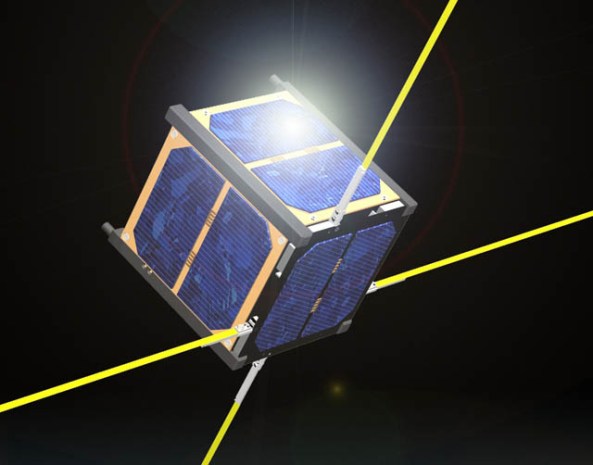
SPROUT, a 20 x 20 x 22 cm amateur radio nano-satellite with a mass of 7.1 kg, plans to launch with the L-band (1236.5 MHz/1257.5 MHz/1278.5 MHz) Synthetic Aperture Radar (SAR) satellite ALOS-2 on May 24, 2014. [Updated May 19, 2014]

SPROUT (Space Research On Unique Technology) was built by students from Nihon University and its objectives are:

1. Operation of satellite by radio amateurs. SPROUT downlinks the digi-talker sound recorded preliminary in the satellite, the digi-peater voice and packet uploaded by radio amateurs, Slow Scan TV (SSTV) and FM packet of the picture of the Earth taken by the satellite camera, which can be received by radio amateurs. SPROUT has two downlink frequencies and two uplink frequencies, and one uplink frequency and one downlink frequency will be open for radio amateurs. They can use the digipeater and packet and use one camera mounted on SPROUT and take the pictures by themselves, and downlink the pictures by SSTV.

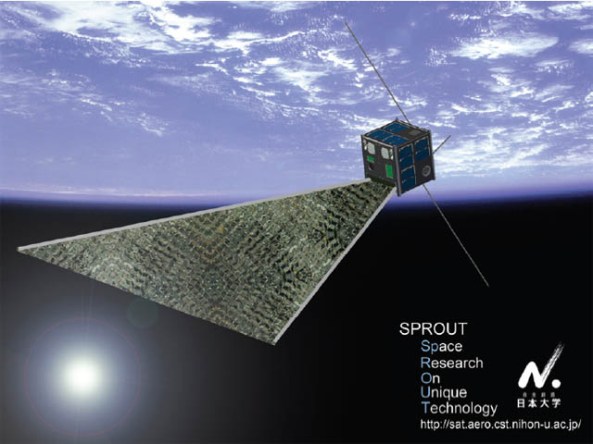
2. Demonstration of the deployment of the combined membrane structure and verification of the design method of the structure SPROUT has a triangular membrane supported by two tubes like framework. They are folded and stored in the satellite before the launch. After the launch, the nitrogen gas is injected into the tubes in space, and they extend, so that the membrane deploys (called “combined membrane structure”).

3. Demonstration of attitude determination and control of a nanosatellite Will conduct the attitude determination experiment on orbit by using the sun sensors, gyros, and geomagnetic sensor, and conduct the attitude control experiment by using the magnetic torquers.

It carries two UHF/VHF radio systems – one for Telemetry, Tracking & Control (TTC) using CW, 1200 bps AFSK and 9600 bps GMSK AX.25 packet and one for amateur operations using 1200 bps AFSK AX.25 packet.

SPROUT plans to launch from the Tanegashima Space Center into a 628 km Sun Synchronous Orbit (SSO) on May 24, 2014.

Callsign: JQ1ZJQ
Size:     214x210x220 mm
Weight:   7.1 kg
Mode: 1200bps AFSK, 9600bps GMSK
CW downlink          437.525 MHz
FM packet downlink   437.525 MHz
Digi-peater uplink   437.600 MHz
Digi-talker downlink 437.600 MHz
SSTV downlink        437.600 MHz

Sprout Satellite English website http://sat.aero.cst.nihon-u.ac.jp/sprout-e/

Sprout Satellite Japanese website http://sat.aero.cst.nihon-u.ac.jp/sprout/

Nihon-Univ. Miyazaki Laboratory on Facebook
https://www.facebook.com/pages/Nihon-Univ-Miyazaki-Laboratory/406566642818860

JE9PEL website http://www.ne.jp/asahi/hamradio/je9pel/jaxalos2.htm

Read the Overview of the L-band SAR Onboard ALOS-2 here.

JURBAN Team Aim for the Moon

JURBAN team member Morgan Glaze

The JURBAN team not only hope to win the Google Lunar X-Prize by landing a robot on the Moon they also aim to inspire future generations to pursue Science, Technology Engineering and Math (STEM).

Continue reading

ESA – Towards a new educational CubeSat initiative

Vega Amateur Radio CubeSats PW-Sat, Masat-1 and Robusta

ESA’s Education Office is inviting the CubeSat community to send their notifications of interest for a new initiative involving the development of educational picosatellites and the provision of deployers and launch services. The call closes on 7 September 2012.

Continue reading

Reform of the Outer Space Act 1986: Consultation

The UK Space Agency has issued a public consultation seeking views of stakeholders on proposed changes to the Outer Space Act 1986.

This is in response to the Government Growth Review published in March 2011, in which the Government set out its wish to reform the Outer Space Act 1986 by introducing an upper limit on liability for UK operators.

The Outer Space Act covers all UK satellites irrespective of size, from tiny low cost educational CubeSats up to large commercial £500 million satellites.

The key aspects of the consultation are the proposals to waive the capped liability and insurance requirement for in-orbit operation of any satellite that meets the criteria of a CubeSat and to remove the requirement for unlimited indemnity from satellite operators.

The existing Outer Space Act imposes heavy additional costs (>£50,000 per annum) on those wishing to launch small educational CubeSats. The additional costs act as a major deterrent and to-date no such UK CubeSat has been launched.

The public consultation closes August 31, 2012.

Further information at
http://www.bis.gov.uk/ukspaceagency/news-and-events/2012/May/
reform-of-the-outer-space-act-1986-consultation

PrintSat – An Amateur Radio 3D Printer CubeSat

The image shows the building of a CubeSat with Additive Manufacturing with the WINDFORM XT. Image Credit Windform

Students at Montana Sate University (MSU) are planning to build their new amateur radio satellite PrintSat with nano-carbon-impregnated plastic using a 3D printer.

David Klumpar KD7MFJ of MSU said 3D printing “will further lower the costs and speed the development of very small satellites, enabling future scientific missions comprised of dozens of satellites flying in formation.”

Jim White WD0E, president of Colorado Satellite Services, explained that “Additive manufacturing (also called 3-D printing) has evolved in the past few years to be a very inexpensive and fast way to make mechanical parts. With PrintSat, the entire structure of the small satellite will be printed. As the first use of additive manufacturing for a satellite, we plan to show it’s not only cheaper and faster, but that we can make parts that cannot be made in traditional ways.”

When in orbit PrintSat will measure and report on the characteristics of the Windform XT2.0 printed material and plating during its mission life in order to verify the utility of additive manufacturing for spacecraft structures and mechanisms.

PrintSat plans to use the same frequencies as RAMPART and use GMSK 9k6 Ax.25 packet radio. It is aiming for a May 2103 launch from the Wallops Flight Facility into a 500km 40 degree inclination orbit.

Other satellites planning to fly on the same launch include Blacknight-1, Spa-1 Trailblazer, Phonesat, Kysat- II, Rampart, NPS-SCAT, Copper, TJSat, Tethersat, Lunar orbiter/lander CubeSat, Swampsat, Cape-2, Dragonsat-1 and Ethersat.

Montana State University Space Science and Engineering Laboratory https://ssel.montana.edu/

Windform XT2.0 http://www.windform.it/windform-xt-2-0-en.html

IARU Amateur Satellite Frequency Coordination Status Pages http://www.amsat.org.uk/iaru

Masat-1 captured the first Hungarian satellite photographs from space

Masat-1, the First Hungarian Satellite made history again when it captured the first satellite space photographs on 8 March 2012 This first photo shows the southern section of the African continent. The next photos were made of Australia and Antarctica, in a quality and quantity unprecedented in the CubeSat realm.

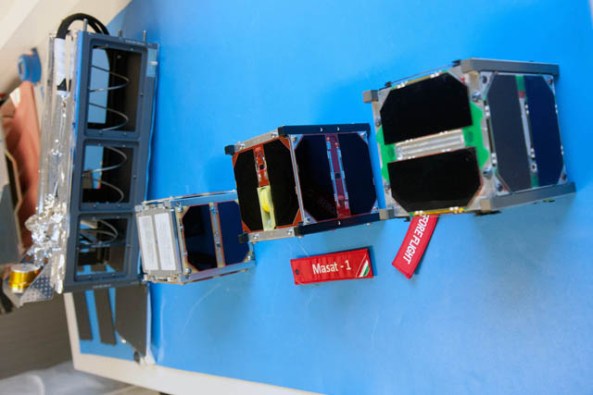
Masat-1 - Flight Model

The Flight Model of Masat-1

The on-board camera of Masat-1 has a mass of about two Euro coins. The maximal resolution is 640×480 pixels. A width of 1 pixel corresponds to a distance of 1 to 10 kilometres on the photos recorded.

The flawless operation of the passive attitude control system made it possible to capture photographs ahead of schedule, but with this passive system only the Southern Hemisphere of the Earth may be targeted by the camera. As the first month of the mission passed, almost every mission objective was fulfilled. The flawless run of the satellite opens a new scientific and technological horizon for experiments which we plan to perform in the coming months.

There is an increasing demand for Eath observation satellites worldwide both from the public and the private sector, as such spacecraft can capture on-demand, high resolution, up to date images of a specific area of the Earth’s surface. The captured images might be used for disaster relief operations,weather forecast services, crop yield estimation and tracking of agricultural operations, civil transport and cartography applications and also defence purposes.

As part of the ESA Education programme, seven CubeSats designed and built by European universities were placed into orbit by Europe’s new Vega launch vehicle on 13th February 2012.
For more information please visit ESA’s Education CubeSat pages.