Space Station SSTV and Packet Radio via SUWS WebSDR

ISS SSTV and Packet Radio signals on the SUWS WebSDR

ISS SSTV and Packet Radio signals on the SUWS WebSDR

Martin Ehrenfried G8JNJ reports excellent SSTV and Packet Radio signals from the International Space Station (ISS) using the online SUWS WebSDR.

144 MHz prototype helix antenna

144 MHz prototype helix antenna

The omni-direction helix antennas at the WebSDR were designed with high elevation satellites in mind. Conventional antennas concentrate the radiation pattern towards the horizon resulting in weaker signals when a satellite is above 15 degrees elevation. Comparisons with other WebSDRs show the SUWS antennas provide a 6 to 10dB better signal to noise ratio on similar passes.

Martin says: “I had been experimenting with single turn ‘twisted halo’ design, and decided to try stacking them to see if I could achieve more gain. Modelling suggested that a stretched 3 turn helix with a helix circumference of approx 1/2 wave length and an overall length of 1/2 wave at 70cm, and fed with a gamma match at the centre would offer reasonable gain, an omni-directional pattern and mixed polarisation.”

You can use the free online SUWS Web Software Defined Radio from your PC or Laptop to receive the ISS and the many amateur radio satellites transmitting in the 144-146 MHz or 435-438 MHz bands. It also provides reception of High Altitude Balloons in the 434 MHz band and coverage of the microwave 10368-10370 MHz band.

The SUWS WebSDR is located at Farnham not far from London, 51.3 N 1.15 W, listen to it at http://websdr.suws.org.uk/

Full details of the antennas are available at http://g8jnj.webs.com/currentprojects.htm

Brazilian radio amateur uses SUWS WebSDR to receive ISS SSTV
https://amsat-uk.org/2014/09/06/iss-sstv-on-suws-websdr/

ISS SSTV image 9/12 received by Martin Ehrenfried G8JNJ using the SUWS WebSDR on Dec 18, 2014

ISS SSTV image 9/12 received by Martin Ehrenfried G8JNJ using the SUWS WebSDR on Dec 18, 2014

434 MHz balloon B-64 returning to UK again

B-64 transmitter payload weighs just 11 grams - Credit Leo Bodnar M0XER

B-64 transmitter payload weighs just 11 grams – Credit Leo Bodnar M0XER

Radio amateur Leo Bodnar M0XER launched his solar powered balloon B-64, carrying an 11 gram transmitter payload, from Silverstone in the UK at 06:51 UT on July 12, 2014 and it’s still flying.

It completed its first circumnavigation of the Northern Hemisphere at 16:30 UT on Friday, July 31 and is expected to complete the second circumnavigation in the next couple of days.

On the afternoon of Thursday, August 21 the balloon was just west of Reykjavik in Iceland heading south at an altitude of 12,500 metres.  Radio amateurs in the British Isles are invited to listen out for the balloon which may come in range late Friday or on Saturday.

B-64 transmits 10 mW on 434.500 MHz using the amateur radio data modes Contestia 64/1000 and APRS (M0XER-4).

The path of the balloon over the past 6 weeks can be seen on the UKHAS tracker at http://spacenear.us/tracker/flyb.php

An APRS map showing the past 24 hours is at http://aprs.fi/#!mt=roadmap&z=11&call=a%2FM0XER-4&timerange=86400&tail=86400

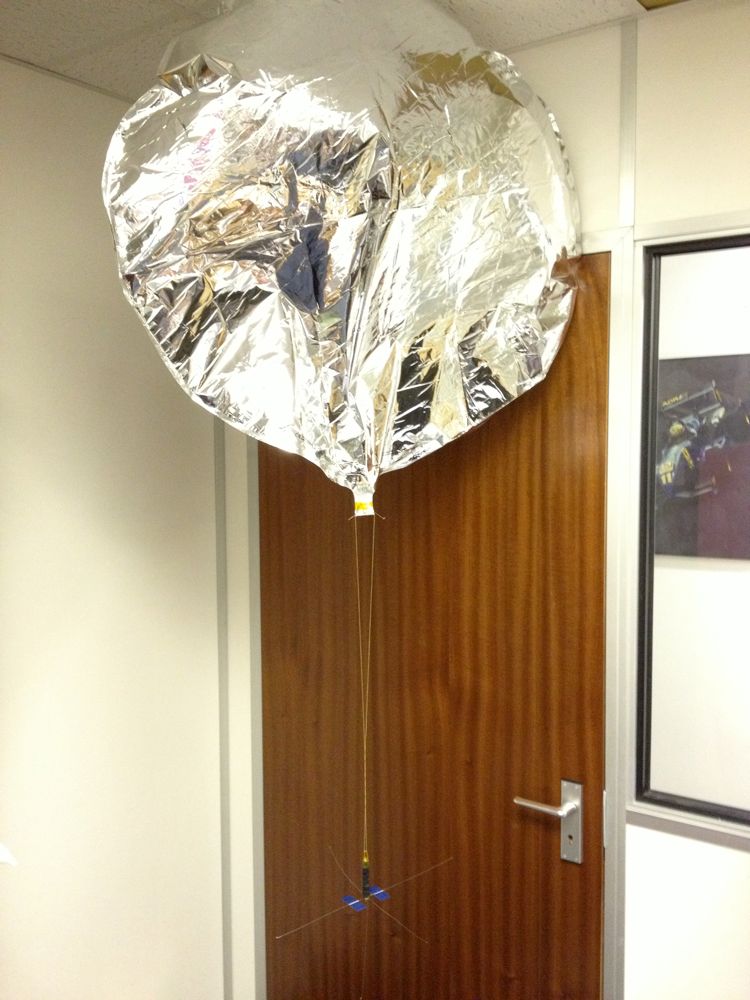
B-64 plastic foil envelope - Image credit Leo Bodnar M0XER

B-64 plastic foil envelope – Credit Leo Bodnar M0XER

Leo has utilised some clever techniques storing positions when the balloon is out of radio contact then later transmitting a log file of previous locations in the comments field of the APRS packet. This enables a fairly complete path to be built up. B-64 only stores 5 days worth of data, where you get a straight line on the track it has been out of radio contact.

Leo Bodnar M0XER balloons http://www.leobodnar.com/balloons/

Listen for B-64 online using the SUWS WebSDR, further details at https://amsat-uk.org/2014/08/15/suws-websdr-moves-to-new-site/

Online real-time tracking of balloons http://spacenear.us/tracker/

Mobile Tracker http://habitat.habhub.org/mobile-tracker/

Beginners Guide to Tracking using dl-fldigi software http://ukhas.org.uk/guides:tracking_guide

Slow Scan Digital Video (SSDV) Guide http://ukhas.org.uk/guides:ssdv (note no SSDV on B-64)

See received SSDV images on the web at http://ssdv.habhub.org/

To get up-to-date information on balloon flights subscribe to the UKHAS Mailing List by sending a blank email to this address: ukhas+subscribe@googlegroups.com

Follow balloon chat on the #highaltitude IRC channel at http://webchat.freenode.net/?channels=highaltitude

What is Amateur Radio ? http://www.essexham.co.uk/what-is-amateur-radio


Typical 434 MHz solar powered payload - Image credit Leo Bodnar M0XER

Typical 434 MHz solar powered payload – Image credit Leo Bodnar M0XER

UKHAS Conference Videos Now Available

James Coxon M6JCX opens UKHAS Conference - Image credit Steve Smith G0TDJ

James Coxon M6JCX opens UKHAS Conference – Image credit Steve Smith G0TDJ

The annual UK High Altitude Society (UKHAS) conference was held on Saturday, August 16, 2014 at the University of Greenwich in London. It attracted those interested in learning about building and flying High Altitude Balloons or in tracking their 434 MHz signals.

There was an impressive line-up of speakers in addition to which there were workshops, demonstrations along with amateur radio exams.

Videos of some of the presentations are now available on the British Amateur Television Club (BATC) site at http://batc.tv/

To watch the videos online or download them to your PC:
• Go to http://www.batc.tv/
• Click on the ‘Film Archive’ icon
• Select ‘UKHAS 2014′ from the Category drop down menu
• Click on ‘Select Category’
• Select the video you wish to watch from the Stream drop down menu
• Click on ‘Select Stream’
• Click the play icon ‘>’ on the player
• Clicking on the icon to the left of the player volume control will give you full screen display.
• To download the video file to your PC right-click on the ‘Click Here’  link under the player.

Morning Sessions

09:30 Assembly – Coffee / Tea + Biscuits
10.10 Introduction – James Coxon M6JCX and Anthony Stirk M0UPU
10.20 Predictor – Daniel Richman M0ZDR and Adam Greig M0RND
10.50 Advanced superpressure balloon technology – Dan Bowen K2VOL
11.30 SUWS WebSDR – Philip Crump M0DNY
11.45 Break
12.00 $50SAT Low cost satellite- Stuart Robinson GW7HPW
12.45 Batc.tv Introduction – Noel Matthews G8GTZ
13.00 Lunch / Show and Tell

Afternoon Sessions

Combination of workshop/lectures.

Main Lecture
14.30 STM32+DSP – Adam Greig M0RND, Jon Sowman M0JSN, Matt Brezja M6VXO
15.30 UKHASNET – James Coxon M6JCX

Side Room
14:30 Pi In The Sky – Anthony Stirk M0UPU and Dave Akerman M0RPI
15.30 Amateur Radio Exams

UKHAS Conference http://ukhas.org.uk/general:ukhasconference2014

Online real-time tracking of balloons http://spacenear.us/tracker/

Beginners Guide to Tracking using dl-fldigi software http://ukhas.org.uk/guides:tracking_guide

Slow Scan Digital Video (SSDV) Guide http://ukhas.org.uk/guides:ssdv

See received SSDV images on the web at http://ssdv.habhub.org/

To get up-to-date information on balloon flights subscribe to the UKHAS Mailing List by sending a blank email to this address: ukhas+subscribe@googlegroups.com

Follow balloon launch day chat on the #highaltitude IRC channel at http://webchat.freenode.net/?channels=highaltitude

434 MHz Balloon B-64 Completes Epic Journey

B-64 Flight Path July 12 to July 31 2014

B-64 Flight Path July 12 to July 31, 2014

At about 16:30 GMT on Friday, July 31, the solar powered B-64 balloon launched by radio amateur Leo Bodnar M0XER crossed the 1 degree West longitude line completing its circumnavigation of the northern hemisphere in just over 19 days.

Oliver M6ODP receiving B-64 at St Michael's Mount

Oliver M6ODP receiving B-64 at St Michael’s Mount

The balloon, flying at an altitude of 12 km, completed its transatlantic crossing and came within range of Cornwall in the morning. Oliver De Peyer M6ODP happened to be visiting St Michael’s Mount in Cornwall at the time. He used his Kenwood TH-F7E handheld to receive an APRS packet from the balloon.

As the day progressed B-64 moved from just south of Cornwall up the English Channel and radio amateurs and listeners from Manchester to Nantes in France were able to receive the 10 mW Contestia 64/1000 and APRS signal on 434.500 MHz.

B-64 passed over the Isle of Wight and floated over Bognor Regis and across Kent heading out into the North Sea near Herne Bay. As of mid-day Saturday it was still flying and transmitting over Sweden and being tracked by members of AMSAT-SM.

B-64 APRS packet received by Oliver M6ODP

B-64 APRS packet received by Oliver M6ODP

Leo Bodnar M0XER launched his balloon carrying an 11 gram transmitter payload from Silverstone in the UK at 06:51 GMT on July 12, 2014. While Leo’s earlier balloons had been foil type party balloons B-64 was a  plastic foil envelope that he made himself.

Using the amateur radio APRS network and the UKHAS network the location of B-64 was tracked as it traveled over Europe, Siberia, with a brief sojourn across North Korea, before heading out over Japan and across the Pacific Ocean. It then briefly entered the United States before swinging north into Canada.

It was heard in Greenland by Peter Thulesen OX3XR and on Friday morning finally came within range of the British Isles.

B-64 plastic foil envelope - Image credit Leo Bodnar M0XER

B-64 plastic foil envelope – Image credit Leo Bodnar M0XER

Leo has utilised some clever techniques storing positions when the balloon is out of radio contact then later transmitting a log file of previous locations in the comments field of the APRS packet. This enables a fairly complete path to be built up. B-64 only stores 5 days worth of data, where you get a straight line on the track it has been out of radio contact.

See the track of B-64 at http://spacenear.us/tracker/?filter=B-64 or at http://habitat.habhub.org/mobile-tracker/

Leo Bodnar M0XER balloons http://www.leobodnar.com/balloons/

Members of the Chelmsford Amateur Radio Society received the signal from B-64. Just 4 weeks earlier, thanks to Chris Stubbs M6EDF, the Society had launched a balloon CARS-1 from their meeting venue. That balloon didn’t have solar power so the signal only lasted for about 10 hours. CARS training organiser Clive G1EUC reported receiving a strong signal from B-64.

B-64 transmitter payload weighs just 11 grams

B-64 transmitter payload weighs just 11 grams

Clive is currently taking names for the next amateur radio Foundation course which starts on Thursday, September 4. If you’d like to join the course or wish to find out more about the hobby give him a ring on:
Tel: 01245-224577
Mob: 07860-418835
Email: training2014 at g0mwt.org.uk
Web: http://www.g0mwt.org.uk/training/

What is Amateur Radio ?
http://www.essexham.co.uk/what-is-amateur-radio

The UK High Altitude Society (UKHAS) Conference takes place Saturday, August 16, 2014 at the University of Greenwich in London
http://ukhas.org.uk/general:ukhasconference2014

Further 434 MHz balloon links at
https://amsat-uk.org/2014/07/30/434-mhz-balloon-goes-around-the-world/

Typical 434 MHz solar powered payload - Image credit Leo Bodnar M0XER

Typical 434 MHz solar powered payload – Image credit Leo Bodnar M0XER


Chelmsford landing planned for SSDV Balloons

Image from the SUPER balloon launched by Dave Akerman M0RPI on July 12, 2014

434 MHz SSDV image from the SUPER balloon launched by Dave Akerman M0RPI on July 12, 2014

Radio amateur Philip Crump M0DNY plans a number of High Altitude Balloon (HAB) flights this weekend transmitting Slow Scan Digital Video (SSDV).

SSDV picture from a PIE balloon - Image credit Dave Akerman M6RPI/2E0LTX/M0RPI

SSDV picture from a PIE balloon – Image credit Dave Akerman M6RPI/2E0LTX/M0RPI

The launches will take place from Gilwell Park near Epping Forest and the balloons are expected to land around Chelmsford in Essex.

They are planned as part of the Gilwell 24 Scouts Activity event, taking place from 9am Saturday, July 12 through the night to 9am Sunday, July 13 in Gilwell Park. The plan is to monitor predictions/weather, prepare the payload, launch when convenient, then Philip M0DNY will chase, recover and repeat, up to 2 additional times.

The balloons are 100g hwoyees, and so are only expected to reach around 14 km altitude due to the weight, and increasing chances of wet landing for a longer flight. A Raspberry Pi is being used for the SSDV, and will store images as well as short but frequent video clips.

Due to tracker issues Philip may be flying a borrowed SUSF tracker on 434.613 MHz, replacing his one on 424.125 MHz.

The USB frequencies used will be
• 434.200 MHz – G24HAB – 600 baud SSDV
And either:
• 434.125 MHz – GILWELL24 – 50 baud RTTY
Or:
• 434.613 MHz – GILWELL24 – 50 baud RTTY + 300 baud TurboHAB FSK (SSB)

The 434.613 MHz tracker will alternate between 50 baud RTTY and 300 baud binary TurboHAB. To decode the binary error corrected format you need this decoder: http://users.ecs.soton.ac.uk/mfb2g09/decoder/decoder.jar , which has been updated since last time. To decode the binary protocol you first need to change ‘Encoding’ to BIN and ‘Baud’ to 300. Upon changing the callsign and position you need to press ‘Update’ for the new data to be used. It will be interesting to see the relative performance, the error correction should make most difference where there is noise or fading.

First launch is tentatively scheduled for 2pm BST Saturday. Philip will post updates on Twitter and #highaltitude. There will most likely be a live stream of the launches check http://batc.tv/ch_live.php?ch=3

David Akerman M0RPI and Heston Blumenthal with balloon - Image credit M0RPI

David Akerman M0RPI with balloon – Image credit M0RPI

Dave Akerman M0RPI is also launching on Saturday between 10-11am from Ross On Wye. His balloon will be transmitting on three frequencies one of which will be Slow Scan Digital Video (SSDV).

$$SUPER: 434.450 MHz, 300 baud RTTY, 880 Hz shift, USB, 8, N, 2, SSDV
$$UAD: 434.480 MHz, Domino EX22
$$UAR: 434.475 MHz, 50 baud RTTY, 400 Hz shift, USB, 7, N, 1

There should be live video streaming on BATC.TV The chase car is M0RPI_chase:
http://www.batc.tv/streams/m0rpi
http://www.batc.tv/streams/m0rpi_chase

The balloons should have a radio range of up to 700 km providing coverage over a large part of the British Isles and into Europe.

Listen to the Balloons via the Web

Radio amateurs Noel G8GTZ, Martin G8JNJ and Phil M0DNY from the Southampton University Wireless Society, have established an Internet accessible WebSDR receiver near Basingstoke in the UK. It has special helix antennas optimised for balloon and satellite reception in the 144 and 434 MHz bands and can be listened to from anywhere in the world. Listen using the WebSDR at http://websdr.suws.org.uk/

Online real-time tracking of balloons http://spacenear.us/tracker/

See the received SSDV images on the web at http://ssdv.habhub.org/

Beginners Guide to Tracking using dl-fldigi software http://ukhas.org.uk/guides:tracking_guide

Slow Scan Digital Video (SSDV) Guide http://ukhas.org.uk/guides:ssdv

To get up-to-date information on balloon flights subscribe to the UKHAS Mailing List by sending a blank email to this address:
ukhas+subscribe@googlegroups.com

Follow the launch day chat on the #highaltitude IRC channel at
http://webchat.freenode.net/?channels=highaltitude

The Chelmsford Amateur Radio Society have a new short training course for those wishing to become radio amateurs starting on September 4. To find out more speak to Clive G1EUC on
Tel: 01245-224577
Mob: 07860-418835
E-mail: training2014 at g0mwt.org.uk
Web: http://www.g0mwt.org.uk/training/

What is Amateur Radio ? http://www.essexham.co.uk/what-is-amateur-radio

Talk – Launching and Tracking of 434 MHz Balloons

Chris Stubbs M6EDF with 434 MHz trackers

Chris Stubbs M6EDF with 434 MHz trackers

On Tuesday, July 1, Chris Stubbs M6EDF will be giving a talk on 434 MHz high altitude balloons to the Chelmsford Amateur Radio Society (CARS). Weather permitting it is hoped to be able to do a balloon launch (434.300 MHz FSK). The meeting is open to all.

Chris took the amateur radio Foundation training course run by CARS in January 2013. He is keen on both electronic construction and software development and combines the two interests in High Altitude Ballooning (HAB). Chris has built many tracker payloads for his balloon launches which usually take place from Danbury Common near Chelmsford.

In May he undertook a STEM (Science, Technology Engineering and Mathematics) event for pupils at the Sandon School in Chelmsford, launching a balloon equipped with his 434.300 MHz tracker enabling the students to track the position of the balloon in real-time. In June he did a similar event for pupils at the Stewards Academy in Harlow.

A balloon like this carrying a small electronic tracker payload traveled all the way to Japan – Image credit Leo Bodnar M0XER

A balloon like this carrying a small electronic tracker payload traveled all the way to Japan – Image credit Leo Bodnar M0XER

The trackers typically transmit 50 bps FSK RTTY in 434 MHz and can have a radio range of over 500 km. The data transmitted comprises the GPS location of the balloon and other sensor readings such as pressure, temperature and altitude. The signals are received by a network of listeners who upload the data to the UK High Altitude Society (UKHAS) central server enabling anyone to see the current location of the balloon on the web.

Some balloon flights aim to achieve very high altitudes, other aim to stay aloft for as low as possible. Leo Bodnar M0XER recently achieved a record breaking flight from Silverstone to Japan using a party balloon with a tiny solar powered payload.

The talk will explain how you can participate in this increasing popular activity.

The Chelmsford Amateur Radio Society meeting takes place at the Oaklands Museum, Oaklands Park, Moulsham Street, CM2 9AQ on Tuesday, July 1. The doors open at 7pm for a 7:30pm start. Admittance and parking are free and the usual raffle will be held.

A map showing the venue can be seen at http://www.g0mwt.org.uk/meeting-map.pdf

Flight path of M6EDF's balloon STEWARDS on June 3. 2014

Flight path of M6EDF’s balloon STEWARDS on June 3. 2014

M6EDF electronics and HAB website http://www.chris-stubbs.co.uk/

The Chelmsford Amateur Radio Society run short training courses for those wishing to get their amateur radio licence. To find out more about amateur radio and the course speak to Clive on
Tel: 01245-224577
Mob: 07860-418835
Email: training2014 at g0mwt.org.uk
Web: http://www.g0mwt.org.uk/training/

What is Amateur Radio ? http://www.essexham.co.uk/what-is-amateur-radio

M6EDF CHEAPO Micro Tracker

MP Congratulates Students on near Space Program
https://amsat-uk.org/2014/06/25/mp-congratulates-students-on-near-space-program/