Giant leap for radio ham’s Pi-powered teddy bear

2013-08-26--14-45-58-PIE-51FBBC News reports on radio amateur Dave Akerman M6RPI‘s successful 434 MHz balloon flight on Monday, August 26, 2013.

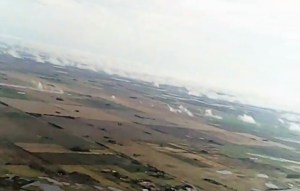
The balloon carried transmitters on 434.200 MHz and 434.250 MHz and transmitted images using the amateur radio Slow Scan Digital Video (SSDV) standard, they are available here.

The BBC say:

A soft toy controlled by a Raspberry Pi computer has re-created Felix Baumgartner’s record-breaking skydive.Mr Baumgartner made the highest ever freefall in October 2012 when he jumped from a balloon about 39km up.

A bear called Babbage has now leapt from a similar height after ascending beneath a hydrogen-filled balloon.

The Raspberry Pi low-cost micro-computer inside Babbage transmitted his position and shot stills and video throughout the flight and descent.

Read the BBC news story at http://www.bbc.co.uk/news/technology-23840596

See the SSDV images at http://ssdv.habhub.org/

Slow Scan Digital Video (SSDV) Guide http://ukhas.org.uk/guides:ssdv

Dave M6RPI website http://www.daveakerman.com/

Dave M6RPI had made an initial attempt on Saturday but the bear’s release mechanism didn’t work
http://www.southgatearc.org/news/august2013/434_mhz_balloons_launch_this_weekend.htm

To get details of upcoming UK balloon launches subscribe to the UKHAS Mailing List by sending a blank email to this address: ukhas+subscribe@googlegroups.com

Video of STRATODEAN High Altitude Balloon Presentation

Team STRATODEAN - Cassie Phelps and Mark Ireland

Team STRATODEAN – Cassie Phelps and Mark Ireland

The members of Team STRATODEAN, Cassie Phelps and Mark Ireland, gave a presentation on their High Altitude Balloon project to the AMSAT-UK International Space Colloquium on Saturday, July 20, 2013.

Image from STRATODEAN Two

Image from STRATODEAN Two

The STRATODEAN team have sent high altitude weather balloons complete with payload from the Forest of Dean up to the edge of space (approx. 34 km up into the Stratosphere).

Each balloon was equipped with a camera and video recorder as well as GPS and a 434 MHz telemetry transmitter running 50 bps, 350 Hz shift, ASCII. The transmitter enables the balloon to be tracked during its flight and then located once it has burst and returned to earth with the help of a parachute.

Their first balloon STRATODEAN One launched on April 21, 2013 followed by STRATODEAN Two on May 18, 2013 and they managed to capture some stunning pictures and video.

Watch the STRATODEAN presentation

STRATODEAN High Altitude Balloon Project http://www.stratodean.co.uk/

To get details of upcoming UK balloon launches subscribe to the UKHAS Mailing List by sending a blank email to this address: ukhas+subscribe@googlegroups.com

Videos of other presentations at the AMSAT-UK International Space Colloquium can be seen via
https://amsat-uk.org/colloquium/colloquium-2013/presentation-videos/

AMSAT-UK publishes a colour A4 newsletter, OSCAR News, that is full of Amateur Satellite information. A sample issue of OSCAR News can be downloaded here.
Join AMSAT-UK online at http://tinyurl.com/JoinAMSAT-UK/

Ham Radio Workshop held at Satellite Event

Participants at the 2013 small satellite developer workshop

Some of the participants at the 2013 small satellite developer workshop

The National Institute of Amateur Radio was involved in the Small Satellite Developer Workshop held July 8-13, 2013 at the Indian Institute of Information Technology, in Kancheepuram.

The event was organized by Dhruva Space, a Bangalore based Small Satellite and High Altitude Ballooning Start-up, in association with the National Institute of Amateur Radio, Hyderabad.

Satellite experts with engineering models on display helped participants to grasp the challenges in designing and developing the subsystems of the small satellites.

To understand space based applications an Amateur Radio workshop was conducted to give participants a live example of usage of communications during disaster management.

Read the full report of the event in the Small Satellite Developer Workshop Newsletter

Dhruva Space http://dhruvaspace.com/outreach/amateur-radio/
https://www.facebook.com/DhruvaSpace

National Institute of Amateur Radio http://www.niar.org/ar.html
https://www.facebook.com/NationalInstituteOfAmateurRadio

Team STRATODEAN High Altitude Balloon Talk

Team STRATODEAN - Cassie Phelps and Mark Ireland

Team STRATODEAN – Cassie Phelps and Mark Ireland

The members of Team STRATODEAN, Cassie Phelps and Mark Ireland, will be giving a web streamed presentation on their High Altitude Balloon project to the AMSAT-UK International Space Colloquium on Saturday, July 20.

The event takes place at the Holiday Inn, Guildford, GU2 7XZ, UK and is open to all.

Image from STRATODEAN Two

Image from STRATODEAN Two

The STRATODEAN team have sent high altitude weather balloons complete with payload from the Forest of Dean up to the edge of space (approx. 34 km up into the Stratosphere). Each balloon was equipped with a camera and video recorder as well as GPS and a 434 MHz telemetry transmitter running 50 bps, 350 Hz shift, ASCII. The transmitter enables the balloon to be tracked during its flight and then located once it has burst and returned to earth with the help of a parachute.

Their first balloon STRATODEAN One launched on April 21, 2013 followed by STRATODEAN Two on May 18, 2013 and they managed to capture some stunning pictures and video.

For those unable to get to the Colloquium all the presentations on the Saturday and Sunday should be broadcast live on the web thanks to dedicated BATC volunteers on their Live Events page at http://batc.tv/ch_live.php?ch=3 The STRATODEAN talk is expected to start at 1:50 PM Saturday.

The times (BST, GMT+1) for all the presentations during the weekend are at http://tinyurl.com/2013ColloquiumSchedule

AMSAT-UK International Space Colloquium July 20-21 https://amsat-uk.org/colloquium/colloquium-2013/

STRATODEAN High Altitude Balloon Project http://www.stratodean.co.uk/

A sample issue of the AMSAT-UK newsletter OSCAR News can be downloaded here.

July 13 Lift-off for LOHAN Balloon Rocket Test

Vulture 2 Spaceplane - Image credit LOHAN

Vulture 2 Spaceplane – Image credit LOHAN

Radio amateurs Dave Akerman M6RPI and Anthony Stirk M0UPU provide an update on a balloon launch planned for this Saturday, July 13 which aims to test the firing mechanism for the LOHAN rocket.

There will be several 434 MHz radio transmitters on-board including one sending Slow Scan Digital Video (SSDV). The radio range is expected to cover most of the British Isles and North-West Europe.

The British Amateur Television Club (BATC) will be providing live coverage of the launch and hopefully also from the two chase vehicles.

Dave and Anthony say:

We will launch a second test of The Register’s LOHAN Project  from Brightwalton around 1000 UT (ISH time is most definitely in effect for this one). If you recall last time due to some problematic predictions the trusty Playmonaut was lost at sea and not recovered despite some valiant efforts by Lester and Neil in a bath tub with an engine on it.

LOHAN_mission_summary_04_bigWe will be repeating the test of the first launch on Saturday under a 2000g Hwoyee balloon. In order to test the firing mechanism for the LOHAN rocket we will be instead using it to detach a payload at a predetermined altitude where the payloads will part ways and land separately.

Each payload will have a primary and backup tracker on it :
Main payload SPEARS : LOHAN Board and a PAVA backup tracker:

Primary : $$SPEARS 434.650 MHz
Secondary : $$REHAB 434.600 MHz

Secondary payload CHAV : Rasp Pi doing SSDV and a PAVA Backup tracker:
Primary : $$CHAV 434.075 MHz
Secondary : $$SHUTIT 434.495 MHz

Transmission format is RTTY speeds please select auto-configure in DL-FLDigi

If we have dubious prediction data we may be launching another payload early in the day to verify that prediction meets reality and we aren’t going to feed another Playmonaut to the fish. This will be on 434.545 MHz and its call sign will be $$PAVA.

The Slow Scan Digital Video (SSDV) on CHAV will change sizes during the flight:
– “launch mode” is small images (320 x 176) till it gets above 3 km
– “flight mode” is larger images (512 x 288) till it drops below 2 km
– “landing mode” takes a single 10-minute video starting at 2 km, then switches back to small images

We will, subject to 3G coverage, be transmitting the preparation, launch and possibly chase live thanks to the nice people at batc.tv. The link is :
http://www.batc.tv/streams/ukhas

There may be a secondary stream (the two chase cars may go separate ways) at :
http://www.batc.tv/streams/ukhas2

SSDV picture from a PIE balloon - Image credit Dave Akerman M6RPI

SSDV picture from a PIE balloon – Image credit Dave Akerman M6RPI

You can of course follow the position of the balloons live at http://www.spacenear.us/tracker and the live SSDV images from the Pi will be uploaded here : http://ssdv.habhub.org/.

Although batc.tv has a chat function we welcome you to join the #highaltitude channel on Freenode to take part in the conversation throughout the day.

Finally we welcome listeners to track the balloons in flight, tracking can be done with any radio reciever that can recieved USB on 70 cms (434 MHz), i.e some scanners, full amateur radio equipment, FUNcube Dongles or just a RTL Dongle being used as an SDR. There is a guide here on how to track. We expect reception range to cover most of the UK and northern Europe.

Cheers,

Anthony M0UPU / Dave M6RPI

LOHAN hooks up with radio ham and top-flight rocketeer G7ALW
https://amsat-uk.org/2013/03/17/lohan-hooks-up-with-radio-ham-and-top-flight-rocketeer-g7alw/

For up-to-date information on balloon launches subscribe to the UKHAS Mailing List by sending a blank email to this address:
ukhas+subscribe@googlegroups.com

AMSAT-LU Ham Radio High-Altitude Balloon to fly FM Repeater and SSTV

AMSAT-LU RF Module

The system board containing RF transmitter module, receiver module, level adjustments, duplexer and antenna connector. Image credit LU7AA

AMSAT Argentina is pleased to announce that on Saturday, June 29, 2013 from 1400 GMT, weather permitting, it is planned to launch an amateur radio high altitude balloon FM repeater ‘Betty II’ from Victorica, La Pampa, 665 km. west of Buenos Aires, it is expected to travel east.

The 435.950/145.950 MHz FM repeater will be activated by a 123 Hz CTCSS subtone. The balloon can also transmit Slow Scan Television (SSTV) ROBOT-36 images from the onboard camera on 145.950 MHz. There is an APRS transmitter on 144.930 MHz.

It should be possible to access the balloon using a 2 watt FM handheld rig from 750 km away giving a theoretical maximum distance for two-way contacts of 1500 km.
AMSAT-LU May 2012Details and photos of the announcement and prior experiences in http://www.amsat.org.ar/globo29.htm

Approval of ANAC (Argentina FAA)) had been granted by NOTAM (notice to air crew) http://amsat.org.ar/images/faxanac.jpg .

For these experiments members of AMSAT-LU, LUSEX, project development group http://lusex.org.ar , are working together with Pampeano and QRM Belgrano Radio Clubs, APRS Group, etc.

Electronics is comprised of a voice UHF to VHF FM repeater with CW TLM, APRS, DTMF and SSTV. According to estimates balloon could reach 30,000 meters high, traveling for 3 hours, 150 km east of the launch site.

This would allow contacts between stations located in the provinces of Buenos Aires, Santa Fe, Entre Rios, Cordoba, Catamarca, Santiago del Estero, La Pampa, San Luis, Mendoza, San Juan, Rio Negro, Neuquen, Uruguay and Chile. (It is launched from the center of the country to facilitate greater participation). Coverage at http://www.amsat.org.ar/picocubr.jpg

To receive the payload, if less than 750 km from launch site, only need is a handy or base FM receiver on 145.950 MHz for voice/sstv and 144.930 for APRS.

The repeater which is enabled via 123 Hz CTCSS subtone, receives 435.950 MHz FM voice (-112dBm, 0.56 uV) emitting 2W output simultaneously on 145.950 MHz.

AMSAT-LU picocubrPayload will also carry an emergency long duration APRS transmitter sourced by solar cells and supercapacitors as batteries.

To enable better utilization, it is suggested short QSOs (license, own locality, grid locator, received signal and short comments).

Simultaneous emits APRS 1200 baud at 144.930, and also in 145.950. The DTI symbol on APRS will change from a balloon ( /O ) during ascent to a slider ( /g ) during the parachute descent.

Will operate for 90 seconds voice, then a beep alerting the end of that time will make way for the issuance of APRS at different frequencies. Every five minutes CW TLM via telegraphy audio tones sends callsign LU7AA and height in meters, then repeat the cycle.

On 145.950 MHz SSTV images ROBOT-36 mode (36 seconds) will be emitted on demand showing what the balloon sees (Can be received, with either MIXW or RX-SSTV (recommended)).

Balloon will carry two GoPro TV cameras (one to ground and another to the horizon) that will record images and sound during flight and can be retrieved with the payload.

It will be live in APRS on http://aprs.fi/?call=lu7aa-11 every minute, including speed, height, internal and external temperatures and battery voltage.

Local georeferenced maps are available for UI-View in http://www.amsat.org.ar/pico2.jpg , http://www.amsat.org.ar/pico2.txt to be renamed to pico2.inf .

The experiment on 435.950 MHz voice also receives and accepts DTMF user issued commands i.e. B * (DTMF keypad UHF handy) will return S5 … ….. on VHF CW 145.950, your signal strength received at balloon, if P10 that states S9 +10.

There are more commands that enable issuance of TLM in CW or APRS beacon and remote commands to drop payload, mode changes, control of timers, energy, power, enable SSTV, etc..

Additionally a VAISALA RS92SGP radiosonde emitting FM wide on 402.740/403 MHz has been added, which provides GPS location, pressure, winds, height, course, dwt point, temperatures, etc. Same data as daily collected by the National Meteorological Service.

Data can be received using an SDR dongle and sondemonitor program available as test for 21 days from internet.

On launch day/time AMSAT-LU will have one of his members on the Ezeiza Airport Traffic Control, acting as a contact between ANAC and AMSAT-LU, using VOR locations application, adapted from EOSS and available on http://amsat.org.ar/vor.asp .

Local frequencies coordination and announcements before and during flights will be 7095 kHz LSB + / -10 kHz and VHF frequencies of local repeaters in the area.

During flight 430.930 AMSAT-LU APRS will operate wide coverage Igate LU7AA-10, installed at the Investigation Center, besides a portable Igate close to launch site. Any area stations that can receive and provide bridge to the APRS network are welcome.

Being an experiment aimed at a next satellite, contacts made between stations thru this UV repeater will be considered valid and awarded upon request by AMSAT-LU Permanent Satellite Certificate, free and also applicable for license upgrades, see http://www.amsat.org.ar/certsat.html, http://www.lu4ao.org.ar, http://www.amsat.org.ar/lu4aao.

Top 10 participants with the highest two-way contacts/distances sum thru repeater will be awarded with a special certificate. Send email with data filled on form http://www.amsat.org.ar/lu4aao/Globo_29jun2013.xls QSOs with stations via the balloon including QRA Locators, QTR to RC QRM Belgrano before July 23.

All reports welcome. If you want or can organize or be part of launch teams, control, monitoring and recovery, operating as an independent station and capturing data, and / or want to join us in this adventure from the launch site can do it through an email to parapente arroba amsat.org.ar.

We appreciate having read this information and forward if possible.

73, LU7AA, AMSAT-LU. aiming to the future by making present fun.
Email: info at amsat.org.ar

AMSAT Argentina http://www.amsat.org.ar/
Facebook http://facebook.com/AMSAT.LU