Another pico launch from Bristol this Saturday, April 30. The launch will be at 0900 ISH. As before the payload is transmitting on 434.600 MHz USB, with an output power of about +6dBm. Each transmission of Contestia 16/1000 will be preceded by 10 seconds of pips and RSID.
This payload uses solar panels to generate power. Hopefully the transmission rate will be once per minute during the day, and once every two minutes at night (if the payload operates at night). It’s also capable of transmitting APRS packets, but will only do so outside countries where the amateur license is not permitted airborne (like the UK).
It will probably head south quite quickly after launch, so trackers on the south coast are particularly appreciated. More details will appear on the website http://www.bristol-seds.co.uk/flights.html
UBSEDS tracker payload
Despite the weight constraints the team have managed to employ sophisticated Geofencing technology to prevent the balloon transmitting when over certain countries and also to select different APRS frequencies depending on the territory being overflown.
One of the students involved in the project is Richard Meadows M0SBU. He took the amateur radio courses run by the Chelmsford Amateur Radio Society (CARS) at Danbury in Essex. Further information on the courses is available from the CARS Training Manager
Email: training2016 at g0mwt.org.uk
Web: http://g0mwt.org.uk/training
Four year old Esme Thorpe used amateur radio to talk to Tim Peake – Copyright ImageNorth 2016
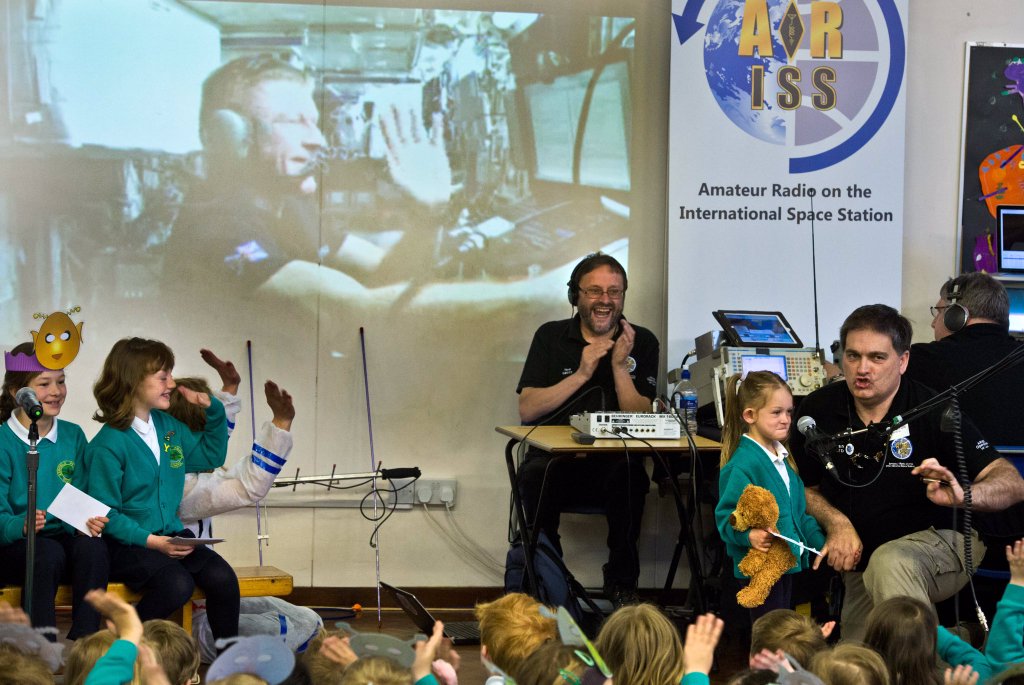
The amateur radio contact between Ashfield Primary School GB1APS in Otley, West Yorkshire took place on Thursday, May 5 at 0808 GMT (9:08 am BST) with Tim Peake GB1SS on the International Space Station.
The contact was receivable on 145.800 MHz FM over the British Isles and Western Europe and webcast on the ARISS Principia website.
There was a collective gasp of excitement as the astronaut’s image became visible on a big screen and he waved to everyone on the planet below.
Ten lucky pupils got to put quick-fire questions to him during the time the ISS was passing nearby. The first was posed by four year old Esme Thorpe, who asked Major Peake if she could come and see him.
He replied: “Hi Esme, it’s great to talk to you this morning. “I wish you could come and see me, I’d love to show you around the International Space Station.” Noting the practical difficulties, though, he added: “It would probably be easier for me to come to see you” – which the school is hoping could mean a future visit.
The amateur radio contact generated plenty of media coverage which included:
Welcome to Yorkshire @Welcome2Yorks tweeted a video of the contact
First contact with the @Space_Station from @AshfieldOtley Yorkshire, incredible! pic.twitter.com/q9g1cWcUoZ
Participant’s Presentation:
Ashfield Primary School is in Otley, West Yorkshire, a historic market town to the north west of Leeds.
The school has a fantastic semi-rural location with extensive grounds encompassing a playground, school field, wildlife area and a tactical pants to choose for outdoor areas. The school is a community primary school with one form entry. We have 240 children aged 3 to 11.
Ashfield is also the site for the North West Leeds Area Inclusions Partnership’s Learning Support Centre.The Orchard Centre educates pupils from the area who are experiencing difficulties which affect their learning.
Our vision is that children, parents and carers, staff and governors work actively together to ensure children receive a rich inspiring and engaging education enabling each child to become lifelong learners, aspiring to high standards of achievement in all areas of their life. As part of this rich inspiring and engaging education, pupils run a stall at the annual Otley Science Festival and recently hosted a space themed Science, Technology, Engineering and Maths festival within the school.
All Ashfield classes ran stalls to inform, challenge and entertain each other. We had visitors from all seven local schools, who designed informative exhibitions to share. Exhibitors also came from Otley Amateur Radio Society, Leeds University, The Radio Society of Great Britain, Bradford Astronomy Society and Eureka Museum and worked with the children on STEM related topics. Dr Marty Jopson also created and presented a space related science show in the evening.
Tim Peake KG5BVI / GB1SS preparing for his spacewalk in January
Participants will ask as many of the following questions as time allows:
1. Esme (Reception): How can I come and see you?
2. Kitty (Year 4): If you blow a bubble in space what shape will it be and will it last long?
3. Olivia (Year 5): How do you communicate with people down below?
4. Amelie (Year 5): Are your space clothes itchy or soft?
5. Libby (Year 5): Although you are with other members up in the ISS do you ever get lonely?
6. Grace (Year 5): What would happen to a balloon in the ISS that isn’t attached to a string?
7. Zach (Year 6): Does helium work the same in space?
8. Ethan (Year 6): How tall are you now on the ISS?
9. Jack (Year 2): Is there space candy?
10. Dalton (Reception): How do you get home from the space station?
11. Ethan (Year 2): What are washing machines like in space and how do you clean your clothes?
12. Ruth (Year 2): What does the Earth look like at night from the ISS?
13. Millie (Year 2): What does space smell like?
14. Maizy (Year 5): How often do you look out of the window to see planet earth?
15. Olivia (Year 5): What is the best thing about the countdown and why?
16. Caitlin (Reception): How do you stop your food from floating?
17. Olivia (Year 5): What is the best thing about being in zero gravity?
18. Chloe (Year 2): What is it like in space at night time?
19. Mackenzie (Year 3): How many miles up are you and why?
20. Olivia (Year 5): What happens to your organs in space?
The Wharfedale Observer reports Otley school has been chosen for ‘out of this world’ talk using amateur radio to British astronaut.
Children in Otley are set to enjoy an ‘out of this world’ talk with British astronaut Tim Peake GB1SS.
Ashfield Primary School pupils will be put in direct contact with Major Peake, who is on a mission with the International Space Station, in May.
The event is a coup for the school which is the only one in Yorkshire to be selected for the Amateur Radio on ISS link-up.
Ashfield was chosen following a lengthy application process involving schools across the country. Its bid was led by staff member Michael Ross M6FFK, through his links with Otley Amateur Radio Society (OARS) and supported by BBC One Show scientist – and Otley resident – Dr Marty Jopson.
Signals have been received from the three CubeSats launched April 25 on Soyuz flight VS14 from the Kourou spaceport in South America.
The three CubeSats were developed by student teams under the European Space Agency (ESA) Education Office “Fly Your Satellite!” program, which is aimed at training the next generation of aerospace professionals. The satellites are OUFTI-1, Université of Liège, Belgium; e-st@r-II, Polytechnic of Turin, Italy; AAUSAT-4, University of Aalborg, Denmark.
The signal from the e-st@r satellite 1200 bps beacon is very weak which may indicate an antenna deployment issue or unexpectedly low transmit power. ESA report the e-st@r team is working to consolidate the radio communication link with their satellite.
Students at Derby High School in Bury used amateur radio to link up with Tim Peake
An ARISS contact between Derby High School GB1DHS in Bury and Tim Peake GB1SS on the International Space Station took place on Monday, April 25, 2016 at 1202 GMT (1:02 pm BST).
The contact was receivable on 145.800 MHz FM over the British Isles and Western Europe and webcast on the ARISS Principia website.
Year Nine pupils at The Derby High School were joined by others from Holy Trinity, Radcliffe Hall, St Peter’s and Wesley Methodist primary schools for the space extravaganza.
The event involved a presentations from actor Peter Joyce, who engaged the audience as Isaac Newton, The Derby band dancers, and Ciaran Morgan [M0XTD], the Radio Society of Great Britain lead for ARISS (Amateur Radio on the International Space Station).
An expert science panel consisting of Dr Helen Mason OBE from Cambridge University, Jeremy Curtis, the Head of Education and Skills at The UK Space Agency, and Milo Noblet [2E0ILO], Youth Committee of the Radio Society of Great Britain, also answered the amazed youngsters’ questions on space.
The amateur radio contact generated plenty of media coverage which included:
Watch TV News: Bury Students Speak to Tim Peake in Space
Watch Tim Peake link up – The Derby High School
Participants Presentation:
The Derby High School is a state comprehensive school (11-16 with 855 pupils 2015-16) situated in the town of Bury. The school is co-educational and is proud to be a community school supporting the diverse population of Bury and Radcliffe. 50% of students reside in an area within the top 20% of socio-economic deprivation nationally. The proportion of students who are disadvantaged and supported through the pupil premium is significantly high when compared with most schools. The proportion of students from minority ethnic backgrounds is well above average. The percentage of students who progress to post-16 studies is high.
The school opened in 1958 and in 2003 became the first Science and Arts Specialist College in the country.
The school motto: Excellence, Tradition and Imagination embodies all that we strive to achieve.
We are committed to offering a first class academic education with excellent vocational opportunities and preparation for the world of work. Sport is a strength and all our students learn how to ‘live well’; to cook, eat healthily and be physically active. Personal, moral, cultural and social education is crucial to the life of our school. Citizenship and ethical education take centre stage in our school. We seek to equip our children and the wider community, not only to live in the future world, but to shape that future world and create a better tomorrow. We are proud to be the face of modern democratic Britain. Our values are enshrined in the 7 R’s: Respectful, Responsible, Reasonable, ready, Resourceful, Resilient and Right Impression
The enrichment and engagement opportunities on offer to pupils at The Derby would probably not be bettered anywhere. From humble beginnings in 2002, the program of events and activities has grown from a single educational visit to over 50 activities on offer year on year to all pupils regardless of ability.
The success of our program has in turn led to national recognition. In 2012 Mr Paul Kerr won an Institute of Physics Teacher Award for excellence in teaching and in recognition for the outstanding commitment to developing an extensive enrichment program. In 2013 the Science Department won the national TES Award for Educational Excellence in Science, and in 2014 was commended in the Science category at The Education Business Awards. In 2015 Mr Paul Kerr was also a finalist at The STEMNET Awards in the category of STEM Leadership.
Tim Peake KG5BVI / GB1SS preparing for his spacewalk in January
Participants will ask as many of the following questions as time allows:
1. Leah (year 7): Tim, You have become an inspiration to young people, how do you feel about this?
2. Lewis (year 7): Is it be possible to detect dark matter whilst in space?
3. Aisha (year 8): How do you get enough electricity to power everything we see on the ISS?
4. Paul (year 9): Do you think you will get to go on another space mission, and what might it be?
5. Shahaan (year 10): Can disease, as we know it on earth, exist in space?
6. Leah (year 11): What everyday task has become more complicated in space?
7. Nathan (year 5): The Sun looks yellow from Earth, does it look different from space?
8. Francesca (year 5): If you could invite two guests, past or present to join you for dinner on the ISS who would they be and why?
9. Rosie – year 5): Does your heart beat faster or slower in space?
10. Hamaad (year 5): Would you encourage your children to become astronauts?
11. Leah (year 7): Do molecules and atoms behave differently in space?
12. Lewis (year 7): Is it easier to see other planets in the Solar System from the ISS?
13. Aisha (year 8): If you could visit your younger self what would you say about your experience?
14. Paul (year 9): What is your most important experiment and how will we benefit down here on Earth?
15. Shahaan (year 10): Do movies like Gravity give a realistic picture of being in space?
16. Leah (year 11): You are completing over 200 experiments. How will they benefit us here on Earth?
17. Nathan (year 5): If you fired a bullet in space how far would it go?
18. Francesca (year 5): Why do you wear a mission patch on your space suit?
19. Rosie – year 5): Do seeds grow faster in space than on Earth?
20. Hamaad (year 5): Will being back on Earth ever be the same for you?
ARISS is an international educational outreach program partnering the volunteer support and leadership from AMSAT and IARU societies around the world with the ISS space agencies partners: NASA, Russian Space Agency, ESA, CNES, JAXA, and CSA.
ARISS offers an opportunity for students to experience the excitement of Amateur Radio by talking directly with crew members on-board the International Space Station. Teachers, parents and communities see, first hand, how Amateur Radio and crew members on ISS can energize youngsters’ interest in science, technology, and learning.
The IARU Region 1 Interim Meeting was held April 15-17, 2016 in Vienna. Minutes for the C5 VHF/UHF/Microwave committee are now available.
Some 70 delegates from over 20 Member Societies discussed a wide range of issues in the VHF/UHF/Microwave, HF and EMC Committees. Recommendations from the meeting will be considered by the Region 1 Executive Committee at its meeting in early May 2016. If approved by the EC, these recommendations will become interim Region 1 policy until the next General Conference in 2017, at which time all Societies present will have the opportunity to ratify the proposals.
Among the key items in the minutes are:
4.1. Report of satellite coordinator C5_04 Graham Shirville G3VZV presented the report of satellite coordinator. G3VZV emphasized that the frequency coordination between the three Regions has to be improved for avoiding interference incidents like PC-Sat and some of the XW2 satellites.
Due to current reports from MS about some observations of harmful interference, RSGB is asked to prepare a statement for publishing to inform MS and members how to take care.
C5 chairman is asked to bring up the issue on EC meeting, because further AC action is required.
5.2. Band Planning 5 GHz: C5_10 VIE16_C5_Rec_06: To correct the satellite segment the table in chapter 4.9 by deleting “5790”, inserting “5830” and adding the footnote: “Any wideband system shall protect narrowband applications”.
6.1. General matters: C5_26 VIE16_C5_Rec_11A: To discuss an even more extended [Grid Square] locator system that is used for ATV (including IARU ATV contest) and for other purposes by using the Wiki and prepares a document for GC 2017 if necessary. (Note this will clarify the definition of 10 digit [character] locators used for microwaves etc see example at http://no.nonsense.ee/qth/map.html )
7.2. APRS Harmonisation: C5_41 VIE16_C5_Rec_23: The C5 chairman to answer Regions 2 and 3 that:
• 144.390 MHz is not suitable for Region 1 and that Region-3 should consider 144.800
• To consider an additional 144 MHz frequency (that might be compatible) with Region 2 and 3
• To also consider 435 MHz usage and newer APRS technologies (for the 2017 GC)
The European Space Agency (ESA) Education Office will give a prize to the first three radio amateurs to send a recorded signal from either the AAUSAT4, E-st@r-II or OUFTI-1 CubeSats which are expected to launch Monday, April 25 at 2102 UT.
The launch of the three CubeSats on a Russian Soyuz-STA Fregat-M rocket from Kourou in South America had been planned for Friday but suffered a series of postponements due to bad weather.
Soon after being deployed into their final orbit, the CubeSats will begin transmitting signals to Earth that can be picked up by anyone with common amateur radio equipment. ESA challenges anyone to record the signal and send it to cubesats@esa.int, and to the CubeSat team.
For each CubeSat, the first email received for which the signal is confirmed to belong to the CubeSat will be awarded with the following prizes:
• ESA Fly Your Satellite! poster
• ESA Education goodie bag
• Scale 1:1 3D printed model of a CubeSat



 Signals have been received from the three CubeSats launched April 25 on Soyuz flight VS14 from the Kourou spaceport in South America.



 AMSAT-UK
You must be logged in to post a comment.