More history made at second amateur radio call

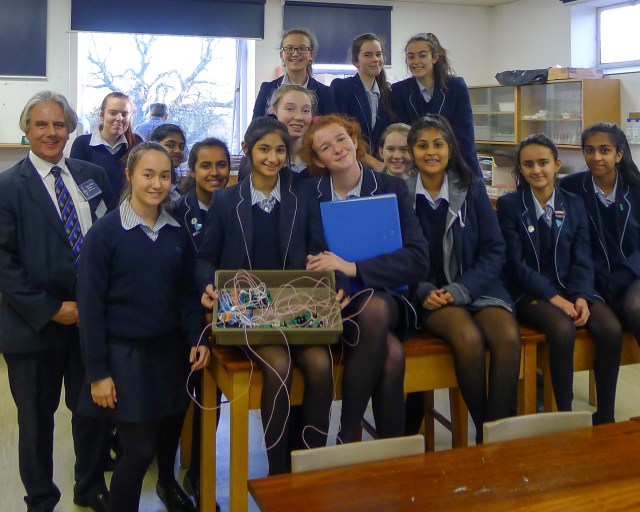
Royal Masonic School for Girls amateur radio contact with Tim Peake - Credit UKSA

Royal Masonic School for Girls amateur radio contact with Tim Peake – Credit UKSA

The second live amateur radio call to a British school with Tim Peake GB1SS took place Thursday, February 11, 2016 at the Royal Masonic School (RMS) for Girls GB1RMS in Rickmansworth, Hertfordshire.

Young women from RMS for Girls who certified as Amateur Radio operators for the live link up -Credit RMS

Young women from RMS for Girls who certified as Amateur Radio operators for the live link up – Credit RMS

Contact was made with the International Space Station (ISS) at around 18:09 GMT and, in a world first at a school, video was streamed over the radio airwaves which meant that the students could see as well as hear Tim. The contact lasted around 8 minutes allowing several students to ask Tim about life on board the ISS.

Year 9 student Saira, asked

What the first word that came into his head was when he saw the Earth from space.

Tim’s response was simple, “beautiful.”

Isabella, aged 7, asked

When I am your age what do you think space travel will look like?

Tim said that Isabella had many years to wait until then but he hoped that trips to the Moon and to Mars would be possible.

Head of Education and Skills for the UK Space Agency, Jeremy Curtis said

The students at the Royal Masonic School did a fantastic and professional job during the contact itself – but more than that, the whole school has really engaged with Tim’s Principia mission by trying out the many education activities he has inspired.

John Gould G3WKL President of the Radio Society of Great Britain (RSGB) said

Tonight was a truly historic moment; not only for the school having their contact with Tim, but, for the first time ever a school received amateur television from the ISS. I hope this event gives all the students at the school, and everyone watching, a sense of inspiration in terms of STEM subjects which have been brought so vividly to light in a fun way through amateur radio.

Ciaran Morgan M0XTD from ARISS said

It was marvellous; we’re absolutely elated and extremely grateful to Tim for setting the camera up. It was far better than we could have expected and I hope that the students enjoyed it as much as we did.

The event was broadcast live via the ARISS UK website and will be made available shortly on their YouTube channel.

Sandringham School in St Albans, Hertfordshire were the first school to make a call to Tim and details of dates for all the other 8 shortlisted schools have now been scheduled.

For more information on ARISS calls and other activities linked to the Principia mission, please visit the events page
https://principia.org.uk/events/

Source: UK Space Agency press release
https://principia.org.uk/news/second-amateur-radio-call/

Read the Watford Observer report and watch the video at
http://m.watfordobserver.co.uk/news/14271561.VIDEO__Watch_history_be_made_as_school_becomes_the_first_in_the_world_to_make_video_contact_with_the_International_Space_Station_and_talk_to_Major_Tim_Peake/

BBC Three Counties Radio Tim Peake talks live from the ISS https://www.youtube.com/watch?v=gPDBfilMXgs

Video of Tim Peake’s first Digital Amateur Television (DATV) HamTV ARISS contact as received direct on 2395 MHz by Colin Watts G4KLB in Bournemouth https://www.youtube.com/watch?v=9keVA21DPBc

What is Amateur Radio? http://www.essexham.co.uk/what-is-amateur-radio

Find an amateur radio training course near you https://thersgb.org/services/coursefinder/

A free booklet is available aimed at introducing newcomers to the hobby that can also be used as a handy reference while getting started, see
http://rsgb.org/main/get-started-in-amateur-radio/alex-discovers-amateur-radio-2/

ISS HamTV used for school contact

Tim Peake HamTV at Royal Masonic School for Girls - Credit Sian Cleaver

Tim Peake HamTV at Royal Masonic School for Girls – Credit Sian Cleaver

In a Tweet sent February 11 the UK Space Agency noted that the HamTV Digital Amateur Television (DATV) transmission by Tim Peake GB1SS from the ISS was a “World First”.

James Patterson M1DST and family listening to Tim Peake

James Patterson M1DST and family listening to Tim Peake

On Thursday, February 11, 2016, at approximately 18:09 UT, an ARISS contact took place between UK astronaut Tim Peake GB1SS and students at the Royal Masonic School for Girls GB1RSM in Rickmansworth, Herts.

The ARISS team of licensed UK Radio Amateurs achieved a world first by receiving live video from the ISS during the contact. Using the HamTV transmitter, which has recently been commissioned on board the ISS, Tim Peake was the first astronaut to use this equipment during a two way schools contact.

As well as building a vehicle based HamTV receive system, which was installed at the school on the day of the contact, the ARISS UK team also installed equipment at the Goonhilly Earth Station in Cornwall to receive the 2395 MHz HamTV transmissions from the ISS, this was then streamed via the web to the school.

On the Expert Panel at the historic contact were Libby Jackson of the UK Space Agency, Sian Cleaver of Airbus, Frances Wray of QinetiQ, Stephanie Fernandes Engineering Skills Policy Specialist at the IET, Matt Cosby of QinetiQ and Chris Bridges 2E0OBC of the Surrey Space Centre.

Radio amateurs across the British Isles and Europe were able to receive Tim Peake’s signal on 145.800 MHz FM. Among them was James Patterson M1DST who uploaded this video to YouTube.

Watch Listening To The ISS

The ARISS program is designed to maximise the impact of the Principia Mission outreach activities. It directly engages students with media and communication technologies with the goal of inspiring them to pursue careers in Science, Technology, Engineering and Maths.

The contact took place on the United Nations International Day of Women and Girls in Science
http://www.unesco.org/new/en/unesco/events/prizes-and-celebrations/celebrations/international-days/int-day-of-women-and-girls-in-science/international-day-of-women-and-girls-in-science-2016/

UK Space Agency “World First” Tweet
https://twitter.com/spacegovuk/status/697847985212952576

Installation of the Goonhilly HamTV receiver
https://amsat-uk.org/2015/11/12/hamtv-on-the-iss-update/

HamTV on the ISS https://amsat-uk.org/satellites/hamtv-on-the-iss/

The questions asked by the students during the contact are at
https://amsat-uk.org/2016/02/07/ariss-rms-girls/

What is Amateur Radio? http://www.essexham.co.uk/what-is-amateur-radio

Find an amateur radio training course near you https://thersgb.org/services/coursefinder/

A free booklet is available aimed at introducing newcomers to the hobby that can also be used as a handy reference while getting started, see
http://rsgb.org/main/get-started-in-amateur-radio/alex-discovers-amateur-radio-2/

Japanese Ham Radio Satellite Launch

ChubuSat-2

ChubuSat-2

After an initial postponement ChubuSat-2, ChubuSat-3 and Horyu-4 were launched into a 575 km, 31 degree inclination orbit at 08:45 UT on Wednesday, February 17, 2016.

Yasutaka Narusawa JR2XEA provides the following information on ChubuSat-2/3:

Nagoya University(NU) and Mitsubishi Heavy Industries(MHI) developed 50kg microsatellite ChubuSat-2(NU) and ChubuSat-3(MHI). These satellites have amateur VHF receiver and amateur UHF transmitter, and will be launched on Feb. 12 2016 (Note: Now Postponed) from Tanegashima, Japan. Komaki Amateur SATCOM Club operates these satellites from Komaki, Japan.

After the satellite separation, each satellite will transmit UHF CW beacon message including battery voltage etc. which is very important information for our initial and critical operation. So we are very happy if you receive the CW beacon message and report to us email: chubusat2@frontier.phys.nagoya-u.ac.jp

In following web site, we show the information(frequency, format, TLE, etc.) about ChubuSat-2 and ChubuSat-3. If we have your report, we will show your report in this page.
https://www.frontier.phys.nagoya-u.ac.jp/en/chubusat/chubusat_satellite2.html

Both satellite will provide the message exchange service. After the on-orbit checkout of the satellite(maybe one month after launch), you can use this service, sending your message with VHF uplink, then your message is written to the on-board memory. By sending inquiry message, anyone can read your message with UHF downlink.

ChubuSat-2 Satellite
Uplink:  145.815 MHz FSK  1200bps
Downlink: 437.100 MHz GMSK 9600bps and CW

ChubuSat-3 Satellite
Uplink:  145.840 MHz FSK  1200bps
Downlink: 437.425 MHz GMSK 9600bps and CW

The uplink/downlink format will be uploaded in above web site.

We hope you get interested in our satellites, receive beacon messages, and enjoy the message exchange service.

Best regards,

Yasutaka Narusawa (JR2XEA)

Horyu-4 downlink 437.375 MHz & 2400.300 MHz 1k2 AFSK,9k6 GMSK, S_BPSK, CW
http://kitsat.ele.kyutech.ac.jp/horyu4WEB/horyu4.html
http://www.amsatuk.me.uk/iaru/finished_detail.php?serialnum=434
https://www.facebook.com/Horyu-4-Arc-Event-Generator-and-Investigation-Satellite-780188535364868/

ARISS contact planned for girls’ school in UK

RMS students study for their Amateur Radio Foundation licence - Image Credit RMS

RMS students study for their Amateur Radio Foundation licence – Image Credit RMS

On Thursday, February 11, 2016, at approximately 18:09 UT, an ARISS contact is planned for the Royal Masonic School for Girls, Rickmansworth,, United Kingdom. The contact between Tim Peake GB1SS and GB1RMS will be receivable in the British Isles and Europe on 145.800 MHz FM and will be streamed live on the web.

UK astronaut Tim Peake KG5BVI / GB1SS

UK astronaut Tim Peake KG5BVI / GB1SS

The Royal Masonic School for Girls is an independent girl’s day and boarding school in Rickmansworth, Hertfordshire, with an exceptional, unusual and distinguished history. Founded in 1788 with the purpose of educating the daughters of Freemasons who were unable to support their families, it is one of the oldest girls’ schools in the country. The school attracts girls aged 4-18 from across Hertfordshire, Buckinghamshire and North London and boarders from all over the world. They also have a Pre School for boys and girls aged 2 to 4. The ethos is both aspirational and nurturing and the girls strive to be the very best they can be, academically, morally and creatively. The public examination results are consistently impressive and each year around 90% of girls leave RMS to take up places at University. Life at RMS is centred on much more than “just” academic success and the School is well known for its exceptional pastoral care, and the wealth of extra-curricular opportunities it offers – including Astronomy as they are one of very few schools in the UK to have their own planetarium and observatory!

This contact will be webcast on the ARISS Principia website.

Students will ask as many of the following questions as time allows.

1. Jana (Year 6): If you have hiccups in space do you bounce around?
2. Eva (Year 7): I watched your video on water and why it turned into a sphere. Would you get the same reaction with a fizzy drink like lemonade?
3. Isabella (Year 3): I’m 7 years old – when I am your age, what do you think space travel will look like?
4. Rosa and Millie (Year 9): We have heard you had to breathe o2 before your brilliant spacewalk.  Are there any precautions you had to take after returning inside the ISS?
5. Saira (Year 9): What was the first word that came into your head when you saw the Earth from Space?
6. Amelia (Year 8): What was the hardest thing to adjust to when you arrived at the ISS?
7. Elizabeth (Year 8): Which of your muscles has been affected the most by the zero gravity?
8. Jasmine (Year 8): Who was your biggest inspiration to travel into space?
9. Tallulah (Year 9): How is being an astronaut different from being an aquanaut, apart from the sea and the air?
10. Kitty (Year 9): What is the best advice that you have been given and wish to pass on to future astronauts before travelling to the ISS??
11. Yasmin (Year 9): Your blog says that you are doing research into new space age metals using a levitation furnace. Why is zero gravity better for this type of experiment?
12. Miranda (Year 8): Aside from plants, how do you produce oxygen on the ISS?
13. Tallulah (Year 10): What is the difference between flying a helicopter and being in a rocket going to the ISS?
14. Aaliya (Year 10): Did your training prepare you for the actual experience of space jet lag given you have said you adjusted so quickly?
15. Evie (Year 8): How is the ISS helping us deal with the challenges of deep space voyages?
16. Laura (Year 12): Is there an ‘up’ on the space station when conducting a spacewalk for navigational /orientating purposes?
17. Sophie (Year 3): What is your favourite experiment that you have carried out in space, and why?
18. Jane (Year 8): What has been the most surprising everyday object on the ISS that you did not expect to find?
19. Diana (Year 10): How often do you see Solar wind?
20. Evie (Year 8): When Chris Hadfield recently visited us he said your guitar skills were good but needed more practice Do you have time to practice the guitar in space?

ARISS offers an opportunity for students to experience the excitement of Amateur Radio by talking directly with crew members onboard the International Space Station. Teachers, parents and communities see, first hand, how Amateur Radio and crewmembers on ISS can energize youngsters’ interest in science, technology and learning.

Story Source: Gaston Bertels, ON4WF, ARISS mentor

ARISS Principia site https://principia.ariss.org/

Listen online to Tim Peake’s radio transmission on 145.800 MHz FM at http://websdr.suws.org.uk/

Listening to the ISS on a handheld radio https://amsat-uk.org/2016/01/10/listening-iss-on-handheld/

What is Amateur Radio? http://www.essexham.co.uk/what-is-amateur-radio

Find an amateur radio training course near you https://thersgb.org/services/coursefinder/

A free booklet is available aimed at introducing newcomers to the hobby that can also be used as a handy reference while getting started, see
http://rsgb.org/main/get-started-in-amateur-radio/alex-discovers-amateur-radio-2/
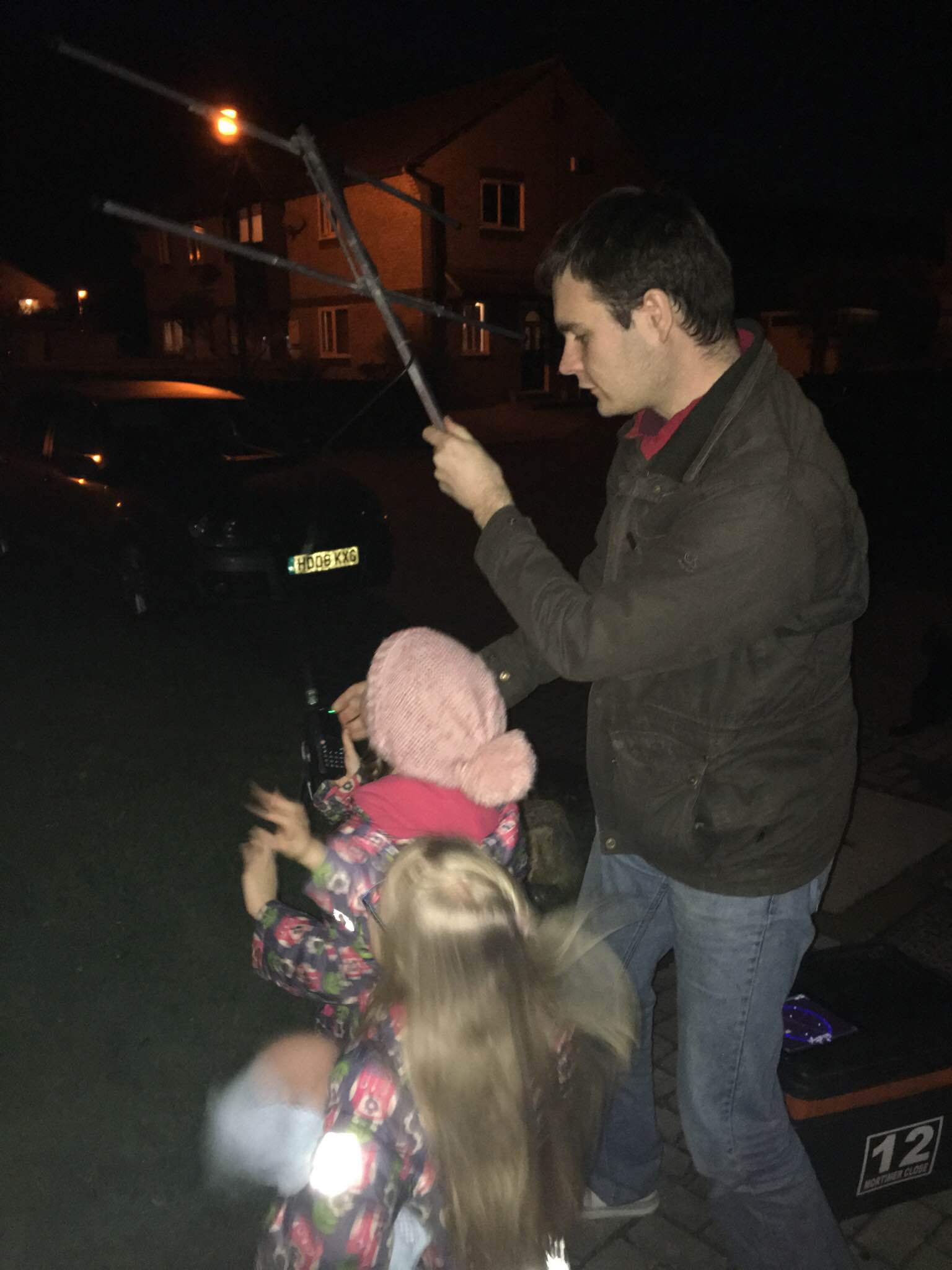
RSGB Board Member Steve Hartley G0FUW with some of the 80 students at the Royal Masonic School for Girls who participated in an Amateur Radio Electronics Buildathon

RSGB Board Member Steve Hartley G0FUW with some of the 80 students at the Royal Masonic School for Girls who participated in an Amateur Radio Electronics Buildathon

All UK ARISS shortlisted schools are now scheduled

Tim Peake KG5BVI preparing for his spacewalk in January

Tim Peake KG5BVI preparing for his spacewalk in January

After the original competition to find schools that could demonstrate a commitment to Space, STEM and outreach was launched by ARISS in the UK and the UK Space Agency, we announced that ten schools had been shortlisted but that not all of those school would have an opportunity to talk to Tim Peake on the ISS.  In fact Tim himself announced at the UK Space Conference in July 2015 that there would be at least three such contacts and that he was hopeful of more.

The ARISS UK team, working with the ARISS International community, are now pleased to announce that after a number of discussions, all ten schools selected for the UK shortlist have now been scheduled. The proposed scheduled is as follows:-

Jan 8 at 0847 GMT : Sandringham School GB1SAN, St. Albans, Herts
Feb 11 at 1811 GMT : Royal Masonic School for Girls GB1RMS, Rickmansworth, Herts
Feb 19 at 1420 GMT : Oasis Academy Brightstowe GB1OAB, Bristol
Feb 26 at 1440 GMT : City Norwich School GB2CNS, Norwich
Mar 5 at 1053 GMT : Powys Combined Schools GB4PCS, Powys, Wales
Apr 18 at 1456 GMT (3:56 pm BST) : St Richards Catholic College GB4SRC, Bexhill on Sea
Apr 23 at 1210 GMT (1:10 pm BST) : Wellesley House School GB1WHS, Broadstairs,  Kent
Apr 25 at 1202 GMT (1:02 pm BST) : The Derby High School GB1DHS, Bury Lancashire
May 5 at 0808 GMT (9:08 am BST) : Ashfield Primary School GB1APS, Otley, West Yorkshire
May 9 at 0926 GMT (10:26 am BST) : The Kings School GB1OSM, Ottery St Mary, Devon

These dates correspond to the predicted orbits of the International Space Station visible during the school day (typically 08:00 – 18:00hrs) and when it is orbiting over the UK.  A significant amount of planning remains to be carried out to turn these proposals into confirmed events – Tim’s on-orbit work schedule also has to be such that he is able to carry out the contact at the same time as the ISS is orbiting over the UK and the schools are available to make the call.  Not a simple task!

We will update the ARISS Principia site with more information as it becomes available so make sure you keep checking there, on Twitter (@m0xtd) or on the UK Space Agency website.

73s

Ciaran – M0XTD
ARISS Operations Lead in the UK

ARISS Principia site https://principia.ariss.org/

July 2015 – School shortlist announced https://amsat-uk.org/2015/07/14/school-shortlist-tim-peake-iss/

Video of Tim Peake ham radio contact with Sandringham School on January 8, 2016
https://amsat-uk.org/2016/01/09/video-tim-peake-sandringham/

Listening to the ISS on a handheld radio https://amsat-uk.org/2016/01/10/listening-iss-on-handheld/

Get press publicity by receiving ISS school contacts
https://amsat-uk.org/2016/03/10/press-publicity-receiving-iss/

What is Amateur Radio? http://www.essexham.co.uk/what-is-amateur-radio

Find an amateur radio training course near you https://thersgb.org/services/coursefinder/

A free booklet is available aimed at introducing newcomers to the hobby that can also be used as a handy reference while getting started, see
http://rsgb.org/main/get-started-in-amateur-radio/alex-discovers-amateur-radio-2/

Primary school students tune in to Tim Peake

St Mildred’s Primary Infant school students listen to Tim Peake using amateur radio

St Mildred’s Primary Infant school students listen to Tim Peake using amateur radio

The amazing interest in Tim Peake’s mission on the International Space Station (ISS) is keeping the Hilderstone Amateur Radio and Electronics Club busy with enquiries from schools.

The pupils of Monkton C of E Primary school were thrilled to receive a message from space when they picked up the signal from a passing amateur radio satellite. They calculated the orbital period from the variations in the satellite’s temperature as it passed from sunlight into the Earth’s shadow, taking 97 minutes to orbit compared to Tim’s 93 minutes. They learned how Isaac Newton explained the orbit of objects around the Earth nearly 300 years before Sputnik was launched!

The year 2 pupils of St Mildred’s Primary Infant school were very excited to hear Tim’s voice live when he answered the pupils’ questions from Sandringham school. They were using 3 handheld amateur radio receivers provided by the club and heard Tim’s reply to the question about the mission being named after Newton’s book Principia.

If you would like to learn about amateur radio and electronics you will be made most welcome at the club. Alternatively you can send them an email to hilderstoneclub<at>gmail.com or visit the club website.

Hilderstone Amateur Radio and Electronics Club
http://g0hrs.org/
https://twitter.com/G0HRS

What is Amateur Radio? http://www.essexham.co.uk/what-is-amateur-radio

Find an amateur radio training course near you https://thersgb.org/services/coursefinder/

A free booklet is available aimed at introducing newcomers to the hobby that can also be used as a handy reference while getting started, see
http://rsgb.org/main/get-started-in-amateur-radio/alex-discovers-amateur-radio-2/