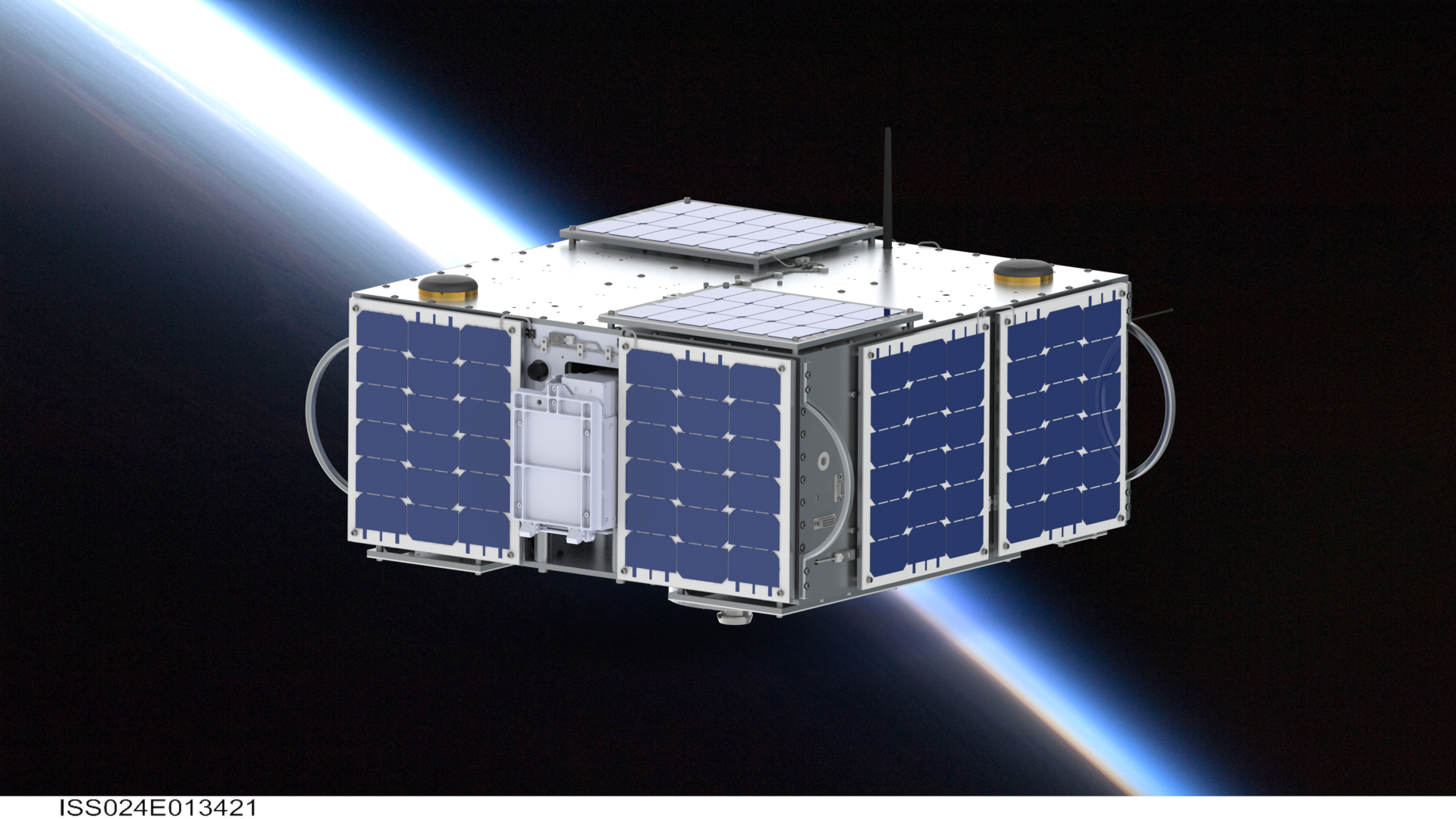
An Unlikely Pair of Satellites

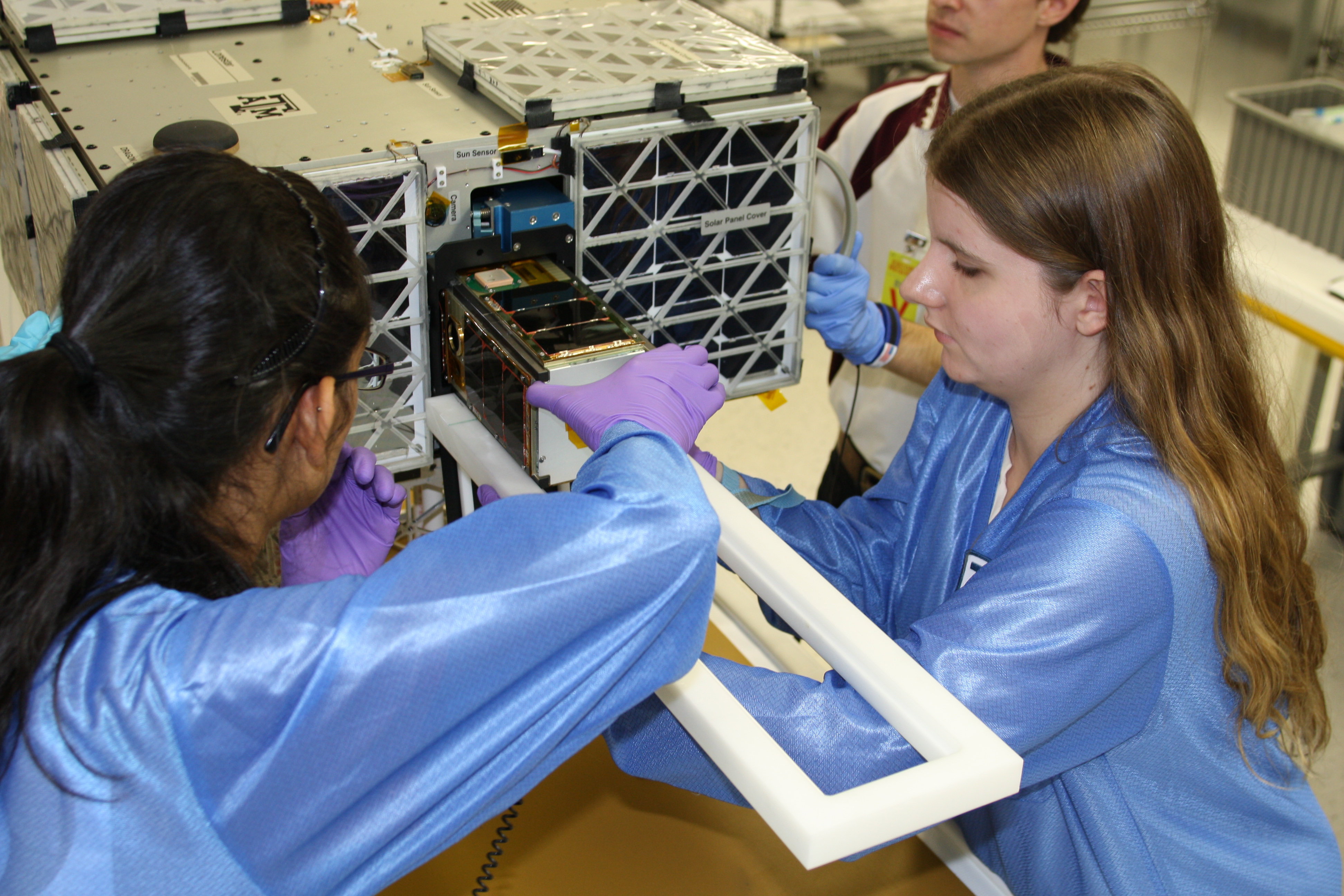
Students working on AggieSat4 and Bevo-2 satellites - Credit Texas A&M University / Dexter Becklund

Students working on the AggieSat4 and Bevo-2 satellites – Credit Texas A&M University / Dexter Becklund

Dr Helen Reed KD7GPX is interviewed in a NASA story about the AggieSat4 and Bevo-2 satellites which were deployed from the International Space Station (ISS) on January 29, 2016.

Students from Texas A&M University and The University of Texas came together for the LONESTAR investigation.

This collaborative effort sent a pair of satellites, AggieSat4 and Bevo-2, to the International Space Station. The satellites were deployed from the space station on January 29, and AggieSat4 will eject Bevo-2 as part of a demonstration of technology with applications for future space exploration.

The two satellites will demonstrate communication protocols between them and with ground stations, as well as systems that allow the satellites to navigate through space and relative to each other and to orient themselves in three dimensions. Flight demonstration of these abilities, necessary for unmanned craft to be able to rendezvous and dock in space without direct human intervention, will contribute to future satellite missions as well.

“The overall objective is to find ways for small spacecraft to join together autonomously in space,” said Dr. Helen Reed, KD7GPX, professor of aerospace engineering and director of the AggieSat Lab at Texas A&M. “We need simple systems that will allow rendezvous and docking with little to no help from a human, which will become especially important as we venture farther out into space. Applications could include in-space assembly or reconfiguration of larger structures or systems as well as servicing and repair.”

Small satellites are less expensive to build and investigators can more easily find space on rocket launches to send them into orbit, but it does take creative thinking to design a functioning satellite with smaller volume and less power. Bevo-2 is 13.3 inches long, 5.3 inches high and 5.3 inches wide, about the size of a loaf of bread. AggieSat4 measures 24 by 24 by 12 inches, slightly larger than a piece of carry-on luggage. Together the satellites weigh 114 pounds.

Read the full story at
http://www.nasa.gov/mission_pages/station/research/unlikely-pair-of-satellites.html

Watch The deployment of AggieSat4

The IARU has coordinated these frequencies for the amateur radio payloads:
• AggieSat4 436.250 MHz 9k6 FSK telemetry (also 153.6 kbps FSK)
• Bevo-2 437.325 MHz CW and 38k4 FSK

The AggieSat4 team request that any amateur radio enthusiasts receiving the beacons sends any data to aggiesat@tamu.edu it would be much appreciated!

AggieSat4 information
https://twitter.com/aggiesat
https://www.facebook.com/AggieSatLab
http://aggiesatweb.tamu.edu/index.php/projects/lab_projects/aggiesat4
https://www.dropbox.com/sh/v8razh1evcabt7a/jrGSjbOJb4

Bevo-2 information
https://www.facebook.com/UTSatLab
https://www.ae.utexas.edu/news/features/bevo-2-satellite-sdl

AggieSat4 reception reports http://www.dk3wn.info/p/?cat=313

AggieSat4 deployment from ISS

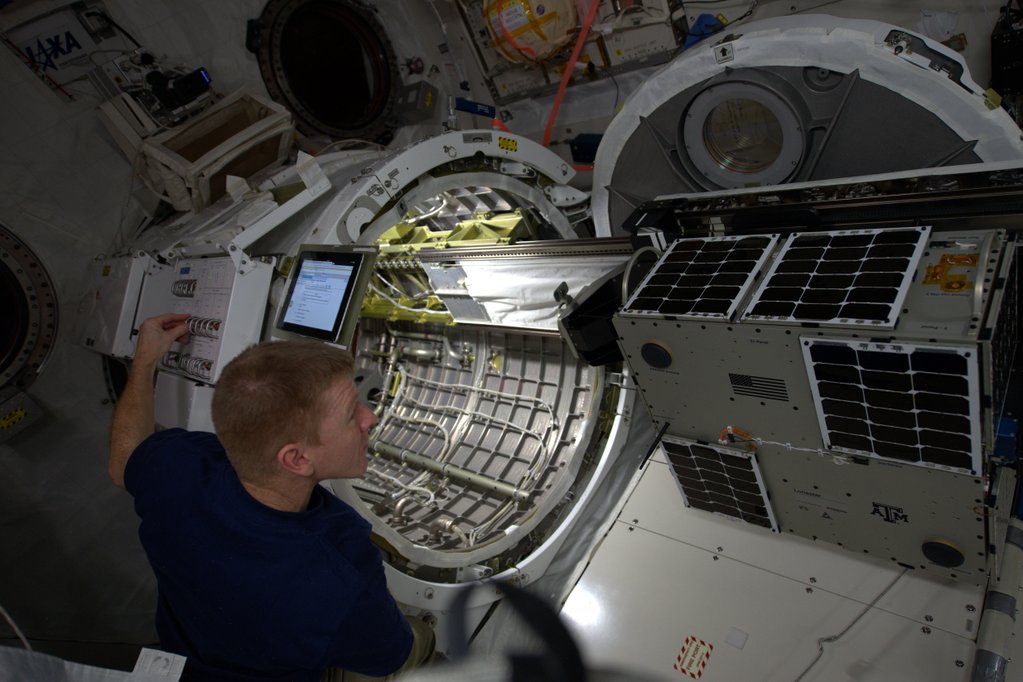
UK astronaut Tim Peake KG5BVI preparing AggieSat4 for deployment

UK astronaut Tim Peake KG5BVI preparing AggieSat4 for deployment

The deployment activities scheduled for Friday, January 29, 2016 include capturing CYCLOPS with the JEM Remote Manipulator System, maneuvering CYCLOPS to the deployment location, and final deployment of AggieSat4 from CYCLOPS

An example of the deployment mechanism can be seen below.

There are four switches, embedded on the CYCLOPS EAF, that inhibit AGS4 from turning. The first event that will occur after deployment will be the release of these inhibits. Once these inhibits are removed, the Electronic Power System (EPS) starts and initiates a 10 minute timer. After the timer ends the Command and Data Handling System starts and initiates a checkout of every system on AGS4. When complete, AGS4 will begin sending a signal to Earth with its Low Data Rate (LDR) radio, indicating that it is alive and well. The team expects to start receiving signals from AGS4 on Friday evening.

This animation shows how the Cyclops Deployment System launches satellites in the 50 to 100 kg class from the International Space Station.

Watch Animation of Station’s Cyclops Satellite Deployer

Thanks to Jan van Gils PE0SAT for this item.

ISS AggieSat4 Satellite Deployment – Amateur Radio Frequencies and Links
https://amsat-uk.org/2016/01/27/iss-satellite-deployment/

Sandringham School presentation

Handheld transceivers being presented to Sandringham School students

Handheld transceivers being presented to Sandringham School students

On Monday, January  26, 2016, Tony Wiltshire, M0TNY/ZB2TY – from Martin Lynch & Sons Ltd and Mark Haynes, M0DXR – from Kenwood UK visited Sandringham School in St Albans.

A presentation and demonstration was made to Polly, M6POG, Emma, M6GJQ and Jessica, M6LPJ, the school’s newly licenced amateurs who previously had made the initial contact with Tim Peake GB1SS aboard the ISS.

The girls had placed orders for Kenwood’s TH-K20E VHF handies with ML&S and have been looking forward to being active on the bands with their own equipment. ML&S hope the demonstration will get them the air very soon and they also thank headmaster Alan Gray, G4DJX, for his hospitality and wish Sandringham School Radio Hams the best for the future!

Rumour has it that 15 more students from the school will be taking their licence exams as a result of the interest from the ISS contact.

ML&S website http://www.MLandS.co.uk/

Video of Tim Peake ham radio contact with Sandringham School
https://amsat-uk.org/2016/01/09/video-tim-peake-sandringham/

TV News: Sandringham school amateur radio ISS contact
https://amsat-uk.org/2016/01/08/bbc-tv-sandringham-school-amateur-radio-iss-contact/

Local newspaper reports reception of Tim Peake KG5BVI / GB1SS from the ISS
https://amsat-uk.org/2016/01/13/local-paper-tim-peake-iss/

Listening to the ISS on a handheld radio
https://amsat-uk.org/2016/01/10/listening-iss-on-handheld/

What is Amateur Radio? http://www.essexham.co.uk/what-is-amateur-radio

Find an amateur radio training course near you https://thersgb.org/services/coursefinder/

A free booklet is available aimed at introducing newcomers to the hobby that can also be used as a handy reference while getting started, see
http://rsgb.org/main/get-started-in-amateur-radio/alex-discovers-amateur-radio-2/
IARU Paper: APRS Harmonization and removal of OSCAR sub-band

IARU_Region_1_logoIARU Region 1 has released the papers for the Interim Meeting to be held in Vienna April 15-17, 2016.

Among the papers for the C5 VHF/UHF/Microwave Committee is one on harmonizing APRS.

VIE16_C5_41_1.pdf – 144 /435 MHz APRS Harmonisation

The paper covers global band planning considerations and among the recommendations says:

Emphasise that spaceborne APRS must be confined to globally coordinated amateur satellite sub bands. Therefore items that are ambiguous and generate confusion in national band plans such as ‘Space communications’ and ‘New Oscar Sub band’ should be removed as soon as possible in all Regions in accordance with IARU-AC and Satellite Coordination guidance

It is believed that ‘New Oscar Sub band’ refers to the USA’s ARRL 144 MHz band plan and ‘Space communications’  to the Australian WIA 144 MHz band plan. These band plans, as well as those for some other countries, show 144.300 – 144.500 MHz as being for Amateur Satellite use.

Direct link for C5 VHF/UHF/Microwave Papers
http://www.iaru-r1.org/index.php/documents/Documents/VHF/C5-papers-v2.zip/

Links for all committee papers and email addresses of Committee Chairs are at
http://www.iaru-r1.org/index.php/88-news/1518-interim-meeting-vienna-2017
[Although URL says 2017 the meeting is 2016]

ARRL 144 MHz Band Plan http://www.arrl.org/band-plan

WIA 144 MHz Band Plan http://www.wia.org.au/members/bandplans/data/documents/Australian%20Band%20Plan%202m%20150729.pdf

ISS AggieSat4 Satellite Deployment

Simulation of AggieSat4 on orbit - Credit Andrew Shell

Simulation of AggieSat4 on orbit – Credit Andrew Shell

The AggieSat4 satellite carrying the Bevo-2 CubeSat is expected to be deployed from the International Space Station (ISS) on January 29, both have amateur radio payloads.

Below is a timelapse of the build process of the Texas A&M student-built satellite, AggieSat4. The video spans an entire year, the amount of time it took to build AGS4, however many more years were put into the design and programming of AGS4 before any hardware was assembled.

AggieSat4 was launched aboard the Orbital ATK Cygnus OA-4 cargo resupply mission. The Cygnus spacecraft was mounted atop a United Launch Alliance Atlas V rocket that took the Cygnus from the Kennedy Space Center up into Low Earth Orbit on December 6 at 4:44pm EST.

AGS4 is planned to release from the ISS on January 29 and will then proceed to eject the University of Texas CubeSat, Bevo-2 and perform relative navigation tasks as well as take pictures of the release of Bevo-2.

The IARU has coordinated these frequencies for the amateur radio payloads:
AggieSat4 436.250 MHz 9k6 FSK telemetry (also 153.6 kbps FSK)
Bevo-2 437.325 MHz CW and 38k4 FSK

Watch AggieSat4 Build Process Timelapse – LONESTAR 2

The AggieSat4 team request that any amateur radio enthusiasts receiving the beacons sends any data to aggiesat@tamu.edu it would be much appreciated!

AggieSat4 information
https://twitter.com/aggiesat
https://www.facebook.com/AggieSatLab
http://aggiesatweb.tamu.edu/index.php/projects/lab_projects/aggiesat4
https://www.dropbox.com/sh/v8razh1evcabt7a/jrGSjbOJb4

Bevo-2 information
https://www.facebook.com/UTSatLab
https://www.ae.utexas.edu/news/features/bevo-2-satellite-sdl

AggieSat4 reception reports http://www.dk3wn.info/p/?cat=313

Chelmsford Talk: Amateur Radio Satellites

Steve Hedgecock M0SHQ sending Packet Radio to the ISS

Steve Hedgecock M0SHQ sending Packet Radio to the ISS

On Tuesday, February 2, Steve Hedgecock M0SHQ will give a presentation to the Chelmsford Amateur Radio Society (CARS) on amateur radio satellites, the talk is open to all.

The main part of the presentation will be on simple satellite operation using an FT-817 and hand held antennas. Steve will also cover amateur radio activity on the International Space Station (ISS) including using the ISS APRS digipeater and reception of ISS Slow Scan Television (SSTV).

The talk coincides with the mission of UK astronaut Tim Peake GB1SS on the space station. Some of you may have already heard Tim using the amateur radio station in the Columbus module to link up with school students as part of the ARISS program.

The meeting takes place at the Oaklands Museum, Moulsham Street, CM2 9AQ. The doors open at 7pm for a 7:30pm start, car parking and admittance are free, visitors are most welcome.

Map http://www.g0mwt.org.uk/meeting-map.pdf

Web http://g0mwt.org.uk/

CARS run short amateur radio training courses, to find out about the next course speak to the training manager Peter Davies M0PSD, contact details are at http://www.g0mwt.org.uk/training/

What is Amateur Radio ? http://www.essexham.co.uk/what-is-amateur-radio