Nepal students to speak to Tim Peake

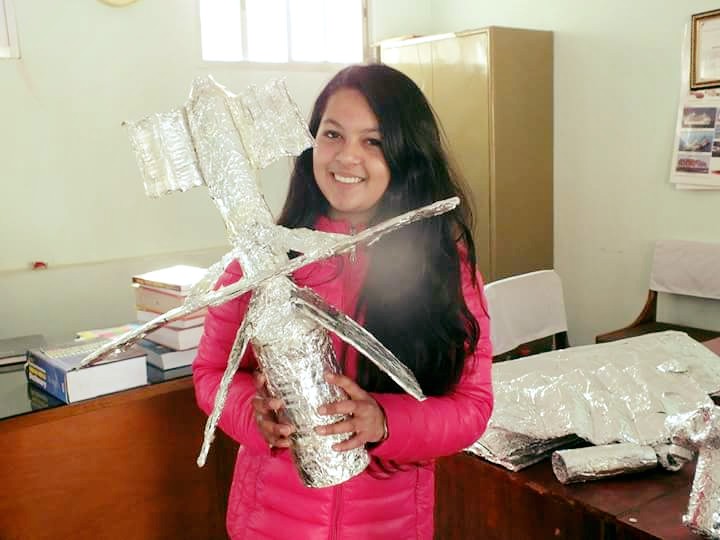
Brihaspati Vidhyasadan students have been building a model of the ISS

Brihaspati Vidhyasadan students have been building a model of the ISS

UK astronaut Tim Peake KG5BVI will be using amateur radio to talk to students at Brihaspati Vidhyasadan School (BVS) in Nepal on Wednesday, January 20 at 08:37:04 UT.

You can listen to the audio online at https://sites.google.com/site/arissaudio/

The Himalayan Times reports this is the first link up  between a school in Nepal and the International Space Station (ISS). It will be a Telebridge contact via Tony Hutchison VK5ZAI in Australia. The ISS should be in range of the Telebridge station for about 8 minutes.

BVS is organising an Exhibition during the week of the contact from January 19-23. Experts as well as knowledgeable students will be at hand to respond to queries of visiting students who will be able to get acquainted with amateur radio during the exhibition.

The Nepal Amateur Radio Operators’ Society is one of the organisations supporting the exhibition.

UPDATE Jan. 20: Read the Nagarik News story on the successful contact http://nagariknews.com/feature-article/story/52883.html
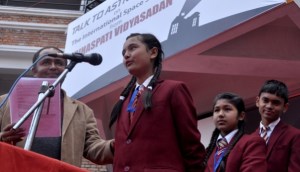
Brihaspati Vidhyasadan School students speak to Tim Peake KG5BVI / NA1SS - Image Credit Nagarik News

Brihaspati Vidhyasadan School students speak to Tim Peake KG5BVI / NA1SS – Image Credit Nagarik News

Brihaspati Vidyasadan is a 32 year old High school, located in Kathmandu, Nepal. Brihaspati runs classes from nursery to 100 at secondary level and the 10+2 program in Science and Management at the higher secondary Level. Besides these Brihaspati also runs Diploma in Hospitality Managemant and Tourism in affiliation with Confederation of Tourism and Hospitality (CTH), UK.

Brihaspati is known for its academic excellence. To date Brihaspati has produced over 2000 SLC graduates and over 600 +2 graduates who have achieved excellent academic achievements. Brihaspati has also been awarded the “Best School in Nepal” in 2055BS.

Brihaspati is also known for its co-curricular and extra-curricular activities including sports, debates and concerts. Over the years the school has achieved Inter-school successes in football (soccer), cricket and basketball at national levels. School has also successes in inter-school competitions like debate, elocution and concerts.

For its academic, co-curricular and extra-curricular achievements Brihaspati has been placed among the Class A schools of Nepal by the Ministry of Education, Government of Nepal.

Brihaspati staff and students have been known for their innovation in education. The school is reputed to be the first school in Nepal to introduce computer education. Brihaspati houses clubs like Lokopakar, which is a student club that looks into Humanitarian aid.  Brihaspati students recently started gThink Inkh, an activity designed using the principles of Extreme Design from Stanford for instilling critical thinking and problem solving skills in students. This program has gained attention of a lot of people in the academia at a very rapid pace.

Brihaspati is located in a 25 acre land space at the heart of Kathmandu within the Balmandir compound. It  has academic facility that is of very high standards. It houses the Free and Open Source Research Lab and Ham (amateur radio) facility that students and staff have access to.

Recently during the earthquake of Nepal, one of the buildings of Brihaspati was used by ham radio operators from Nepal and India to coordinate search and reconciliation of families where over 500 families were reunited with their loved ones.

Read The Himalayan Times story at
https://thehimalayantimes.com/nepal/nepali-students-to-talk-to-astronaut-in-intl-space-station/

Brihaspati Vidhyasadan School
http://www.bvs.edu.np/bvstalkstoiss/
https://www.facebook.com/bvsTalksToISS/

ARISS http://www.ariss.org/upcoming-contacts.html

Amateur radio village at EMF 2016

GB2EMF Amateur Radio Village EMF 2016An amateur radio village is planned for  the Electromagnetic Field EMF 2016 event which takes place August 5-7, 2016 near Guildford in Surrey.

London Hackspace Amateur Radio Club are planning to erect at least one of their Clark masts in the village. During EMF 2016 they will be showcasing Amateur Radio on bands from 3.5 MHz (80m) to 430 MHz (70cm) and maybe higher using the call sign GB4EMF.

The event is aimed at makers, scientists, engineers, radio enthusiasts and more.

EMF Amateur Radio Village https://wiki.emfcamp.org/wiki/Village:Amateur_Radio

Call for Participation https://www.emfcamp.org/cfp

EMF Camp on Twitter https://twitter.com/emfcamp
London Hackspace ARC https://twitter.com/m0hsl

Previous EMF events have generated BBC News coverage
https://amsat-uk.org/2014/09/02/bbc-reports-emf-2014/

Local newspaper reports reception of Tim Peake on ISS

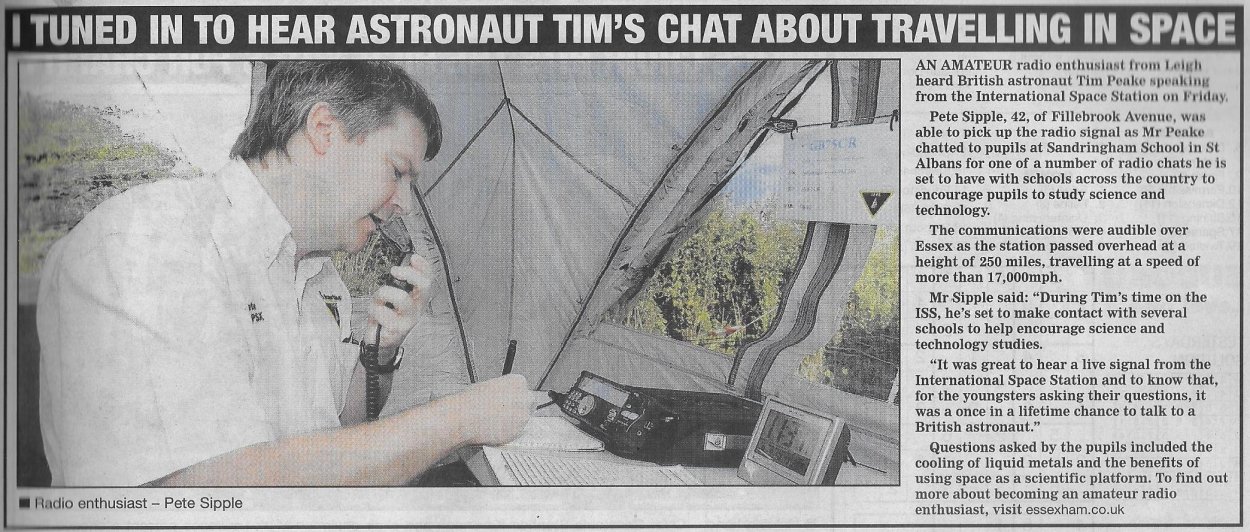
ISS amateur radio article in Southend Echo Jan 13, 2016

ISS amateur radio article in Southend Echo newspaper published January 13, 2016

ISS school contacts provide an opportunity for radio amateurs across the country to get publicity for the hobby in their local newspaper.

Simply hearing Tim Peake using amateur radio from the ISS is in itself a newsworthy event which can be used to promote your local amateur radio club and the hobby in general.

When Essex radio amateur Pete Sipple M0PSX received a signal from ISS astronaut Tim Peake talking to Sandringham School students in Hertfordshire he contacted his local newspaper, the Southend Echo, and told them about it. The newspaper was very interested to hear that someone in their local area had actually received the ISS and published the story, see above.

Pete M0PSX has kindly made available the press release he sent to the local newspaper so that others can use it as a template, download press release here.

Dates of future Tim Peake amateur radio school contacts are at
https://amsat-uk.org/2015/12/15/tim-peake-iss-school-contacts-announced/

Essex Ham – What is Amateur Radio? http://www.essexham.co.uk/what-is-amateur-radio

ISS SSTV activity January

ISS SSTV image 1 received by Murray Hely ZL3MH January 31, 2015

ISS SSTV image 1 received by Murray Hely ZL3MH January 31, 2015

The ARISS Russia Team is planning to support a couple of Slow Scan Television (SSTV) events in the next few months on 145.800 MHz FM.

The upcoming spacewalk (EVA) will result in the amateur radio equipment on the ISS being powered down on Friday, January 15 at about 07:40 UT. Power-up is expected to take place on January 16 at 15:15 UT.

An SSTV session had been targeted for Saturday, January 16 to celebrate 15 years of ARISS school contacts with the ISS crew. The new date will be announced at http://ariss-sstv.blogspot.co.uk/

The SSTV transmissions, in mode PD120, will be made from the amateur radio station located in the Russian Service Module of the ISS using the callsign RS0ISS. The equipment used for SSTV is a Kenwood D710 transceiver running about 25 watts output which provides a very strong signal enabling reception on simple equipment.

A 2m handheld with a 1/4 wave antenna will be enough to receive the transmissions. In the UK we use narrow 2.5 kHz deviation FM but the ISS transmits on 145.800 MHz with the wider 5 kHz deviation used in much of the world. Most rigs can be switched been wide and narrow deviation FM filters so select the wider filter. Hand-held rigs all seem to have a single wide filter fitted as standard.

Check the ARISS SSTV blog for updates and additional information as it becomes available
http://ariss-sstv.blogspot.co.uk/

ISS Slow Scan TV hints, links for PC and iPhone SSTV Apps and a sample PD120 signal are at
https://amsat-uk.org/beginners/iss-sstv/

ISS SSTV video and “ISS SSTV Reception Hints” by John Brier KG4AKV
https://spacecomms.wordpress.com/iss-sstv-reception-hints/

Dmitry Pashkov R4UAB reports SSTV activity postponed to Saturday, January 16
http://tinyurl.com/R4UAB-ISS-SSTV-201501

Listening to the ISS on a handheld radio

In this video Dan Trudgian M0TGN shows how to listen to the ISS using nothing more than a handheld radio, a Yaesu VX8, from Hackpen Hill in Wiltshire.

In the UK we use narrow 2.5 kHz deviation FM but the ISS transmits on 145.800 MHz with the wider 5 kHz deviation used in much of the world. Most base station and mobile radios can be switched been wide and narrow deviation FM filters and for best results you should select the wider filter. Handheld radios all seem to have a single wide filter fitted as standard.

As a result of Doppler shift the 145.800 MHz ISS signal may vary by +/- 3.5 kHz during a pass going from 145.835 to 145.7965 MHz. Many FM radios can only tune in steps of 5 kHz, with such equipment you may get best results by selecting 145.805 at start of pass, then 145.800 and finally 145.795 MHz.

Watch GB1SS – Tim Peake QSO with Sandringham School

Read Dan’s blog http://www.m0tgn.com/

Follow Dan on Twitter @M0TGN

Dates of future Tim Peake amateur radio school contacts are at
https://amsat-uk.org/2016/02/03/all-uk-ariss-shortlisted-schools-are-now-scheduled/

ARISS Principia site https://principia.ariss.org/

How to hear the ISS https://amsat-uk.org/beginners/how-to-hear-the-iss/

Get press publicity by receiving ISS school contacts
https://amsat-uk.org/2016/03/10/press-publicity-receiving-iss/

The ISS should be transmitting Slow Scan TV (SSTV) later this year on 145.800 MHz FM
http://ariss-sstv.blogspot.co.uk/
https://amsat-uk.org/beginners/iss-sstv/

Video of Tim Peake ham radio contact with Sandringham School

Sandringham School students at ITV News in London - Image Credit @SandringhamSch1

Sandringham School students at ITV News in London – Image Credit @SandringhamSch1

A 92 minute video containing the Sandringham School GB1SAN and Tim Peake GB1SS amateur radio contact is now available in the ARISS UK Team channel on YouTube.

The amateur radio contact with the International Space Station took place on Friday, January 8, 2016 and was led by Jessica Leigh M6LPJ. The video includes the presentations given to the students by ARISS UK’s Ciaran Morgan M0XTD, Head Teacher Alan Gray G4DJX, and the Chair of the RSGB Youth Committee Mike Jones 2E0MLJ.

Watch ARISS Schools contact between Sandringham School, GB1SAN, and Tim Peake GB1SS Friday, January 8, 2016

TV News: Sandringham school amateur radio ISS contact
https://amsat-uk.org/2016/01/08/bbc-tv-sandringham-school-amateur-radio-iss-contact/

What is Amateur Radio? http://www.essexham.co.uk/what-is-amateur-radio

Find an amateur radio training course near you https://thersgb.org/services/coursefinder/

A free booklet is available aimed at introducing newcomers to the hobby that can also be used as a handy reference while getting started, see
http://rsgb.org/main/get-started-in-amateur-radio/alex-discovers-amateur-radio-2/