Successful SSTV and Digitalker transmissions from SPROUT

SPROUT SSTV received by Paulo PV8DX Nov 22, 2015

SPROUT SSTV received by Paulo PV8DX

On November 22, 2015 SSTV and Digitalker transmissions were made from the SPROUT amateur radio satellite on 437.600 MHz FM (+/- 9 kHz Doppler shift). These transmissions are planned to take place every Sunday (Japanese Standard Time).

Many FM radios can be switched been wide and narrow deviation FM filters. For best results you should select the wider filter designed for 5 kHz deviation FM.

SPROUT (Space Research On Unique Technology) was built by students from Nihon University. It is a 20 x 20 x 22 cm nano-satellite with a mass of 7.1 kg in a 654 km, 97.9 degree inclination Sun Synchronous Orbit (SSO).

Paulo PV8DX in Brazil reports receiving both the SSTV image and the Digitalker transmission a recording of which can be heard here:

.
Real-Time tracking of SPROUT at http://www.n2yo.com/?s=39770 (tick Draw Footprint)

SPROUT SSTV and Digitalker are active every Sunday
https://amsat-uk.org/2015/11/19/sprout-sstv-active-sundays/

SPROUT Digitalker full text http://www.ne.jp/asahi/hamradio/je9pel/sprdigie.htm

Second Birthday of FUNcube-1

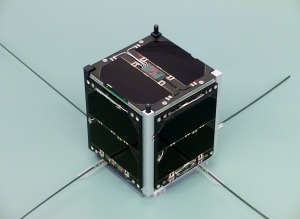
FUNcube-1 flight model - Image credit Wouter Weggelaar PA3WEG

AO-73 (FUNcube-1) – Image credit Wouter Weggelaar PA3WEG

FUNcube-1 (AO-73) was launched into space two years ago on November 21, 2013.

We are delighted to be able to report that more than 900 stations, including many schools around the world, have received the telemetry from the spacecraft since launch. Our Data Warehouse is storing more than 750 MB of data from almost 1 million data packets. We are very grateful to everyone who has been contributing to the success of this mission. Please continue to keep the data flowing as it will provide a valuable resource for students in the future.

The stats continue – speeding along at around 17,500 mph, FUNcube-1, which had a launch mass of just 982 grams, has completed more than 10,500 orbits of the earth. This means a total distance travelled of more than 260 million miles.

All telemetry sensors continue to provide valid data, real time, whole orbit and high resolution channels alike. The flight code is really robust and we have only had three unexpected “events” since launch. Two of these we believe to have been caused by noise of the command receiver being incorrectly interpreted as a command and only one appears to have been caused by a RAM error. The battery and solar panels also continue to work perfectly and provide a very positive power budget.

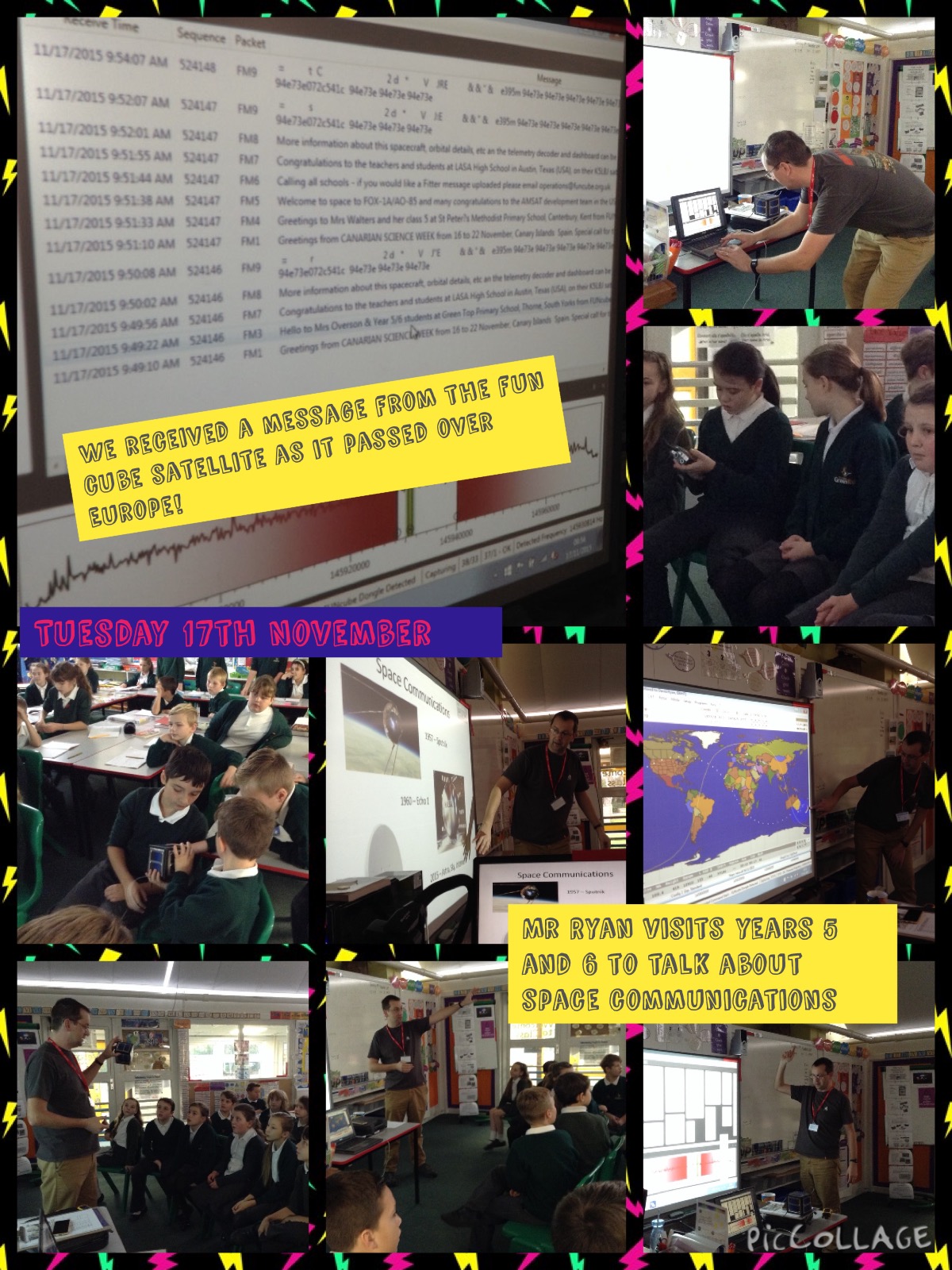
We have sent out many Fitter messages for school and other similar events. On November 17, 2015 there was a demonstration at Thorne Green Top School in Yorkshire. Here is a report from Dave Ryan EI4HT/M0GIW:

FUNcube-1 Educational Outreach - Thorne Green Top School in Yorkshire

FUNcube-1 Educational Outreach – Thorne Green Top School in Yorkshire

Good Morning All  

Firstly -thanks to all for your help, we had a great morning at Green Top and the highlight was FUNcube.

I started with a slide show talking about communications from cave paintings all the way up to smartphones, we looked at space communications and travel from Sputnik to Astra and Apollo to the Millennium Falcon! We spoke about satellites and how they are used every day and how we all got to watch “I’m A Celebrity” via Satellite last night from Australia.

I brought in lots of props too, some old Motorola MX330 radios, some PMR 446, and a marine band radio .I also had a small model of a CubeSat that I knocked up over the weekend, I also passed around some NOAA images from last week’s Abigail storm and I had a few QSL cards from ISS and MIR from years ago when I lived in Ireland.  

The FUNcube pass was great, really strong signals, I had my turnstile and FCD set up and had audio through speakers and used the class projector to show Satpc32 and the Dashboard.  

There was a great buzz of excitement when we got the first packet and even more when the Fitter messages came through. The kids were fascinated to see the signal arrive just as the software predicted and then hear the telemetry and the decode.  

After the pass we were able to look at the Warehouse online and print off the QSL card and certificate.

 I didn’t get a chance to take many pics but Mrs Overson will update the School Blog and she took lots of pics.

http://greentopschool.co.uk/blog

Once again thanks to all at FUNcube, looking forward to Tim Peake on the ISS in the New Year and planning another visit to the School then.

Regards

Dave EI4HT / M0GIW

PS: I was back dropping my own kids off this morning and Mrs Overson told me they have printed a QSL card and Certificate for each of the students and they have used them for their class journals.

As well providing a great educational resource, FUNcube-1 operates at night and generally at weekends with the linear transponder active for radio amateurs to use for communications. The transponder continues to provide an excellent service. As users will be aware, the transponder uplink frequencies vary with receiver temperature. The RX temp telemetry channel is the best one to use for tracking this effect. This does make it quite difficult to use full computer control for transponder operations and we have already developed new oscillator circuits to improve this performance for future missions.

For the telemetry uplinked to the Data Warehouse, it is possible to download special Certificate or QSL Card here http://amsatuk.me.uk/on/funcube_qsl.php and, for transponder users, the “73 on 73 award” continues at https://amsat-uk.org/funcube/73-on-73-award/

The Nayif-1 CubeSat mission, which includes a full FUNcube payload, is expected to be launched into a similar orbit in the first half of next year and will provide an additional level of service to the community.

Meanwhile we hope everyone will continue to have fun with FUNcube-1!

FUNcube-1 https://amsat-uk.org/satellites/communications/funcube-1/
Nayif-1 https://amsat-uk.org/satellites/communications/nayif-1/
FUNcube on Twitter https://twitter.com/FUNcubeUK
AMSAT-UK on Twitter https://twitter.com/AmsatUK
Facebook https://facebook.com/AmsatUK
YouTube https://youtube.com/AmsatUK
SPROUT SSTV and Digitalker active every Sunday

SSTV image received from SPROUT by Mario LU4EOU on May 31, 2014 at 0408 UT

SSTV image received from SPROUT by Mario LU4EOU on May 31, 2014 at 0408 UT

Slow Scan TV (SSTV) images in Scottie 1 format will be transmitted from the SPROUT satellite every Sunday (Japanese Standard Time) on 437.600 MHz FM (+/- 9 kHz Doppler shift). The Digitalker will also be active.

SPROUT, a 20 x 20 x 22 cm amateur radio nano-satellite with a mass of 7.1 kg, launched successfully with the L-band (1236.5 MHz/1257.5 MHz/1278.5 MHz) Synthetic Aperture Radar (SAR) satellite ALOS-2 on May 24, 2014 at 0305 UT. SPROUT is in a 654 km, 97.9 degree inclination Sun Synchronous Orbit (SSO).

SPROUT (Space Research On Unique Technology) was built by students from Nihon University and its objectives are:

SPROUT Satellite - Credit Nihon-Univ. Miyazaki Laboratory

SPROUT Satellite – Credit Nihon-Univ. Miyazaki Laboratory

1. Operation of satellite by radio amateurs.

A FM Digitalker will enable the satellite to speak to amateurs around the world.

The Voice Message Box will record transmissions from radio amateurs and play them back.

Pre-loaded images from the Message Gallery can be transmitted using Slow Scan TV (SSTV).

Pictures of the Earth can be transmitted by SSTV and radio amateurs can receive it using free software such as MMSSTV. As part of the Earth mapping project the team ask radio amateurs to contribute pictures they have received from the satellite for display on the SPROUT website.

The satellite also has a packet radio Digipeater and Text Message Box function.

SPROUT in orbit2. Demonstration of the deployment of the combined membrane structure and verification of the design method of the structure SPROUT has a triangular membrane supported by two tubes like framework. They are folded and stored in the satellite before the launch. After the launch, the nitrogen gas is injected into the tubes in space, and they extend, so that the membrane deploys (called “combined membrane structure”).

3. Demonstration of attitude determination and control of a nanosatellite using the sun sensors, gyros, geomagnetic sensor and magnetic torquers.

Callsign: JQ1ZJQ
Size: 214x210x220 mm
Weight: 7.1 kg
Mode: 1200bps AFSK, 9600bps GMSK
CW downlink 437.525 MHz
FM packet downlink 437.525 MHz
Digipeater uplink 437.600 MHz
Digitalker downlink 437.600 MHz
SSTV downlink 437.600 MHz

Many FM radios can be switched been wide and narrow deviation FM filters. For best results you should select the wider filter designed for 5 kHz deviation FM.

SPROUT Amateur Radio SSTV Satellite

SPROUT Amateur Radio SSTV Satellite

SPROUT English website http://sat.aero.cst.nihon-u.ac.jp/sprout-e/

SPROUT Japanese website http://sat.aero.cst.nihon-u.ac.jp/sprout/

Nihon-Univ. Miyazaki Laboratory on Facebook
https://www.facebook.com/pages/Nihon-Univ-Miyazaki-Laboratory/406566642818860

Telemetry Software http://sat.aero.cst.nihon-u.ac.jp/sprout-e/2-Software-e.html

Telemetry format http://sat.aero.cst.nihon-u.ac.jp/sprout-e/2-Formats%20of%20telemetry-e.html

SPROUT launch data page
http://sat.aero.cst.nihon-u.ac.jp/sprout-e/2-Launch%20data-e.htmlTLE’s from the North American Aerospace Defence Command (NORAD) are also available at http://celestrak.com/NORAD/elements/tle-new.txt

Free Slow Scan TV (SSTV) software MMSSTV http://hamsoft.ca/pages/mmsstv.php

The JE9PEL website has information on other satellites on this launch
http://www.ne.jp/asahi/hamradio/je9pel/jaxalos2.htm

Read the Overview of the L-band SAR Onboard ALOS-2 here.

SPROUT satellite students at Nihon-Univ. Miyazaki Laboratory

SPROUT satellite students at Nihon-University Miyazaki Laboratory

Updated SSETI Express Observation Report

SSETI Express LogoNeil Melville-Kenney PA9N has made more sightings of the SSETI Express (XO-53) satellite during a further visit to ESRANGE.

He has updated the SSETI Express Phase E 400-800 THz Downlink Report with his latest observations. This report provides a clear insight into the work carried out during their recent campaign and to methods and equipment used.

It is worthy of note that ten years ago there was only one radio amateur in the launch team and that, since then, four of the other five team members have now obtained their licences.

Read the latest EXPRESS_E_ESA_2015-11-14_-_400-800_THz_Downlink_Report

As the report states, further observations will be much appreciated!

10th anniversary of SSETI Express XO-53 launch
https://amsat-uk.org/2015/10/27/tenth-anniversary-of-xo-53-launch/

AO-85 Commissioned

Fox-1A-Flight-Unit

AO-85 (Fox-1A) Flight Unit

AO-85 has been formally commissioned and turned over to AMSAT-NA Operations, who are now responsible for the scheduling and modes.

The following guidelines are provided for users:

Uplink power should be on the order of minimum 200 W EIRP for full quieting at lower antenna elevation angles. Your mileage may vary. With an Arrow, 5 W has been used successfully to make contacts.

Polarity is important. The satellite antennas are linear. So, if you are using linearly polarized antennas, you will need to adjust throughout the pass. Full duplex operation facilitates these adjustments while transmitting and is highly recommended.

The downlink [145.980 MHz nominal] is very strong and should be heard well with almost any antenna.

Downlink audio is 5 kHz deviation, as expected. Many will perceive that the audio is “low.” This is an effect of the filtering below 300 Hz, which provides for the DUV telemetry, coupled with any noise on the uplink signal resulting from lack of full quieting or being off frequency. That makes for less fidelity than a typical receiver in terms of audio frequencies passed.

Transmit (downlink) frequency varies with temperature.  Due to the wide range of temperatures we are seeing in the eclipse cycle, the transmitter can be anywhere from around 500 Hz low at 10°C to near 2 kHz low at 40°C.

Receive frequency has been generally agreed to be about 435.170 MHz, although the AFC makes that hard to pin down and also helps with the uplinks that are off frequency.

Probably the most notable observations about AO-85 are an apparent lack of sensitivity and difficulty in turning on the repeater with the 67 Hz CTCSS when it is not yet activated, or holding it on by the presence of the CTCSS.  We have determined a probable cause for the sensitivity issue and while that can’t be fixed on AO-85 we are taking steps to prevent similar issues on the rest of the Fox-1 CubeSats.  The tone detection threshold along with the receive sensitivity issue makes it hard to bring up the repeater.  This is being addressed by adjusting the values for a valid tone detection in the other Fox-1 CubeSats now that we have on orbit information about temperatures and power budget. Full details will be in the Nov/Dec AMSAT Journal.

It is important to remember that science is the reason behind the Fox-1 satellites. Not only does science help with the launch cost, it provides a great amount of educational value both from the science payload and in amateur radio itself. The data-under-voice (DUV) telemetry is an excellent way to provide the science without sacrificing the use of the satellite for communications, which would be the case if higher speed downlinks were needed. DUV provides constant science as long as the repeater is in use, which in turn provides more downlink data for the science – a mutually beneficial combination.

Fox-1A is AMSAT-NA’s first CubeSat. Many new techniques are incorporated and lessons will be learned, as with any new “product.” The Fox-1 Project is a series of CubeSats. A total of five will be built and flown. Launches are scheduled for three more, and a new NASA CubeSat Launch Initiative proposal will be submitted for the fifth. We will incorporate changes from what we learn in each launch, to the extent possible, in subsequent Fox-1 CubeSats.

Of the four NASA sponsored CubeSats on the ELaNa XII launch October 8, we are sad to report that ARC1 was never heard from and BisonSat was lost after a few weeks of operation. AMSAT extends our deepest sympathy to the people who worked so hard on these projects. To our members, we want to say that the Fox Team is very proud and pleased that our first CubeSat is very successful and hopefully will be for some time.

AO-85 information https://amsat-uk.org/satellites/communications/ao-85-fox-1a/

Nayif-1 at YouthConnect

Nayif-1 at YouthConnectYouthConnect is an initiative led by the Expo 2020 UAE team and is catered specifically for the Youth of today. The Nayif-1 team took part in the event by throwing a workshop titled “Introduction to Cubesatellites.”

What's a CubeSat ? Brainstorming Session

What’s a CubeSat ? Brainstorming Session

YouthConnect is the first in a long-lasting and wide-ranging series highly interactive forums designed by youth for youth. The inaugural event took take place on Saturday, November 14, 2015. This first interactive, full-day forum, part of a far wider programme to talk to the younger members of society, was open to all UAE residents between the ages of 18-25.

“From our earliest days conceiving Expo”, says Her Excellency Reem Al Hashimy, UAE Minister of State and Director General of the Bureau Dubai Expo 2020 “we were determined to put our youth at the heart of our plans. It is these young men and women who will be representing and leading our nation in the years to come. So it is important that they contribute to these events and decide what they want to see and do on the day.”

Nayif-1 was built by students at the American University of Sharjah, UAE, in partnership with the Mohammed bin Rashid Space Centre. The nanosatellite will incorporate a novel autonomous attitude determination and control system. This will be the first flight of this system. Additionally it will carry a UHF to VHF linear transponder that will have up to 0.5 watt output and which can be used by Radio Amateurs worldwide for SSB and CW communications.

A launch is planned for the first half 2016 on the SpaceX Falcoln 9 SHERPA mission with deployment into an elliptical, sun synchronous, Low Earth Orbit (LEO) of about 450 by 720 km.

Follow Nayif-1 on Twitter https://twitter.com/Nayifone

Frequency information https://amsat-uk.org/satellites/communications/nayif-1/

YouthConnect at Expo 2020 Dubai
http://expo2020dubai.ae/en/news/article/expo_2020_dubai_unveils_youthconnect

CubeSat at YouthConnect