Raspberry Pi used for Amateur Radio Satellite Software

Dave Johnson, G4DPZ, AMSAT-UK/AMSAT-NA, running GPredict on his Raspberry Pi

AMSAT-UK and AMSAT-NA member Dave Johnson, G4DPZ, has been using the Raspberry Pi to run amateur radio satellite software.

The £22 ($35) Model B Raspberry Pi is a credit-card sized ARM-based computer board that plugs into a TV and a keyboard. Based around the 700 MHz ARM11 processor the board has 256 MB SDRAM, two USB ports, Ethernet with composite and HDMI video outputs. Low-level peripherals are GPIO pins, SPI, I²C, I²S and UART.

It was developed in Cambridgeshire by a UK registered charity, the Raspberry Pi Foundation, which exists to promote the study of computer science and related topics, especially at school level, and to put the fun back into learning computing.

Dave’s Raspberry Pi runs Debian Squeeze with Xwindows and is accessed using VNC over his shack network.

The first amateur radio application he got running was the GPredict satellite tracking software, thanks go to Alex Csete OZ9AEC for making such a portable implementation. Dave found the sofware and updates of the Keplerian Two Line Elements from the Internet worked perfectly.

GPredict free real-time satellite tracking and orbit prediction http://gpredict.oz9aec.net/

Raspberry Pi http://www.raspberrypi.org/

You can buy the Raspberry Pi through Premier Farnell/Element 14 http://www.farnell.com/ and RS Components http://rswww.com/  Both distributors sell all over the world.

Raspberry Pi – the road to compliance
http://www.electronicsweekly.com/blogs/electronics-legislation/2012/05/raspberry-pi—the-road-to-com.html

BBC video: 7-10 year olds get to grips with the Raspberry Pi http://www.bbc.co.uk/news/technology-18301670

Raspberry Pi emulator for Windows http://sourceforge.net/projects/rpiqemuwindows/

STRaND-2 and OSCAR-5 in SatMagazine

The STRaND-2 nanosats feature in the June issue of the free publication SatMagazine.

These innovative satellites, being developed in the UK by the University of Surrey and SSTL, feature on pages 25 and 26 of the magazine

Additionally on page 71 there is a picture of the satellite OSCAR-5 that was built by radio amateurs at the University of Melbourne, Australia.

Download the June 2012 SatMagazine at http://www.satmagazine.com/2012/SM_Jun2012.pdf

SatMagazine http://www.satmagazine.com/

STRaND-2 ‘Kinect’ Satellites Video http://www.uk.amsat.org/7851

Surrey Satellite to put Xbox parts in space http://www.uk.amsat.org/7771

‘Kinect’ STRaND-2 at UK Space Agency Conference http://www.uk.amsat.org/6795

Watch Venus Transit Online June 5-6

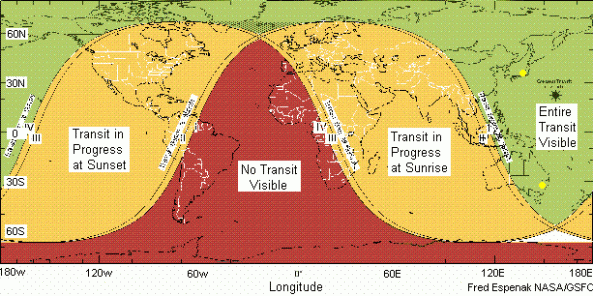
At 22:09 UT on June 5, 2012 the planet Venus will appear as a small, dark disk moving across the face of the Sun. The transit will finish at 04:49 UTC on June 6 (exact time depends on location of observer).

Clouds permiting, it may be visible to observers in the UK from dawn (about 03:46 UT in London).

This will be the last time the planet Venus will make the trek across the face of the sun as seen from Earth until the year 2117.

Note: Observing the Sun directly without appropriate protection can damage or destroy retinal cells, causing temporary or permanent blindness.

Clint Bradford K6LCS has posted a collection of URL’s where you should be able to watch the Venus transit online from sites around the world.

NASA (USA) http://venustransit.nasa.gov/2012/transit/

NASA Edge http://www.nasa.gov/multimedia/podcasting/nasaedge/index.html

University of Barcelona  (from a telescope in Norway) https://gaia.am.ub.es/serviastro/www/html/venus2012/live/index.html

National Solar Observatory http://venustransit.nso.edu/live.html

Exploratorium  (via the Mauna Loa Observatory) http://www.exploratorium.edu/venus/

NASA TV http://www.nasa.gov/ntv

Coca Cola Space Science Center (from Australia) http://www.ccssc.org/transit2012.html

Bareket observatory (Israel)
http://www.bareket-astro.com/live-astronomical-web-cast/live-free-venus-transit-webcast-6-june-2012.html

Mt. Lemmon Sky Center http://skycenter.arizona.edu/annoucement/live

Astronomers Without Borders (from Mt. Wilson, California)
http://www.astronomerswithoutborders.org/projects/transit-of-venus/live-webcast.html

The 2012 Transit of Venus using HAM Radio http://aprs.org/VenusTransit2012.html

Transit of Venus Special Event June 6, 2012
http://www.southgatearc.org/news/may2012/transit_of_venus_special_event.htm

Ultra-high Definition video recording of 2012 Venus Transit
http://www.nasa.gov/multimedia/videogallery/index.html?media_id=145648241

13cm Band Rules Expanded to Allow MedRadio Adjacent to Satellites

The ARRL is reporting in a First Report and Order and a Further Notice of Proposed Rulemaking (ET 08-59) released on May 24, the FCC decided to expand the Part 95 Personal Radio Service rules to allow medical devices to operate on a secondary basis in the 2360-2400 MHz band. International amateur satellite operations are allocated between 2400-2450 MHz, adjacent to the new devices.

The new allocation is  Medical Body Area Networks (MBAN) which provide a way for health care facilities to monitor their patients via wireless networks. Because use of these frequencies will be on a secondary basis, MBAN stations will not be allowed to cause interference to, and must accept interference from, primary services, including US radio amateurs who operate on a terrestrial primary basis in the 2390-2395 MHz and 2395-2400 MHz bands.

The ARRL has posted their full analysis and report at:
http://tinyurl.com/13cm-Medical-Allocation (arrl.org)

Source AMSAT News Service (ANS)

Satellite Link Budget Information and Lunar Beacons

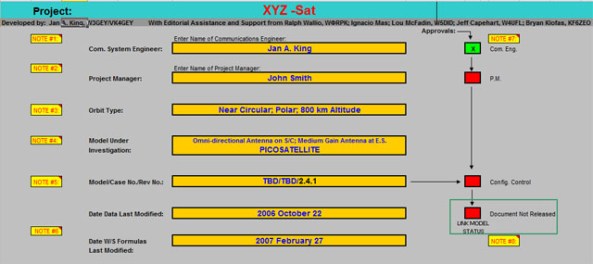
Download the spread sheet here (1.2 MB) (ver 2.4.1 – updated 11/4/2007)

Download Basic Analog Transponder Spread sheet here and its notes here

Lunar Beacons – The Earth Moved by James Miller G3RUH http://www.amsat.org/amsat/articles/g3ruh/110.html

Lunar Transponder Calculations by Domenico I8CVS http://www.uk.amsat.org/wp-content/uploads/2012/06/Lunar-Transponder-Calculations-by-I8CVS.txt

23cm band covered by GNSS

An article in the May 2012 edition of the free publication Microwave Journal shows that all of 1240-1300 MHz except for two narrow gaps will be used by global navigation satellite systems (GNSS).

The article by Rachid El Assir, Rohde & Schwarz, conatin a chart that graphically illustrates where the GNSS systems will operate in 1240-1300 MHz band.

A gap of about 3 MHz occurs at 1240 and one of about a MHz at 1259 MHz.

Read Global Navigation Satellite Systems and Their Applications
http://www.microwavejournal.com/articles/17568-global-navigation-
satellite-systems-and-their-applications

Microwave Journal http://www.microwavejournal.com/publications/1