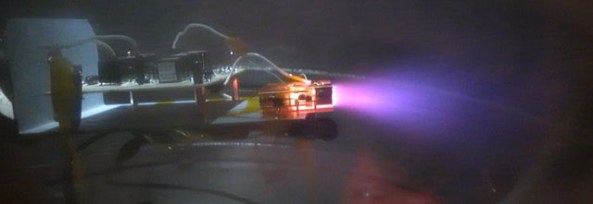
UK CubeSat Plasma Propulsion Thruster

STRaND-1 CubeSat Plasma Propulsion Test

STRaND-1 CubeSat Plasma Propulsion Thruster

The amateur radio STRaND-1 smartphone CubeSat is a joint project between SSTL and the Surrey Space Centre (SSC). It’s not only its smartphone that makes it exceptional. Engineers at the Surrey Space Centre have also developed a unique mass and power saving plasma propulsion system to fly on the satellite. This system will be the first propulsive technology to provide very precise attitude control and pointing.

STRaND-1 will carry both a Resistojet and a Pulsed Plasma Thruster (PPT) module on board. The PPT will consist of eight micro thrusters; four located at the top of the satellite stack and four located at the bottom. The micro thrusters operate by discharging a discrete train of pulses. Each pulse is a plasma discharge that forms between two metal electrodes, much like a small lightning bolt or electrical spark. The spark erodes the metal from the electrodes and electromagnetics accelerate the eroded mass out of the nozzle, which produces thrust. This is known as the Lorentz force.

Surrey Space Centre has developed two ways of minimising mass and volume. Firstly, the electrodes which form the plasma discharge also function as the propellant. As metal is highly dense, more propellant can be stored in a smaller volume than that of conventional chemical propulsion systems. The total weight of the propellant for the whole STRaND-1 PPT system is just 10g.

Secondly, Surrey Space Centre’s novel discharge initiation system uses a mechanical contact trigger built out of a tiny piezoelectric motor only 5mm in length. This takes up less space than the conventional spark plug system which requires volume intensive circuitry.

A video of the Pulsed Plasma Thruster firing can be seen st http://www.facebook.com/video/video.php?v=10150533409463432

Download a video of the STRaND-1 presentation given at the 2011 AMSAT-UK International Space Colloquium in Guildford from http://www.batc.tv/vod/Strand.flv

A six page article on STRaND-1 appeared in the Spring 2011 issue of the AMSAT-UK publication OSCAR News available for download at http://www.uk.amsat.org/on_193_final.pdf

UK Amateur Radio Smartphone CubeSat STRaND-1 http://www.uk.amsat.org/1942

STRaND on Facebook http://www.facebook.com/nanosats

BBC TV – How Satellites Rule Our World

They are constantly circling hundreds of miles above our heads, driving our daily lives – yet we barely give satellites a second thought. Satellite engineer Dr. Maggie Aderin-Pocock Ph.D., MBE wants to change all that. She wants to make us realise and appreciate what these unsung heroes of the modern world have done for us.

Maggie reveals how satellites have revolutionised exploration, communication, location-finding and spying. She discovers how they have transformed not only the way we see our planet but our understanding of the dangers within it, like volcanoes and earthquakes. Plus, she discovers the jaw-dropping power of the technology used by satellites to make our lives run smoothly.

The final 8 minutes of the show covers CubeSats and features Peter Shaw of the amateur radio STRaND smartphone satellite project.

‘In Orbit: How Satellites Rule Our World’ was broadcast on BBC 2 at 2100 BST (2000 UT) on Sunday, March 25 and is available to watch on the web at
http://www.bbc.co.uk/iplayer/episode/b01f6qpq/In_Orbit_How_Satellites_Rule_Our_World/

It is understoood that this broadcast could be blocked in certain countries. A way around this may be to use a Proxy Server or software such as Expat Shield.

Dr. Maggie Aderin-Pocock Ph.D., MBE http://en.wikipedia.org/wiki/Maggie_Aderin-Pocock

UK Amateur Radio Smartphone CubeSat STRaND-1 http://www.uk.amsat.org/1942

WebSDR Adds 437 MHz Goliat CubeSat Coverage

The WebSDR receiver located at the Astronomical Observatory Department of “Stefan cel Mare” University in Suceava, Romania has provided coverage of the 3.5 MHz band.

Now coverage of 437.470 – 437.515 MHz has been added enabling the Romanian amateur radio CubeSat Goliat to be received.

It is operated by Andrei YO8SSQ, e-mail andrei-at-avatar.afraid.org and Cezar YO8TLC, e-mail cezarl-at-usv.ro and located at Latitude 47.6417N Longitude 26.2453E, grid locator KN37cp. The height ASL is 350m.

Listen to the 80m and Goliat WebSDR at http://sdr.opt.ro:8901/

Goliat CubeSat http://www.goliat.ro/

BBC TV Newsnight show on Clyde Space and UKube-1

UKube-1 is a 3U CubeSat being designed and produced by Clyde Space for the UK Space Agency. UKube-1 is the UK’s first CubeSat and will fly a total of 6 independent payloads. This news piece was prepared by the BBC covering Clyde Space and the UKube-1 mission.

Watch BBC Newsnight item on Clyde Space and UKube-1

UKube-1 will carry a set of AMSAT-UK FUNcube boards providing a 435/145 MHz linear transponder and BPSK telemetry beacon.

Japan to Launch Amateur Radio Satellites

Kibo Robot Arm CubeSat Deployment

Kibo Robot Arm CubeSat Deployment

The Japan Aerospace Exploration Agency (JAXA) has announced the launch of five amateur radio satellites on two launches taking place in May and July.

The first H-IIA launch takes place on May 17, 1639-1642 UT and will carry the amateur radio satellite HORYU-2

The second launch on July 21, 0218 UT of the HTV3 will deliver the JEM-Small Satellite Orbital Deployer (J-SSOD) to the International Space Station (ISS).

J-SSOD will enable small satellites to be deployed from the ISS using the Japanese Experiment Module (JEM) robot arm.

The Japanese amateur radio satellites WE-WISH and FITSAT-1, along with San Jose State University’s TechEdSat and the Vietnamese F-1 will also be delivered to the ISS on this launch and it is planned they will be deployed from the ISS on September 20.

JAXA press releases:
http://www.jaxa.jp/press/2012/03/20120321_h2af21_e.html
http://www.jaxa.jp/press/2012/03/20120321_h2bf3_e.html

Thanks to Masahiro Arai JN1GKZ for this information.

UKube-1 to launch in 2013

UKube-1 Systems Engineer Steve Greenland

UKube-1 Systems Engineer Steve Greenland

The BBC report that the first satellite to be built in Scotland is due to be launched next year.

BBC News say UKube-1 is being built at the West of Scotland Science Park in Maryhill, Glasgow and is expected to enter orbit in 2013.

UKube-1 systems engineer Steve Greenland is quoted as saying:

“People often ask me what my job is and I tell them that I’m building satellites in Maryhill,” he says.

“Sometimes they don’t believe it. Sometimes they laugh at me.”

Read the full story and watch the video at http://www.bbc.co.uk/news/uk-scotland-glasgow-west-17439236

Artists impression of UKube-1 in orbit

Artists impression of UKube-1 in orbit

UKube-1 will carry a set of AMSAT-UK FUNcube boards that will provide a 435/145 MHz linear transponder for SSB/CW amateur radio communications.

UKube-1 final design approved http://www.uk.amsat.org/2430

Bath TOPCAT Project http://www.uk.amsat.org/1612

Clyde Space http://www.clyde-space.com/

Daily Mail newspaper story http://www.dailymail.co.uk/sciencetech/article-2117610/UKube-1-satellite-First-space-cubesat-Scotland-launch-2013.html