The Hindu – Hams Engineering Success

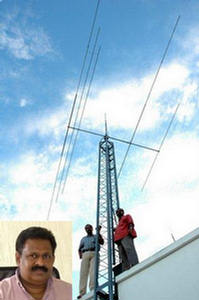
The Hindu newspaper reports on K. G. Girish Babu VU2KGB who uses computerised antenna design for VHF and UHF wireless communication. He helped his son Rahul make an antenna, the largest in India, which can track amateur radio satellites.

He says he also designed and manufactured the entire ground station antenna and structures for the experiments jointly conducted by the German Aerospace (DLR) and Indian Space Research Organisation (ISRO).

Wireless communication always fascinated him. He made a wireless transmitter while studying in class eight, for the science exhibition. “Thanks to my teacher Rajan and the wonderful chemisty and physics lab at our school (Government HS, Chavakkad). He always encouraged my experiments and brought me copies of Science Today magazine.”

While in college, (St Albert’s, Kochi), “I, along with a friend, rigged up a wireless transmitter. We didn’t know that it was illegal. When some issues came up, we hid the equipment,” he remembers.

In 1979, he cleared the examination to obtain his Grade I amateur radio operator licence with the call sign VU2KGB. His wife, A. Maya Shankar, is licenced at VU2CIA.

Read the full The Hindu story at http://www.thehindu.com/life-and-style/money-and-careers/article2974047.ece

Connecting Students with Space

The GENSO project features in an article in the February 2012 edition of the free magazine ESA Bulletin.

GENSO is a worldwide network of education and amateur radio ground stations linked together via the internet.

Student satellite teams can normally only gather around 20 minutes of data per day from their satellite using their own ground station. GENSO will give them free access to potentially hundreds of stations around the globe and increase their data return to many hours per day. It will also allow them to command their spacecraft from the other side of the world.

A team from AMSAT-UK supported this project by developing a standard ground station specification together with a full set of software drivers for the different hardware items.

The software development was carried out in a cooperative effort of students and radio amateurs worldwide.

The 2008 AMSAT-UK International Space Colloquium featured a demonstration and presentations on GENSO.

The five page article starts on page 39 and the amateur radio stations of Graham Shirville G3VZV, Dave Johnson G4DPZ and David Mynatt KA0SWT get a brief mention on page 43. Read the ESA Bulletin online at

http://esamultimedia.esa.int/multimedia/publications/ESA-Bulletin-149/

AMSAT-UK and ESA co-operation on GENSO
http://www.southgatearc.org/news/november2007/amsat_esa_genso_cooperation.htm

GENSO http://www.genso.org/

Astronaut's Flashing Success

Blue Laser Flash seen from ISS

Light (top center) flashed from the Lozano Observatory, about 40 miles north of San Antonio, was easily visible from orbit. Click on the image to see it full-sized.

Radio amateur and ISS astronaut Don Pettit KD5MDT describes how he succeeded in receiving signals on a frequency of 650 THz.

Flashing the International Space Station with beams of light as it passes overhead had never been successfully done—until now.

It sounds deceptively easy. In an earlier post I wrote about the technical requirements. But like so many other tasks, it becomes much more involved in the execution than in the planning.

Early Sunday morning, at 01:27 our time, the San Antonio Astronomical Association, an amateur astronomy group, succeeded in flashing space station with a one-watt blue laser and a white spot light as we passed overhead. This took a number of engineering calculations. Projected beam diameters (assuming the propagation of a Gaussian wave for the laser) and intensity at the target had to be calculated. Tracking space station’s path as it streaked across the sky was another challenge. I used email to communicate with Robert Reeves, one of the association’s members. Considering that it takes a day, maybe more, for a simple exchange of messages (on space station we receive email drops two to three times a day), the whole event took weeks to plan.

I was ready with cameras for the early morning San Antonio pass and can report that it was a flashing success. Here’s one of the pictures to prove it.

Don Pettit KD5MDT

Astronaut’s Flashing Success

Blue Laser Flash seen from ISS

Light (top center) flashed from the Lozano Observatory, about 40 miles north of San Antonio, was easily visible from orbit. Click on the image to see it full-sized.

Radio amateur and ISS astronaut Don Pettit KD5MDT describes how he succeeded in receiving signals on a frequency of 650 THz.

Flashing the International Space Station with beams of light as it passes overhead had never been successfully done—until now.

It sounds deceptively easy. In an earlier post I wrote about the technical requirements. But like so many other tasks, it becomes much more involved in the execution than in the planning.

Early Sunday morning, at 01:27 our time, the San Antonio Astronomical Association, an amateur astronomy group, succeeded in flashing space station with a one-watt blue laser and a white spot light as we passed overhead. This took a number of engineering calculations. Projected beam diameters (assuming the propagation of a Gaussian wave for the laser) and intensity at the target had to be calculated. Tracking space station’s path as it streaked across the sky was another challenge. I used email to communicate with Robert Reeves, one of the association’s members. Considering that it takes a day, maybe more, for a simple exchange of messages (on space station we receive email drops two to three times a day), the whole event took weeks to plan.

I was ready with cameras for the early morning San Antonio pass and can report that it was a flashing success. Here’s one of the pictures to prove it.

Don Pettit KD5MDT

AMSAT-UK Colloquium 2012 First Call for Speakers

Holiday Inn Guildford GU2 7XZ

Holiday Inn Guildford GU2 7XZ

The AMSAT-UK International Space Colloquium will be held on September 15-16, 2012 in Guildford.

The Colloquium attracts an international audience from across Europe as well as North America and the Middle East. Attendees range from the builders of the CubeSats and Nanosats, those who communicate through them and beginners who wish to find out more about this fascinating branch of the hobby.

It provides a rare opportunity to chat with satellite designers and builders, discussions frequently continue until the early hours of the morning.

A Gala dinner is held on the Saturday evening along with the fund raising auction.

This is the first call for speakers for the AMSAT-UK International Space Colloquium 2012 which, due to the Olympic & Paralympic Games, will be held this year on the weekend of September 15-16, 2012 at the Holiday Inn, Guildford, GU2 7XZ, United Kingdom.

This Colloquium will take place a few weeks before the planned launch of AMSAT-UK’s FUNcube-1 satellite carrying a 435/145 MHz linear transponder for SSB/CW communications.

AMSAT-UK invites speakers, to cover topics about micro-satellites, CubeSats, Nanosats, space and associated activities, for this event.

They are also invited to submit papers for subsequent publishing on the AMSAT-UK web site. We normally prefer authors to present talks themselves rather than having someone else give them in the authors’ absence. We also welcome “unpresented” papers for the web site.

We appreciate that it is not always possible to give a firm indication of attendance at this stage but expressions of interest would be appreciated.

Submissions should be sent *ONLY* to G4DPZ, via the following routes:

e-mail: david dot johnson at blackpepper dot co dot uk

Postal address at http://www.qrz.com/db/G4DPZ

AMSAT-UK also invite anyone with requests for Program Topics to submit them as soon as possible to G4DPZ. Invitations for any papers on specific subjects will be included in the future call. Likewise if anyone knows of a good speaker, please send contact and other information to G4DPZ.

AMSAT-UK International Space Colloquium http://www.uk.amsat.org/colloquium/twelve

VO-52 Transponder Activation Postponed

HAMSAT VO-52

HAMSAT VO-52

It had been hoped that the amateur radio SSB/CW satellite HAMSAT (VO-52) would be reactivated on Thursday, March 8 but this has now been postponed.

More time is needed to carry out observations on the state of the satellite, which fell silent Feb. 28, so the activation has been put back by at least a week.

HAMSAT (VO-52) carries two linear transponders for SSB/CW operation. It had been using the Indian transponder but when it is switched back on it will use the Dutch transponder built by William Leijenaar PE1RAH. The frequencies used will be:

Uplink:         435.2250 – 435.2750 MHz SSB/CW
Downlink:     145.9250 – 145.8750 MHz SSB/CW
Beacon:       145.8600 MHz CW

Working the SSB satellites http://www.uk.amsat.org/2712

HAMSAT VO-52 Falls Silent http://www.uk.amsat.org/5217

Leijenaar Electronics http://www.leijenaarelectronics.nl/

AMSAT-India http://www.amsatindia.org/