
CEPT CPG decides position on 144, 50 and 1240-1300 MHz

CEPT Logo“At the insistence of the European Commission, a WRC-23 agenda item was considered necessary to address the world-wide protection of Regional Navigational Satellite Systems from amateur emissions in the band 1240-1300 MHz.”

The CEPT ECC CPG met in Ankara during August 26-30 to finalise their position ahead of the ITU World Radiocommunication Conference 2019 (WRC-19) to be held in Sharm el-Sheikh, Egypt, October 28 to November 22. This conference will define the Agenda Items for WRC-23.

RSGB volunteers along with other radio amateurs in IARU Region 1 countries put in a considerable amount of work to defend the amateur radio allocations. Their hard work ensured the removal of 144-146 MHz from a study of additional spectrum for aeronautical applications and an agreement on a European Common Proposal for 50-52 MHz.

IARU Region 1 have released this report on the meeting:

The CEPT Conference Preparatory Group met this week in Ankara, Turkey. Items of interest to the amateur service which were finalised were:

– Agreement to a European Common Proposal (ECP) on allocating 50-52 MHz to the amateur service in Region 1 on a secondary basis with a footnote listing those countries where the amateur service will have a primary allocation in the band 50-50.5 MHz (WRC Agenda Item 1.1)

– Agreement to an ECP on spectrum to be considered for International Mobile Telecommunications, which does not now include the primary amateur band at 47-47.2 GHz (WRC Agenda Item 1.13)

– Agreement to an ECP that retains the current regulatory position in the 5725-5850 MHz frequency band which includes secondary allocations to the amateur service and the amateur-satellite service (WRC Agenda Item 1.16)

– Removal of 144-146 MHz from a French proposal for study of additional spectrum for aeronautical applications. (WRC Agenda Item 10)

– At the insistence of the European Commission, a WRC-23 agenda item was considered necessary to address the world-wide protection of Regional Navigational Satellite Systems from amateur emissions in the band 1240-1300 MHz. A draft WRC Resolution was agreed which underlines the importance of this frequency band to the amateur service and explicitly excludes the removal of existing allocations as part of the proposed agenda item. (WRC Agenda Item 10)

– There was no change to the already agreed CEPT position on Wireless Power Transmission (WRC Agenda item 9.1.6). This states that no change is needed in the Radio Regulations to address the question of operating frequency for WPT-EV, but leaves open the question of spurious emissions from WPT-EV.

Commenting on the outcome of CPG, IARU Region 1 President Don Beattie, G3BJ, said that the IARU team at Ankara (the only representatives of the amateur service at the meeting) had presented clear and convincing arguments for the amateur service position and he was pleased that regulators had recognised the strength of the amateur case. He expressed his thanks to everyone who had contributed to the outcome at CPG.

The issues now move to WRC in Egypt in November for final resolution. IARU will be there.

IARU Region 1 https://iaru-r1.org/

Note: Although the CEPT position includes a Primary allocation at 50.0 to 50.5 MHz it is for the Amateur Service only – the Amateur Satellite Service is excluded.

CEPT ECC CPG19-9 Ankara Meeting Minutes and Annexes are available for download at
https://cept.org/ecc/groups/ecc/cpg/client/meeting-documents/?flid=10064

Background to 1240-1300 MHz https://amsat-uk.org/2019/08/19/threat-to-amateur-radio-23cm-band/

Talks by radio amateurs at UKHAS Conference London Sept 7

SSDV picture from a PIE balloon - Image credit Dave Akerman M0RPI

SSDV picture from a PIE balloon – Image credit Dave Akerman M0RPI

The 2019 UK High Altitude Society Conference is taking place in White City, London on Saturday, September 7. Ticket sales close August 31.

The conference takes place at The Invention Rooms, 68 Wood Lane, White City, London, W12 7TA, and attracts those interested in learning about building and flying High Altitude Balloons or in tracking their 434 MHz signals.

Some of the radio amateurs giving talks on high altitude balloon communications are:

• AutoRX by Mark Jessop VK5QI

• Citizen space exploration & inflatable spacecraft by Michael Johnson M0MJJ

• The Apollo Flight – model-making and tech behind the dashboard by Dave Akerman M0RPI

• Insurance & UKHAS Server Support by Steve Randall G8KHW

• Recovering, Reprogramming and Re-flying Radiosondes by Andrew Mulholland MI0BPB

• Hwoyee NSL-45 Experiences by Dave Akerman M0RPI and Steve Randall G8KHW

There will be helium and foil balloons available for the pico launch at the end of the conference.

UKHAS conference information is at https://ukhas.org.uk/general:ukhasconference2019

Tickets are at https://www.imperialcollegeunion.org/shop/club-society-project-products/space-society–products/27226/uk-high-altitude-society-conference-ticket

New French CEPT paper still seeks 144-146 MHz for Aeronautical

CEPT LogoThe French administration has renewed its attack on the Amateur Radio 144-146 MHz band ahead of a key CEPT ECC CPG meeting in Ankara, August 26-30.

In a paper to be considered at the conference the French Administration says it is not at this time seeking Primary status for the Aeronautical Mobile Service in 144-146, however, their intent is still that the Aeronautical Mobile Service should share the amateur 2m band.

It is clear where such sharing would inevitably lead, amateur operation in the band would only be tolerated if there were no interference to Aeronautical Mobile. Radio Amateurs might be subject to heavy restriction and low EIRP limits.

We can get on idea of France’s long term intent for 144 MHz from their attitude to the 1240-1300 MHz band. It was initially said the Galileo constellation could amicably share this allocation and amateur operation could continue but now France says “unregulated use of the band 1240-1300 MHz by the amateur service is a serious source of harmful interference to RNSS receivers.”
See https://amsat-uk.org/2019/08/19/threat-to-amateur-radio-23cm-band/
The French paper CPG(19)137 F – AI10 – Non safety AMS-background information is at
https://www.cept.org/Documents/cpg/53024/cpg-19-137_f-ai10-non-safety-ams-backgroud-information

Read the IARU paper – CPG(19)115_IARU – AI10 – View on 144-146 MHz under B10-2
https://www.cept.org/Documents/cpg/52931/cpg-19-115_iaru-ai10-view-on-144-146-mhz-under-b10-2

Read the Save 2 Meter story – French administration strikes back at IARU at
https://www.save2m.org/2019/08/french-administration-strikes-back-at-iaru/

Follow Save 2 Meter at https://twitter.com/Save2Meter

Other Ankara meeting documents are at
https://cept.org/ecc/groups/ecc/cpg/client/meeting-documents/?flid=10031

Highlights of CITEL WRC Preparatory Meeting: August 12-16 Ottawa

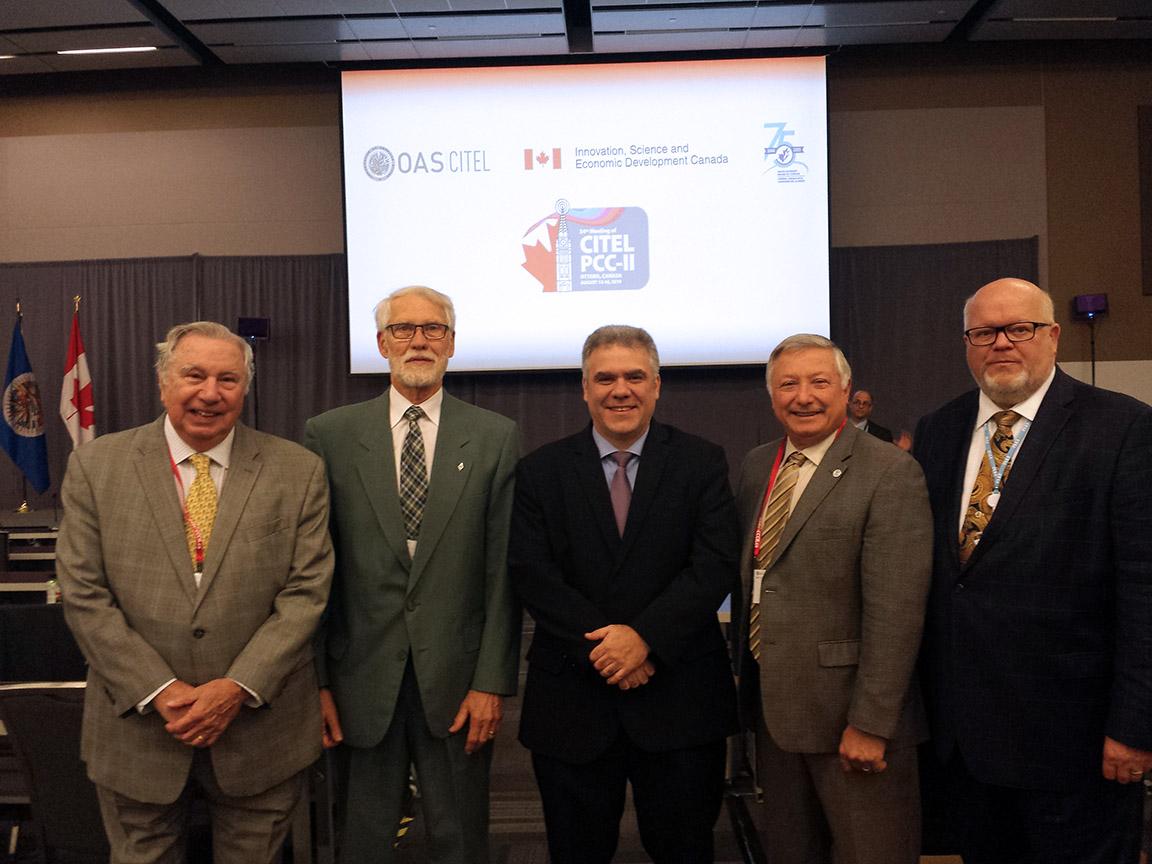
Radio amateurs at CITEL WRC Preparatory Meeting Ottawa

Radio amateurs at CITEL WRC Preparatory Meeting Ottawa

CITEL, the telecommunications committee of the Organization of American States, concluded a week of meetings on Friday, August 16 at the Shaw Centre in Ottawa.

The Radio Amateurs of Canada (RAC) report:

These meetings have as their principal purpose to try to establish common positions on agenda items which will be acted upon during the World Radiocommunication Conference (WRC-19) which begins on Monday, October 28 in Sharm El-Sheikh, Egypt.

The following Radio Amateurs (from left to right in the above photo) were present at the CITEL meetings and were tasked with looking out for issues of concern to the Amateur Radio Service:

• Bryan Rawlings, VE3QN – on the Canadian Delegation and Radio Amateurs of Canada’s Special Advisor to World Radiocommunication Conferences
• George Gorsline, VE3YV – member of the Executive Committee for the International Amateur Radio Union (IARU-R2)
• Flavio Archangelo, PY2ZX – on the Brazilian Delegation and International Amateur Radio Union Region 2 CITEL Coordinator
• Serge Bertuzzo, VA3SB, Radio Amateurs of Canada’s International Affairs Officer
• Jon Siverling, WB3ERA – on the American Delegation and the Technical Relations Officer for the American Radio Relay League (ARRL)

The following are the principal highlights of the week’s activities for Radio Amateurs:

Six Metres: There are now 14 signatories to an Inter-American Position (IAP) which in effect voices no objection to an allocation in 50 – 54 MHz to the Amateur Service in the International Telecommunication Union (ITU) Region 1 (Europe, the Mideast and Africa).

Six Metres: Amateurs were successful in adding wording to protect the Amateur primary allocation in 50 – 54 MHz from a US proposal to study implementing space-based Earth Exploration Service radars to operate in or close to 45 MHz.

47 GHz: Amateurs were successful in having Mexico remove the frequency segment 47 – 47.2 GHz from their proposal to study several additional frequency ranges for the Fixed Satellite Service.

47 GHz: An IAP supported by 11 member states supports No Change (NoC) to the existing (Amateur Primary) allocation in 47 – 47.2 GHz. Specifically, not to be considered for sharing with 5G International Mobile Telephony (IMT).

5 GHz WAS/RLAN: An IAP supported by 12 member states supports No Change (NoC) to the existing allocations in 5725 to 5850 MHz and 18 member states support No Change in the range 5850 to 5925 MHz (as opposed to using these frequency ranges for higher-power and outdoor wireless access points). The Amateur secondary allocation in Canada is 5650 to 5925 MHz.

WPT(EV): Wording in a Canadian contribution with additions from the American delegation has been added relative to a WRC-19 agenda item which seeks to identify frequencies for medium and high-power wireless charging of electric vehicles. The wording emphasizes the requirement to properly set standards to avoid harmful interference to radio services from WPT(EV) systems.

Note: The French proposal to consider 144 – 146 MHz for sharing with the aeronautical mobile service was not on the CITEL agenda. It will be considered next in a CEPT meeting in Ankara in late August. For more information please visit:
https://www.rac.ca/2-metre-sharing-proposal-is-on-cept-conference-preparatory-group-agenda/

This was the last CITEL meeting before the upcoming WRC-19 Conference; therefore, the above is a fair representation of the status of the various Amateur issues going into that meeting.

Stay tuned to the WRC-19 webpage on the RAC website for more updates https://www.rac.ca/wrc/

Bryan Rawlings, VE3QN
Special Advisor to World Radiocommunication Conferences
Radio Amateurs of Canada

Ideas sought for the next FUNcube satellite

AO-73 (FUNcube-1) – Image credit Wouter Weggelaar PA3WEG

In November the FUNcube-1 CubeSat will have been in orbit for 6 years and the FUNcube team are now soliciting suggestions for the next satellite

The team are looking for suggestions for:
• Conformation of the satellite (2U / 3U)
• Orbit (LEO / MEO)
• STEM Outreach
• Amateur Radio Payloads
• Research Payloads

Please email your ideas to:
funcube-next <at> funcube.org.uk

The topic will be discussed during the AMSAT-UK Colloquium on Sunday 13th October 2019 https://amsat-uk.org/colloquium/

If you would like to join the team, please email:
operations <at> funcube.org.uk

Dave, G4DPZ
on behalf of the FUNcube Team

Threat to Amateur Radio 23cm band

Galileo LogoA joint paper by France, Lithuania, Malta, Slovenia and The Netherlands for the CEPT CPG meeting in Ankara, August 26-30, attacks the continued use by Radio Amateurs of our 1240-1300 MHz band.

This is the final CEPT CPG meeting in preparation for the ITU World Radiocommunication Conference 2019 (WRC-19) to be held in Sharm el-Sheikh, Egypt, October 28 to November 22. This conference will define the Agenda Items for WRC-23.

Paper AI10 – Proposal on AS-RNSS says:

Galileo is close to full operational capability and its E6 signals in the band 1260-1300 MHz will support new services such as the free-to-use Galileo High Accuracy Service, and also robust authentication, expected to be used by a variety of applications including autonomous vehicles and the Internet of Things (IoT).

Several cases of interference to Galileo E6 receivers from amateur service emissions have occurred in the recent past, sometimes at significant distance, and have taken several hours or even days to be eliminated. There is therefore a serious concern that as Galileo E6 receivers are deployed and used more widely, cases of interference from amateur stations will rapidly grow in number.

A WRC-23 agenda item is necessary to address this issue because:

1. Unregulated use of the band 1240-1300 MHz by the amateur service is a serious source of harmful interference to RNSS receivers. This is demonstrated by experience.

2. The number of Galileo receivers in 1260-1300 MHz will increase dramatically, and interference cases will multiply if not addressed timely.

3. Galileo and other RNSS systems will deploy at global scale, and interference scenario between amateur emissions and RNSS receivers include cross-border cases. The issue is therefore of international nature and is to be addressed in the ITU framework.

4. Galileo is a major European asset, and a decision at WRC-23 is essential to be compatible with the roadmap of deployment of Galileo receivers in this band.

Download Paper: AI10 – Proposal on AS-RNSS from
https://cept.org/ecc/groups/ecc/cpg/client/meeting-documents/?flid=10031

Also see the IARU paper: RNSS Proposal WRC-19 AI 10 at the same URL

Some background information is at
https://amsat-uk.org/2019/05/31/1240-1300-mhz-band-discussed-by-cept-wgfm-and-cpg-pta/

European Commission Joint Research Centre report written 2014 and published 2015 on Compatibility between Amateur Radio Services and Galileo in the 1260-1300 MHz Radio Frequency Band. It reports the effect of transmissions of 0.1, 1 and 15 watts EIRP on a Galileo receiver up to 10 km away – download PDF here

January 2006 – Potential Interference To Galileo From 23cm Band Operations by Peter Blair G3LTF
http://www.southgatearc.org/articles/galileo.htm