Radio ham’s Femtosats project wins ISS Design Competition

Femtosats deploying from 3D printed spacecraftRadio amateur Andy Filo KJ6ZGI has been announced as winner of the ISS Design Competition organised by component distributor Mouser.

Tech Crunch reports nearly 250 ideas were submitted, everything from tools to toys to scientific instruments. The proposals were vetted and submitted for judgment by tech-savvy astronaut and former ISS resident Col. Chris Hadfield VA3OOG, and Grant Imahara, of Mythbusters fame.

Andy’s winning entry was for a 3D printed “mothership” to launch Femosats into space. Femtosats are 30mm square and 4mm thick self contained satellites that extend the Internet of Things to Space.

Watch 2016 ISS Design Challenge Winners! – Empowering Innovation Together™ with Grant Imahara

Read the Tech Crunch story at https://techcrunch.com/2016/11/07/3d-printed-satellite-launcher-heads-to-iss-with-blessing-of-chris-hadfield-and-grant-imahara/

Mouser ISS Design Competition winners http://www.mouser.com/contests/iss-project-contest?entry_id=131259785

Andy KJ6ZGI has previous worked with Zac Manchester KD2BHC on the KickSat project
http://makezine.com/2014/04/11/how-to-kick-a-sat/

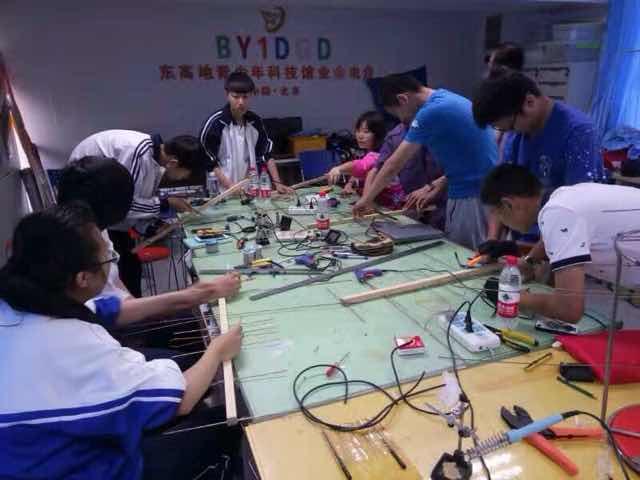
Sandringham students’ Amateur Radio project success

Sandringham students used amateur radio to talk to Tim Peake on the ISS

Sandringham students used amateur radio to talk to Tim Peake GB1SS on the ISS

The Watford Observer newspaper reports that Sandringham School students’ amateur radio communication project gave them the opportunity to visit the UK Parliament at Westminster.

The Observer says: Four students from a St Albans school showed off their engineering prowess to politicians, policy makers and businesses in Parliament.

The Year 9 and 11 students from Sandringham School, on The Ridgeway – Sandy Cairns, Polly Gupta M6POG, Stanley MacMurray and Emma Wilkinson M6GJQ – were invited to the event on Monday [Oct 31] after impressing judges with their engineering project at the regional heats of The Big Bang UK Young Scientists and Engineers Competition

Their amateur radio communication project saw them set up a radio to speak with Tim Peake while he was aboard the International Space Station.

Rhian Kazwini, Head of Science at Sandringham School, said: “Entering the competition has been great fun and given the team an idea of just how interesting a career in engineering could be.”

Read the full story at http://www.watfordobserver.co.uk/stalbans/14842162.St_Albans_students__space_chat_with_astronaut_Tim_Peake_earns_them_trip_to_Parliament/

In January 2016 students at Sandringham School used amateur radio to talk to UK astronaut Tim Peake GB1SS on the International Space Station watch the video at https://amsat-uk.org/2016/01/09/video-tim-peake-sandringham/

What is Amateur Radio? http://www.essexham.co.uk/what-is-amateur-radio

Find an amateur radio training course near you https://thersgb.org/services/coursefinder/

A free booklet is available aimed at introducing newcomers to the hobby that can also be used as a handy reference while getting started, see
http://rsgb.org/main/get-started-in-amateur-radio/alex-discovers-amateur-radio-2/

RSGB Spectrum Forum Reports Released

Sarah-Sipple-M6PSK-G100RSGB_Aug2013The reports from the RSGB Spectrum Forum meeting held October 29, 2016 have been released. The VHF Spectrum Report highlights the 12 dB increase in Noise Floor.

The report, produced by the RSGB VHF Manager John Regnault G4SWX, notes that Ofcom have increased the noise floor criteria used to calculate coverage areas for Low Band VHF from -104dBm to -92dBm. This recognises the increase in human-generated noise in this part of the spectrum.

The increase in Noise Floor level means you now need 150 watts to achieve the coverage once obtained with a 10 watt transmitter.

Read the VHF Spectrum Report at
http://rsgb.org/main/files/2016/11/5.2_VHF-Managers-report_Oct2016.pdf

Read the AMSAT-UK report at
http://rsgb.org/main/files/2016/11/7.1_AMSAT-UK_SpectrumForum_Oct2016.pdf

Read the other Spectrum Forum reports at
http://rsgb.org/main/blog/spectrum-forum-posts-overview/spectrum-forum-meeting-minutes/2016/11/04/spectrum-forum-meeting-2016/

HFsat will have 21 to 29 MHz transponder

HFsat concept of operations

HFsat concept of operations

US Naval Academy students are planning an amateur radio CubeSat HFsat carrying an HF transponder as well as 2m APRS.

They are working with Bill N6GHZ on the HF transponder card which will provide a bandwidth of 30 kHz, the frequencies are currently 21.4 MHz uplink and 29.42 MHz downlink. Doppler shift will be reduced to less than 2 Hz per second by using an inverting transponder.

The satellite will be gravity gradient stabilized by its long full size 10 meter band halfwave HF dipole antenna with tip masses

Read more about HFsat at http://aprs.org/hfsat.html

IARU satellite frequency coordination page http://www.amsat.org.uk/iaru/

UBAKUSAT linear transponder satellite

UBAKUSAT Amateur Radio CubeSat

UBAKUSAT Amateur Radio CubeSat

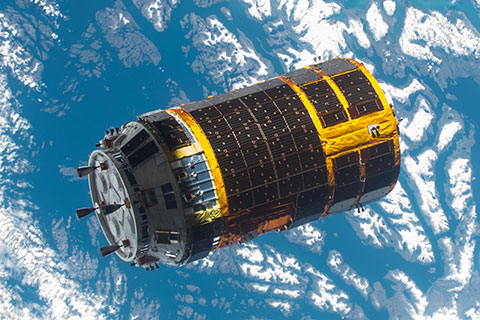
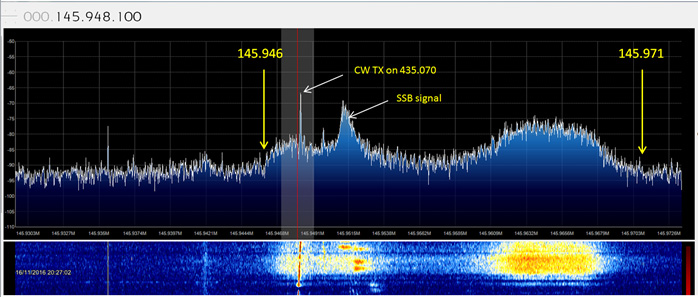
Turkey’s 3U CubeSat UBAKUSAT carrying an amateur radio 145/435 MHz SSB/CW transponder is planned to be deployed from the ISS in 2017.

The linear transponder is almost the same as that on the TURKSAT-3USAT which was launched on April 26, 2013.

UBAKUSAT CubeSat

UBAKUSAT CubeSat

The satellite is being developed by Istanbul Technical University, Faculty of Aeronautics and Astronautics, Space Systems Design and Test Lab (SSDTL) along with TAMSAT, GUMUSH and ERTEK Ltd, with some support of the RF lab of ITU (RFL) and Ministry of Transportation, Communication and Maritime in collaboration with the Japanese Government.

The first ever CubeSat of Turkey, ITUpSAT1 was also successfully developed by SSDTL. ITUpSAT1 was placed in a LEO orbit of 720 km, on September 23, 2009 by a PSLV rocket. Its beacon signals are still heard by amateur radio stations worldwide.

The primary mission of UBAKUSAT is to provide voice communications for amateur radio stations around the globe. Additionally the satellite will carry the TAMSAT Simplesat card which will send telemetry data, including the relative radiation data absorbed by the card, to ground stations. There is also a CW beacon.

The satellite also contains typical subsystems that are required for its successful operation: structure, EPS, batteries, solar panels, OBC, antenna.

The estimated duration of the satellite mission is about 6 to 12 months before re-entry. The launch from Japan to the International Space Station is planned for late 2016 or early 2017 and deployment from the ISS will occur sometime later.

IARU coordinated frequencies:
• 437.225 MHz CW Beacon
• 437.325 MHz Telemetry
• SSB/CW transponder:
– 145.940-145.990MHz
– 435.200-435.250 MHz

IARU satellite frequency coordination pages http://www.amsat.org.uk/iaru/

Turkish Amateur Satellite Technologies Organization (TAMSAT)
http://tinyurl.com/TurkeyTAMSAT
https://www.facebook.com/tamsat.amsattr
https://twitter.com/tamsat_tr
http://www.youtube.com/user/tamsatvideo

Ham radio in National Geographic film Before Mars

Before Mars - Hana and Joon Seung - Credit National Geographic Channels - Scott Gries

Before Mars – Hana and Joon Seung – Credit National Geographic Channels – Scott Gries

The National Geographic channel have announced the release of the short film Before Mars which is the dramatic backstory of Hana and Joon Seung, identical twin sisters who will grow up to be central characters in the upcoming global event series, MARS.

Shot in Ellenville, NY, “Before Mars” is the story of twin Korean American teenage girls who move to a new town with their military mom. Hana finds a ham radio and with the help of an Elmer, successfully makes contact with an astronaut on the International Space Station. In the story, that feat helps inspire the sisters to pursue careers in space exploration—one as an astronaut on the Mars mission, the other as an official at Mission Control.

The amateur radio researcher on the film was Michael Gilmer N2MG.

Watch Before Mars

In the USA and Territories you can watch the 33 minute National Geographic Channel short film Before Mars at
http://channel.nationalgeographic.com/mars/videos/before-mars/

Read the National Geographic Channel Guide to Ham Radio which briefly mentions the achievement of UK radio amateur Adrian Lane 2E0SDR.
http://channel.nationalgeographic.com/mars/articles/a-guide-to-ham-radio/

How to hear the ISS https://amsat-uk.org/beginners/how-to-hear-the-iss/

What is Amateur Radio ? http://www.essexham.co.uk/what-is-amateur-radio

Find an Amateur Radio training course near you https://thersgb.org/services/coursefinder/