F-1 CubeSat on its way to International Space Station

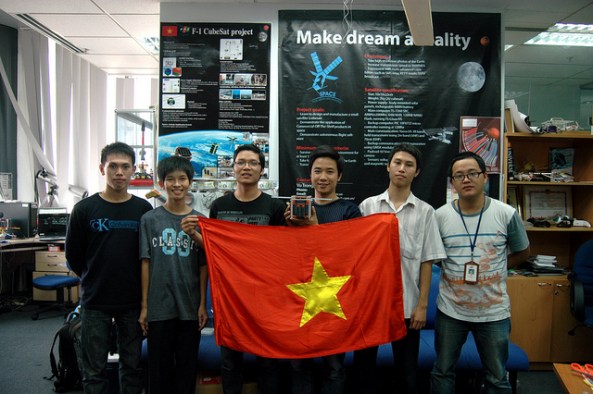
FSpace team members Phạm Quang Hưng, Đinh Quốc Trí, Khánh Has, Thu Trong Vu XV9AA, Hong Thai Pham and Dao Thang – picture taken by Nguyễn Trần Hoàng

The amateur radio F-1 CubeSat, built by the FSpace team of young engineers and students at the FPT University, is on its journey to the International Space Station (ISS). It is the first satellite to be built in Vietnam and the project has attracted much TV news coverage.

FSpace F-1 Amateur Radio CubeSat

F-1 carries a low-resolution C328 camera for an earth observation mission. The camera is capable of a maximum resolution of 640 by 480 pixels with 8 bit color. Images will be downloaded when commanded by the FSpace ground station.

There is a 3-axis magnetometer (developed by Angstrom Space Technology Center, Uppsala University, Sweden) and several temperature sensors.

The satellite’s callsign is XV1VN and the communications subsystem is built around two Yaesu VX-3R amateur radio handheld transceivers. One will operate on UHF the other on VHF.
Yaesu VX-3R1 transmits on 437.485 MHz FM, it has no battery so will operate on solar power only. As a result it will only be active when the satellite is in sunlight and when active the output power will vary between 0.1 and 0.3 watts depending on the amount of illumination. The antenna is a half-wave dipole. The FM beacon will send Morse code at 10 words per minute every 30 seconds (configurable). A sample of the beacon can be heard here.

VX-3R2 operates on 145.980 MHz FM and is connected to Lithium-Polymer (LiPo) batteries so will operate in both dark and sunlight. The power output is 1 watt into a half-wave dipole antenna. Using a TinyTrak4 packet radio modem it will send an AFSK 1200 bps AX.25 packet every 60 seconds (configurable).

F-1 was launched along with four other CubeSats in the HTV-3 cargo vessel on an H-IIB rocket from the Tanegashima Space Center, Japan, on July 21 at 02:06 UT and will arrive at the ISS on July 27.

F-1 in the JEM-Small Satellite Orbital Deployer (J-SSOD)

It will remain on the ISS until September when it will be deployed by Japanese astronaut and radio amateur Akihiko Hoshide KE5DNI using the ISS Kibo robot arm.

F-1 is mounted in a JEM-Small Satellite Orbital Deployer (J-SSOD) with the amateur radio TechEdSat and FITSat-1 CubeSats. In a second deployment pod are WeWish and a scientific 2U CubeSat Raiko. The CubeSats will be deployed into a 400 km orbit and should have a lifetime of 3 or 4 months before re-entering the Earth’s atmosphere and burning up.

In this video the team from FPT University sing the song “Vietnam’s orbit”. Artist/singer Trương Quý Hải has supported the F-1 CubeSat project from the beginning and composed the song just a few weeks before the launch. The accompanying music clip was completed just hours before the launch of F1. The team very much appreciated this.

Watch Quỹ đạo Việt Nam – Trương Quý Hải – “Vietnam’s Orbit” by Trương Quý Hải

A video depicting the planned deployment of the F-1 CubeSat, callsign XV1VN, from the ISS can be seen at http://www.uk.amsat.org/?p=8446

FSpace information for radio amateurs http://fspace.edu.vn/?page_id=27

Bentre News report http://www.youtube.com/watch?v=9gmffi2rQPQ

VN Express report http://www.youtube.com/watch?v=Ah8w1my41VE

VTV1 http://www.youtube.com/watch?v=uiEeaGN5Y6E

The five CubeSats on the HTV-3 launch are:

+ F-1
http://fspace.edu.vn/?page_id=10
On-board camera for earth observation mission
Yaesu VX-3R 1, 437.485 MHz FM downlink:
o Solar cell power only, operates in sunlight only
o Output power: between 0.1W and 0.3W depending on illumination, half-wave dipole antenna
o Morse code beacon (10 chars) using FM CW every 30 seconds, listen here

Yaesu VX-3R 2, 145.980 MHz FM downlink:
o Rechargeable battery, operates in dark and sunlight
o Output power: max 1.0W, half-wave dipole antenna
o AFSK 1200bps, half duplex, one AX.25 packet every 60 seconds

+ We Wish
http://www.meisei.co.jp/news/2011/0617_622.html
Infrared camera for environmental studies
Downlink on 437.505 MHz

+ FITSat 1
http://www.fit.ac.jp/~tanaka/fitsat.shtml
High-speed data test, high power LED visual tracking
CW Beacon 437.250 MHz,
FM Data   437.445 MHz,
High speed data 5840.00 MHz.

+ TechEdSat
http://ncasst.org/techedsat.html
http://www.uk.amsat.org/5018
Downlink on 437.465 MHz

+ Raiko – the only non-amateur radio CubeSat
http://tinyurl.com/RAIKO-CubeSat (Google English)
2U CubeSat, photography, Ku-band beacon

Astronaut Tim Peake invites students to apply for space class of 2013

European Space Agency (ESA) astronaut of British nationality Tim Peake is encouraging school children to get fit and stay active at the Farnborough International Airshow this week. Budding young astronauts aged 8 to 13 from across the UK are invited to take part in the international challenge Mission X: Train Like an Astronaut – a programme to encourage school students to focus more on fitness and nutrition.

Tim Peake.

The programme developed by the partners of the International Space Station (ISS) uses astronaut training to teach how good diet and exercise play an important role in human performance in space and on the Earth. The programme is free and the activities can be used by individuals, schools or community groups. The international challenge will start in January 2013.

Mission X logoTim Peake is taking a short break from his own astronaut training to attend the Airshow and invite schools to participate in the Mission X: Train Like an Astronaut 2013 challenge. At Farnborough Airshow Tim spoke to teachers, students and families about his own astronaut training and challenged them to take part in the astronaut fitness programmes available as part of Mission X.

Tim as well as being a test pilot and ESA astronaut is also a keen runner, skier and scuba diver.
4000 UK students from over 44 British schools have already taken part in the Mission X challenges in 2011 and 2012. Students had the opportunity to take part in live link-ups with the International Space Station and find out about life in space. As well as Tim Peake, Mission X UK has been supported by ESA astronauts Andr Kuipers and Paolo Nespoli, NASA astronaut Piers Sellers and private astronaut Richard Garriott.
Jeremy Curtis, Head of Education at the UK Space Agency noted:

The UK Space Agency is enabling children to access astronaut training and nutrition regimes and learn about the science behind them

“This is a unique opportunity to find out first hand about astronaut training and to find out how you can get involved in Mission X – Train Like An Astronaut. The UK Space Agency is enabling children to access astronaut training and nutrition regimes and learn about the science behind them. The children taking part will also learn about space and could be the space explorers of the future.”

Tim Peake commented:
Spaceflight can be physically demanding and part of my job is to train hard so that I‘m always ready to go into space

“Being fit and healthy is a key requirement for future astronauts. Spaceflight can be physically demanding and part of my job is to train hard so that I‘m always ready to go into space. It’s much easier to exercise on earth than in microgravity! The real mission is to encourage kids today to exercise and eat a healthy diet, and astronaut training exercises are an exciting, fun way to do it.”

People have been flocking from around the world to visit the UK Space Agency in the Space Zone at Farnborough. The latest industry developments and cutting edge technology are on display to demonstrate the work being done to layout the future direction for space. Space is a growing industry with a bright future. One of the ways the Agency nourishes and supports it is by inspiring the next generation of space scientists, engineers and enthusiasts.

The next Mission X challenge will be launching in January 2013 – with the expectation of doubling the intake from 4000 to 8000 students across the UK. To find out more about how your children or school can be involved, register your interest.

CubeSat Launch Success

The HTV-3 cargo vessel carrying five CubeSats blasted off on an H-IIB rocket from the Tanegashima Space Center on Saturday, July 21 at 02:06 UT on its way to the International Space Station (ISS).

On July 27 it is scheduled to arrive at the ISS  where it will be grappled by the Expedition 32 crew using the station’s Canadarm2 robotic arm and attached to the forward end of the Harmony module to begin a stay of just under a month.

Onboard are four amateur radio CubeSats, F-1, We-Wish, FitSat-1 and TechEdSat along with a scientific CubeSat Raiko.

The CubeSats will remain on the ISS until the first week in September when they will be deployed by Japanese astronaut and radio amateur Akihiko Hoshide KE5DNI using the ISS Kibo robot arm.

The F-1 CubeSat carries a pair of Yaesu VX-3R handheld transceivers to provide communications on 145.980 MHz and 437.485 MHz FM using AX.25 packet radio data.

FITSAT-1 will carry an Optical Communications experiment that aims to write Morse Code across the night sky, although only when in range of Japan. It will also transmit CW on 437.250 MHz, FM AX.25 data on 437.445 MHz and high speed data on 5840.00 MHz.

We-Wish will transmit  on 437.505 MHz FM AX.25 data.
TechEdSat will transmit on 437.465 MHz and will also communicate via the Iridium and Orbcomm satellite phone networks, a first for a CubeSat.

Watch the launch of the HTV-3

Video of planned deployment of F-1 CubeSat XV1VN from the ISS http://www.uk.amsat.org/8446

F-1 CubeSat on TV http://www.uk.amsat.org/8861

Live TV broadcast for launch of HTV-3 CubeSats

FSpace, the team of young engineers and students at the FPT University who developed the amateur radio F-1 CubeSat, report on the final launch preparations for the HTV-3 cargo vessel that will carry five CubeSats to the International Space Station (ISS).

FSpace say final inspection was performed on July 9, and from July 13-15, a rehearsal was conducted simulating the launch operation. Late access cargo loading will continue until July 19 then the hatch will be closed and the H-IIB launch vehicle with the HTV-3 will be moved to the launch pad. The launch is planned for July 21 at 02:18 UT.

FSpace report that live TV coverage will be available at these URL’s:

– NASA TV HD (HD resolution, for high speed connections) http://www.ustream.tv/nasahdtv

– NASA TV (standard resolution, for lower speed connections) http://www.nasa.gov/multimedia/nasatv/index.html

– Live webcam from Tanegashima launch pad (automatically updated once every few minutes)  http://space.jaxa.jp/tnsc/webcam/index_e.shtml

Read the full FSpace report at http://fspace.edu.vn/?p=716&lang=en

It is planned that the CubeSats will be deployed from the space station in September by Japanese astronaut Akihiko Hoshide KE5DNI using the ISS Kibo robot arm. The five CubeSats are:

+ F-1
http://fspace.edu.vn/?page_id=10
On-board camera for earth observation mission
Yaesu VX-3R 1, 437.485 MHz FM downlink:
o Solar cell power only, operates in sunlight only
o Output power: between 0.1W and 0.3W depending on illumination, half-wave dipole antenna
o Morse code beacon (10 chars) using FM CW every 30 seconds, listen here

Yaesu VX-3R 2, 145.980 MHz FM downlink:
o Rechargeable battery, operates in dark and sunlight
o Output power: max 1.0W, half-wave dipole antenna
o AFSK 1200bps, half duplex, one AX.25 packet every 60 seconds

+ We Wish
http://www.meisei.co.jp/news/2011/0617_622.html
Infrared camera for environmental studies
Downlink on 437.505 MHz

+ FITSat 1
http://www.fit.ac.jp/~tanaka/fitsat.shtml
High-speed data test, high power LED visual tracking
CW Beacon 437.250 MHz,
FM Data   437.445 MHz,
High speed data 5840.00 MHz.

+ TechEdSat
http://ncasst.org/techedsat.html
http://www.uk.amsat.org/5018
Downlink on 437.465 MHz

+ Raiko – the only non-amateur radio CubeSat
http://tinyurl.com/RAIKO-CubeSat (Google English)
2U CubeSat, photography, Ku-band beacon

A video depicting the planned deployment of the F-1 CubeSat, callsign XV1VN, from the ISS can be seen at http://www.uk.amsat.org/?p=8446

F-1 CubeSat Blog on Facebook https://www.facebook.com/groups/116436068290/

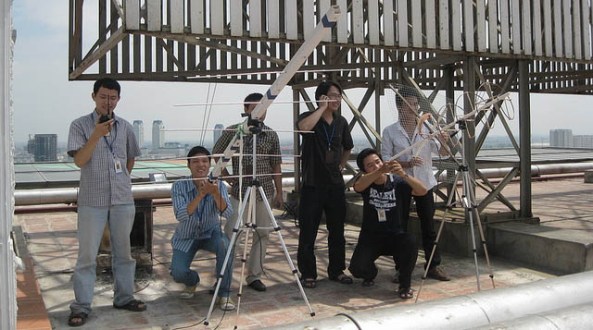
FSpace Team with home made antennas for NOAA weather satellite reception

Three Radio Hams Scheduled to Head to ISS This Weekend

Akihiko Hoshide KE5DNI, Yuri Malenchenko RK3DUP and Sunita Williams KD5PLB

ARRL report that NASA will televise the launch and docking of the next mission to the International Space Station (ISS), scheduled for 8:40 PM (CDT) Saturday, July 14 (0140 UT, Sunday, July 15).

NASA Flight Engineer Sunita Williams, KD5PLB, along with Russian cosmonaut Yuri Malenchenko, RK3DUP, and Japan Aerospace Exploration Agency astronaut Akihiko Hoshide, KE5DNI, are completing preparations as they undergo their final Soyuz spacecraft fit. Live NASA TV coverage of the Soyuz TMA-05M spacecraft launch from the Baikonur Cosmodrome in Kazakhstan begins at 8:30 PM CDT on Saturday, July 14 (0130 UT July 15).

The trio will arrive at the station on July 16, joining NASA Flight Engineer Joe Acaba, KE5DAR, and two Russian cosmonauts: Expedition 32 Commander Gennady Padalka, RN3DT, and Flight Engineer Sergei Revin, RN3BS. Acaba, Padalka and Revin have been aboard the ISS since mid-May. Williams, Malenchenko and Hoshide — who also will be part of the Expedition 33 crew starting in September — will return to Earth in mid-November. Source ARRL

NASA TV’s scheduled coverage is available at,
http://www.arrl.org/news/three-hams-scheduled-to-head-to-iss-this-weekend

Soyuz FG Rocket with the Soyuz TMA-05M Spacecraft – Roscosmos

F-1 CubeSat on TV

The Vietnamese TV station VTV1 broadcast a news story about the amateur radio CubeSat F-1, callsign XV1VN, due to be launched to the International Space Station (ISS) on July 21.

The broadcast shows students from the FPT University in Hanoi who are involved in the project and has an interview with Thu Trong Vu XV9AA.

F-1 carries a low-resolution camera (640×480), a 3-axis magnetometer and two Yaesu VX-3R transceivers using 145.980 and 437.485 MHz.

It is planned to launch to the ISS on July 21 in the HTV-3 cargo vessel and be deployed in September by Japanese astronaut Akihiko Hoshide KE5DNI using the ISS Kibo robot arm.


Watch CubeSat F-1 on VTV1

For the latest news on F-1 see the FSpace website http://fspace.edu.vn/

Video depicting F-1 CubeSat XV1VN deployment from the ISS http://www.uk.amsat.org/?p=8446

Vietnam Student CubeSat F-1 http://www.uk.amsat.org/?p=5025