ARISS and Ham Radio Opportunities Video

Dayton 2012 presentation by Mark Hammond N8MH describing the different roles and opportunities for Technical Mentors and Ground Station operators to play in an ARISS contact with the International Space Station.

Watch ARISS and Ham Radio Opportunities by N8MH Dayton 2012.mp4

Amateur Radio on the International Space Station ARISS http://ariss.rac.ca/

Video of HTV-3 Spacecraft and CubeSat Deployer

Kibo Robot Arm CubeSat Deployment

The Japanese H-II Transfer Vehicle “KOUNOTORI” (HTV) is an unmanned transfer vehicle which can carry amateur radio CubeSats along with food, clothes and equipment needed for experiments in the International Space Station (ISS).

“KOUNOTORI 3” (HTV-3) is planned to launch on July 21, 2012 from Tanegashima Space Center and will be carrying four amateur radio CubeSats WE-WISH, FITSAT-1, F-1, and TechEdSat along with the CubeSat Raiko which carries a beacon in KU-Band.

This video, produced by the Japanese Space Agency JAXA, gives an overview of the HTV-3 and its payloads. At  3:56 into the video there is a segment on the JEM-Small Satellite Orbital Deployer  (J-SSOD) that Japanese astronaut Akihiko Hoshide KE5DNI will use to deploy the CubeSats from the ISS. The Software Defined Radio gets a mention at 7:34.

Watch KOUNOTORI3 (HTV3) – Third Expedition to Space at
http://www.youtube.com/watch?v=3uxRbANmxik

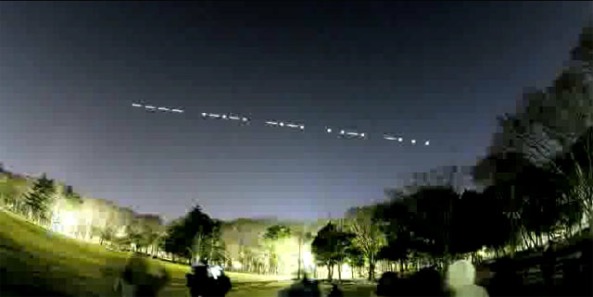
FITSAT-1 to Write Morse Code Across The Night Sky

FITSAT-1 plans to use LED’s to signal in Morse code

The Amateur Radio CubeSat FITSAT-1 will carry an Optical Communications experiment that aims to write Morse Code across the night sky.

Kibo Robot Arm CubeSat Deployment

Kibo Robot Arm CubeSat Deployment

This innovative satellite also plans to transmit 115.2 kbps digital data in the Amateur Satellite Service 5.8 GHz band using a transmitter capable of 2 watts output.

FITSAT-1 (aka NIWAKA) is a 1U CubeSat (10*10*10cm) developed by students at the Fukuoka Institute of Technology (FIT).

In July 2012 it should be carried to the International Space Station (ISS) in the HTV-3 cargo vessel.  FITSAT-1 will then be deployed from the ISS around September by Japanese astronaut Akihiko Hoshide KE5DNI using the Kibo robot arm.

The main mission will be to demonstrate high speed data transfer from a satellite, it can transmit a VGA-size (640×480 pixel) JPEG photograph in only 5 to 6 seconds.

Takushi Tanaka JA6AVG and FITSAT

Takushi Tanaka JA6AVG and FITSAT

The second mission is to determine if a satellite can be made to appear as an “artificial star” using high-output LEDs in flash mode. The light from this flash will be received by the ground station, which has a telescope with photo-multiplier linked to a 5.8GHz parabola antenna. This is a basic experiment to investigate the possibility of optical communication with satellites.

A UHF AX25 1k2baud transceiver will be carried for telemetry and telecommand purposes and a UHF CW beacon will also be provided. It will be deployed along with the satellites RAIKO and WE-WISH, F-1 and TechEdSat into a 350x350km 51.6deg inclination orbit.

The following downlink frequencies have been coordinated by the IARU Satellite Frequency Coordination Panel: CW 437.250 MHz, FM 437.445 MHz, High speed data 5840.00 MHz.

FITSAT-1 information, pictures and deployment movie http://www.fit.ac.jp/~tanaka/fitsat.shtml

Kibo Robot Arm http://kibo.jaxa.jp/en/about/kibo/rms/

IARU Satellite Frequency Coordination Panel pages hosted by AMSAT-UK http://www.amsat.org.uk/iaru/

Columbus Ham Radio Powered-On

Joe_Acaba_KE5DAR

Joe Acaba KE5DAR

NASA Flight Engineer Joe Acaba, KE5DAR, and his two Russian crewmates, Soyuz Commander Gennady Padalka, RN3DT, and Flight Engineer Sergei Revin, RN3BS, arrived on the International Space Station (ISS) this week.

They joined the three other radio amateurs on the ISS – Expedition 31 Commander Oleg Kononenko, RN3DX, of the Russian Federal Space Agency, Flight Engineer Don Pettit, KD5MDT, of NASA and Flight Engineer Andrei Kuipers, PI9ISS, of the European Space Agency.

A status report video released by NASA for May 14-18 notes that Joe Acaba, KE5DAR, powered on the ham radio in the ESA Columbus module. The ham radio reference occurs 09:05 into the video.


Watch ISS Update: Weekly Recap for May 14-18, 2012

The NASA ISS daily status report for May 18 notes that Joe KE5DAR also powered on the ham radio station in the Russian Service Module.
http://www.nasa.gov/directorates/heo/reports/iss_reports/2012/05182012.html

Listening to the International Space Station http://www.uk.amsat.org/3491

SpaceX Dragon to Blast-Off to ISS

Classroom preperation for the student spaceflight experiments program SSEP

On Tuesday, May 22 at 07:44 UT SpaceX’s Dragon hopes to transport the student payload Aquarius on SSEP Mission 1 to the International Space Station (ISS).

The set of SSEP Mission 1 experiments, called Aquarius, was originally slated to fly aboard the Soyuz 30. But in an interesting twist of fate, the experiments were re-manifested on the maiden voyage of the SpaceX Dragon to the ISS. Aquarius not only becomes part of a historic first but also allows the space station to remain an out-of-this-world platform to engage students in STEM — science, technology, engineering and mathematics.

The SpaceX Dragon launch will be broadcast live on the Internet details at
http://www.nasa.gov/nasatv

NASA – Space Station — Here We Come!
http://www.nasa.gov/audience/foreducators/station-here-we-come.html

Three More Radio Hams Venture to ISS Next Week

ISS Expedition 31 Crew 640

The six radio hams comprising the ISS Expedition 31 crew. In the front row are Russian cosmonauts Oleg Kononenko RN3DX (right), commander; and Gennady Padalka RN3DT, flight engineer. Pictured from the left (back row) are NASA astronaut Joe Acaba KE5DAR, Russian cosmonaut Sergei Revin RN3BS, European Space Agency astronaut Andre Kuipers PI9ISS and NASA astronaut Don Pettit KD5MDT, all flight engineers. Photo credit: NASA

The ARRL report that NASA will televise the launch and docking of the next mission, carrying three radio amateurs to the International Space Station (ISS), scheduled for May 14.

NASA Flight Engineer Joseph Acaba, KE5DAR, and his two Russian crewmates, Soyuz Commander Gennady Padalka, RN3DT, and Flight Engineer Sergei Revin, RN3BS, are completing their training as they undergo Soyuz spacecraft fit.

Live NASA TV coverage of the Soyuz TMA-04M spacecraft launch from the Baikonur Cosmodrome in Kazakhstan begins at 9 PM CDT on Monday, May 14 (0200 UTC May 15), with the launch scheduled for 10:01 PM CDT (0301 UTC).

The trio will arrive at the station May 16, joining Expedition 31 Commander Oleg Kononenko, RN3DX, of the Russian Federal Space Agency, Flight Engineer Don Pettit, KD5MDT, of NASA and Flight Engineer Andrei Kuipers, PI9ISS, of the European Space Agency, who have been aboard the ISS since December 2011. Padalka, Acaba and Revin will transition to the Expedition 32 crew in July and return to Earth in mid-September.

For NASA TV’s scheduled coverage see the full ARRL story at http://www.arrl.org/news/three-hams-venture-to-iss-next-week

You can watch NASA TV online at http://www.nasa.gov/multimedia/nasatv/index.html

Listening to the International Space Station http://www.uk.amsat.org/3491