Video of Space Station Reception on 145.800 MHz FM

Baofeng UV-3R

Baofeng UV-3R

On Monday, January 9, Edmund 2E0MDO received the International Space Station (ISS) using a Baofeng UV-3R hand-held with its supplied antenna. He has made a video to show how you can hear the ISS with simple equipment. He writes:

Continuing the theme of receiving the International Space Station in random car parks in Southern England, using various low-tech cheap equipment…

This time I was near Worthing (West Sussex) around 1020 GMT on Monday 9 January 2012. I am using my old camera again so hopefully the audio is not as overdriven as the Portsmouth video!

The signal from the space-station I am receiving is on 145.800MHz, in narrow FM, at the top-end of the 2 meter amateur radio band. The signal going up to the space-station was coming from a school in France. Sadly I couldn’t receive that side of the conversation. The astronaut speaking is Dan Burbank, callsign KC5ZSX.

Watch International Space Station received in Worthing – 9 January 2012

The handheld is the Mark II version of the very cheap and cheerful (but excellent value for the money) Baofeng UV-3R, using just the supplied rubber duck as an antenna. The smallest step size on the radio is 5kHz, so I couldn’t do anything about the Doppler shift unfortunately! 145.800 was close enough though.

There is slight breakthrough from pagers, which cannot be helped in a radio of this size and complexity. Using a bigger and better antenna might actually have made the breakthrough worse.

If I can receive the ISS, then *anybody* can! Go for it, whatever your receiving setup is!!

For more information on hearing the ISS read ‘Listening to the International Space Station’ at http://www.uk.amsat.org/3491

The Baofeng UV-3R MK-II is available for around £30 ($45) from many on-line suppliers. See this review of the older MK-I http://www.essexham.co.uk/news/baofeng-uv-3r-handheld-radio-review.html

Programming the Baofeng UV-3R From a PC
http://www.essexham.co.uk/news/programming-the-baofeng-uv-3r-from-a-pc.html

Setting up the Baofeng UV-3R for a Repeater
http://www.essexham.co.uk/news/setting-up-the-baofeng-uv-3r-for-gb3da-danbury-repeater.html

ARISS ham radio contact with Descartes High School, France
http://www.southgatearc.org/news/january2012/ariss_event_0901.htm

Listening to the International Space Station

International Space Station

International Space Station

The amateur radio station on the ISS can be received using very simple equipment.

History

The first Amateur Radio equipment was delivered to the International Space Station (ISS) in September 2000 and an Amateur Radio station was established onboard for use by Astronauts who are licenced Radio Amateurs. Commander William Shepherd, KD5GS, made the first Amateur contacts in November of that year.

Most of the astronauts on the International Space Station are licenced Radio Amateurs and sometimes during their spare time they talk to other Radio Amateurs back on earth. There is a special thrill in talking to an astronaut out in space!

What equipment do you need to hear the ISS ?

Baofeng UV-3R

You can hear the ISS on a Baofeng UV-3R

Almost any 144 MHz FM rig will receive the ISS, you can even use a general coverage VHF scanner with an external antenna. As far as the antenna is concerned the simpler the better. My favourite is a ¼ wave ground plane as it has a high angle of radiation. I’ve found large 2m colinears don’t work quite as well since the radiation pattern is concentrated at the horizon.

You can receive the ISS outdoors using a 2 metre hand-held with its helical antenna but a 1/4 wave whip will give far better results.

In the UK we use narrow 2.5 kHz deviation FM but the ISS transmits using the wider 5 kHz deviation used in much of the world. Most rigs can be switched been wide and narrow deviation filters so select the wider deviation. Hand-held rigs all seem to have a single wide filter fitted as standard.

What will you hear ?

Much of the time the Space Station equipment operates in “automatic mode”. It can act as an AX.25 packet repeater, voice repeater or transmit Slow Scan Television (SSTV) pictures. Voice and SSTV transmissions take place on 145.800 MHz FM, when they are not active AX.25 packet may be heard on 145.825 MHz.

The aim to start with is simply to listen to the sounds from the satellite. You can check the current mode of operation on the ISS Fan Club website.

Astronaut Susan Helms KC7NHZ having a contact

Astronaut Susan Helms KC7NHZ having a contact

The ISS amateur radio station is used for school contacts. These educational contacts enable students to communicate directly via Amateur Radio with the Astronauts and ask them questions. In recent years a number of UK schools have made contact with the space station thanks to GB4FUN and volunteers from AMSAT-UK.

When the astronauts put out a CQ call they also use 145.800 MHz FM but operate “split” listening for replies 600 kHz lower on 145.200 MHz. If you are lucky and hear them calling CQ just remember to activate your rigs repeater shift to ensure you reply on the correct frequency. You should never transmit on 145.800 MHz.

When to listen

The ISS is in a very low orbit and so is only in range 5 or 6 times each day and then only for a maximum of 10 minutes on the best orbit. This means you need to make sure you’re listening at the right time to hear it. There are a number of websites that tell you when to listen. I use the orbital predictions on the ISS Fan Club site.

Doppler Shift

The International Space Station is travelling around the Earth at over 28,000 Km/h. This high speed makes radio signals appear to shift in frequency, a phenomenon called Doppler Shift.

This Doppler shift will cause the ISS transmit frequency of 145.800 MHz to look as if it is 3.5 kHz higher in frequency, 145.8035, when ISS is approaching your location. During the 10 minute pass the frequency will move lower shifting a total of 7 kHz down to 145.7965 as the ISS goes out of range. To get maximum signal you ideally need a radio that tunes in 1 kHz or smaller steps to follow the shift but in practice acceptable results are obtained with the radio left on 145.800 MHz.

AMSAT-UK

The Amateur Satellite organisation in this country is AMSAT-UK. Its members are involved in the construction of new Amateur Radio satellites and in running the stations used for ISS school contacts and. The group produce a quarterly A4 colour publication OSCAR News that is full of information on the Amateur satellites. You can join online via the AMSAT-UK website.

Get the latest status of the space station at the ISS Fan Club http://www.issfanclub.com/

Orbital Predictions (select ISS) http://www.amsat.org/amsat-new/tools/predict/

The IZ8BLY Vox Recoder enables you to record the ISS on 145.800 MHz FM while you’re away from home http://antoninoporcino.xoom.it/VoxRecorder/

Amateur Radio on the International Space Station (ARISS) http://www.rac.ca/ariss/oindex.htm
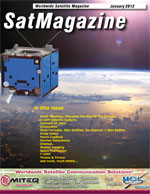
CubeSats Feature in Sat Magazine

The January issue of the free publication Sat Magazine covers a number of amateur radio satellites.

On pages 54-65 is an article about Small Satellites. Among the many amateur radio satellites mentioned are FITSAT-1, WE WISH, the Vega CubeSats, QB50, AubieSat-1, Prime Explorer-1, FASTRAC.and ARISSat-1/KEDR. The AMSAT-India 435/145MHz Linear Transponder is also mentioned.

Download the January Sat Magazine from http://www.satmagazine.com/2012/SM_Jan_2012.pdf

Sat Magazine http://www.satmagazine.com/

The DIY Magic of Amateur Radio Video

A new promotional video has been released to attract Hackers, Makers and Innovators to amateur radio.

The video features well known hacker and maker Diana Eng KC2UHB along with Ham Nation’s Bob Heil K9EID and ISS Astronaut Doug Wheelock KF5BOC. It follows some of the innovative, imaginative and fun ways “hams” use radio technology in new and creative ways and points out that amateur radio clubs are similar to hacker groups.

Watch The DIY Magic of Amateur Radio in HD

Featured in the video is the Ham Radio HSMM-MESH™. A high speed, self discovering, self configuring, fault tolerant, wireless computer network that can run for days from a fully charged car battery, or indefinitely with the addition of a modest solar array or other supplemental power source. The focus is on emergency communications. http://www.hsmm-mesh.org/

A Hi-Res 480 MB version of the DIY Magic DVD can be downloaded from http://p1k.arrl.org/pub/pr/

Diana Eng KC2UHB joins ARRL Public Relations Committee
http://www.southgatearc.org/news/march2010/diana_eng_joins_arrl.htm

London Hackspace work on HackSat1 http://www.uk.amsat.org/2482

Hackers and Makers in AMSAT-UK are building the amateur radio satellite FUNcube. AMSAT-UK publishes a colour A4 newsletter, OSCAR News, which is full of Amateur Satellite information. Free sample issue at http://www.uk.amsat.org/on_193_final.pdf
Join online at http://tinyurl.com/JoinAMSAT-UK

Soyuz rocket blasts off for International Space Station A Russian Soyuz rocket, carrying three astronauts, has blasted off to the International Space Station from Kazakhstan.

The rocket carrying Russian cosmonaut Oleg Kononenko RN3DX, Nasa astronaut Don Pettit KD5MDT and the European Space Agency’s Andre Kuipers PI9ISS lifted off under freezing conditions at the Baikonur Cosmodrome in Kazakhstan.

The crew, who will stay at the International Space Station until March, are on a mission to bring the station back up to full manpower after an August cargo launch accident disrupted flights.

The all-veteran crew is scheduled to reach the orbital outpost at 1522 GMT on Friday. They will join station commander Dan Burbank and two Russian cosmonauts who arrived last month, bringing the complex back to its full staff of six.

With the space shuttles’ retirement, Nasa is dependent on Russia to fly crews to the station, a service that currently costs the United States about $350 million (£222 million) a year.

The station, a $100 billion project of the United States, Russia, Europe, Japan and Canada, is a multi-purpose research laboratory for biology, physics, astronomy and other studies that orbits about 240 miles above Earth.

Cuban TV features Amateur Satellite Operation

Hector Luiz Martinez CO6CBF was interviewed on Cuban TV about his amateur radio satellite operating.

Hector, CO6CBF, got his first license at the age of 11 and has been licensed for 11 years. He first became interested in satellites when he heard about the deployment of Suitsat from the International Space Station and he began to search for information about space communications. He eventually built an antenna and made his first satellite contact on January 27, 2011 via the AO-51 satellite.

Since then he has had a contact with an astronaut on the International Space Station and was recently awarded the first satellite VUCC from Cuba. The satellite VHF/UHF Century Club (VUCC) is awarded for contacts with stations in 100 grid squares.

Hector is one of only three radio amateurs in Cuba who are active on the satellites.

Watch the Spanish language TV interview which starts with Hector assembling his satellite antenna