HuskySat-1 with 145/435 transponder to deploy from Cygnus

HuskySat-1

HuskySat-1

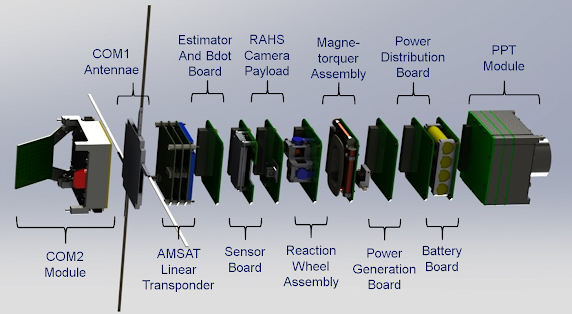
ARRL reports University of Washington’s HuskySat-1 3U CubeSat, launched November 2, 2019, is set to deploy January 31 after the vehicle that carried it to the International Space Station undocks.

Update January 31, 2020: HuskySat-1 is expected to be deployed by Cygnus at 22:30 GMT on Jan 31, the 435.800 MHz beacon should be activated at 23:05 GMT.

ARRL say:

HuskySat-1 has remained stowed aboard a Northrop Grumman Cygnus supply vehicle. Within 24 hours after Cygnus’ departure from the ISS, HuskySat-1 and SwampSat 2 will be deployed into orbit. After deployment, HuskySat-1’s 1,200 bps BPSK beacon on 435.800 MHz should be active and decodable with the latest release of AMSAT’s FoxTelem software. HuskySat-1 is expected to carry out its primary mission before being turned over to AMSAT for amateur radio operation.

HuskySat-1 features a 30 kHz wide V/U linear transponder for SSB and CW. The uplink passband will be 145.910 – 145.940 MHz LSB/CW. The downlink passband will be 435.840 – 435.810 MHz USB/CW (inverting). Telemetry will be transmitted on 435.800 MHz, 1k2 bps BPSK with an experimental downlink at 24.049 GHz.

Read the full ARRL story at
http://www.arrl.org/news/huskysat-1-with-vhf-uhf-linear-transponder-set-to-deploy-soon

HuskySat-1 site https://sites.google.com/uw.edu/huskysatellitelab/huskysat-1

Slow Scan TV from ISS January 30-31

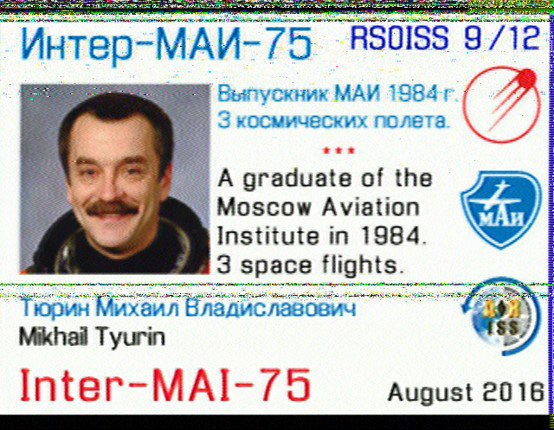
ISS SSTV MAI-75 image 9/12 received by Chertsey Radio Club on Baofeng handheld

ISS SSTV image 9/12 received by Chertsey Radio Club on Baofeng handheld

Russian cosmonauts are expected to activate Slow Scan Television (SSTV) image transmissions on 145.800 MHz FM from the International Space Station on Thursday, January 30 and Friday, January 31 as part of the MAI-75 experiment.

The expected activation times are:
• Thursday, Jan 30 at 13:30 – 19:00 GMT
• Friday, Jan 31 at 15:00 -17:30 GMT

Note: The computer that supports this activity failed recently so a replacement is being used. It is unknown what impact this may have to the operations.

Transmissions will be made on 145.800 MHz FM (5 kHz deviation) in the SSTV mode PD-120. Once received, images can be posted and viewed by the public at http://www.spaceflightsoftware.com/ARISS_SSTV/index.php

ISS SSTV uses a Kenwood TM D710E transceiver which is part of the amateur radio station located in the Russian ISS Service Module.

Please note that SSTV events are dependent on other activities, schedules and crew responsibilities on the ISS and subject to change at any time. You can check for updates regarding planned operation at:
ISS Ham https://twitter.com/RF2Space
ARISS Status https://twitter.com/ARISS_status
ARISS SSTV Blog https://ariss-sstv.blogspot.com/
AMSAT Bulletin Board http://www.amsat.org/mailman/listinfo/amsat-bb

You can receive signals from the ISS when it’s in range of the UK from anywhere in the world using these WebSDR’s, select 145800.00 kHz and FM:
SUWS VHF/UHF/Microwave WebSDR https://amsat-uk.org/2014/03/19/suws-vhfuhfmicrowave-websdr/
144-146 MHz WebSDR at Goonhilly https://amsat-uk.org/2019/08/24/goonhilly-144-146-mhz-websdr/

Read the MagPi article Pictures from space via ham radio
https://www.raspberrypi.org/magpi/pictures-from-space-via-ham-radio/

ISS SSTV info and links https://amsat-uk.org/beginners/iss-sstv/

Qarman beacon telemetry information released

QARMAN CubeSat

QARMAN CubeSat

QARMAN, a nano-satellite designed and built at VKI, was launched to the International Space Station on December 5, 2019. Deployed is expected to take place in the week of February 12, 2020.

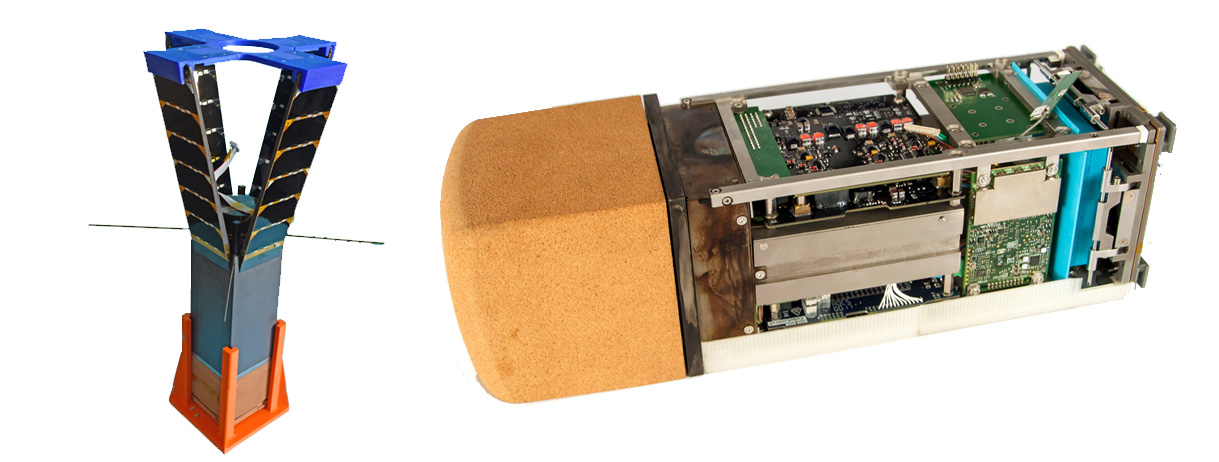
QARMAN (Qubesat for Aerothermodynamic Research and Measurements on AblatioN) is the world’s first CubeSat designed to survive atmospheric re-entry. Work on it started in 2013 at the von Karman Institute for Fluid Dynamics (VKI).

The aim of the QARMAN mission is to demonstrate the usability of a CubeSat platform as an atmospheric entry vehicle. Spacecraft descending towards a planet with an atmosphere experience very harsh environment including extreme temperatures (several thousand degrees).

Information about Qarman’s 437.350 MHz 9600 bps GMSK AX.25 beacon has now been released by the team.

Download the Qarman Beacon Definition QARMAN_BCNdef_v1.1

Download the Beacon Decoder spreadsheet QARMAN_BCNdecoder

Reports can be sent to operations@qarman.eu

ISS SSTV December 28 until January 1

ISS SSTV MAI-75 image 9/12 received by Chertsey Radio Club on Baofeng handheld

ISS SSTV image 9/12 received by Chertsey Radio Club on Baofeng handheld

Russian cosmonauts are expected to activate Slow Scan Television (SSTV) image transmissions on 145.800 MHz FM from the International Space Station from Saturday, December 28 to Wednesday, January 1.

ARISS will be supporting SSTV transmissions worldwide in memory of cosmonaut Alexei Leonov. Event runs from setup at 1100 GMT on December 28, 2019 until scheduled shutdown at 1820 GMT on January 1, 2020.

Transmissions will be sent on 145.800 MHz FM (5 kHz deviation) in the SSTV mode PD-120. Once received, images can be posted and viewed by the public at http://www.spaceflightsoftware.com/ARISS_SSTV/index.php

ISS SSTV uses a Kenwood TM D710E transceiver which is part of the amateur radio station located in the Russian ISS Service Module.

Please note that SSTV events are dependent on other activities, schedules and crew responsibilities on the ISS and subject to change at any time. You can check for updates regarding planned operation at:
ISS Ham https://twitter.com/RF2Space
ARISS Status https://twitter.com/ARISS_status
ARISS SSTV Blog https://ariss-sstv.blogspot.com/
AMSAT Bulletin Board http://www.amsat.org/mailman/listinfo/amsat-bb

The Polish ARISS Team have prepared an award for participants in this SSTV experiment. Please see https://ariss.pzk.org.pl/sstv/

You can receive signals from the ISS when it’s in range of the UK from anywhere in the world using these WebSDR’s, select 145800.00 kHz and FM:
SUWS VHF/UHF/Microwave WebSDR https://amsat-uk.org/2014/03/19/suws-vhfuhfmicrowave-websdr/
144-146 MHz WebSDR at Goonhilly https://amsat-uk.org/2019/08/24/goonhilly-144-146-mhz-websdr/

Read the MagPi article Pictures from space via ham radio
https://www.raspberrypi.org/magpi/pictures-from-space-via-ham-radio/

ISS SSTV info and links https://amsat-uk.org/beginners/iss-sstv/

ISS SSTV Dec 4, 5 and 6

ISS SSTV MAI-75 image 9/12 received by Chertsey Radio Club on Baofeng handheld

ISS SSTV MAI-75 image 9/12 received by Chertsey Radio Club on Baofeng handheld

Russian cosmonauts are expected to activate Slow Scan Television (SSTV) image transmissions on 145.800 MHz FM from the International Space Station on Wednesday to Friday, December 4, 5 and 6.

This is the schedule for the planned activation of the MAI-75 SSTV activity from the ISS.
• Dec 4: On – 12:00 GMT, Off – 16:50 GMT
• Dec 5: On – 11:25 GMT, Off – 17:15 GMT
• Dec 6: On – 10:20 GMT, Off – 16:40 GMT

Transmissions will be sent on 145.800 MHz FM (5 kHz deviation) in the SSTV mode PD-120. Once received, images can be posted and viewed by the public at http://www.spaceflightsoftware.com/ARISS_SSTV/index.php

ISS SSTV uses a Kenwood TM D710E transceiver which is part of the amateur radio station located in the Russian ISS Service Module.

Please note that SSTV events are dependent on other activities, schedules and crew responsibilities on the ISS and subject to change at any time. You can check for updates regarding planned operation at:
ISS Ham https://twitter.com/RF2Space
ARISS Status https://twitter.com/ARISS_status
ARISS SSTV Blog https://ariss-sstv.blogspot.com/
AMSAT Bulletin Board http://www.amsat.org/mailman/listinfo/amsat-bb

You can receive signals from the ISS when it’s in range of the UK from anywhere in the world using these WebSDR’s, select 145800.00 kHz and FM:
SUWS VHF/UHF/Microwave WebSDR https://amsat-uk.org/2014/03/19/suws-vhfuhfmicrowave-websdr/
144-146 MHz WebSDR at Goonhilly https://amsat-uk.org/2019/08/24/goonhilly-144-146-mhz-websdr/

Read the MagPi article Pictures from space via ham radio
https://www.raspberrypi.org/magpi/pictures-from-space-via-ham-radio/

ISS SSTV info and links https://amsat-uk.org/beginners/iss-sstv/

Inspiring Youth with Science in Space

Astronaut Sunita Williams KD5PLB answers questions from a student using amateur radio

Astronaut Sunita Williams KD5PLB answers questions from a student using amateur radio

NASA highlight the role of amateur radio in letting young people speak directly with astronauts and cosmonauts on the International Space Station:

An ARISS contact takes place as a part of a comprehensive suite of education activities. To prepare for an exchange, students study the space station and the research conducted there. They also learn about wireless technology, radio science, and satellite communication used for space exploration.

The space station must pass over these earthbound communicators during amateur radio transmissions in order to relay signals between the space station’s ham radio and ground receivers. Other factors affect the timing of scheduled contacts, including weather, crew availability, and the schedules of visiting vehicles.

These ham radio conversations usually last about 10 minutes. Crew members answer questions from students as they and community members look on. During a pass, the crew can answer an average of 18 questions, depending on their complexity.

Ham radio on the space station connects and inspires students in four ways: providing first-hand education about life in space, directly connecting students with space station crew, sharing amateur radio technologies, and building global partnerships.

Read the full NASA story at
https://www.nasa.gov/mission_pages/station/research/news/b4h-3rd/ge-inspiring-youth-with-space-science