CQ Magazine honours Britons involved in Astro Pi project

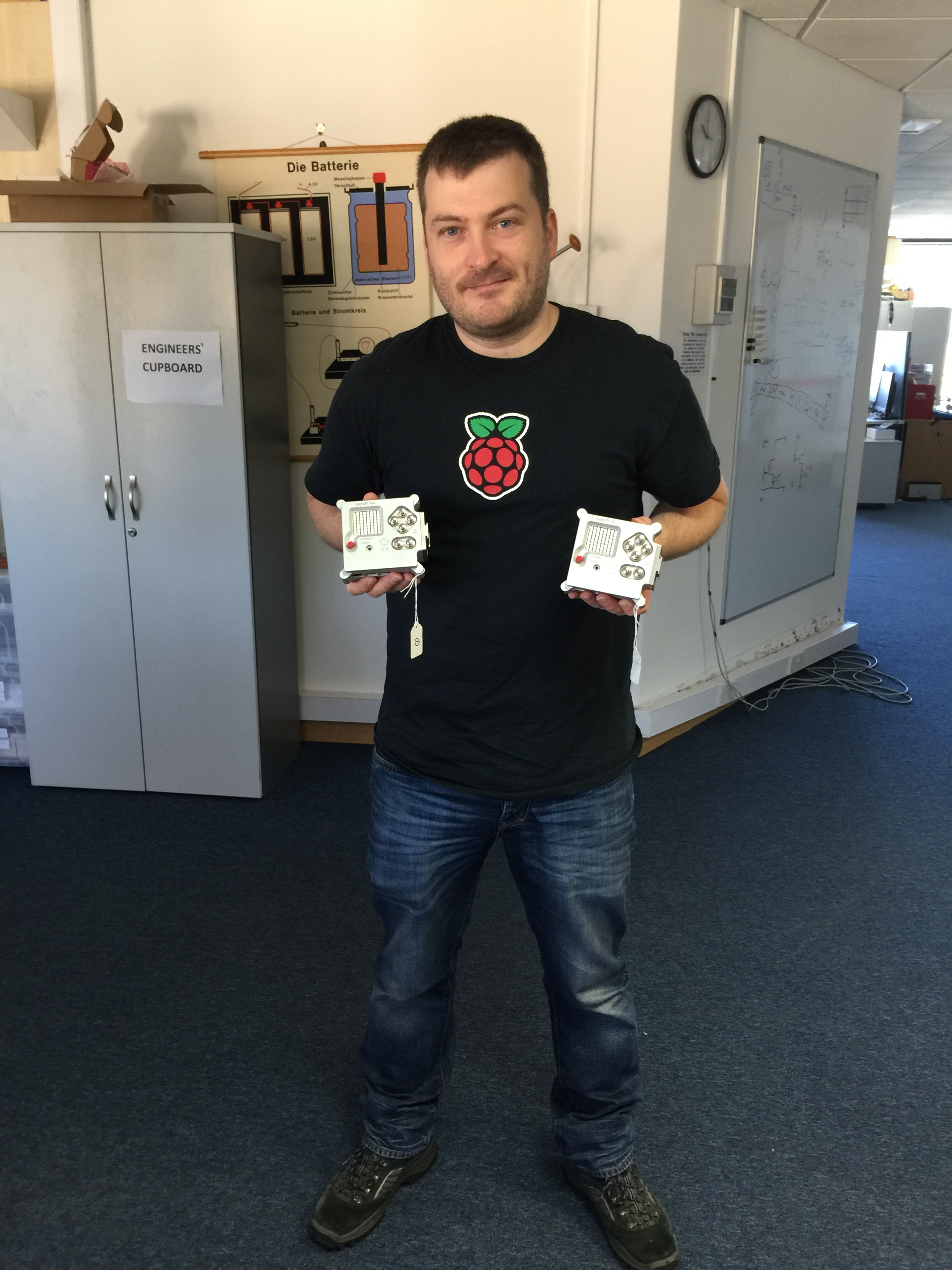
David Honess M6DNT with both ISS Astro Pi computers

David Honess M6DNT with both ISS Astro Pi computers

Radio amateurs David Honess, M6DNT, and Tim Peake, KG5BVI / GB1SS, have been inducted into the prestigious CQ Amateur Radio Hall of Fame.

The CQ Amateur Radio Hall of Fame honours those individuals, whether licenced radio amateurs or not, who have made significant contributions to amateur radio; and those amateurs who have made significant contributions either to amateur radio, to their professional careers or to some other aspect of life on our planet.

David Honess, M6DNT, developed the Astro Pi project which sent two Raspberry Pi computers to the International Space Station as platforms for students on Earth to write and run their own computer code in space. In November 2016 he was honored for this work with the Sir Arthur Clarke Award, presented by the Arthur C. Clarke Foundation and the British Interplanetary Society.

David said “I was really surprised when I heard I’d been inducted into the Hall of Fame, especially alongside Tim! Thank you to CQ magazine for the honour.”

“I’m so jealous of the kids these days, if you could have sent BBC Basic code to the Mir space station when I was kid I would have gone mad for it! Astro Pi gives young people a chance to be real ISS scientists, to have their code run in space and do something meaningful.”

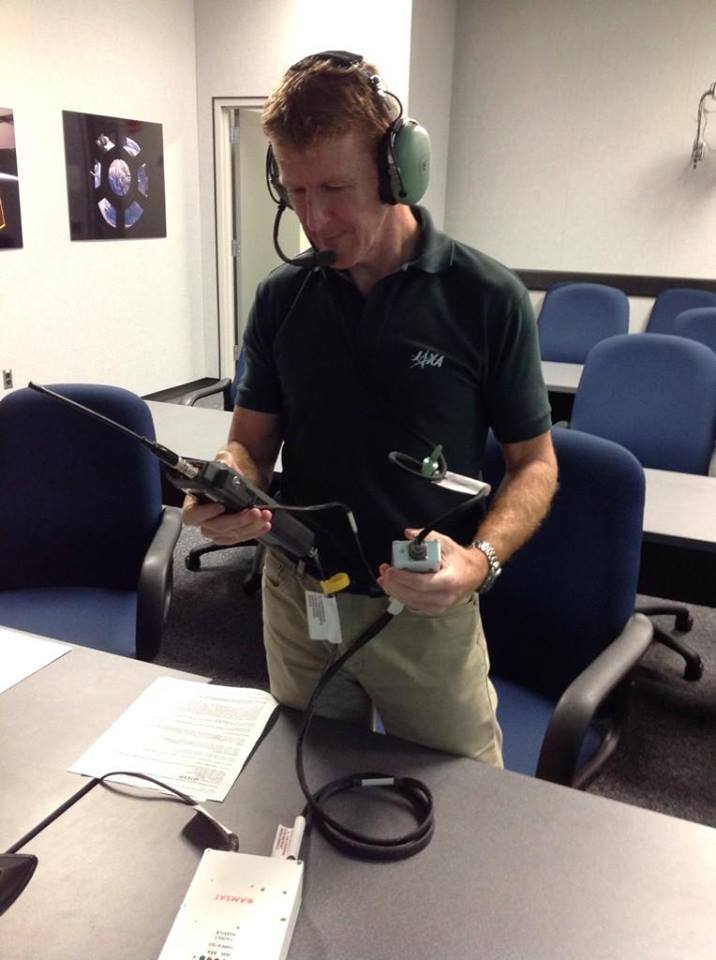
Tim Peake KG5BVI training on the amateur radio station equipment he would use on the ISS

Tim Peake KG5BVI training on the amateur radio station equipment he would use on the ISS

UK astronaut Tim Peake, KG5BVI /GB1SS, coordinated the International Space Station end of the Astro Pi project.

Tim was very active in the ARISS program during his mission on the ISS. In his free time he used the amateur radio station in the Columbus module to talk to students at schools in the UK and around the world. These contacts included the first use of Digital Amateur Television (DATV) transmissions to schools from space.

Amateur Radio on the International Space Station (ARISS)
http://www.ariss.org/

ARISS Principia UK school contacts https://principia.ariss.org/

Videos of Tim Peake GB1SS amateur radio contacts with UK schools
https://www.youtube.com/channel/UCQS-yDk7PdE9cRv4MNu8pCw/videos

Astro Pi: Your Code in Space https://www.raspberrypi.org/blog/tag/astro-pi/

Astro Pi https://astro-pi.org/
Twitter https://twitter.com/astro_pi
Izzy Astro Pi https://twitter.com/astro_pi_ir
Ed Astro Pi https://twitter.com/astro_pi_vis

CQ Amateur Radio Hall of Fame
http://www.cq-amateur-radio.com/cq_awards/cq_hall_of_fame_awards/cq_hall_of_fame_awards.html

David Honess, M6DNT, presented with Sir Arthur Clarke Award
https://amsat-uk.org/2016/11/25/radio-ham-awarded-space-achievement-honour/

LilacSat-1 CubeSat deployed from ISS

Students installing antennas at BY2HIT

Students installing antennas at BY2HIT

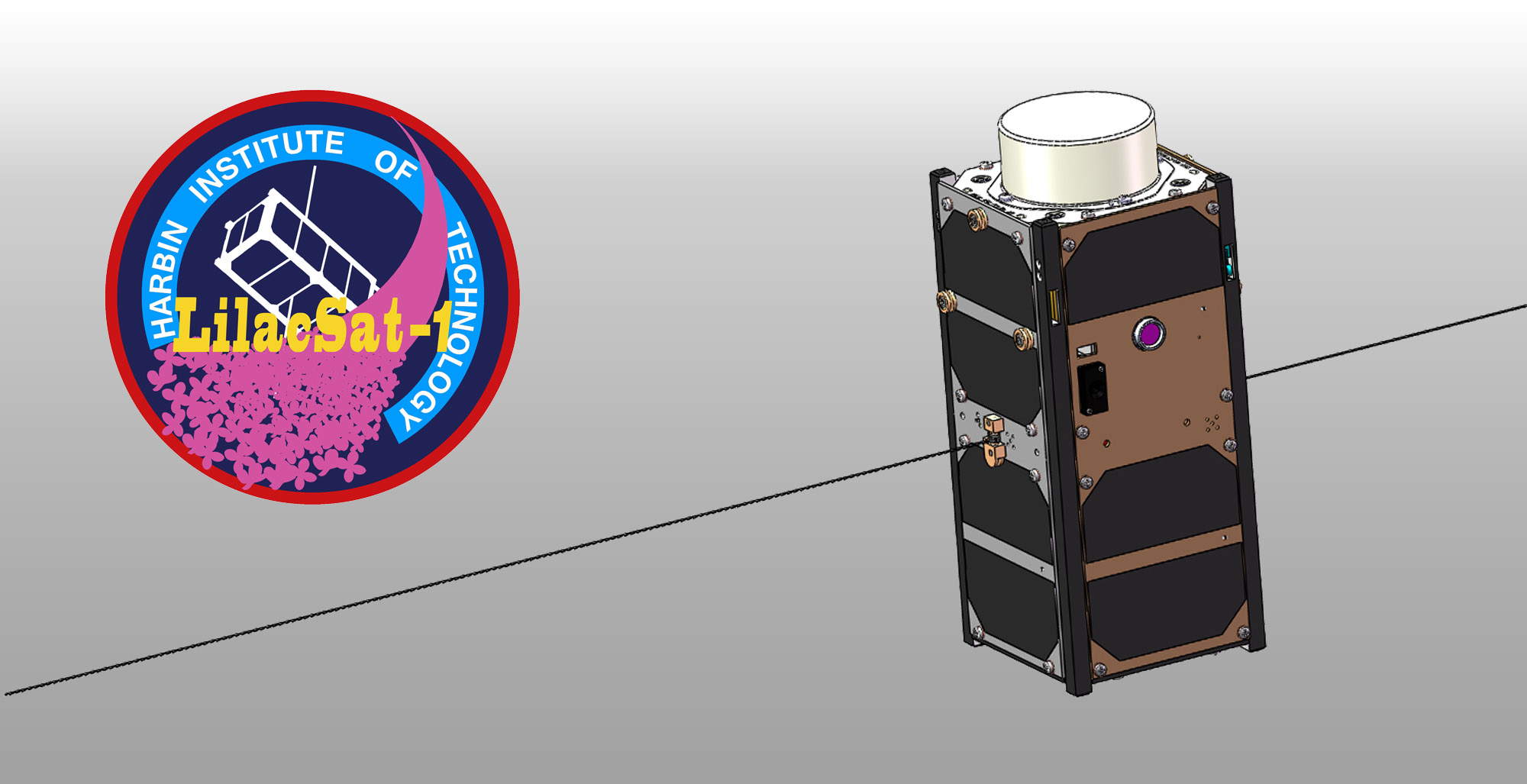
The student built LilacSat-1 carries an amateur radio 145/436 MHz FM to Codec2-BPSK digital voice transponder, APRS Digipeater and camera.

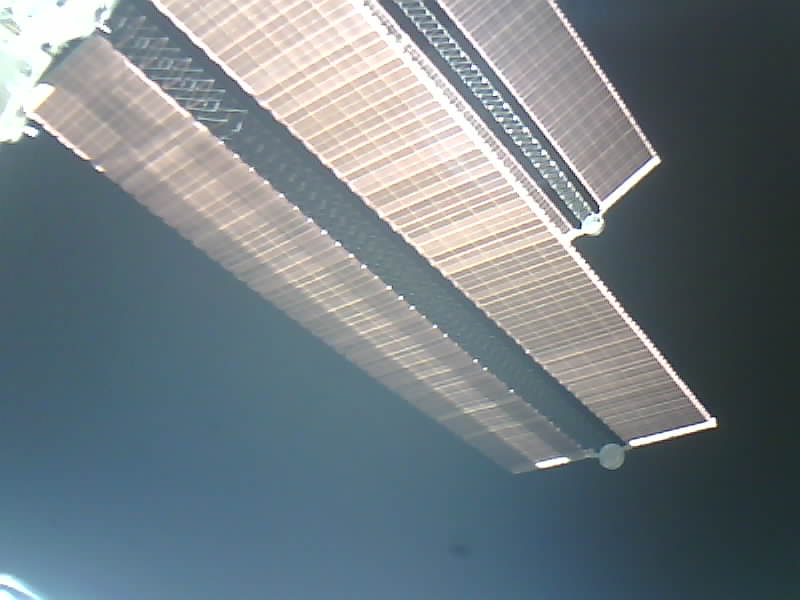
Image of ISS Solar Panels taken by LilacSat-1 just after deployment

Image of ISS Solar Panels taken by LilacSat-1 just after deployment

The satellite was developed at the Harbin Institute of Technology and is part of the QB50 mission which aims to study the lower thermosphere. It was deployed from the International Space Station at 0835 GMT on Thursday, May 25, 2017.

Shortly after deployment LilacSat-1 took a picture of the solar panels on the ISS. The image was downloaded by the students on 436.510 MHz +/- 10 kHz Doppler Shift using 9600 bps BPSK.

The FM to Codec2-BPSK transponder was activated late afternoon GMT on Thursday, May 25:
• FM Uplink 145.985 MHz with 67 Hz CTCSS (PL Tone)
Codec2 9600 bps BPSK Downlink 436.510 MHz

The first contact using the Codec2 transponder took place on May 31 between Mike Rupprecht DK3WN and John Grant GI7UGV http://www.dk3wn.info/p/?p=79889

LilacSat-1 radio information is at http://lilacsat.hit.edu.cn/?page_id=594

Adam Whitney K0FFY has documented how to receive the LilacSat-1 Codec2 Digital Voice transponder using the FUNcube Dongle Pro+ SDR http://adamwhitney.net/working-lilacsat-1/

M6SIG live CD for LilacSat 1 and 2
http://chertseyradioclub.blogspot.co.uk/2017/06/m6sig-live-cd-for-lilacsat-1-and-2.html

Lilacsat 1 and 2 decoder now available on Experimental Raspberry Pi (3) image with GNU radio / gr-lilacsat
http://chertseyradioclub.blogspot.co.uk/2017/06/lilacsat-1-and-2-decoder-now-available.html

LilacSat-1 Codec2 downlink by Daniel Estévez EA4GPZ / M0HXM
http://destevez.net/2016/10/lilacsat-1-codec-2-downlink/

Updated LilacSat-1 Live CD from M6SIG latest link at http://lilacsat.hit.edu.cn/?page_id=594

The main payload is an ion and neutral particle mass spectrometer (INMS) developed by the University of London (UCL) to measure the mass and distribution of charged and neutral atoms.

LilacSat-1 signal received by JA0CAW

LilacSat-1 signal received by JA0CAW

In preparation for the deployment HIT students installed new VHF and UHF antennas for the ground station.

Harbin Institute of Technology Amateur Radio Club BY2HIT
http://www.by2hit.net/
http://weibo.com/by2hit/
http://www.qsl.net/by2hit/
https://www.qrz.com/db/BY2HIT

LilacSat-1 page (use Google translator) http://lilacsat.hit.edu.cn/?page_id=143

QB50 LilacSat-1 information https://upload.qb50.eu/detail/CN02/

IARU information http://www.amsatuk.me.uk/iaru/finished_detail.php?serialnum=343

Keplerian Two Line Elements (TLEs) ‘Keps’ for new satellites launched in past 30 days
http://celestrak.com/NORAD/elements/tle-new.txt

LilacSat-1 CubeSat

LilacSat-1 CubeSat

QB50 CubeSats to deploy from ISS

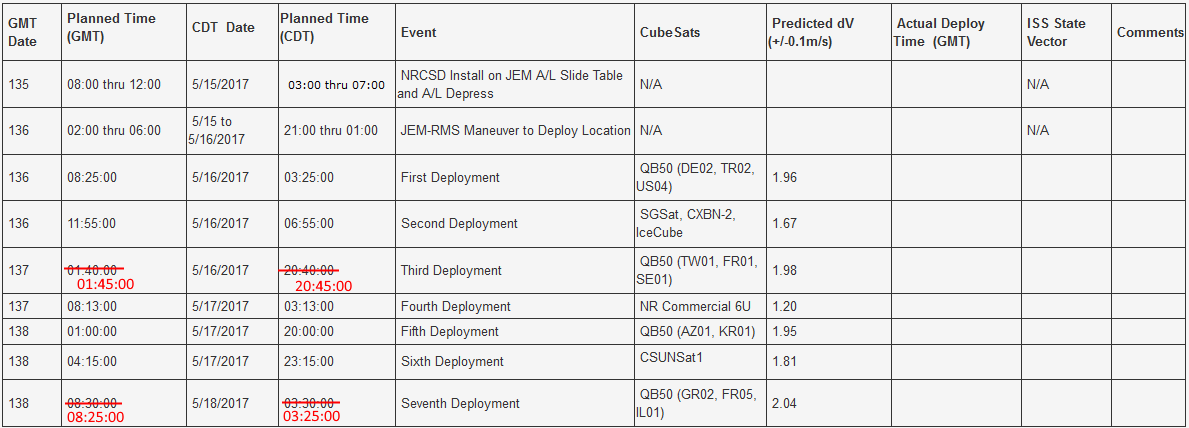
QB50 ISS LogoThe first phase of QB50 CubeSats should be deployed from the International Space Station over three days May 16-18, 2017.

Download QB50 ISS CubeSats Deployment and Radio Information PDF

Update May 16: 
3rd deployment 0145 GMT May 17
7th deployment 0825 GMT May 18

Built by university students and research organisations from 23 countries around the world, the QB50 constellation aims to study the lower thermosphere 200-380 km above the Earth.

There are 28 QB50 CubeSats on the ISS awaiting deployment and it is understood that 11 will be deployed in this first phase. The beacons should be activated about 30 minutes after deployment.

The QB50 CubeSats have downlinks between 435.8 and 438 MHz and reports from radio amateurs are most welcome. Beacon data received can be uploaded to a dedicated QB50 webpage at
https://upload.qb50.eu/

Two of the ISS QB50 CubeSats, ON01FR 437.020 MHz and ON05FR 436.880 MHz, carry V/U FM transponders. The uplink frequency for both is 145.860 MHz with 210.7 Hz CTCSS, see http://site.amsat-f.org/2017/05/12/qb50-document-de-description-des-telemesures-des-satellites-on01fr-on05fr/

QB50 Revised Deployment TimesList of QB50 CubeSats with Beacon format and frequency information
https://upload.qb50.eu/listCubeSat/

Keplerian Two Line Elements (TLEs) ‘Keps’ for new satellites launched in past 30 days
http://celestrak.com/NORAD/elements/tle-new.txt

QB50 project https://www.qb50.eu/
https://twitter.com/QB50Mission

On the deployment days radio amateurs and QB50 teams will be on the #CubeSat IRC channel. Join the deployment chat at http://irc.lc/freenode/cubesat

Don’t have a suitable 435-438 MHz receiver? Try listening online with the SUWS WebSDR located near London http://websdr.suws.org.uk/

On June 19, 2014 two precursor QB50 CubeSats were launched, QB50p1 and QB50p2, which carried amateur radio transponders
https://amsat-uk.org/2014/06/19/successful-launch-of-amateur-radio-satellite-payloads/
Israeli High School Students Build CubeSat

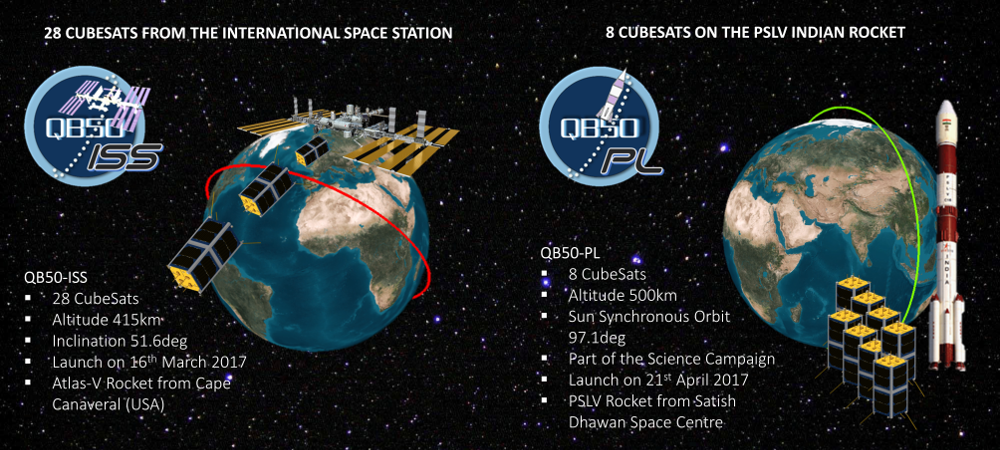
28 QB50 CubeSats were launched to ISS on April 18, a further 8 are to launch on a PSLV in May

28 QB50 CubeSats were launched to ISS on April 18, a further 8 are to launch on a PSLV in May

Over 80 Israeli high school students have built a CubeSat called Duchifat-2 as part of the QB50 Thermosphere research program.

Duchifat-2 is one of 28 QB50 CubeSats from 23 countries launched on April 18, 2017 to the International Space Station (ISS) from where they shall be placed into orbit in six weeks time.

QB50 ISS LogoSpace Watch reports:

Duchifat-2 and its companion CubeSats will measure the plasma density of the Thermosphere between 85km and 300km altitude above the Earth’s surface. Israeli students will study the data from the CubeSats at the Herzliya Science Centre, where signals from the orbiting satellites will be received.

Israeli Minister for Science, Technology, and Space, Ofir Akunis, said in a government statement that, “Duchifat-2 is not only an educational venture that brings space closer to youth and lays the way for tomorrow’s generation, it is also an international research project. This is Israeli pride for the future generation, and an opportunity to increase public awareness about space.”

Read the full story at
https://spacewatchme.com/2017/04/israeli-high-school-students-build-duchifat-2-cubesat/

Times of Israel
http://www.timesofisrael.com/nanosatellite-built-by-israeli-high-schoolers-blasts-into-space/

A further eight QB50 CubeSats are planned to launch in May on an Indian PSLV rocket into a 500 km orbit.

All the CubeSats in the QB50 project will mainly operate on frequencies in the 2 m and 70 cm amateur bands. To avoid interference to terrestrial amateur radio activity the frequency was coordinated by the IARU Satellite Adviser and advisory panel http://amsat.org.uk/iaru

QB50 project https://www.qb50.eu/

JE9PEL QB50 CubeSat Frequency Spreadsheet
https://amsat-uk.org/2015/11/08/je9pel-qb50-cubesat-spreadsheet/

South African QB50 CubeSats

CubeSats being deployed from the ISS on February 11, 2014

CubeSats being deployed from the ISS on February 11, 2014

Two South African built satellites are about to be launched to the International Space Station as part of the QB50 project.

SARL News reports:

The South African satellite industry is taking another step forward as a player in the international space arena with the launch of two South African built nanosatellites from Cape Canaveral in Florida USA.

Two CubeSats, ‘nSight1’ (QB50 AZ02) designed and manufactured by Cape Town-based SCS Space, a member of the SCS Aerospace Group and ‘ZA-Aerosat’ (QB50 AZ01) designed and manufactured by CubeSpace of the Stellenbosch University, are to be launched as part of a batch totaling 28 CubeSats from 23 different countries

The launch is set for April 18, 2017 at 15:11 GMT. Their initial destination is the International Space Station (ISS), where they will be unloaded by the ISS crew with the help of robotic arms. The satellites will eventually be deployed into low-earth orbit over a period of 30 to 60 days as the ISS orbits the Earth.

Both the South African satellites are part of the QB50 project funded by the European Union and managed by the von Karman Institute to conduct research in the lower thermosphere between 200 to 380 km altitude. The data collected from this experiment over a period of 18 months will be used to complement current atmospheric models especially applicable to re-entry trajectories of spacecraft. All CubeSats will eventually burn up at the end of their operational lifetimes.

All the CubeSats in the QB50 project will mainly operate on frequencies in the 2 m and 70 cm amateur bands. To avoid interference to terrestrial amateur radio activity the frequency was coordinated by the IARU Satellite Adviser and his advisory panel http://amsat.org.uk/iaru

QB50 project https://www.qb50.eu/

JE9PEL QB50 CubeSat Frequency Spreadsheet
https://amsat-uk.org/2015/11/08/je9pel-qb50-cubesat-spreadsheet/

ISS Packet Digipeater Back On 145.825 MHz FM

International Space Station – Image Credit NASA

ARISS is pleased to announce that Packet Radio from the International Space Station is back on 145.825 MHz FM.

A few months back, the ARISS Team did the foot work and paperwork to launch the final copy of the Ericsson VHF handheld radio to the ISS.  This work was began in October after the unit onboard the ISS failed.  ARISS has been using the Ericssons for 16 years. In the last days of February, the launch vehicle, SpaceX 10’s Dragon, flew to the ISS.  Then the ISS crew had the odious job of unloading and unpacking 5,500 pounds of cargo along with the Ericsson HT.

ARISS got word this morning that we now have VHF capability back in the Columbus module.  Followers of ISS Fan Club have already posted that they’ve heard and used packet, and are thrilled.

In 2015, ARISS began its first fundraising campaigns.  It relies on NASA, ARRL, AMSAT and individual donors, along with ARISS volunteers to pay the day-to-day operations expenses and everything related to the hardware, testing, and certification.  Donors can go to http://www.amsat.org and http://www.ariss.org to support the program.

EMike McCardel, AA8EM
Rotating Editor AMSAT News Service

Almost any 144 MHz FM rig will receive the ISS, you can even use a general coverage VHF scanner with an external antenna. As far as the antenna is concerned the simpler the better. A ¼ wave ground plane has a high angle of radiation and works well. Large 144 MHz colinears are not as good because the radiation pattern is concentrated at the horizon while the ISS is above 15 degrees elevation for most of a pass.

You can receive the ISS outdoors using a 144 MHz hand-held with its helical antenna but a 1/4 wave whip will give far better results.

In the UK we use narrow 2.5 kHz deviation FM but the ISS transmits using the wider 5 kHz deviation used in much of the world. Most rigs can be switched been wide and narrow deviation filters so select the wider deviation. Hand-held rigs all seem to have a single wide filter fitted as standard.

How to work the ISS using APRS Packet Radio
https://amsat-uk.org/beginners/how-to-work-the-iss-on-aprs-packet-radio/