ISS Packet Digipeater Back On 145.825 MHz FM

International Space Station – Image Credit NASA

ARISS is pleased to announce that Packet Radio from the International Space Station is back on 145.825 MHz FM.

A few months back, the ARISS Team did the foot work and paperwork to launch the final copy of the Ericsson VHF handheld radio to the ISS.  This work was began in October after the unit onboard the ISS failed.  ARISS has been using the Ericssons for 16 years. In the last days of February, the launch vehicle, SpaceX 10’s Dragon, flew to the ISS.  Then the ISS crew had the odious job of unloading and unpacking 5,500 pounds of cargo along with the Ericsson HT.

ARISS got word this morning that we now have VHF capability back in the Columbus module.  Followers of ISS Fan Club have already posted that they’ve heard and used packet, and are thrilled.

In 2015, ARISS began its first fundraising campaigns.  It relies on NASA, ARRL, AMSAT and individual donors, along with ARISS volunteers to pay the day-to-day operations expenses and everything related to the hardware, testing, and certification.  Donors can go to http://www.amsat.org and http://www.ariss.org to support the program.

EMike McCardel, AA8EM
Rotating Editor AMSAT News Service

Almost any 144 MHz FM rig will receive the ISS, you can even use a general coverage VHF scanner with an external antenna. As far as the antenna is concerned the simpler the better. A ¼ wave ground plane has a high angle of radiation and works well. Large 144 MHz colinears are not as good because the radiation pattern is concentrated at the horizon while the ISS is above 15 degrees elevation for most of a pass.

You can receive the ISS outdoors using a 144 MHz hand-held with its helical antenna but a 1/4 wave whip will give far better results.

In the UK we use narrow 2.5 kHz deviation FM but the ISS transmits using the wider 5 kHz deviation used in much of the world. Most rigs can be switched been wide and narrow deviation filters so select the wider deviation. Hand-held rigs all seem to have a single wide filter fitted as standard.

How to work the ISS using APRS Packet Radio
https://amsat-uk.org/beginners/how-to-work-the-iss-on-aprs-packet-radio/

ITF-2 (YUI-2) Satellite Update

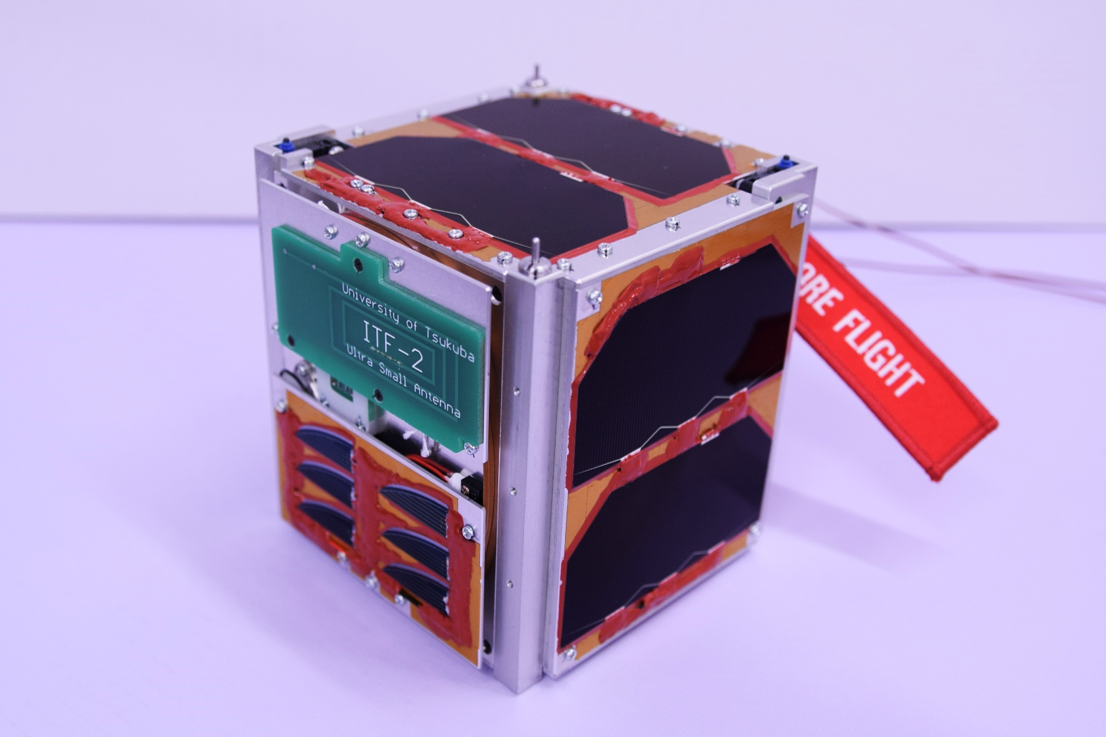
ITF-2 Yui ProjectAtsushi Yasuda JI1OEH reports the ITF-2 (YUI-2) CubeSat entered normal operation phase on March 25 JST, it was deployed from the ISS on January 16, 2017.

Update: ITF-2 was giving the OSCAR number Tsukuba-OSCAR 89 (TO-89).

Telemetry information and messages will be transmitted in this phase for the achievement of main mission.

The details of AWARD and SWL cards are:

AWARD:
With reference to the message on January 15 UTC, the First 100 Reports from overseas stations are qualified for this award. Only ten overseas stations sent report so far. Still enough award can be issued. Additionally, a souvenir, a sticky screen cleaner, will be given with this award.

The design motif is the small antenna of ITF-2
https://twitter.com/yui_tsukuba/status/841096655046758400

ITF-2 Flight Model

ITF-2 Flight Model

SWL cards:
Five designs are prepared. The stations which report more than five times can receive all designs. Also, the specially designed card will be presented to the stations which received a signal from the small antenna, because the reports are valuable to demonstrate the antenna in space. So far, two stations succeeded in the reception.

Designs of SWL cards
https://twitter.com/yui_tsukuba/status/846219342190555136

Further special events are planned for the promotion of receptions by more stations. This will be announced later.

There were some reception reports by very simple equipment, for example, Dipole or 5/8 wave length whip with USB tuner dongle (RTL2832).

The examples are
Ex1: https://twitter.com/dspic/status/842000948834717696
Ex2: https://twitter.com/dspic/status/826823146955120640

Reception reports can be submitted at:
https://operationitf-2.blogspot.jp/p/blog-page_58.html

Operation information of ITF-2: http://operationitf-2.blogspot.jp/

Looking forward to reports from more stations.

Atsushi Yasuda, JI1OEH
University of Tsukuba Satellite project

ARISS Closer to Launching New Radio System

International Space Station – Image Credit NASA

The ARISS team took a giant step closer to flying the new ARISS Interoperable Radio System to the International Space Station, having met a major milestone.

Lou McFadin, W5DID, and Kerry Banke, N6IZW, travelled to the NASA Johnson Space Center (JSC) in Houston, Texas, in mid-February for preliminary testing of Banke’s breadboard version of the ARISS Multi-voltage Power Supply. The two worked alongside JSC engineers and JSC EMC lab personnel, putting the specially built power supply through its paces, checking against US and Russian space specifications for Power Quality and Electromagnetic Compatibility (EMC) preliminary tests.

The result:  Outstanding news-the ARISS Team can move on to the next step, fabrication of prototype and flight units.  The JSC engineers disclosed that the ARISS breadboard power supply was the first hardware to have passed all of the space agencies’ tests!  They said the very professional ARISS Team certainly knew hardware development and design.

Amateur Radio on the International Space Station (ARISS) logoARISS-International Chair Frank Bauer thanked Banke and McFadin for the multiple days spent putting the unit through the serious battery of NASA and Russian preliminary electrical tests.  Banke expressed pleasure with the results: “I was looking to come away with what we needed to move forward. We achieved that.”  He was impressed with the support he and McFadin received from the testing group, and said key players on those teams who are also ham radio operators, commented that they find equipment brought in that is supported by ham radio operators, to earn particularly good marks.  McFadin asserted that the Multi-voltage Power Supply’s fine test results are due to ARISS’s team working very well together and being very experienced.

The completed testing of the breadboard unit means McFadin can now purchase expensive space-certified parts so the final prototype/flight power supplies can be fabricated.  He and Banke now know that when the final, even more rigorous tests are done, the units will pass with flying colors.

Watch for more news stories on the hardware and the fundraising campaign to help support the costs associated with designing, building, and testing the new ARISS radio system-the Kenwood D710GA and Multi-voltage Power Supply. Those wishing to contribute toward the final fabrication and flight tests are highly appreciated and asked to go to the AMSAT website,  www.amsat.org to click on the “ARISS Donate” button.  Or visit the donation page on the ARISS website, http://www.ariss.org/donate.html

Contributions are tax deductible. Those who contribute $100 or more will receive the handsome ARISS Challenge Coin.  If you or your ham club or place of employment wish to make a highly substantial contribution, contact Frank Bauer, KA3HDO, at ka3hdo@verizon.net.

Source ARISS News Release 17-04

Frank Bauer, KA3HDO was on the Ham Talk Live podcast discussing ARISS and
the gear aboard the ISS. The link to the podcast is:
http://www.spreaker.com/user/hamtalklive/episode-55-ham-radio-on-the-iss-with-fra

SpaceX launch ham radio transceiver to ISS

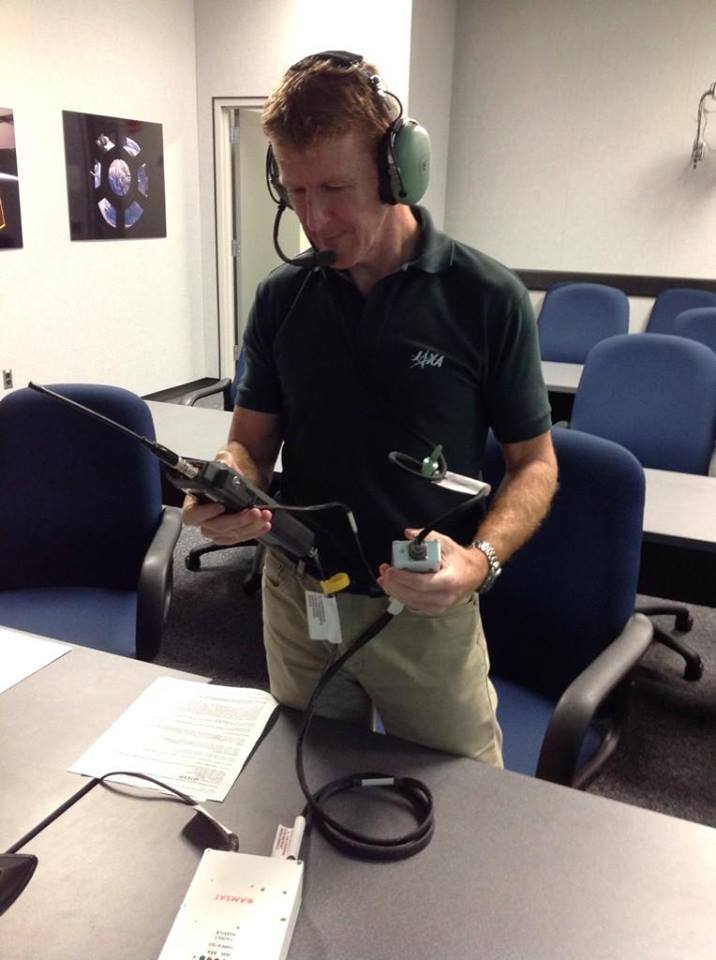
UK astronaut Tim Peake KG5BVI trained to use the Ericsson VHF transceiver for his ISS mission

UK astronaut Tim Peake KG5BVI / GB1SS  trained to use the Ericsson VHF transceiver for his ISS mission

The CRS-10 mission carrying vital amateur radio equipment to the International Space Station launched on a SpaceX Falcon 9 rocket at 1439 UT on Sunday, February 19, 2017.

Frank Bauer KA3HDO, ARISS International Chair and AMSAT-NA V.P. for Human Spaceflight Programs writes:

Included as part of the successful launch of the SpaceX Dragon vehicle to ISS is an ARISS Ericsson 2 meter VHF radio.  This radio will replace the Ericsson radio that failed a few months ago.  The VHF radio is used for school group contacts and amateur packet radio in the Columbus module.  Once the Dragon vehicle is berthed to ISS, the Ericsson will be unstowed and, at some point, installed in Columbus, replacing the UHF radio that is now supporting APRS packet and some school contacts.

Our thanks to SpaceX on an outstanding and historic flight from Kennedy Space Center’s Launch Pad 39A, where many Space Shuttle missions  and nearly all the Apollo moon missions were launched.  We also would like to thank our ARISS benefactors-NASA and CASIS, the Center for the Advancement of Science in Space.  And, of course, our amateur radio long-time sponsors-our national amateur radio organizations around the world, including the American Radio Relay League (ARRL) in the US, and our international AMSAT organizations, including AMSAT-NA.

Before closing, I want to let you know that ARISS is making great progress on the development of the new interoperable radio system that we hope to use to replace our aging radio infrastructure in the Columbus module and the Service module.  The hard (and expensive) part of this effort is just beginning, with testing and human certification on the horizon.  We thank all that have donated to the cause thus far.  We hope you continue to help ARISS move forward through your support, including your volunteer time and talent and, of course, financial contributions through the AMSAT web site donate button http://www.amsat.org/

Amateur Radio on the International Space Station ARISS http://ariss.org/

Receive Pictures from Space – ISS SSTV Feb 13-14

ISS SSTV image 2 received by Mike Rupprecht DK3WN April 12, 2016 at 1556 UT

ISS SSTV image 2 received by Mike Rupprecht DK3WN April 12, 2016 at 1556 UT

Slow-scan television (SSTV) transmissions are planned from the International Space Station (ISS) on February 13-14, 2017.

The SSTV images will be transmitted as part of the MAI-75 Experiment on 145.800 MHz FM using the Kenwood TM-D710 transceiver located in the Russian ISS Service module. It is expected they will use the PD-180 SSTV format.

The MAI-75 activities have been scheduled for the Russian crew on Monday, February 13 from 09:25-18:00 GMT and Tuesday, February 14 from 11:25-16:30 GMT.

Note the ISS transmissions on 145.800 MHz FM use the 5 kHz deviation standard rather than the narrow 2.5 kHz used in Europe. If your transceiver has selectable FM filters try the wider filter.

The ISS Fan Club website will show you when the space station is in range http://www.issfanclub.com/

ISS SSTV information and links at https://amsat-uk.org/beginners/iss-sstv/

ARISS-SSTV Images http://ariss-sstv.blogspot.co.uk/

Listen to the ISS when it is over Russia with the R4UAB WebSDR

Listen to the ISS when in range of London with the SUWS WebSDR http://websdr.suws.org.uk/

If you receive a full or partial picture from the Space Station your Local Newspaper may like to know http://www.southgatearc.org/news/2016/july/now-is-a-great-time-to-get-ham-radio-publicity.htm

Tancredo-1 TubeSat Video

Ubatubasat TeamPaulo PV8DX has released a video describing the new TubeSat Tancredo-1 and showing reception of the 437.200 MHz downlink by Drew KO4MA.

Tancredo-1, mounted in a TuPOD Deployer, was ejected from the International Space Station on January 16, 2017. The satellite is a STEM project built by middle school students at Escola Municipal Tancredo Neves school in Ubatuba, in the state of Sao Paulo, Brazil.

The video is in Portuguese but try enabling the YouTube Closed Caption subtitles and use the Auto-translator to get English.

Watch TubeSat TANCREDO 1 – By PV8DX

Links and further information on the Tancredo-1 TubeSat
https://amsat-uk.org/2016/12/02/school-tancredo-1-tubesat/

Six CubeSats Deploy from ISS
https://amsat-uk.org/2017/01/14/six-cubesats-to-deploy-from-iss/