Making contacts through the ISS APRS UHF Digipeater

International Space Station - Image Credit NASA

International Space Station – Image Credit NASA

John Brier KG4AKV has released a video showing his contact through the International Space Station packet radio digipeater on 437.550 MHz FM (+/-10 kHz Doppler shift).

This was my second contact through the ISS digipeater. I actually contacted the same station I contacted in this video, W8LR, three days before, but I wasn’t recording any video.

For this video I recorded the audio from my Kenwood TH-D72a and later played it back to Soundmodem+UISS. Soundmodem decodes many more packets than my radio does. I made a screen capture of UISS and its map so you can see the complete details of every received packet.

Another thing this video shows is how hard it can be to track a near overhead pass (close to 90 degrees elevation). When I was beginning in satellites I only tried to work overhead passes because I knew the signal would be strongest when the satellite was closest to me. While that is true, the closer the satellite is to you the faster its relative speed is. When it passes overhead it switches from coming towards you to going away from you very fast, and drops 10s of degrees in seconds. That makes the satellite very easy to lose track of.

In this video I got distracted while changing settings on my radio and lost the ISS after it went overhead. It didn’t help that I was using a tripod for the first time. I prefer to hold the antenna in my hand precisely because I find it’s easier to track, as I can make quick adjustments and listen for the signal going up and down. To control the radio for packet, it helps to have two hands.

Watch I made CONTACT! UHF ISS Digipeater

You can subscribe to John’s Space Comms YouTube Channel at
https://www.youtube.com/SpaceComms1?sub_confirmation=1

Tomsk-TPU-120 CubeSat to deploy during EVA

Tomsk-TPU-120 CubeSat - Credit Tomsk Polytechnic University

Tomsk-TPU-120 CubeSat – Credit Tomsk Polytechnic University

The amateur radio CubeSat Tomsk-TPU-120 may be deployed during a Russian spacewalk (EVA) in July 2017.

The satellite was developed by students at the Tomsk Polytechnic University to test new space materials technology and is the world’s first space vehicle with a 3D-printed structure. It was launched from Baikonur in Kazakhstan to the ISS on March 31, 2016 in a Progress-MS-2 cargo vessel.

It will be deployed by hand during a Russian spacewalk, which is why unlike other CubeSats this one has a handle. The call sign of the satellite is RS4S.

According to Alexey Yakovlev, head of the Tomsk Polytechnic University’s Institute of High Technologies, the 3D printed satellite is something of a landmark for additive manufacturing, being the first example of a fully 3D printed satellite: “The Tomsk-TPU-120 is the first such project in the world, in which the entire casing of a satellite is fully 3D printed using dynamic modeling,” Yakovlev recently told Sputnik. “The combination of these technologies can significantly reduce the development time and the number of full-scale tests, find new engineering solutions, and reduce the project’s cost.”

In May 2016 the Tomsk Polytechnic University celebrated its 120th anniversary. As part of the celebrations on May 10/11 the Tomsk-TPU-120 was activated in the ISS and transmitted a greeting to Earth inhabitants, recorded by students of the university in 10 languages: Russian, English, German, French, Chinese, Arabic, Tatar, Indian, Kazakh and Portuguese.

The greeting message was transmitted once a minute on 437.025 MHz FM. A Kenwood transceiver on the ISS provided a cross-band relay, re-transmitting the signal on 145.800 MHz FM.

Read the 3ders article at
http://www.3ders.org/articles/20161229-russian-scientist-says-3d-printed-satellite-entering-orbit-in-2017.html

Sputnik News – Unique 3D-Printed Siberian Satellite to Orbit Earth
https://sputniknews.com/science/201612261049011599-russia-satellite-3D-printer-experiments/

ISS Calendar http://spaceflight101.com/iss/iss-calendar/

Tomsk-TPU-120 CubeSat Video https://amsat-uk.org/2016/05/23/tomsk-tpu-120-cubesat-video/

Middle School Students’ Tancredo-1 TubeSat Scheduled for Launch

Ubatubasat Team

Ubatubasat Team

The Tancredo-1 satellite, a small TubeSat built by middle school students in Brazil, is scheduled to be sent to the International Space Station on December 9, 2016. The satellite will be sent to the ISS inside the TuPOD TubeSat deployer onboard JAXA’s KOUNOTORI6 cargo ship (HTV-6 mission). The TuPOD is expected to be ejected into space by the J-SSOD satellite deployer on December 19th and on December 21st, Tancredo-1 is expected to be finally ejected from the TuPOD into space. Once in space, Tancredo-1 will start transmitting telemetry data.

Tancredo-1

Tancredo-1

Tancredo-1 is the first satellite of the Ubatubasat project, a STEM project idealized by Prof. Cândido Oswaldo de Moura at Escola Municipal Tancredo Neves public school in Ubatuba, state of Sao Paulo, Brazil. The project is supported by the Brazilian Institute for Space Research (INPE) and the Brazilian Space Agency (AEB). Tancredo-1 will initially have the same orbit as the ISS, but it will slowly drift with time and will eventually reenter in the atmosphere and burn.

The Ubatubasat project team and AMSAT-BR would like to kindly request radio amateurs around the planet to monitor and report any signals heard from Tancredo-1. Please send any reports (audio, AX.25 KISS files, etc) to py2sdr@gmail.com

Tancredo-1 will transmit on 437.200 MHz using 1200 bps AFSK AX.25.

Telemetry format and equations: https://goo.gl/qOK6qM

For more information see:
http://www.ubatubasat.com/en/
http://www.amsatuk.me.uk/iaru/finished_detail.php?serialnum=419
http://amsat-br.org/

73, Edson PY2SDR
AMSAT-BR

Information on other ISS CubeSats http://spaceflight101.com/htv-6/htv-6-cargo-overview/

Receive Pictures from Space – ISS SSTV Dec 8-9

ISS SSTV image 2 received by Mike Rupprecht DK3WN April 12, 2016 at 1556 UT

ISS SSTV image 2 received by Mike Rupprecht DK3WN April 12, 2016 at 1556 UT

Slow-scan television (SSTV) transmissions are planned from the International Space Station (ISS) on December 8-9, 2016.

The SSTV images will be transmitted as part of the MAI-75 Experiment on 145.800 MHz FM using the Kenwood TM-D710 transceiver located in the Russian ISS Service module.

The MAI-75 activities have been scheduled for the Russian crew on Dec 8 from 12:35 to 18:00 GMT and Dec 9 from 12:40 to 17:40 GMT.

Note the ISS transmissions on 145.800 MHz FM use the 5 kHz deviation standard rather than the narrow 2.5 kHz used in Europe. If your transceiver has selectable FM filters try the wider filter.

The ISS Fan Club website will show you when the space station is in range http://www.issfanclub.com/

ISS SSTV information and links at https://amsat-uk.org/beginners/iss-sstv/

ARISS-SSTV Images http://ariss-sstv.blogspot.co.uk/

Listen to the ISS when it is over Russia with the R4UAB WebSDR

Listen to the ISS when in range of London with the SUWS WebSDR http://websdr.suws.org.uk/

If you receive a full or partial picture from the Space Station your Local Newspaper may like to know http://www.southgatearc.org/news/2016/july/now-is-a-great-time-to-get-ham-radio-publicity.htm

Radio ham awarded space achievement honour

Astro Pi Logo

Astro Pi Logo

Cornwall Live reports that radio amateur David Honess M6DNT has been awarded a prestigious space achievement honour for his Astro Pi work with the Tim Peake GB1SS Principia mission.

David Honess M6DNT was presented with a Sir Arthur Clarke Award, on behalf of the Arthur C. Clarke Foundation and the British Interplanetary Society, for Space Achievement – Industry/Project Individual.

This came after Mr Honess and his Astro Pi project which installed two Raspberry Pi’s (Izzy and Ed) on to the International Space Station as the platform for students to run their own code in space and speak with Major Tim Peake GB1SS.

Mr Honess has been “the driving force” behind getting two UK designed and manufactured Astro Pi computers onto the International Space Station to provide a unique facility to inspire children and adults to learn to code.

Read the full story at
http://www.cornwalllive.com/west-cornwall-man-wins-award-for-space-achievement-after-project-with-tim-peake/story-29893608-detail/story.html

Sir Arthur Clarke Awards Winners
http://www.bis-space.com/2013/04/05/9719/sir-arthur-clarke-awards-winners

You can follow the two ISS Astro Pi’s Izzy and Ed at
https://twitter.com/astro_pi_ir
https://twitter.com/astro_pi_vis

AMSAT-UK https://amsat-uk.org/
Twitter https://twitter.com/AmsatUK
Facebook https://facebook.com/AmsatUK
YouTube https://youtube.com/AmsatUK

JAXA to launch satellites with ham radio payloads to ISS

H-II Transfer Vehicle KOUNOTORI

H-II Transfer Vehicle KOUNOTORI

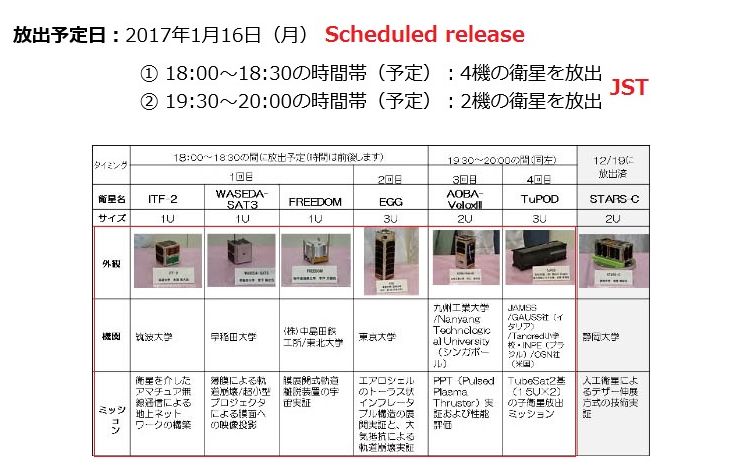
Mineo Wakita JE9PEL reports on the AMSAT Bulletin Board that six satellites with amateur radio payloads are to be launched to the International Space Station in December.

JAXA announced to the public November 7 that seven nano satellites are to be installed in H-IIB Transfer Vehicle “KOUNOTORI” (HTV) to be launched in December. Satellites are only about 1U~3U in size and will conduct experiments aimed at realizing the space elevator which is expected to facilitate the movement of Earth and Universe in the future. It’s the first time to launch in JAXA with seven satellites at a time.

HTV6 Launch: 1326 UT, Dec. 9, 2016 at the Tanegashima Space Center, Japan.

                   Downlink   Beacon     Mode
AOBA-VeloxIII       437.375  437.375  1k2 AFSK,CW
ITF-2               437.525  437.525  1k2 FM,CW
STARS-C (Mother)    437.405  437.245  1k2 FM,CW
STARS-C (Daughter)  437.425  437.255  1k2 FM,CW
WASEDA-Sat3         437.290  437.290  1k2 PCM-FSK,CW
TuPod               437.425  437.425  1k2 GMSK,CW

H-II Transfer Vehicle “KOUNOTORI” (HTV), JAXA
http://global.jaxa.jp/projects/rockets/htv/index.html

AOBA-VeloxIII Kyusyu Institute of Technology
http://aoba2016.blog.fc2.com/

EGG University of Tokyo / Nihon University
http://repository.exst.jaxa.jp/dspace/bitstream/a-is/2961/1/SA6000021010.pdf

FREEDOM Tohoku University / Nakashimada Engineering Works, Ltd
http://www.tohoku.ac.jp/japanese/newimg/pressimg/tohokuuniv-press_20140926_01web.pdf

ITF-2 University of Tsukuba
http://yui.kz.tsukuba.ac.jp/en/

TuPOD Gauss Srl
http://www.gaussteam.com/tupod-almost-ready-for-launch/

STARS-C Shizuoka University
http://stars.eng.shizuoka.ac.jp/english.html

WASEDA-SAT3 Waseda University
http://www.miyashita.mmech.waseda.ac.jp/Waseda-Sat3/