Radio ham awarded space achievement honour

Astro Pi Logo

Astro Pi Logo

Cornwall Live reports that radio amateur David Honess M6DNT has been awarded a prestigious space achievement honour for his Astro Pi work with the Tim Peake GB1SS Principia mission.

David Honess M6DNT was presented with a Sir Arthur Clarke Award, on behalf of the Arthur C. Clarke Foundation and the British Interplanetary Society, for Space Achievement – Industry/Project Individual.

This came after Mr Honess and his Astro Pi project which installed two Raspberry Pi’s (Izzy and Ed) on to the International Space Station as the platform for students to run their own code in space and speak with Major Tim Peake GB1SS.

Mr Honess has been “the driving force” behind getting two UK designed and manufactured Astro Pi computers onto the International Space Station to provide a unique facility to inspire children and adults to learn to code.

Read the full story at
http://www.cornwalllive.com/west-cornwall-man-wins-award-for-space-achievement-after-project-with-tim-peake/story-29893608-detail/story.html

Sir Arthur Clarke Awards Winners
http://www.bis-space.com/2013/04/05/9719/sir-arthur-clarke-awards-winners

You can follow the two ISS Astro Pi’s Izzy and Ed at
https://twitter.com/astro_pi_ir
https://twitter.com/astro_pi_vis

AMSAT-UK https://amsat-uk.org/
Twitter https://twitter.com/AmsatUK
Facebook https://facebook.com/AmsatUK
YouTube https://youtube.com/AmsatUK
JAXA to launch satellites with ham radio payloads to ISS

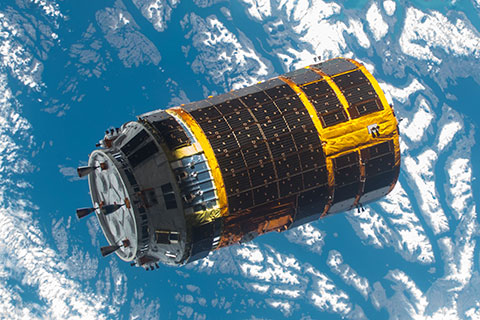
H-II Transfer Vehicle KOUNOTORI

H-II Transfer Vehicle KOUNOTORI

Mineo Wakita JE9PEL reports on the AMSAT Bulletin Board that six satellites with amateur radio payloads are to be launched to the International Space Station in December.

JAXA announced to the public November 7 that seven nano satellites are to be installed in H-IIB Transfer Vehicle “KOUNOTORI” (HTV) to be launched in December. Satellites are only about 1U~3U in size and will conduct experiments aimed at realizing the space elevator which is expected to facilitate the movement of Earth and Universe in the future. It’s the first time to launch in JAXA with seven satellites at a time.

HTV6 Launch: 1326 UT, Dec. 9, 2016 at the Tanegashima Space Center, Japan.

                   Downlink   Beacon     Mode
AOBA-VeloxIII       437.375  437.375  1k2 AFSK,CW
ITF-2               437.525  437.525  1k2 FM,CW
STARS-C (Mother)    437.405  437.245  1k2 FM,CW
STARS-C (Daughter)  437.425  437.255  1k2 FM,CW
WASEDA-Sat3         437.290  437.290  1k2 PCM-FSK,CW
TuPod               437.425  437.425  1k2 GMSK,CW

H-II Transfer Vehicle “KOUNOTORI” (HTV), JAXA
http://global.jaxa.jp/projects/rockets/htv/index.html

AOBA-VeloxIII Kyusyu Institute of Technology
http://aoba2016.blog.fc2.com/

EGG University of Tokyo / Nihon University
http://repository.exst.jaxa.jp/dspace/bitstream/a-is/2961/1/SA6000021010.pdf

FREEDOM Tohoku University / Nakashimada Engineering Works, Ltd
http://www.tohoku.ac.jp/japanese/newimg/pressimg/tohokuuniv-press_20140926_01web.pdf

ITF-2 University of Tsukuba
http://yui.kz.tsukuba.ac.jp/en/

TuPOD Gauss Srl
http://www.gaussteam.com/tupod-almost-ready-for-launch/

STARS-C Shizuoka University
http://stars.eng.shizuoka.ac.jp/english.html

WASEDA-SAT3 Waseda University
http://www.miyashita.mmech.waseda.ac.jp/Waseda-Sat3/

Radio ham’s Femtosats project wins ISS Design Competition

Femtosats deploying from 3D printed spacecraftRadio amateur Andy Filo KJ6ZGI has been announced as winner of the ISS Design Competition organised by component distributor Mouser.

Tech Crunch reports nearly 250 ideas were submitted, everything from tools to toys to scientific instruments. The proposals were vetted and submitted for judgment by tech-savvy astronaut and former ISS resident Col. Chris Hadfield VA3OOG, and Grant Imahara, of Mythbusters fame.

Andy’s winning entry was for a 3D printed “mothership” to launch Femosats into space. Femtosats are 30mm square and 4mm thick self contained satellites that extend the Internet of Things to Space.

Watch 2016 ISS Design Challenge Winners! – Empowering Innovation Together™ with Grant Imahara

Read the Tech Crunch story at https://techcrunch.com/2016/11/07/3d-printed-satellite-launcher-heads-to-iss-with-blessing-of-chris-hadfield-and-grant-imahara/

Mouser ISS Design Competition winners http://www.mouser.com/contests/iss-project-contest?entry_id=131259785

Andy KJ6ZGI has previous worked with Zac Manchester KD2BHC on the KickSat project
http://makezine.com/2014/04/11/how-to-kick-a-sat/

Sandringham students’ Amateur Radio project success

Sandringham students used amateur radio to talk to Tim Peake on the ISS

Sandringham students used amateur radio to talk to Tim Peake GB1SS on the ISS

The Watford Observer newspaper reports that Sandringham School students’ amateur radio communication project gave them the opportunity to visit the UK Parliament at Westminster.

The Observer says: Four students from a St Albans school showed off their engineering prowess to politicians, policy makers and businesses in Parliament.

The Year 9 and 11 students from Sandringham School, on The Ridgeway – Sandy Cairns, Polly Gupta M6POG, Stanley MacMurray and Emma Wilkinson M6GJQ – were invited to the event on Monday [Oct 31] after impressing judges with their engineering project at the regional heats of The Big Bang UK Young Scientists and Engineers Competition

Their amateur radio communication project saw them set up a radio to speak with Tim Peake while he was aboard the International Space Station.

Rhian Kazwini, Head of Science at Sandringham School, said: “Entering the competition has been great fun and given the team an idea of just how interesting a career in engineering could be.”

Read the full story at http://www.watfordobserver.co.uk/stalbans/14842162.St_Albans_students__space_chat_with_astronaut_Tim_Peake_earns_them_trip_to_Parliament/

In January 2016 students at Sandringham School used amateur radio to talk to UK astronaut Tim Peake GB1SS on the International Space Station watch the video at https://amsat-uk.org/2016/01/09/video-tim-peake-sandringham/

What is Amateur Radio? http://www.essexham.co.uk/what-is-amateur-radio

Find an amateur radio training course near you https://thersgb.org/services/coursefinder/

A free booklet is available aimed at introducing newcomers to the hobby that can also be used as a handy reference while getting started, see
http://rsgb.org/main/get-started-in-amateur-radio/alex-discovers-amateur-radio-2/

Ham radio in National Geographic film Before Mars

Before Mars - Hana and Joon Seung - Credit National Geographic Channels - Scott Gries

Before Mars – Hana and Joon Seung – Credit National Geographic Channels – Scott Gries

The National Geographic channel have announced the release of the short film Before Mars which is the dramatic backstory of Hana and Joon Seung, identical twin sisters who will grow up to be central characters in the upcoming global event series, MARS.

Shot in Ellenville, NY, “Before Mars” is the story of twin Korean American teenage girls who move to a new town with their military mom. Hana finds a ham radio and with the help of an Elmer, successfully makes contact with an astronaut on the International Space Station. In the story, that feat helps inspire the sisters to pursue careers in space exploration—one as an astronaut on the Mars mission, the other as an official at Mission Control.

The amateur radio researcher on the film was Michael Gilmer N2MG.

Watch Before Mars

In the USA and Territories you can watch the 33 minute National Geographic Channel short film Before Mars at
http://channel.nationalgeographic.com/mars/videos/before-mars/

Read the National Geographic Channel Guide to Ham Radio which briefly mentions the achievement of UK radio amateur Adrian Lane 2E0SDR.
http://channel.nationalgeographic.com/mars/articles/a-guide-to-ham-radio/

How to hear the ISS https://amsat-uk.org/beginners/how-to-hear-the-iss/

What is Amateur Radio ? http://www.essexham.co.uk/what-is-amateur-radio

Find an Amateur Radio training course near you https://thersgb.org/services/coursefinder/

Raspberry Pi could generate ISS HamTV video

International Space Station - Image Credit NASA

International Space Station – Image Credit NASA

The ARISS meeting minutes for August 16, 2016 cover the discussion about using a Raspberry Pi computer board to generate video to feed the ISS Digital ATV transmitter.

An idea was proposed by Jean-Pierre Courjaud F6DZP for using Raspberry Pi at the transmitting ground stations for generating a H264 video stream that modulates a DVB-S or DVB-52 carrier. His report was distributed to the ARISS team on August 12, 2016.

Discussion:  Jean-Pierre Courjaud had brought this idea to a Ham TV Technical (HTT) meeting for using Raspberry Pi to generate a H264 video stream. Raspberry Pi is used in the United Kingdom for DATV on 2 meters.

Gaston Bertels ON4WF termed this a cost effective solution, probably easy to work on, many people and schools would be able to receive video from the ISS, and he inquired if this idea was proposed for the Paolo Nespoli IZ0JPA flight next year. Jean-Pierre Courjaud related that Paolo Nespoli had asked about it, and the team hopes he could use it if the idea is presented for review to the ARISS-International Technical Evaluation & Support Committee and approved by ARISS Delegates.

Jean-Pierre Courjaud explained that Raspberry Pi could be a solution for two things—first, the webcam could be used instead of the onboard ISS camera, and second, signals received by schools could be transmitted back to the crew.  Frank Bauer KA3HDO felt the astronauts would like this.  Dave Taylor W8AAS asked about the type of receiver schools would need and how signals would be uplinked.  Jean-Pierre Courjaud clarified that schools would have a narrowband ATV receiver that uses a USB dongle; this would bring the signal to the Surface Pro computer that Paolo Nespoli plans to fly on ISS, and modified mini-tutioune software would decode the uplink signal received from the L-band antenna.

Dave Taylor inquired what new hardware would have to be tested and certified for flight.  Jean-Pierre Courjaud said that Nespoli plans to take the Surface Pro, and to be tested and launched would be the USB interface that would work with the L-band antenna and serve as an L-band receiver with the Surface Pro. During Nespoli’s mission the mini-tutioune software could be uploaded to his Surface Pro.  Oliver Amend DG6BCE planned to share the meeting discussion with Emanuele D’Andria I0ELE and ask him and the committee, because the project originated with AMSAT-Italia, to give the plan, including what must be tested and launched, to Mark Steiner K3MS, chair of the ARISS-International Technical Evaluation & Support Committee.

Read the full ARISS Meeting Minutes August 16, 2016 at
http://www.ariss.org/meeting-minutes/august-2016

ARISS Meeting Minutes http://www.ariss.org/meeting-minutes/