ISS Slow Scan TV in April

ISS SSTV image 2 received by Mike Rupprecht DK3WN April 12, 2016 at 1556 UT

ISS SSTV image 2 received by Mike Rupprecht DK3WN April 12, 2016 at 1556 UT

ARISS reports that International Space Station (ISS) Slow Scan TV (SSTV) transmissions on 145.800 MHz FM are scheduled between April 11-15, 2016.

UPDATE: Dmitry Pashkov R4UAB reported the ISS SSTV equipment was activated at 1200 UT, April 11 but there was no signal on 145.800 MHz. The crew resolved the problem and Nitin Muttin VU3TYG reported the ISS SSTV was active during the 0735 UT April 12 pass over India. Since then radio amateurs around the world have been receiving the SSTV pictures among them Mike Rupprecht DK3WN.

ISS SSTV image 1 Murray Hely ZL3MH 20150131

ISS SSTV image 1 of Yuri Gagarin received by Murray Hely ZL3MH January 31, 2015

The schedule for the ARISS commemorative event is currently:
• Setup and activation on April 11 about 18:25 UT.
• Paused April 12 from 12:15 until 14:15 UT to allow for a school contact with Romania.
• Paused April 13 from 12:45 until 14:30 UT to allow for a school contact with Argentina.
• Deactivation on April 14 at 11:35 UT.
This opportunity should cover most of the world during the operational period.The image transmissions should be on 145.800 MHz and the mode is planned to be PD180.

The event commemorates the 15th anniversary last November of the first Amateur Radio on the International Space Station (ARISS) school contact. Since then astronauts on the ISS have made over 1,000 amateur radio contacts with schools across the globe.

April 12 is the 55th anniversary of the first human space flight by Yuri Gagarin.

In addition, MAI-75 (SSTV Experiment) will be conducting two sessions afterwards. The first one is Thursday, April 14 from 14:45 until 18:00 UT. The second session is on Friday, April 15 from 14:10 until 19:00 UT. These times do not cross N. America but will provide opportunities for Europe, Southeast Asia, Australia and S. America.

It is reported the MAI-75 tests will involve the SSTV mode PD290 which has a resolution of 800×600 and an image transmission time of 5 minutes.

Check the ARISS SSTV Blog for the latest updates http://ariss-sstv.blogspot.co.uk/

For information on how to receive SSTV from the ISS with sample audio from John Brier KG4AKV and a link to his popular hints page see https://amsat-uk.org/beginners/iss-sstv/

In the UK we use narrow 2.5 kHz deviation FM but the ISS transmits on 145.800 MHz with the wider 5 kHz deviation used in much of the world. Most base station and mobile radios can be switched been wide and narrow deviation FM filters and for best results you should select the wider filter. Handheld radios all seem to have a single wide filter fitted as standard.

As a result of Doppler shift the 145.800 MHz ISS signal may vary by +/- 3.5 kHz during a pass going from 145.835 to 145.7965 MHz. If the smallest step size your FM radio tunes in is 5 kHz you would get best results by selecting 145.805 at start of pass, then 145.800 and finally 145.795 MHz.

Local newspapers are usually keen to publish stories about the reception of signals from the Space Station. If you receive an SSTV picture why not tell your local newspaper about it to help get publicity for amateur radio and your local radio club.

Information on the MAI-75 SSTV experiment
http://www.energia.ru/eng/iss/researches/education-26.html

You can see SSTV images received from the ISS and upload your images at the ARISS SSTV Gallery http://www.spaceflightsoftware.com/ARISS_SSTV/
UK Space Agency: Ham Radio in Top 10

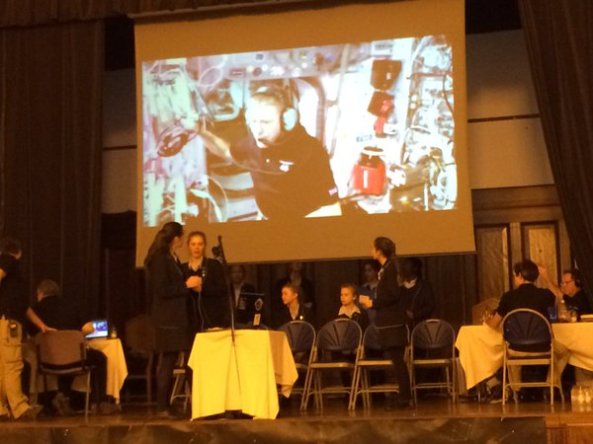
Tim Peake HamTV at RMSforGirls - Credit Sian Cleaver

Tim Peake used HamTV to talk to students – Credit Sian Cleaver

On April 7 to celebrate the 44th birthday of astronaut Tim Peake the UK Space Agency published their 10 favourite moments from his Principia mission – Amateur Radio was number 7

The UKSA say “Five schools have held amateur radio call to Tim as he passes over the UK aboard the ISS. In a world first at a school, video was streamed over the radio airwaves which meant that the students could see as well as hear. We’re looking forward to the next five calls coming up over the coming weeks.”

Read UKSA Happy Birthday Tim! https://principia.org.uk/news/happy-birthday-tim/

Listening to the ISS on a handheld radio https://amsat-uk.org/2016/01/10/listening-iss-on-handheld/

Get press publicity by receiving ISS school contacts
https://amsat-uk.org/2016/03/10/press-publicity-receiving-iss/

What is Amateur Radio? http://www.essexham.co.uk/what-is-amateur-radio

Find an amateur radio training course near you https://thersgb.org/services/coursefinder/

A free booklet is available aimed at introducing newcomers to the hobby that can also be used as a handy reference while getting started, see
http://rsgb.org/main/get-started-in-amateur-radio/alex-discovers-amateur-radio-2/

The Derby High School to speak to ISS

UK astronaut Tim Peake KG5BVI GB1SS in the ISS Jan 2016

UK astronaut Tim Peake KG5BVI / GB1SS

The Bury Times reports The Derby High School GB1DHS will be one of only two schools in the North West to hold an amateur radio contact with UK astronaut Tim Peake GB1SS. The contact is scheduled for Monday, April 25 at 12:02 GMT (1:02 pm BST).

The newspaper says: The call from The Derby High School to the International Space Station will take place on the week commencing April 25, but because the link is dependent on the exact orbit of the ISS and the crew schedules, the exact dates and times for possible calls will not be known until around 10 days before the link up is scheduled.

The Derby was selected to host a call after applying to take part in the Amateur Radio competition, a collaboration between the UK Space Agency, the Radio Society of Great Britain (RSGB) and the European Space Agency (ESA).

Read the full story at
http://www.burytimes.co.uk/news/14392824.High_school_chosen_to_make_special_radio_call_to_astronaut_Tim_Peake/

The Derby High School
https://twitter.com/derbyhighbury
http://www.derby.bury.sch.uk/

ARISS Principia site https://principia.ariss.org/

UK ARISS shortlisted schools schedule
https://amsat-uk.org/2016/02/03/all-uk-ariss-shortlisted-schools-are-now-scheduled/

What is Amateur Radio? http://www.essexham.co.uk/what-is-amateur-radio

Find an amateur radio training course near you https://thersgb.org/services/coursefinder/

A free booklet is available aimed at introducing newcomers to the hobby that can also be used as a handy reference while getting started, see
http://rsgb.org/main/get-started-in-amateur-radio/alex-discovers-amateur-radio-2/

Otley school to talk to ISS

UK astronaut Tim Peake KG5BVI GB1SS in the ISS Jan 2016

UK astronaut Tim Peake KG5BVI / GB1SS

The Wharfedale Observer reports Otley school has been chosen for ‘out of this world’ talk using amateur radio to British astronaut.

Children in Otley are set to enjoy an ‘out of this world’ talk with British astronaut Tim Peake GB1SS.

Ashfield Primary School pupils will be put in direct contact with Major Peake, who is on a mission with the International Space Station, in May.

The event is a coup for the school which is the only one in Yorkshire to be selected for the Amateur Radio on ISS link-up.

Ashfield was chosen following a lengthy application process involving schools across the country, and will be put in touch with the space station at some point between May 3 and 6.

Its bid was led by staff member Michael Ross M6FFK, through his links with Otley Amateur Radio Society (OARS) and supported by BBC One Show scientist – and Otley resident – Dr Marty Jopson.

Read the full story at
http://www.wharfedaleobserver.co.uk/news/14347948.Otley_school_chosen_for__out_of_this_world__talk_to_British_astronaut/

Dates of future Tim Peake amateur radio school contacts are at
https://amsat-uk.org/2016/02/03/all-uk-ariss-shortlisted-schools-are-now-scheduled/

Listening to the ISS on a handheld radio https://amsat-uk.org/2016/01/10/listening-iss-on-handheld/

What is Amateur Radio? http://www.essexham.co.uk/what-is-amateur-radio

Find an amateur radio training course near you https://thersgb.org/services/coursefinder/

A free booklet is available aimed at introducing newcomers to the hobby that can also be used as a handy reference while getting started, see
http://rsgb.org/main/get-started-in-amateur-radio/alex-discovers-amateur-radio-2/

Listen for ISS with Raspberry Pi 3 and LimeSDR

LimeSDR 100 kHz to 3800 MHz SDR Transceiver - Credit Lime Microsystems

LimeSDR 100 kHz to 3800 MHz SDR Transceiver – Credit Lime Microsystems

Andrew Back G7JKB writes in Design Spark about using the Raspberry Pi 3, he is very adamant about this technology, his long journey to mastery started with the alluring Teardrop Flags at a technology trade show some years ago.

LimeSDR to receive amateur radio transmissions from the International Space Station. Update: The article refers to the SoDeRa SDR but due to a trademark issue the name is now LimeSDR.

Raspberry Pi 3 - Credit RS-Online

Raspberry Pi 3 – Credit RS-Online

The LimeSDR board was only formally announced in February 2016 at the Mobile World Congress. Developed by Lime Microsystems in Guildford, Surrey and featuring their latest Field programmable RF (FPRF) transceiver, the LMS7002M, the SoDeRa is capable of supporting just about any wireless standard that operates between 100 kHz and 3.8 GHz. As if this wasn’t enough, it’s also dual channel — MIMO — with two each fully independent transmit and receive channels.

The board also includes an Altera Cyclone IV FPGA, enabling high throughput processing to be carried out in hardware, between the transceiver and FX3 USB 3.0 controller.

Read Andrew’s article at
http://www.rs-online.com/designspark/electronics/eng/blog/listening-for-the-iss-with-raspberry-pi-3-and-sodera

Watch LimeSDR board – create apps for wireless networks

Launch announcement http://www.cnx-software.com/2016/02/23/canonical-introduces-sodera-software-defined-radio-solution-for-base-stations-and-iot-gateways/

Lime Microsystems, Surrey Research Park, GU2 7YG http://www.limemicro.com/

LimeSDR http://limesdr.org/
https://twitter.com/LimeSDR_org

Andrew Back G7JKB
https://twitter.com/9600
http://carrierdetect.com/

Tim Peake talks about Amateur Radio on the ISS

Amateur Radio on the International Space Station (ARISS) logo

In this video, UK astronaut Tim Peake KG5BVI / GB1SS talks about the opportunities ARISS offers and the impact it can have on the next generation of explorers.

Amateur Radio on the International Space Station (ARISS) lets students worldwide experience the excitement of talking directly with crew members of the International Space Station, inspiring them to pursue interests in careers in science, technology, engineering and math, and engaging them with radio science technology through amateur radio.

On Thursday, March 10, 2016 astronauts on the International Space Station logged their 1,000th educational contact with the ground. No matter how many times it happens, talking directly with someone orbiting above the Earth remains a thrill for students.

Watch ARISS: Talking to Astronauts

Read more at http://www.nasa.gov/mission_pages/station/research/news/ariss_students/

Follow Tim Peake during his stay in space at: https://twitter.com/astro_timpeake

For more on ARISS, visit: http://www.ariss.org/

What is Amateur Radio? http://www.essexham.co.uk/what-is-amateur-radio

Find an amateur radio training course near you https://thersgb.org/services/coursefinder/

A free booklet is available aimed at introducing newcomers to the hobby that can also be used as a handy reference while getting started, see
http://rsgb.org/main/get-started-in-amateur-radio/alex-discovers-amateur-radio-2/