ARISS Amateur Radio on the International Space Station
Mike KC8YLD has posted some guidance as to when the Amateur Radio stations on the ISS would be turned off.
Current flight rules require all the ham radios to be off during an EVA. Technically, the VHF radios needs to be off for Russian EVAs and the UHF radio needs to be off for US EVAs.
For dockings and undockings, again the ISS operates under a flight rule that has the VHF/UHF radios off for Progress, Soyuz and ATV vehicle activity. Note that Cygnus, Dragon, HTV and formerly the Shuttle did not require the radios to be off.
For Ham TV, it will be off for any EVA. It needs to be off for ATV (the last one November) docking and undocking. It also has to be off when the Robotics arm is in close proximity.
ARISS International Delegates, its Board of Officers, and international team members will meet at Big Sight, Tokyo, Japan on August 20-23, 2015 for a critical meeting to discuss ARISS strategy, teamwork, hardware and operations.
Delegates are voting members of ARISS-I representating the 5 ISS member regions: United States, Russia, Japan, Canada and Europe.
The meeting will open with remarks from meeting host Keigo Komuro, JA1KAB from ARISS Japan and JARL.
Other agenda items will include:
• Welcome by the Japanese Space Agency JAXA & an Overview of the JAXA Innovative Satellite Technology Demonstration Program
• ARISS working group business discussions and reports, including: regional reports, ARISS Terms of Reference update, space agency coordination status, sustainability & fundraising and ARISS future endeavors
• Technical discussions on current and future hardware developments, including: Next Generation ARISS Radio Systems, the Astro-Pi Project, and an update on the Ham-TV system
• Operations discussions, including presentations on: Educational Activities, International Expansion & Planning of SSTV. School
Selection and Regional Scheduling Procedures and plans for the
upcoming Tim Peake Mission
Along with their ambitious schedule the delegates will begin each day with an opportunity for informal discussions and will have the opportunity to visit the Tsukuba Space Center.
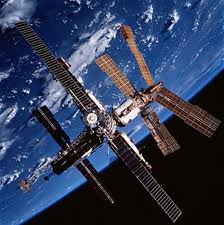
A newspaper story says a Swindon radio amateur was believed to be the first in the UK to contact an astronaut on a space station, the Russian Mir, which hosted UK and USA astronauts.
The story published in the Swindon Advertiser on August 7 says: “…it took place almost 20 years before another amateur hit the headlines this week for doing the same thing.
Radio ham Donald Shirreff [G3BGM], who died in 2010, was believed to be the first amateur radio enthusiast to successfully make contact with astronauts aboard an international space station more than 19 years ago.
In 1996, former MI5 agent Donald, then 77, took an unusual approach to his retirement and set his sights on contacting cosmonauts aboard Russian space station Mir.”
On Aug 7, commenting on the Daily Mail website on the story about a recent ISS amateur radio contact, Donald Shirreff’s son (User ID crunchbard) posted:
“My father Donald Shirreff (1918-2010) used to communicate in the 1990s with Russian cosmonauts on the Mir space station as it flew over his Wiltshire farmhouse. He was a keen radio ham, with a 40-foot mast in the garden. Though he spoke some Russian he often used Yana, a Russian friend, as translator. The cosmonauts seemed to enjoy this light relief after hard work over Russian territory. His greatest coup was to talk to British-born Michael Foale when he was a guest on Mir.”
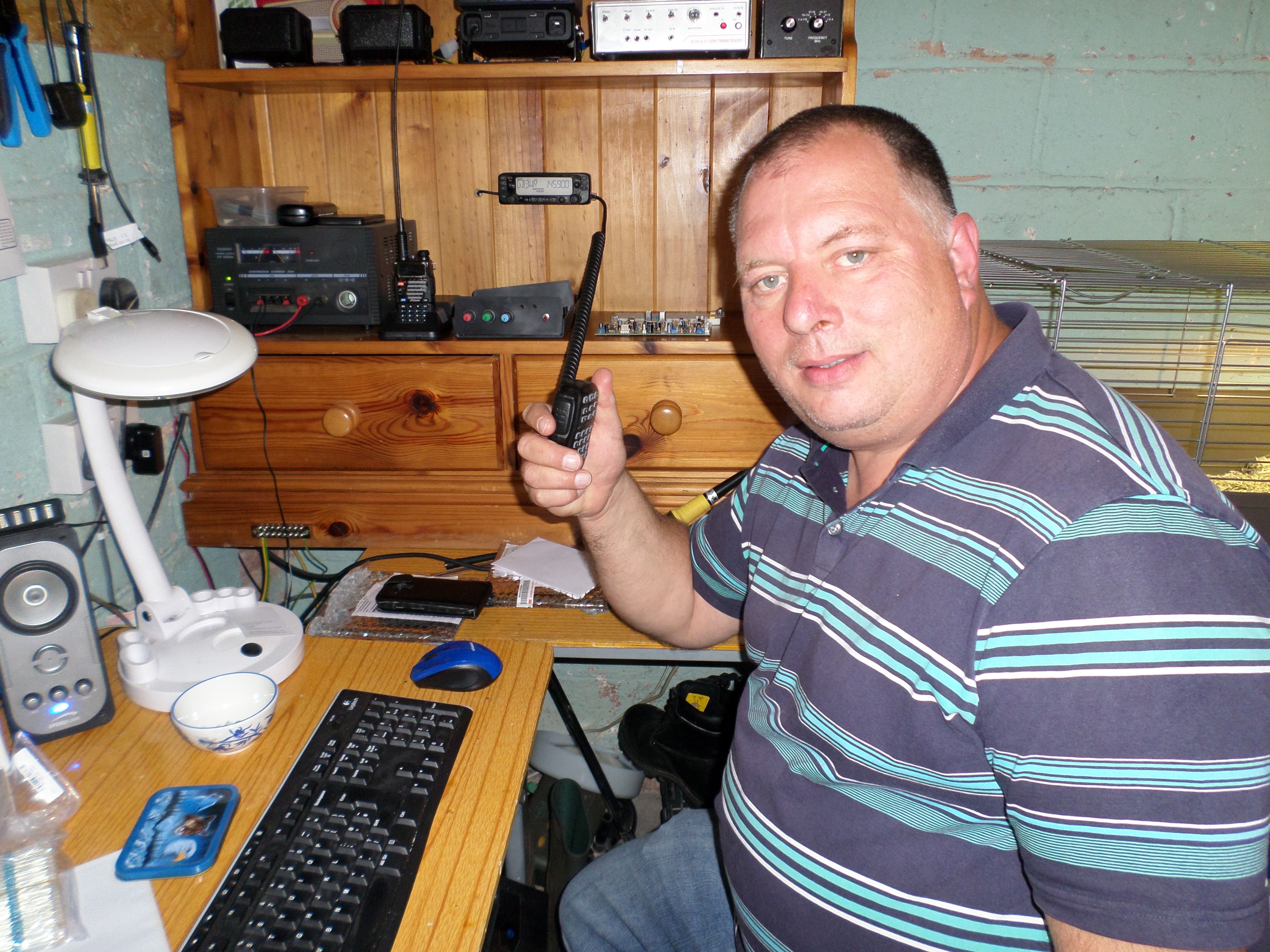
Adrian Lane 2E0SDR got some great publicity for the hobby in national newspapers and TV about an amateur radio contact he had with an astronaut on the International Space Station.
Many of the ISS astronauts hold amateur radio licences. In their spare time they carry out scheduled amateur contacts with school students and occasionally talk direct to individual radio amateurs in their home.
There are two amateur radio stations on the ISS; one is located in the ESA Columbus module with the call sign NA1SS, the other is in the Russian Service module and uses the call sign RS0ISS. A description of the stations can be found at http://www.ariss.org/contact-the-iss.html
Adrian Lane 2E0SDR
Adrian’s contact took place in October 2014, he used an Icom FM transceiver running 25 watts with a VHF Eggbeater Antenna designed by Jerry K5OE. In August 2015 he contacted his local newspaper the Gloucester Citizen to place an advert for Under 11’s soccer players for the local youth team. During the conversation he happened to say he had spoken to the ISS.
The story was published in the Thursday, August 6, 2015 edition of many UK national daily newspapers including The Sun, The Times, Telegraph, Independent, Daily Mail, Daily Express and Mirror.
The Thursday edition of the BBC Radio 4 Today show also featured the story at 8:09:46am. To hear it fast forward to 2:09:46 in this recording: http://www.bbc.co.uk/programmes/b0643x5z#play it was also mentioned on BBC Radio 5.
During Thursday evening the story featured on the TV news station CNN.
On Friday, August 7, Adrian was interviewed about the contact on the BBC TV Victoria Derbyshire programme and was mentioned on the BBC World Service. Watch the BBC TV interview at http://www.bbc.co.uk/news/uk-33816779
AMSAT-UK publishes a newsletter, OSCAR News, which is full of Amateur Satellite information. A sample issue of OSCAR News can be downloaded here.
Join AMSAT-UK via the online shop at http://shop.amsat.org.uk/
Italian ESA astronaut Paolo Nespoli, who holds the amateur radio callsign IZ0JPA, will be heading for space a third time, as part of Expeditions 52 and 53 to the International Space Station. He will be launched on a Soyuz vehicle in May 2017 on a five-month mission.
The new mission is part of a barter agreement between NASA and Italy’s ASI space agency involving ESA astronauts. It will be ASI’s third long-duration flight, following Luca Parmitano’s Volare in 2013 and Samantha Cristoforetti’s Futura this year.
Paolo’s first spaceflight was his two-week Esperia mission on the Space Shuttle’s STS-120 in 2007, ASI’s second short-duration flight under the barter agreement. One of his main tasks was to help install the Node-2 module on the Space Station.
He returned to the Station in 2010 for ESA’s 160-day MagISStra mission as part of Expeditions 26 and 27. In addition to his many experiments, he was involved in the dockings of two cargo craft: Europe’s second Automated Transfer Vehicle and Japan’s second HII Transfer Vehicle.
Following his second flight, Paolo worked at ESA’s ESRIN centre in Italy and at the European Astronaut Centre in Cologne. He recently began training at the Gagarin Cosmonaut Training Centre near Moscow, Russia, for his new adventure.





You must be logged in to post a comment.