QB50 CubeSats to be deployed from ISS

Planet Lab Dove CubeSats leaving the Nanoracks Deployer on February 11, 2014

Planet Lab Dove CubeSats leaving the ISS Nanoracks Deployer on February 11, 2014

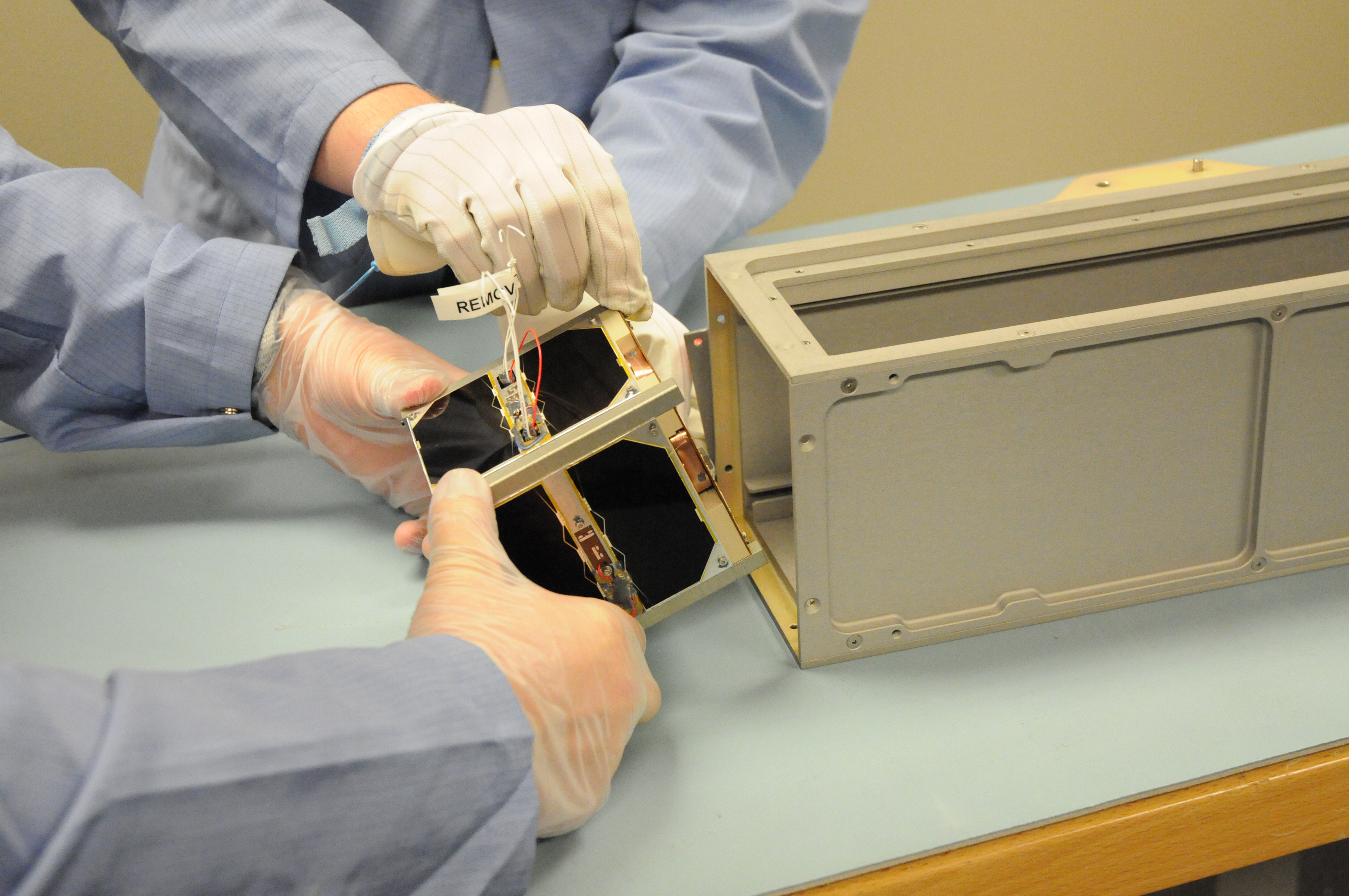
It has been announced that the fifty CubeSat QB50 constellation should be shipped to the International Space Station (ISS) in July 2016 for subsequent deployment. It had been planned for them to be launched by Alcantara Cyclone Space, a joint venture between the governments of Ukraine and Brazil, but that option is not longer available.

QB50p1 and QB50p2 Precursor 2U CubeSats - Image Credit ISIS

QB50p1 and QB50p2 Precursor 2U CubeSats – Image Credit ISIS

The AlbertaSat website reports on the 9th QB50 Workshop, held September 8, 2015 in Liège, Belgium. The CubeSats are now planned to be deployed from the ISS using the Japanese Experiment Module (JEM) and the Nanoracks CubeSat Deployers.

Eight NanoRacks deployers are installed on the Multi-Purpose Experiment Platform (MPEP). Each deployer has a capacity of 6U and so can hold up to six 1U, three 2U or two 3U CubeSats. They are carried by Japanese Experiment Module-Remote Manipulator System (JEM-RMS).

AlbertaSat provide an update on the QB50 precursor CubeSats P1/P2 which were launched in 2014. The first payload is working, and while it has been resetting, no damage appears to have occurred. It is possible that the second payload is damaged, but it is still functioning.

Representatives from QB50 also took the time to clearly define their goals and specify the details of the project. The project aims to probe probe thermosphere with about 40 sensors which study atmospheric science. These sensors include the Langmuir Probes that will be on Ex Alta-1. 40 CubeSats will be fitted with one of these sensors. The other 10 CubeSats will have in-orbit demonstrations.

QB50 project https://www.qb50.eu/

Launch of QB50 precursor CubeSats QB50p1 (EO-79) and QB50p2 (EO-80)
https://amsat-uk.org/2014/06/19/successful-launch-of-amateur-radio-satellite-payloads/

January 2014 original QB50 CubeSat launch contract signed
https://amsat-uk.org/2014/01/28/qb50-cubesat-launch-contract-signed/

AlbertaSat
http://albertasat.ca/
https://www.facebook.com/AlbertaSa

Radio hams launch to ISS Wednesday

Danish Astronaut Dr Andreas Mogensen at an AMSAT-UK International Space Colloquium

Danish Astronaut Dr Andreas Mogensen at AMSAT-UK International Space Colloquium

Denmark’s first astronaut Andreas Mogensen KG5GCZ is expected to blast-off to the ISS from Baikonur in Kazakhstan on Wednesday, September 2.

While on the ISS he plans to deploy two Danish CubeSats, GomX-3 and AAUSat-5 which both carry amateur radio payloads.

Onboard the Soyuz TMA-18M with Andreas will be Kazakhstan’s first cosmonaut Aydin Aimbetova who takes the mission place vacated by the UK’s Sarah Brightman. The commander is Sergey Volkov RU3DIS who, during an ISS spacewalk in 2011, deployed the KEDR/Radioskaf-B/ARISSat-1 satellite which carried an amateur radio transponder and Slow Scan TV.

These dates and frequencies are from Dmitry R4UAB http://r4uab.ru/?p=10087
• Soyuz TMA-18M launch – Sept 2 at 07:37:43 (04:37:43 GMT)
• Docking with the ISS – Sept 4 at 10:42 (07:42 GMT) ± 3 minutes
• Planned mission duration for Sergey Volkov RU3DIS is 188 days.
• Planned mission duration for Andreas Mogensen KG5GCZ and Aydin Aimbetova is 10 days
• Soyuz frequency 130.167 MHz
• ISS frequency 143.625 MHz

Danish CubeSats head for ISS https://amsat-uk.org/2015/08/19/danish-cubesats-head-for-iss/

iriss mission blog http://blogs.esa.int/iriss/

Follow Andreas KG5GCZ on Twitter https://twitter.com/Astro_Andreas

AMSAT-UK
Web https://amsat-uk.org/
Twitter https://twitter.com/AmsatUK
Facebook https://facebook.com/AmsatUK
YouTube https://youtube.com/AmsatUK
Flickr https://flickr.com/AmsatUK

Amateur Radio and ISS on ABC radio show

International Space Station - Image Credit NASA

International Space Station – Image Credit NASA

On Thursday, August 20, Onno VK6FLAB was interviewed by Gillian O’Shaughnessy for the ABC 720 Breakfast Show to talk about Amateur Radio after a UK based radio ham, Adrian 2E0SDR, managed a contact with the ISS from his garden shed.

Read the ABC 720 Blog Post http://blogs.abc.net.au/wa/2015/08/pilots-of-the-airwaves-ham-radio-in-perth.html

Programme Stream http://www.abc.net.au/radio/programitem/peo9QyBOdL?play=true

Sound Cloud https://soundcloud.com/720abcperth/amateur-radio-crossing-the-universe

You can also download the interview as an MP3 file
http://www.vk6.net/announcements/posts/20150820-amateurradioonabc720localradio/ABC%20Radio%20-%20Breakfast%20-%2020%20August_64bit.mp3?attredirects=0&d=1

Source: http://www.vk6.net/announcements/posts/20150820-amateurradioonabc720localradio

Worldwide publicity for hobby from contact with the ISS by Adrian Lane 2E0SDR
https://amsat-uk.org/2015/08/05/uk-radio-hams-iss-contact-in-the-press/

What is Amateur Radio ? http://www.essexham.co.uk/what-is-amateur-radio

Danish CubeSats head for ISS

GomX-3 being built - Credit ESA

GomX-3 being built – Credit ESA

Two CubeSats built in Denmark, GomX-3 and AAUSat-5, are on their way to the International Space Station.

Danish Astronaut Andreas Mogensen KG5GCZ and Murray Niman G6JYB

Danish Astronaut Andreas Mogensen KG5GCZ and Murray Niman G6JYB

Japan’s fifth H-II Transfer Vehicle blasted off from Tanegashima Space Center on Wednesday, August 19 at 1150 UT. The HTV-5 is expected to arrive at the ISS on August 24 and the CubeSats will be unloaded for later deployment.

The 3 Unit CubeSat GomX-3 is part of the outreach programme for the visit of the Danish astronaut, Andreas Mogensen KG5GCZ @Astro_Andreas, to the ISS. His Soyuz spacecraft is expected to launch on September 2. The project is supported and coordinated with ESA and the Danish Ministry of Science and Education.

A number of outreach activities are being planned that will involve schools, radio amateur societies and social media both during the astronaut mission and continuing with the CubeSat mission. The IARU have coordinated 437.250 MHz for the 1k2-9k6 bps beacon.

AAUSat-5 and Deployer - Credit ESA

AAUSat-5 and Deployer – Credit ESA

AAUsat-5 is a 1 Unit CubeSat built by students at Aalborg University. The primary mission is to test an improved receiver for detecting Automatic Identification System signals emitted by ships. Down on the ground, these signals are short-range, operating mainly on a ship-to-shore and ship-to-ship basis, leaving large spans of the world’s oceans uncovered. But signals also travel up to orbital altitude, opening up the prospect of worldwide monitoring. The IARU have coordinated 437.425 MHz for the GMSK beacon.

Once deployed the two spacecraft may have a lifetime of around 6-9 months before they burn up in the Earth’s atmosphere.

Watch AAUSAT5 CubeSat mission from the International Space Station

Andreas attended the 2009 AMSAT-UK International Space Colloquium in Guildford.

Andreas Mogensen KG5GCZ http://andreasmogensen.esa.int/

IARU coordinated satellite frequencies information is at http://www.amsatuk.me.uk/iaru/finished.php

Related ESA stories:
http://www.esa.int/Education/Student_satellite_wins_green_light_for_Station_deployment
http://www.esa.int/Our_Activities/Space_Engineering_Technology/Technology_CubeSat_hitch-hiker_on_today_s_HTV_launch

School students decode ISS images

ISS SSTV in the Deccan Chronicle

ISS SSTV in the Deccan Chronicle

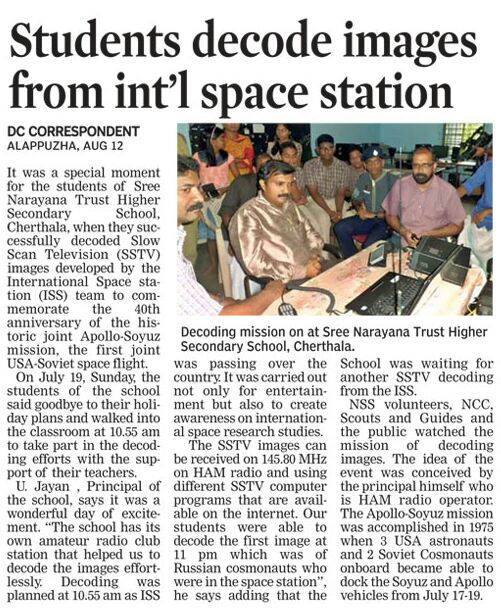
Students at Sree Narayana Trust Higher Secondary School returned to the classroom during their holidays to receive amateur radio Slow Scan Television from the International Space Station.

The special ISS transmissions were made in July to commemorate the 40th anniversary of the Apollo-Soyuz mission.

The Deccan Chronicle newspaper reports that with the support of their teachers the students were able to decode the SSTV images on a frequency of 145.800 MHz FM.

The school has an amateur radio club, callsign VU2SQL, and the Principal is licenced radio amateur U.Jayan VU2JYU.
http://www.qrz.com/db/vu2sql

See the full article on the National Institute of Amateur Radio (NIAR) Facebook page at
https://www.facebook.com/NIAR.org/photos/a.272605179532734.63897.272263639566888/743023429157571/?type=1&theater

Examples of ISS SSTV images received by radio amateurs can be seen at
http://www.spaceflightsoftware.com/ARISS_SSTV/index.php

ISS Slow Scan TV https://amsat-uk.org/beginners/iss-sstv/

When ISS Ham Radio might be off

ARISS Amateur Radio on the International Space Station

ARISS Amateur Radio on the International Space Station

Mike KC8YLD has posted some guidance as to when the Amateur Radio stations on the ISS would be turned off.

Current flight rules require all the ham radios to be off during an EVA. Technically, the VHF radios needs to be off for Russian EVAs and the UHF radio needs to be off for US EVAs.

For dockings and undockings, again the ISS operates under a flight rule that has the VHF/UHF radios off for Progress, Soyuz and ATV vehicle activity. Note that Cygnus, Dragon, HTV and formerly the Shuttle did not require the radios to be off.

For Ham TV, it will be off for any EVA. It needs to be off for ATV (the last one November) docking and undocking. It also has to be off when the Robotics arm is in close proximity.

Sites for information include:
http://www.ariss.org/
http://www.issfanclub.com/
http://www.nasa.gov/mission_pages/station/expeditions/index.html

There are Amateur Radio stations in both the ISS Russian Service module and the ESA Columbus module, see http://www.ariss.org/contact-the-iss.html