
International Space Station
Astronaut Akihiko Hoshide KE5DNI used amateur radio to speak to Scouts at Space Jam 6 in Rantoul, Illinois.
International Space Station
Astronaut Akihiko Hoshide KE5DNI used amateur radio to speak to Scouts at Space Jam 6 in Rantoul, Illinois.

An English language NHK TV news story covers the amateur radio CubeSat FITSAT-1 also known as NIWAKA which launched to the International Space Station (ISS) on July 21.

Takushi Tanaka JA6AVG and FITSAT
FITSAT-1 has multiple downlinks, CW on 437.250 MHz, AX.25 on 437.445 MHz and a 4 watt high speed data transmitter on 5840 MHz capable of sending a 640 by 480 pixel VGA JPEG image in 6 seconds.
In addition it carries high power LEDs that will be driven with 100W pulses to produce extremely bright flashes. These, it is hoped, will be observable by the unaided eye or with small binoculars. Both the 5840 MHz and optical downlinks have a high power consumption so they may only be activated when in range of the ground station in Japan. It use a neodymium magnet for attitude control.
The CubeSat will remain on the ISS until September when it will be deployed by Japanese astronaut and radio amateur Akihiko Hoshide KE5DNI using the ISS Kibo robot arm.
FITSAT-1 (NIWAKA) is mounted in a JEM-Small Satellite Orbital Deployer (J-SSOD) with the amateur radio TechEdSat and F-1 CubeSats. In a second deployment pod are WeWish and a scientific 2U CubeSat Raiko. The CubeSats will be deployed into a 400 km orbit and should have a lifetime of 3 or 4 months before re-entering the Earth’s atmosphere and burning up.
In this video NHK interviews Takushi Tanaka JA6AVG and students from the Fukuoka Institute of Technology (FIT) about the project.
Watch NHK – Tiny Satellites, Big Possibilities
FITSAT-1 information, pictures and deployment movie http://www.fit.ac.jp/~tanaka/fitsat.shtml
Kibo Robot Arm http://kibo.jaxa.jp/en/about/kibo/rms/
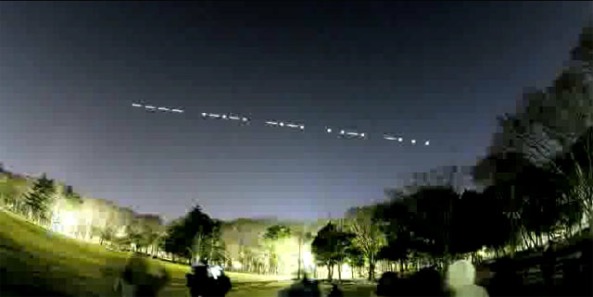
FITSAT-1 plans to use LED’s to signal in Morse code
In the July 17 ARISS meeting Kenneth Ransom N5VHO reported that his group is in the final stages of preparing the certification for flight of the replacement hardware for the degraded Ericsson VHF [145 MHz] radio.
The Ericsson rig is part of the second ISS amateur radio station that is located in the Columbus module.
The team had hoped for a launch of the equipment on flight 33-S [Dec. 5], but it may be launched on flight 49-P [Nov. 1], which is a month sooner than 33-S. The team is endeavoring to finish the certification in time for this earlier flight option. The degraded Ericsson VHF radio may be returned on flight 32-S in October. The team is very interested in trying to determine what the problem has been with this radio.
Read the minutes of the July 17 ARISS meeting at http://ariss.rac.ca/arisstel2012-07-17.htm
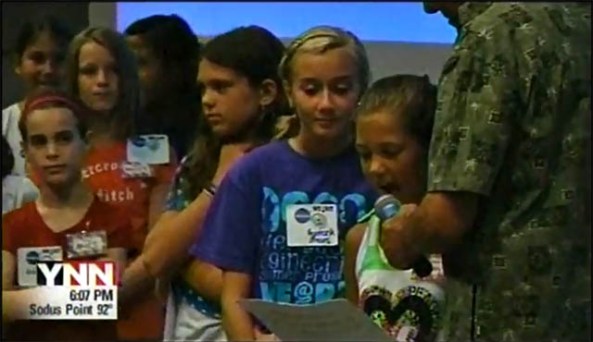
Engineers of the future talk to the International Space Station using Amateur Radio
YNN (channel 9) reports on an “out of this world” amateur radio contact between campers attending RIT’s Everyday Engineering Program in Rochester and astronaut Sunita Williams KD5PLB
Sunita was operating the Kenwood TM-D700 ham radio station located in the International Space Station’s Service Module using the callsign NA1SS on 145.800 MHz. The Everyday Engineering Program station at the Rochester Institute of Technology had the callsign W2RIT.
The Women in Engineering Program at Rochester Institute of Technology (WE@RIT) is dedicated to increasing the representation of women engineers and women leaders within the engineering profession. Founded in 2003, WE@RIT strives towards achieving gender parity within the Kate Gleason College of Engineering and hosts a comprehensive series of pre-engineering outreach, recruitment, and community building programs in support of this vision.
http://www.rit.edu/http://www.rit.edu/
Watch RIT on TV News: Chat with International Space Station
http://www.youtube.com/watch?v=wDvQnA4WTxI

Wendy Quinn W1DY explains how to go about hearing and talking to the International Space Station (ISS).
The video shows the ISS frequencies used in most of the world, uplink 144.490 MHz, downlink 145.800 MHz, however, in IARU Region 1 (Europe/Africa) the uplink is 145.200 MHz. So just tune to 145.800 MHz and activate the standard -600 kHz repeater shift.
Watch ISS
The current location of the ISS and the status of its amateur radio stations can be found at http://www.issfanclub.com/
Listening to the International Space Station http://www.uk.amsat.org/3491

The HTV-3 cargo vessel carrying five CubeSats blasted off on an H-IIB rocket from the Tanegashima Space Center on Saturday, July 21 at 02:06 UT on its way to the International Space Station (ISS).
On July 27 it is scheduled to arrive at the ISS where it will be grappled by the Expedition 32 crew using the station’s Canadarm2 robotic arm and attached to the forward end of the Harmony module to begin a stay of just under a month.
Onboard are four amateur radio CubeSats, F-1, We-Wish, FitSat-1 and TechEdSat along with a scientific CubeSat Raiko.
The CubeSats will remain on the ISS until the first week in September when they will be deployed by Japanese astronaut and radio amateur Akihiko Hoshide KE5DNI using the ISS Kibo robot arm.
The F-1 CubeSat carries a pair of Yaesu VX-3R handheld transceivers to provide communications on 145.980 MHz and 437.485 MHz FM using AX.25 packet radio data.
FITSAT-1 will carry an Optical Communications experiment that aims to write Morse Code across the night sky, although only when in range of Japan. It will also transmit CW on 437.250 MHz, FM AX.25 data on 437.445 MHz and high speed data on 5840.00 MHz.
We-Wish will transmit on 437.505 MHz FM AX.25 data.
TechEdSat will transmit on 437.465 MHz and will also communicate via the Iridium and Orbcomm satellite phone networks, a first for a CubeSat.
Watch the launch of the HTV-3
Video of planned deployment of F-1 CubeSat XV1VN from the ISS http://www.uk.amsat.org/8446
F-1 CubeSat on TV http://www.uk.amsat.org/8861

 AMSAT-UK
You must be logged in to post a comment.