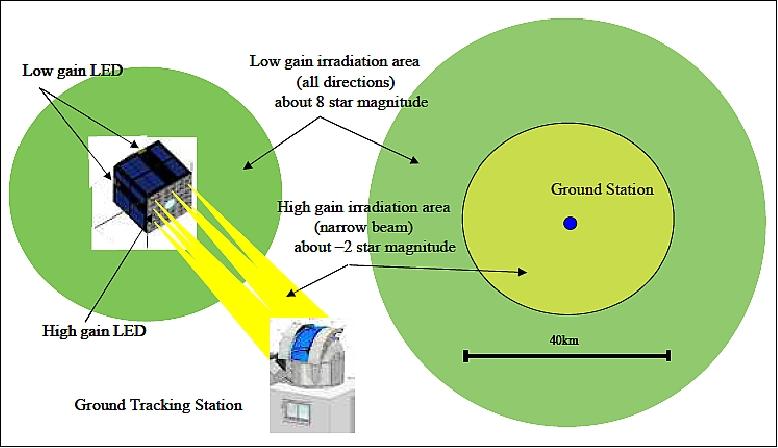
Illustration of high-gain and low-gain LED illumination scenario at the ground station – Image credit Shinshu University
An English language article about ShindaiSat is available at
https://directory.eoportal.org/web/eoportal/satellite-missions/s/shindaisat
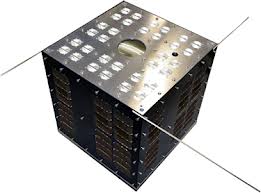 ShindaiSat is a 20 kg spacecraft approx 300 by 300 by 350 mm which is planning to use bright LEDs for Space to Earth optical communication using Morse code. It also carries an optical lens system for receiving modulated LED light from the ground station.
There will be an AX.25 packet radio telemetry beacon and a low power CW beacon. Downlink frequencies of 437.305 and 437.485 MHz have been coordinated by the IARU Amateur Satellite Frequency Coordination Panel.
The article says “A launch of ShindaiSat as a secondary payload is manifested for mid-2014 on the primary GPM (Global Precipitation Measurement) mission of NASA and JAXA. JAXA is providing the launch on the H2A vehicle from the Tanegashima Space Center, Japan.
Orbit: Non-sun-synchronous circular orbit, altitude = 407 km, inclination = 65º.”
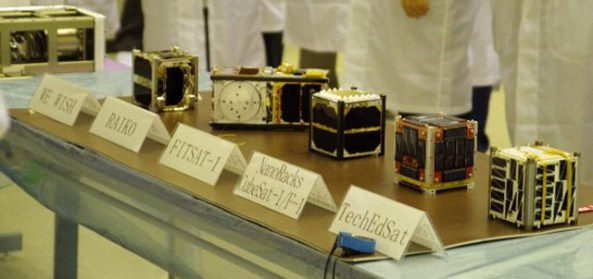



 The Japan Aerospace Exploration Agency (JAXA) would like to announce that the Small Demonstration Satellite-4 (SDS-4) completed its critical phase operations and moved to the initial phase. The SDS-4 was launched by the H-IIA F21 at 1:39 a.m. on May 18, 2012 (Japan Standard Time) as a secondary payload with the Global Change Observation Satellite 1st – Water “SHIZUKU” (GCOM-1.)
 AMSAT-UK
You must be logged in to post a comment.