NASA Seeks Proposals for Small Satellite Demonstrations

NASA is seeking proposals for flight demonstrations of small satellite technologies with the goal of increasing the technical capabilities and range of uses for this emerging category of spacecraft.

Small satellites typically weigh less than 400 pounds (180 kg) and are generally launched as secondary payloads on rockets carrying larger spacecraft. The small satellite category includes softball-sized “CubeSats,” which are standardized, small, cube-shaped spacecraft that can carry small payloads, and even smaller experimental spacecraft.

“NASA’s Edison SmallSat program helps to continue America’s leadership in space through the further development of this class of satellites — small, agile and relatively inexpensive spacecraft that could perform many tasks in space enabling new missions and providing unique educational opportunities,” said Michael Gazarik, director of NASA’s Space Technology Program at the agency’s headquarters in Washington. “These spacecraft represent a new opportunity among the many ways that NASA can approach its diverse goals in science, exploration and education.”

NASA’s Edison Small Satellite Demonstration Program has released a broad agency announcement seeking low-cost, flight demonstration proposals for small satellite technology. The topic areas for this solicitation will be limited to demonstrations of communications systems for small satellites, proximity operations with small satellites and propulsion systems for Cubesat-scale satellites. Other technology and application demonstrations will be addressed in future solicitations.

“Encouraging the growth of small-spacecraft technology also benefits our economy,” said Andrew Petro, Edison program executive at NASA Headquarters. “Many of the technologies that enable small spacecraft come from the world of small business, where commercial practices provide innovative and cost-effective solutions. Those technologies will continue to advance as demand and competition drive companies to excel.”

The advancement of small spacecraft technologies offers the potential for small satellites to expand the types of science and exploration at NASA. These spacecraft can accomplish new types of missions never before possible, and they are expected to provide space access to more technologists and scientists. Their small size means that they are less expensive to build and launch, which allows NASA to engage the expanding small-space community, including small businesses and university researchers, in technology that helps enable larger goals.

Executive summaries of proposals must be submitted by March 4, 2012. NASA expects to invite full proposals this spring, with selections made this fall. A selected project must be completed within two to three years at a total cost of no more than $15 million. The number of awards will depend on the quality and cost of proposals and availability of funding.

The Edison Small Satellite Demonstration Program is managed by NASA’s Ames Research Center at Moffett Field, Calif., for the Space Technology Program, which works to provide the technologies and capabilities that will enable NASA’s future missions. To view the announcement and instructions for submissions, visit:

http://tinyurl.com/7an7lcs

For more information on NASA’s Space Technology Program, visit:

How Disposable, Networked Satellites Will Democratize Space

A New Standard	 Satoshi

A New Standard Satoshi

In 1999, professors Robert Twiggs of Stanford University and Jordi Puig-Suari of California Polytechnic State University began to standardize the satellite business. They designed a small orbital unit-–a four-inch cube with little metal feet–-that was wide enough for solar cells, basing their design on a plastic display box for Beanie Babies. Their “CubeSat” had enough room for a computer motherboard and a few other parts necessary to do limited experiments in space, such as monitoring weather or photographing Earth. The design would significantly lower the cost for students to conduct experiments in space. CubeSats could be launched at the same time and piggyback on larger, more expensive missions, mitigating the expense of getting satellites into orbit.

With the design complete, Puig-Suari began to work with the three U.S. agencies that regularly launch satellites—the National Reconnaissance Office, the Department of Defense’s Space Test Program and NASA—to convince them to build CubeSat-ready berths into as many launches as possible. Meanwhile, the aerospace engineering department at CalPoly has become a sort of standards clearinghouse for NASA, testing each academic satellite to make sure the box won’t shake itself apart and cast shrapnel through the rocket during launch. CalPoly and Stanford maintain a forum and post all standards on CubeSat.org.

With so many scheduled launches, an undergraduate engineering student […] can design one during her freshman year and see it reach space before graduation.Twiggs and Puig-Suari’s efforts are paying off. Since 2001, about 50 CubeSats have entered space. The pair sent up their first in 2003, spending $100,000 in grant money to stow it on a Russian Dnepr launch. When the SpaceX Falcon 9 rocket launched in December 2009, six CubSats were aboard, packed three units at a time inside a spring-loaded jack-in-the-box container called a Poly-Picosatellite Orbital Deployer (P-POD), that was developed at CalPoly. After the payload deployed, the door of the P-POD popped open and the spring pushed all three satellites into orbit, where they unfurled solar panels and began transmitting information to their creators below. This year at least three rockets will launch with room for CubeSats, including the NROL-36, which can fit 11.

With so many scheduled launches, an undergraduate engineering student at one of the nearly 100 schools making CubeSats can design one during her freshman year and see it reach space before graduation. When Roland Coelho, a CalPoly graduate student, was filling out a preflight survey for his CubeSat last year, the range safety officer at Vandenberg Air Force Base in California approached him in confusion. “It asks whether you’ll need a military convoy to escort you,” the officer said. “You don’t?”

“Oh, that’s right,” Coelho replied. “It fits in the trunk of my car.”

Many academic CubeSats currently in orbit report their position, battery life and findings to ham-radio operators on Earth, who forward the information to the originating school. But projects are becoming more ambitious. The Air Force plans to use two networked CubeSats to monitor the Earth’s atmosphere and provide the world’s first real-time look at space weather. Carl Brandon of Vermont Technical College is developing an ion-drive CubeSat system that he says will be able to propel itself to the moon.

Puig-Suari and Charles Scott MacGillivray, who ran a small team of satellite developers at Boeing until last year, have now spun off their own company, called Tyvak, which produces CubeSats on a contract basis for private clients and the U.S. government. A marketplace of standardized components has also emerged, led by Stanford engineering professor Andrew Kalman’s Pumpkin, Inc., which has sold CubeSat kits to more than 100 universities, governments and nonprofit organizations. Kalman says that once people begin to think of CubeSats as disposable, building them out of off-the-shelf components and sending them up 100 at a time, the devices will truly have come of age. “If we launch a group of satellites built out of Android phones, you’ll have app developers able to dream up what to put in space,” he says.

A CubeSat today can cost as little as $100,000 to build, and buying a berth on something like a Falcon 9 runs around $250,000. In the aerospace industry, that’s spare change. The low cost also makes losing a CubeSat tolerable. Last March, a rocket carrying NASA’s Glory satellite and three CubeSats crashed into the ocean. “We were bummed,” says Coelho, who watched the failed launch. “But the NASA guys had lost a $400 million satellite.” One of the lost CubeSats was, in fact, a duplicate. In October, its twin made it into space.

CubeSat:  Austin Williams/Polysat, California Polytechnic University

HOW TO READY A CUBESAT FOR SPACE

The pre-launch guidelines for CubeSats stipulate that the object must be 10 by 10 by 11 centimeters (the extra centimeter is for the little metal feet) and no heavier than 1.3 kilograms. A satellite must remain fully deactivated—no power of any kind—until it exits its spring-loaded launch container; errant signals could scramble the electronics of the primary payload or the rocket’s guidance system. And teams must submit a detailed plan for de-orbiting—tipping the satellite such that it disintegrates in the atmosphere—within five years of leaving Earth, or risk having their satellite killed before it ever takes off.

Three Radio Amateurs to launch to ISS

NASA astronaut Don Pettit KD5MDT

NASA astronaut Don Pettit KD5MDT

On Wednesday, December 21, three radio amateurs will fly to the International Space Station (ISS) for a 6 month stay.

NASA astronaut Don Pettit KD5MDT, Russian cosmonaut Oleg Kononenko RN3DX and Dutch astronaut Andre Kuipers, PI9ISS continue preparations for their planned Soyuz launch to the ISS on on December 21 at 0816 EST (1316 GMT).

The SpaceFlightNow web site posted a photo album of the ISS Expedition 30 crew this week during inspections and fit checks in the seats: http://spaceflightnow.com/station/exp30/111209fitcheck/

The European Space Agency has released a video of Andre Kuipers’ mission which can be viewed at:
http://spaceflightnow.com/station/exp30/kuipers.html

The Soyuz TMA-03M spacecraft will be encapsulated in the aerodynamic shroud and then mated to its rocket booster next week in preparation for rollout to the launch pad on December 19. After launch the Soyuz will fly a two-day trek to rendezvous with the station for a planned automated docking December 23 at 1020 EST (1520 GMT).

These three hams are headed for a half-year mission aboard the ISS as members of Expeditions 30 and 31.

Source ANS

Watch the launch and docking live on NASA TV
http://www.southgatearc.org/news/december2011/nasa_tv_to_cover_launch_of_ham_radio_trio.htm

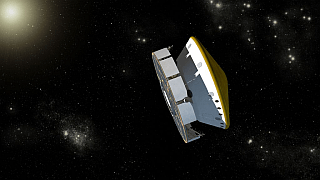
Radio Amateurs Receive Mars Science Laboratory

Mars Science Laboratory

Mars Science Laboratory

Radio Amateurs have received signals from the NASA Mars Science Laboratory using the AMSAT-DL amateur radio facility at Bochum in Germany.

On November 26, 2011 at 15:02 UTC the Mars Science Laboratory (MSL) successfully launched on an Atlas V 541 from the Cape Canaveral Air Force Station Space Launch Complex 41. It is carrying Curiosity, a 900 kg rover about the size of a small car.

It is expected to arrive at the “Red Planet” in August 2012 after a nine month flight.

Just over 7 hours after launch at 21:45 UTC the X-band telemetry signal from the MSL was received using the Bochum amateur radio facility. The signal, received at a distance of 112,000 km, had a spin-modulation of +/- 3.5 Hz with 2 revolutions / minute.

This is believed to be the first reception of the MSL outside the official NASA Deep Space Network (DSN) and the USN tracking station at Dongara, Australia (under contract to JPL for the MSL launch).

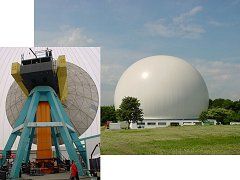
Bochum Amateur Radio Facility

Amateur Radio Facility at Bochum

For reception of MSL James Miller G3RUH remotely reconfigured the Bochum tracking and receiving system. The MSL X-Band telemetry signal was received automatically in Bochum, no-one had to be physically on-site. This shows how flexible and reliable the system at Bochum is, ready for the planned AMSAT-DL P5-A mission to Mars.

The 20m dish at Bochum is also used by AMSAT-DL to automatically receive real-time solar data from the NASA STEREO A / B satellites. The data is transmitted to a NOAA server in the USA via the Internet.

Congratulations to the AMSAT-DL team on a remarkable acheivement.

Control Software for the Bochum Radio Telescope by James Miller G3RUH
http://www.amsat.org/amsat/articles/g3ruh/126.html

Stereo A/B Spacecraft Telemetry Reception at Bochum by James Miller G3RUH
http://www.amsat.org/amsat/articles/g3ruh/127.html

AMSAT-DL in Google English http://tinyurl.com/AMSAT-DL

AMSAT-UK publishes a newsletter, OSCAR News, full of Amateur Satellite information. Sample issue at http://www.uk.amsat.org/on_193_final.pdf  Join online at http://alturl.com/avuca

Space station hams land safely

Space station hams land safely

New ISS Commander Daniel Burbank KC5ZSX

New ISS Commander Daniel Burbank KC5ZSX

Three radio amateurs returned safely to Earth on Monday, having completed nearly six months in space onboard the International Space Station (ISS) Continue reading

CubeSat Deployable Boom

Drexel University Team

Drexel University Team

The team at Drexel University have been doing some research on a deployable boom for CubeSats.

The YouTube description reads:

Drexel University’s experiment, Characterizing the Performance of the CubeSat Deployable Boom in Microgravity has been selected to participate in NASA’s 2011 Grant Us Space Reduced Gravity Education Flight Program. This flight will take place in Houston. The flight week the team participated in was July 7-16, 2011.

Watch MicroG_SpaceGrant_Drexel_July_2011.mov

The Triangle – Students ride NASA flight
http://thetriangle.org/2011/08/12/students-ride-nasa-flight/