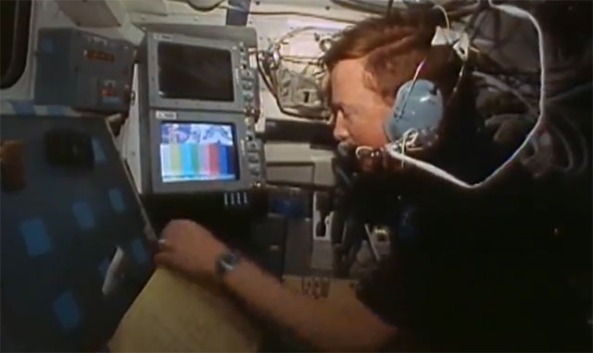
Richard Richards KB5SIW Receiving SSTV on Space Shuttle mission STS-50
The 1992 space shuttle STS-50 mission was the first time that astronauts received an amateur radio fast-scan television video. It was sent by the ham radio club station W5RRR at the Johnson Space Center (JSC).
Narrated by the Commander and crew, this video contains footage selected by the astronauts, as well as their comments on the mission. Footage includes launch, onboard crew activities, and landing.
The amateur radio aspect of the mission gets a mention at 11:32 into this video.
Watch Space Shuttle STS-50 Columbia Spacelab USML pt1-2 Post Flight Press 1992 NASA
Watch Space Shuttle STS-50 Columbia Spacelab USML pt2-2 Post Flight Press 1992 NASA
The Virginian-Pilot reports that when fifth-grader Tristan Jolley of Mack Benn Jr. Elementary school wasn’t picked to attend this year’s NASA student symposium in Houston, he was disappointed – motivated, too.
If anything, he said, it made him want to work harder. So he sent a balloon up to near space and captured some great video.
He won’t get a grade for his work, his teacher Liz Petry said she wants students to take risks and to learn from the process.
The Virginian-Pilot reports that when fifth-grader Tristan Jolley of Mack Benn Jr. Elementary school wasn’t picked to attend this year’s NASA student symposium in Houston, he was disappointed – motivated, too.
If anything, he said, it made him want to work harder. So he sent a balloon up to near space and captured some great video.
He won’t get a grade for his work, his teacher Liz Petry said she wants students to take risks and to learn from the process.
The UK Space Biomedicine Association invites students, professionals and the general public to the first UK Space Environments Conference in Aberdeen, 16 – 17 June, 2012. This is the only conference where representatives from UK organisations actively engaged in fields such as Space Biomedicine, Exobiology, Astrochemistry and Microgravity-physics will collectively meet to aid the development of space environments research and education in the UK. The meeting represents a unique opportunity to:
Showcase current activities related to research and education in the space environment.
Interact and collaborate with pioneers & colleagues from numerous disciplines involved in R&D associated with aspects of the space environment.
Contribute to and learn about the development of a national UK space biomedicine strategy.
Keynote speakers will be:
Dr Jeff Davis, Director of NASA space life science and medical operations
Professor Charles Cockell, Professor of Astrobiology at Edinburgh University
British astronaut Major Tim Peake will also be speaking about the challenges and benefits of performing science in space.
Venue: Satrosphere Science Centre, 179 Constitution Street, Aberdeen, AB24 5TU Dates: 16-17th June 2012 Registration: Professionals- £91, Students- £67 Website:http://uksba.org/conference/
W0ORE STS-51-F QSL Card - Image Credit John Magliacane KD2BD
The second ham radio transmissions by an amateur radio operator in space were made by Tony England W0ORE during the Challenger shuttle mission STS 51-F in 1985.
He achieved the first ever two-way Slow Scan TV (SSTV) space contact during the flight when he contacted GB3RS the headquaters station of the Radio Society of Great Britain (RSGB).
Tony W0ORE was running a Motorola model MX-340 handheld 2-meter transceiver and a Robot Research model 1200C slow-scan television scan converter with an antenna fitted on the inside of one of Challengers windows.
Narrated by the Commander and crew, these videos contains footage selected by the astronauts, as well as their comments on the mission. Footage includes launch, onboard crew activities, and landing. The Shuttle Amateur Radio Experiment (SAREX) is mentioned 11:40 into the video.
Space Shuttle STS-51-F Challenger Spacelab 2 Post Flight Press Conference Film 1985 Part 1 of 2
STS-51-F (also known as Spacelab 2) was the nineteenth flight of NASA’s Space Shuttle program, and the eighth flight of Space Shuttle Challenger. It launched from Kennedy Space Center, Florida, on 29 July 1985, and landed at Edwards Air Force Base, California, just under eight days later on 6 August 1985, at 12:45:26 pm PDT.
You must be logged in to post a comment.