$50Sat Eagle2 PocketQube Operational

$50SAT-Eagle2

$50SAT-Eagle2

$50SAT – Eagle2 – the PICAXE and RFM22B micro satellite was successfully launched from Dombarovsky Air Base in Russia on November 21 at 07:10 UT.

It went active soon after being released from UNISAT-5 and the 437.505 MHz (+/-10 kHz Doppler shift) Morse beacon from $50SAT was heard in the UK at 10:28 that morning (Nov. 21).

$50SAT is a very low cost and simple satellite and most radio amateurs should be able to receive the Morse beacon and FSK RTTY data with an omni directional antenna.

The primary purpose of $50SAT (Eagle2) was to create a cost effective platform for engineering and science students to use for developing real world skills. The PocketQube form factor has no precision mechanical parts and can be built from locally obtained sheet metal.

$50sat is comprised of two 40mm x 40mm circuit boards. The first is the processor/radio board which contains the PICaxe 40X2 processor programmed in PICaxe basic, the Hope RFM22B single chip radio and some peripheral devices. The PICaxe 40X2 is an easy to use micro controller popular in the education sector.

The second board is the power control and monitor board. This board contains four maximum power point controllers, one for each solar array on each side of the spacecraft as well as current monitors for the battery and summed solar power. The battery is a common 3.7 volt lithium ion camera battery.

The satellite will transmit data telemetry about the satellites operation, a sequence of call signs in slow FM Morse and some key data as fast FM Morse (120 WPM). The main data payload will also be transmitted as FSK RTTY which should be readily heard on the ground with basic amateur radio equipment.

$50SAT has been a collaborative education project between Professor Bob Twiggs, KE6QMD, Morehead State University and three other radio amateurs, Howie DeFelice, AB2S, Michael Kirkhart, KD8QBA, and Stuart Robinson, GW7HPW.

The $50SAT team plan to make all the software and hardware designs freely available to anyone who wants them for personal or educational use. For further information see the $50SAT Dropbox at https://www.dropbox.com/sh/l3919wtfiywk2gf/-HxyXNsIr8

There is a discussion group for $50SAT at:
http://groups.yahoo.com/neo/groups/50dollarsat/conversations/topics

50DollarSat http://www.50dollarsat.info/

HOPE RFM22B FSK transceiver http://www.hoperf.com/rf/module/fsk/RFM22B.htm

PICAXE-40X2 microcontroller http://www.picaxe.com/Hardware/PICAXE-Chips/PICAXE-40X2-microcontroller/

Dnepr satellites https://amsat-uk.org/satellites/dnepr-november-2013/
Mass Amateur Radio Satellite Launch November 21

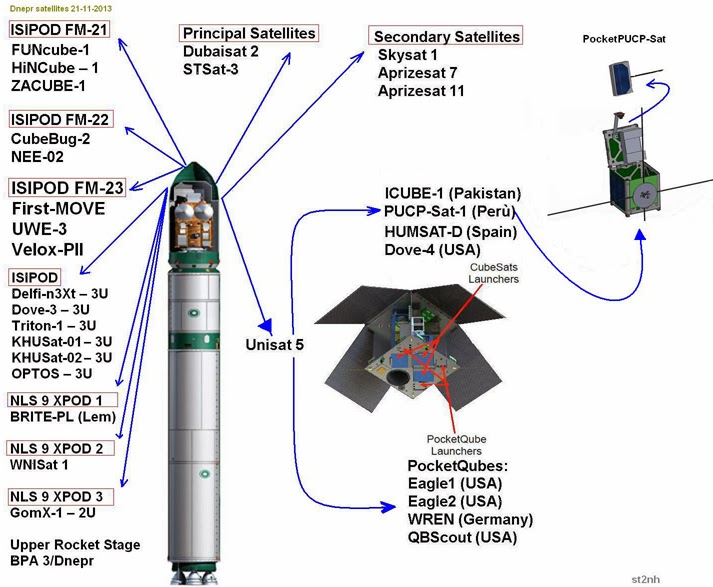
Satellites on Dnepr launch November 21, 2013 - Image credit Nader Omer ST2NH

Satellites on Dnepr launch November 21, 2013 – Image credit Nader Omer ST2NH

The largest ever launch of satellites carrying amateur radio payloads should take place on November 21, 2013 at 07:10:11 UT on a Dnepr from Dombarovsky near Yasny.

One of the satellites UniSat-5 will itself deploy a number of additional satellites. Among them should be the CubeSats PUCP-SAT-1, HumSat-D, Icube-1 and the PocketQubes Wren, Eagle-1 (BeakerSat), Eagle-2 ($50Sat), QB-Scout1. PUCP-SAT-1 intends to subsequently release a further satellite Pocket-PUCP.

Nader Omer ST2NH has produced the graphic above which shows satellites to be deployed. It is thought UNiSat-5 may not deploy its satellites until January.

As well as UniSat-5 and its associated CubeSats and PocketQubes these amateur radio satellites are also believed to be on the Yasny Dnepr launch:
HinCube
FUNcube-1
ZAcube-1
First-MOVE
UWE-3
Velox-PII
CubeBug-2
Triton-1
Delfi-n3Xt
GOMX-1

A list of the IARU coordinated amateur radio frequencies for the Yasny Dnepr satellites is available here.

BRITE-PL1 (20 x 20 x 20 cm) is also on the launch, frequency information on the web indicates it may have a 4 kbps transceiver on 437.365 MHz and a beacon on 145.890 MHz in addition to the primary downlink on 2234.4 MHz.

The Ecuadorian 1U CubeSat NEE-02 Krysaor has fold-out solar panels.  It carries a 0.9 watt HD TV transmitter that operates in the 980 MHz band and it is believed a beacon will send a Morse Code ID, a Slow Scan TV (SSTV) image and Ecuadors national anthem.

Further information about the satellites on this launch can be found at
http://www.zarya.info/blog/?p=1745
http://www.pe0sat.vgnet.nl/2013/upcoming-dnepr-launch/

Read the satellite blog of Nader Omer ST2NH at http://st2nh-blogger.blogspot.co.uk/

WREN a Ham Radio Slow Scan TV PocketQube Satellite

Sacha Tholl in the WREN Mission Control Center

Sacha Tholl in the WREN Mission Control Center

The tiny PocketQube satellite WREN, just 5x5x5 cm and weighing 250 grams, aims to transmit amateur radio Slow Scan TV (SSTV) pictures using the Martin-1 format.

WREN - Image credit Stadoko

WREN – Image credit Stadoko

Despite its small size WREN is equipped with a camera, a gyro, a magnetic field sensor, momentum wheels and pulsed plasma microthrusters. The camera is equipped with an image processing system which can find the position of the Sun and the Earth automatically.

The communications uplink and downlink will take place on the IARU coordinated frequency of 437.405 MHz.

WREN is flying inside a larger satellite called UNISAT-5 that will be launched in late November, 2013 on a Dnepr rocket from Dombarovsky near Yasny. UNISAT-5 should deploy WREN after launch.

On September 7, 2013 Paul Kocyla and Sacha J. Tholl presented the working engineering model of the WREN PocketQube satellite to the public at the Maker Faire at Kerkrade in The Netherlands. In this video they are sending live pictures during the faire using amateur radio SSTV, just as WREN will do in orbit.

Watch Satellite Wren, sending Pictures by SSTV at the continium Maker Faire in Kerkrade NL September 7, 2013

The four team members explain in the following video the mission objectives of WREN, believed to be the smallest satellite ever to carry Pulse Plasma Thrusters.

Watch Fly a Satellite in Space…Without Leaving Your Couch

In this video Sacha J. Tholl talks to Chantal Cappelletti, CEO from GAUSS S.R.L., the WREN PocketQube launch provider, and Paride Testani, principal investigator of the UNISAT-5 Project.

Watch How is WREN, the tiniest Satellite with Thrusters (5 cm³, 250gram) getting into Orbit?

Watch The Wren flight model being build and the mission control software updated

First picture transmitted by WREN in Martin-1 SSTV format - Ronghua Wang and Paul Kocyla

First picture transmitted by WREN in Martin-1 SSTV format – Ronghua Wang and Paul Kocyla

WREN Kickstarter http://www.kickstarter.com/projects/1467273745/wren-fly-a-real-spacecraft-by-yourself

WREN vibration testing http://www.kickstarter.com/projects/1467273745/wren-fly-a-real-spacecraft-by-yourself/posts/633161

Facebook http://www.facebook.com/StaDoKo

Paul Kocyla satellite developer http://www.pk-remote.com/

Italian Microsat to Deploy Amateur Radio Satellites
https://amsat-uk.org/2012/05/25/italian-microsat-to-deploy-amateur-radio-satellites/

Satellite tracking information https://amsat-uk.org/beginners/satellite-tracking/

WREN was built by four guys in a garage

WREN was built by four guys in a garage

50DollarSat PocketQube Satellite

A Dnepr launch

A Dnepr launch

50DollarSat (A.K.A. $50SAT or Eagle-2) is a PocketQube micro satellite made from commercial electronic components and designed to fit in a 50 mm cube.

The primary purpose of the project was to create a cost effective platform for engineering and science students to use for developing real world skills. The PocketQube form factor has no precision mechanical parts and can be built from locally obtained sheet metal.

50DollarSat is comprised of two 40 mm x 40 mm circuit boards. The first is the processor/radio board which contains the PICaxe 40X2 processor programmed in PICaxe basic, the Hope RFM22B single chip radio and some peripheral devices. The PICaxe 40X2 is an easy to use micro controller popular in the education sector.

The second board is the power control and monitor board. This board contains four maximum power point controllers, one for each solar array on each side of the spacecraft as well as current monitors for the battery and summed solar power. The battery is a common 3.7V lithium ion camera battery.

The satellite will transmit data telemetry about the satellites operation, a sequence of call signs in slow FM Morse and some key data as fast FM Morse (120 WPM). The main data payload will also be transmitted as FSK RTTY which should be readily heard on the ground with basic amateur radio equipment.

50DollarSat (Eagle-2) has been a collaborative education project between Professor Bob Twiggs, KE6QMD,  Morehead State University and three other radio amateurs, Howie DeFelice, AB2S, Michael Kirkhart, KD8QBA, and Stuart Robinson, GW7HPW.

50DollarSat will be one of PocketQubes and CubeSats which will be carried by the UniSat-5 microsatellite. It is due to launch in November from a Russian Dnepr silo launched rocket at Dombarovsky near Yasny. UniSat-5 will be released into a sun synchronous 700km orbit. After deployment UniSat-5 will then release its CubeSats and PocketQubes.

50DollarSat http://www.50dollarsat.info/

HOPE RFM22B FSK transceiver http://www.hoperf.com/rf/module/fsk/RFM22B.htm

PICAXE-40X2 microcontroller http://www.picaxe.com/Hardware/PICAXE-Chips/PICAXE-40X2-microcontroller/

Italian Microsat to Deploy Amateur Radio Satellites
https://amsat-uk.org/2012/05/25/italian-microsat-to-deploy-six-amateur-radio-satellites/