CEPT CPG decides position on 144, 50 and 1240-1300 MHz

CEPT Logo“At the insistence of the European Commission, a WRC-23 agenda item was considered necessary to address the world-wide protection of Regional Navigational Satellite Systems from amateur emissions in the band 1240-1300 MHz.”

The CEPT ECC CPG met in Ankara during August 26-30 to finalise their position ahead of the ITU World Radiocommunication Conference 2019 (WRC-19) to be held in Sharm el-Sheikh, Egypt, October 28 to November 22. This conference will define the Agenda Items for WRC-23.

RSGB volunteers along with other radio amateurs in IARU Region 1 countries put in a considerable amount of work to defend the amateur radio allocations. Their hard work ensured the removal of 144-146 MHz from a study of additional spectrum for aeronautical applications and an agreement on a European Common Proposal for 50-52 MHz.

IARU Region 1 have released this report on the meeting:

The CEPT Conference Preparatory Group met this week in Ankara, Turkey. Items of interest to the amateur service which were finalised were:

– Agreement to a European Common Proposal (ECP) on allocating 50-52 MHz to the amateur service in Region 1 on a secondary basis with a footnote listing those countries where the amateur service will have a primary allocation in the band 50-50.5 MHz (WRC Agenda Item 1.1)

– Agreement to an ECP on spectrum to be considered for International Mobile Telecommunications, which does not now include the primary amateur band at 47-47.2 GHz (WRC Agenda Item 1.13)

– Agreement to an ECP that retains the current regulatory position in the 5725-5850 MHz frequency band which includes secondary allocations to the amateur service and the amateur-satellite service (WRC Agenda Item 1.16)

– Removal of 144-146 MHz from a French proposal for study of additional spectrum for aeronautical applications. (WRC Agenda Item 10)

– At the insistence of the European Commission, a WRC-23 agenda item was considered necessary to address the world-wide protection of Regional Navigational Satellite Systems from amateur emissions in the band 1240-1300 MHz. A draft WRC Resolution was agreed which underlines the importance of this frequency band to the amateur service and explicitly excludes the removal of existing allocations as part of the proposed agenda item. (WRC Agenda Item 10)

– There was no change to the already agreed CEPT position on Wireless Power Transmission (WRC Agenda item 9.1.6). This states that no change is needed in the Radio Regulations to address the question of operating frequency for WPT-EV, but leaves open the question of spurious emissions from WPT-EV.

Commenting on the outcome of CPG, IARU Region 1 President Don Beattie, G3BJ, said that the IARU team at Ankara (the only representatives of the amateur service at the meeting) had presented clear and convincing arguments for the amateur service position and he was pleased that regulators had recognised the strength of the amateur case. He expressed his thanks to everyone who had contributed to the outcome at CPG.

The issues now move to WRC in Egypt in November for final resolution. IARU will be there.

IARU Region 1 https://iaru-r1.org/

Note: Although the CEPT position includes a Primary allocation at 50.0 to 50.5 MHz it is for the Amateur Service only – the Amateur Satellite Service is excluded.

CEPT ECC CPG19-9 Ankara Meeting Minutes and Annexes are available for download at
https://cept.org/ecc/groups/ecc/cpg/client/meeting-documents/?flid=10064

Background to 1240-1300 MHz https://amsat-uk.org/2019/08/19/threat-to-amateur-radio-23cm-band/

144-146 MHz WebSDR at Goonhilly

Goonhilly 144 MHz WebSDR

Goonhilly 144 MHz WebSDR

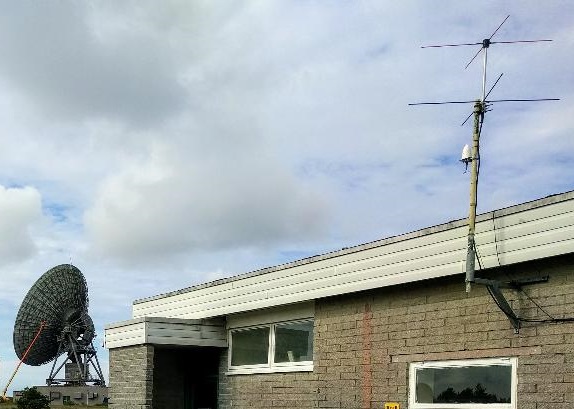
The AMSAT-UK and BATC 144-146 MHz Web-based Software Defined Radio installation at Goonhilly is now available. The WebSDR uses the standard FUNcube TLM Receive Antenna that can be purchased from the AMSAT-UK Online Store.

WebSDR Antenna top right

WebSDR Antenna top right

This is being provided in collaboration with Goonhilly Earth Station where it is kindly hosted alongside the existing receiving equipment for the amateur radio transponders on the Qatar-Oscar-100 (QO-100 / Es’hail-2) geostationary satellite.

It shares the same Turnstile antenna that is used for the reception of the AO73, EO88 & JO97 CubeSats.

Being located in the far South West of the UK, it is anticipated the SDR will be useful for early Acquisition of Signal (AOS) of 144 MHz downlinks from amateur satellites and the International Space Station (ISS). Additionally it can be used for reception of tropospheric signals from the south – the Spanish beacon ED1ZAG on 144.403 MHz has been already been heard on the system.

The new 144 MHz band WebSDR is available at https://vhf-goonhilly.batc.org.uk/

The AMSAT-UK / BATC 10 GHz WebSDR for QO-100 is still available at https://eshail.batc.org.uk/

AMSAT-UK: https://amsat-uk.org/
Twitter: https://twitter.com/AmsatUK
Facebook: https://facebook.com/AmsatUK
YouTube: https://youtube.com/AmsatUK

BATC: https://batc.org.uk/
Twitter: https://twitter.com/batconline
Live event streaming: https://batc.org.uk/live/

Ideas sought for the next FUNcube satellite

AO-73 (FUNcube-1) – Image credit Wouter Weggelaar PA3WEG

In November the FUNcube-1 CubeSat will have been in orbit for 6 years and the FUNcube team are now soliciting suggestions for the next satellite

The team are looking for suggestions for:
• Conformation of the satellite (2U / 3U)
• Orbit (LEO / MEO)
• STEM Outreach
• Amateur Radio Payloads
• Research Payloads

Please email your ideas to:
funcube-next <at> funcube.org.uk

The topic will be discussed during the AMSAT-UK Colloquium on Sunday 13th October 2019 https://amsat-uk.org/colloquium/

If you would like to join the team, please email:
operations <at> funcube.org.uk

Dave, G4DPZ
on behalf of the FUNcube Team

Threat to Amateur Radio 23cm band

Galileo LogoA joint paper by France, Lithuania, Malta, Slovenia and The Netherlands for the CEPT CPG meeting in Ankara, August 26-30, attacks the continued use by Radio Amateurs of our 1240-1300 MHz band.

This is the final CEPT CPG meeting in preparation for the ITU World Radiocommunication Conference 2019 (WRC-19) to be held in Sharm el-Sheikh, Egypt, October 28 to November 22. This conference will define the Agenda Items for WRC-23.

Paper AI10 – Proposal on AS-RNSS says:

Galileo is close to full operational capability and its E6 signals in the band 1260-1300 MHz will support new services such as the free-to-use Galileo High Accuracy Service, and also robust authentication, expected to be used by a variety of applications including autonomous vehicles and the Internet of Things (IoT).

Several cases of interference to Galileo E6 receivers from amateur service emissions have occurred in the recent past, sometimes at significant distance, and have taken several hours or even days to be eliminated. There is therefore a serious concern that as Galileo E6 receivers are deployed and used more widely, cases of interference from amateur stations will rapidly grow in number.

A WRC-23 agenda item is necessary to address this issue because:

1. Unregulated use of the band 1240-1300 MHz by the amateur service is a serious source of harmful interference to RNSS receivers. This is demonstrated by experience.

2. The number of Galileo receivers in 1260-1300 MHz will increase dramatically, and interference cases will multiply if not addressed timely.

3. Galileo and other RNSS systems will deploy at global scale, and interference scenario between amateur emissions and RNSS receivers include cross-border cases. The issue is therefore of international nature and is to be addressed in the ITU framework.

4. Galileo is a major European asset, and a decision at WRC-23 is essential to be compatible with the roadmap of deployment of Galileo receivers in this band.

Download Paper: AI10 – Proposal on AS-RNSS from
https://cept.org/ecc/groups/ecc/cpg/client/meeting-documents/?flid=10031

Also see the IARU paper: RNSS Proposal WRC-19 AI 10 at the same URL

Some background information is at
https://amsat-uk.org/2019/05/31/1240-1300-mhz-band-discussed-by-cept-wgfm-and-cpg-pta/

European Commission Joint Research Centre report written 2014 and published 2015 on Compatibility between Amateur Radio Services and Galileo in the 1260-1300 MHz Radio Frequency Band. It reports the effect of transmissions of 0.1, 1 and 15 watts EIRP on a Galileo receiver up to 10 km away – download PDF here

January 2006 – Potential Interference To Galileo From 23cm Band Operations by Peter Blair G3LTF
http://www.southgatearc.org/articles/galileo.htm

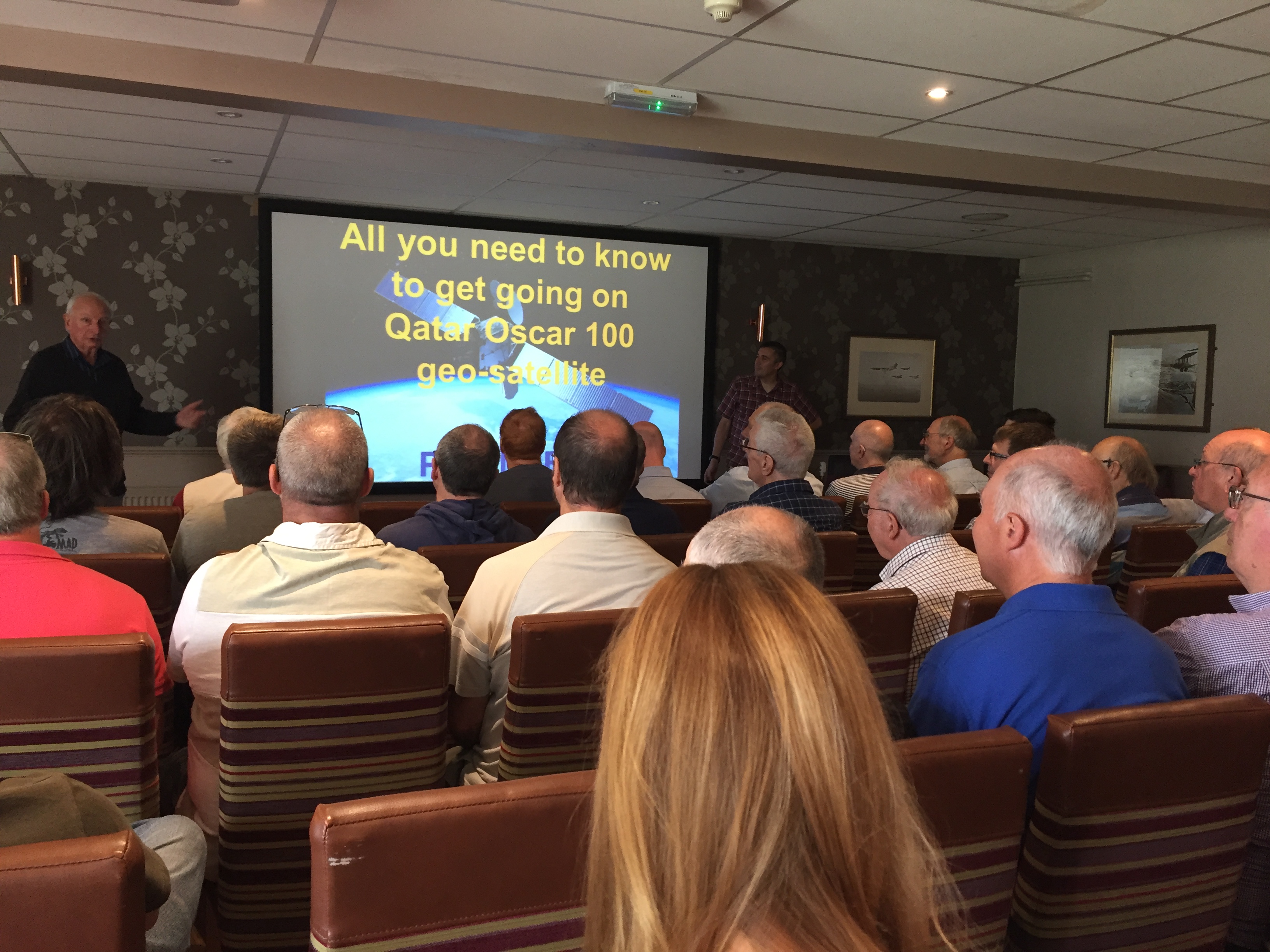
QO-100 geostationary satellite talk at Hamfest 2019

QO-100 talk by Paul M0EYT at Hamfest 2019

QO-100 talk by Paul M0EYT at Hamfest 2019

Paul Marsh M0EYT gave a presentation titled ‘All you need to know to get going on Es’hail-2 / QO-100 geostationary satellite’ at Hamfest 2019 in Dorset on Sunday, August 11.

The 50 minute talk covered satellite information, software, hardware, dish alignment and was followed by a question and answer session.

The talk proved to be very popular and attracted a large audience.

Paul has made available a PDF copy of the slides and you can download it here.

QO-100 (Es’hail-2) information https://amsat-uk.org/satellites/geo/eshail-2/

Listen to the QO-100 10 GHz downlink using the AMSAT-UK / BATC WebSDR at Goonhilly https://eshail.batc.org.uk/

UHF–VHF Receive Converter for use with a satellite LNB by David Bowman G0MRFDownload article PDF here

Article: Receiving the Es’hail-2 geostationary satellite by George Smart M1GEO at
https://www.george-smart.co.uk/2019/02/eshail2-rx/

AMSAT-CE working on CESAR-1 FM transponder satellite

AMSAT-CE LogoThe Radio Club de Chile has announced the reactivation of the AMSAT-CE Foundation.

The Government of Chile has announced a plan to renew the Chilean Air Force Fasat Charlie satellite, along with promoting the construction of several micro and nano satellites.

This motivated the AMSAT-CE Foundation to propose that the CESAR-1 project of Chilean radio amateurs can be reactivated, modernized and completed, as part of the government plan.

Radio Club de Chile has supported AMSAT-CE since its begining and the Vice-President of Radio Club of Chile, José Tijoux CE3BCO, has just joined the Board of Directors of AMSAT-CE continuing and strengthening the space activity of Chilean radio amateurs .

The AMSAT-CE Foundation was created in 1993 and its first project is CESAR-1 which stands for CE (Chile) Satellite of Radiocommunication.

AMSAT-CE is designing and building five satellites, to be used by radio amateurs around the world, which will allow a series of scientific experiments in the field of digital communications, as well as gravimetric and orbitgraphic studies.

Of these five satellites, one will be the engineering prototype, three will be flight units, and the remaining one will be used to check or replicate on the ground the operation of the units that are in space.

The CESAR-1 satellite will be a  23 cm cube with a mass of about 12 kg and is planned to have five main experiments:

• A real-time digital transponder (Digipeater) using AX.25 at 9,600 kbps

• An electronic message box (Store and Forward) using AX.25 at 9.6 kbps)

• A 145 MHZ to 436 MHz band FM transponder

• A link to two terrestrial repeaters that will enable low power stations operating on 147 MHz FM to access the satellite

• An on-board GPS receiver, which will collect information for gravimetric and orbitgraphic research.

The orbit of CESAR-1 will be low, polar and heliosynchronous (about 800 km high).

AMSAT-CE
https://www.amsat-ce.org/
https://twitter.com/AmsatChile

Radio Club de Chile
http://www.ce3aa.cl/amsat-ce/
https://twitter.com/RCDECHILE