CAS-7B ( BP-1B ) amateur radio satellite now ready for launch

CAS-7B / BP-1B undergoing test

CAS-7B / BP-1B undergoing test

CAS-7B ( BP-1B ) satellite is an amateur radio satellite combined with educational. Chinese Amateur Satellite Group ( CAMSAT ) is working the project with Beijing Institute of Technology ( BIT ), one of the most famous aerospace universities in China. The university provides support in launch of the satellite, there are many teachers and students from this university are participating in the development and testing of the satellite. With the help of CAMSAT, the university has established an amateur radio club (call sign: BI1LG), many students are the members, they are learning amateur radio satellite communication and experience endless fun.

CAS-7B / BP-1B satellite schematic diagram

CAS-7B / BP-1B satellite schematic diagram

Because of the orbital apogee and the size and mass of the satellite, the orbital life of the satellite is expected to be only one week, up to a maximum of one month, which will also provide with an opportunity for hams to track and monitor satellite entering the atmosphere.

The CAS-7B ( BP-1B ) is scheduled to be launched at the end of June 2019. The launch will use a new launch vehicle from a small commercial rocket company. This is the first launch of this launch vehicle, and there is a large possibility of failure, if the launch fails, we will have another launch later this year.

Satellite Name: CAS-7B/BP-1B
• Architecture: 1.5U Cube-satellite with flexible film ball
• Dimensions: 263Lx140Wx105H mm with 500 mm diameter flexible film ball
• Mass: 3kg
• Stabilization: Pneumatic resistance sail passive control

Orbit:
• Orbit type : LEO
• Apogee : 300km Circular orbit
• Inclination : 42.7º
• Period : 90.6min

Payload:
• VHF Antenna: one 1/4λ monopole antenna with max.0dBi gain is located at +Y side
• UHF Antenna: two 1/4λ monopole antennas with max.0dBi gain are located at –Z and +Z side
• CW Telemetry Beacon: 435.715MHz 20dBm
• V/U FM Transponder Downlink: 435.690MHz 20dBm, 16kHz bandwidth
• V/U FM Transponder Uplink: 145.900MHz 16kHz bandwidth

CAMSAT CAS-7B ( BP-1B ) News Release PDF with Telemetry Format – CAMSAT CAS-7B News Release

CAS-7B / BP-1B undergoing thermal vacuum test

CAS-7B / BP-1B undergoing thermal vacuum test

AMSAT-UK payload on ESEO has been activated

Frame received by PQ2HX in Brazil at around 14:17 UTC on April 12, 2019

Frame received by PQ2HX in Brazil at around 14:17 UTC on April 12, 2019

ESA have just released a new mission update for the ESEO Mission. It can be seen at https://www.esa.int/Education/ESEO/ESEO_mission_updates

We are delighted that on April 12, 2019, the BPSK telemetry transmitter, on our payload, was enabled for a period of just over 200 minutes in orbit!

ESEO AMSAT-UK Payload Telemetry Data

ESEO AMSAT-UK Payload Telemetry Data

Although we were not able to announce this activation in advance, more than ten stations around the world successfully received the telemetry on 145.895 MHz and submitted it to the FUNcube Data Warehouse. We are very grateful to them for their support.

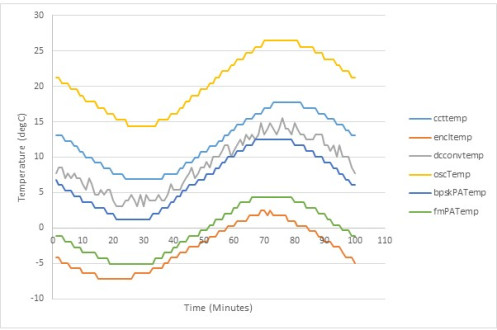
Over 50 channels of Real Time and Whole Orbit Data were collected. For example, a number of on-board temperatures are shown in this graph which covers the period from 11:58 to 13:36 UTC

The very last frame received was captured by PQ2HX in Brazil at around 14:17 UTC.

We are keenly awaiting further possibilities to exercise more of the payload as soon as this becomes possible but, in the meantime, is good to know that all the telemetry channels reported nominal values.

RSGB AGM Es’hail-2 / QO-100 talk now available

Dave Crump G8GKQ, Phil Crump M0DNY and Noel Matthews G8GTZ receive award from RSGB President Dave Wilson M0OBW - image credit RSGB

Dave Crump G8GKQ, Phil Crump M0DNY and Noel Matthews G8GTZ receive award from RSGB President Dave Wilson M0OBW – image credit RSGB

The RSGB have made available a recording and slides of the presentation given at the AGM on April 27, 2019 about the Es’hail-2 / QO-100 amateur radio transponders.

After the formal AGM proceedings and the trophy presentations, attendees were treated to an introductory talk on Qatar-Oscar 100 geostationary satellite given by Noel Matthews, G8GTZ, Dave Crump, G8GKQ and Phil Crump, M0DNY.

Listen to the talk and download the slides at
https://rsgb.org/main/about-us/agm/agm-2019-proceedings/

Play the Listen to AGM 2019 afternoon recording and fast forward to 20 minutes and 41 seconds in. The slides are near the bottom of the page.

Qatar OSCAR-100 web receiver now live
https://amsat-uk.org/2019/02/10/qatar-oscar-100-web-receiver-now-live/

Es’hail-2 awards at RSGB AGM

AMSAT-DL President Peter Guelzow DB2OS at the Qatar National Day Station A71QND

AMSAT-DL President Peter Guelzow DB2OS

At the RSGB AGM in Birmingham on Saturday, April 27, 2019 two awards were made in recognition of work related to the amateur radio transponders on the geostationary satellite Es’hail-2 / QO-100.

The prestigious Louis Varney Cup for Advances in Space Communication was awarded to Peter Gülzow DB2OS for his leadership of the team responsible for the Qatar-OSCAR-100 mission which is now in service.

Dave Crump G8GKQ, Phil Crump M0DNY and Noel Matthews G8GTZ receive award from RSGB President Dave Wilson M0OBW - image credit RSGB

Dave Crump G8GKQ, Phil Crump M0DNY and Noel Matthews G8GTZ receive award from RSGB President Dave Wilson M0OBW – image credit RSGB

The Fraser Shepherd Award for Research into Microwave Applications for Radio Communication was awarded to Dave Crump G8GKQ, Phil Crump M0DNY, Noel Matthews G8GTZ and Graham Shirville G3VZV for enabling access for all the amateur radio community to QO-100 by developing and installing a narrow band transponder WebSDR, and wide band transponder spectrum monitor.

After the award presentation Dave, Phil and Noel gave a talk on Es’hail-2 / QO-100 covering a brief history of how the project came about, an overview of equipment required to operate QO-100 and an introduction and a demonstration of the WebSDR and spectrum monitor, which allow you to listen to stations on the narrow band segment using only a standard web browser.

Graham Shirville G3VZV was unable to be present to collect the award as on that Saturday he had to attend the key IARU Region 1 VHF/UHF/uW (C5) meeting in Vienna.

One of the presentations given at the IARU-R1 meeting was Popularity of ATV in the Netherlands by Chris van den Berg PA3CRX which you can see at
https://prezi.com/zxap36vhivca/popularity-of-atv-in-the-netherlands-jan-2019/

Graham Shirville G3VZV 5th from right at the IARU Region 1 VHF/UHF/uW (C5) meeting in Vienna

Graham Shirville G3VZV 5th from right at the IARU Region 1 VHF/UHF/uW (C5) meeting in Vienna

Coronation station HS10KING/mm on geostationary satellite

Es'hail-2 Qatar-OSCAR-100To mark the Coronation of King Vajiralongkorn Bodindradebayavarangkun (King Rama X) from May 4-6, 2019 the Radio Amateur Society of Thailand under the Patronage of His Majesty the King will be operating a special event station

The station will be operated from the Royal Thai Navy aircraft carrier, the Chakri Narubet, in the Gulf of Thailand from May 3-6 using the callsign HS10KING/mm.

This station will be making QSOs in the 40, 20, 15 and 10 metre HF bands, on 2 metres VHF and also using amateur radio satellites, including the Es’hail-2 / QO-100 satellite.

Royal Thai Navy aircraft carrier HTMS Chakri Narubet

Royal Thai Navy aircraft carrier HTMS Chakri Narubet

Consequently, the May meeting of RAST will be postponed to the second Sunday of the month, and will take place on Sunday May 12 at Sena Place Hotel when applications to take the upcoming Intermediate Class examination will be available

As usual all RAST members are welcome to attend this meeting and hopefully they will be able to have a QSO with HS10KING/mm.

Sincere 73,

Tony Waltham, HS0ZDX
RAST Vice-President
RAST English-language website: https://www.qsl.net/rast/

The Es’hail-2 / QO-100 geostationary satellite provides continuous coverage from Brazil across Africa and Europe all the way to Thailand. You can listen to its 10 GHz downlink from anywhere in the world by using the AMSAT-UK / BATC WebSDR based at Goonhilly
https://amsat-uk.org/2019/02/10/qatar-oscar-100-web-receiver-now-live/

SatNOGS satellite ground station article in HackSpace magazine

HackSpace magazine issue 18 front coverThe May edition of HackSpace magazine, issue 18, featuring articles by radio amateur Jo Hinchliffe MW6CYK is available as a free PDF.

On pages 34-47 is his special feature on Space, which explains how you can build a SatNOGS satellite ground station to receive amateur radio satellites.

Jo’s article Make a Slim Jim Antenna appears on pages 110-111.

Also in the magazine, on pages 96-99, Ben Everard explains how to build an ISS count‑down timer.

You can download the free HackSpace magazine PDF from
https://hackspace.raspberrypi.org/issues/18

Direct link to the PDF
https://magazines-static.raspberrypi.org/issues/full_pdfs/000/000/072/original/HackSpaceMag18.pdf

Jo Hinchliffe MW6CYK
https://twitter.com/concreted0g
https://concretedog.blogspot.com/