AMSAT Phase 4B Ground Engineering Report

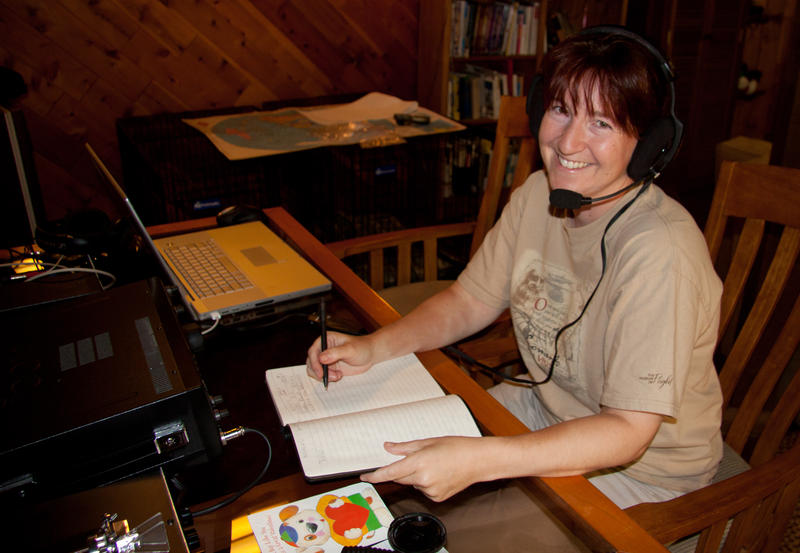
Michelle Thompson W5NYV

Michelle Thompson W5NYV

On February 13, Michelle Thompson W5NYV released her latest AMSAT Phase 4B Ground Engineering Report.

Michelle has nine years experience in embedded hardware and software design and is managing the digital ground station program in support of a digital payload for an AMSAT geosynchronous satellite opportunity called Phase 4.

Watch Phase 4B Weekly Report February 13, 2016

So what happened when I finally got to the lab? Well, we able to obtain an example flow graph, with some controversy between installations, for DVB. Here is a DVB S2 transmitter in GNUradio. After some troubleshooting to get it to work with the X310, we saw an output waveform using the built-in instruments in GNUradio. Here’s the list of blocks availabe in mainstream GNUradio for DVB. Isn’t this great? Note that there is already DVB-S2X, although it has not been completely tested due to the lack of receivers. Wouldn’t it be great if we could help out here?

Next, we transmitted a test signal. It looked a bit puny at first, but we found the settings for gain and improved performance a bit. In other advancements, the HackRF team submitted their first pull request in their documentation. Here’s an FM receiver implementation based on Michael Ossmann’s wonderful tutorials about using HackRF and GNUradio at https://greatscottgadgets.com/sdr/

We tried to receive with DVB-T RTL-SDR dongles, but haven’t quite gotten this to work yet!

If you are anywhere in the ballpark about being interested in SDRs, then watch these videos. If it seems remotely interesting, then consider joining up our team and participating. It’s a lot of fun and we need you.

Here’s the instrumentation of the FM broadcast band experiment. The waterfall shows the stations clearly.

Next up is something I wanted to point out to those of you interested in microwave experimentation. Here’s the band plan for 10GHz. Note that our downlink is in the Space, Earth, and Telecommand sub band. Note that right next door is an analog and digital band, where bandwidths greater than 1Mhz are welcome. That would be us, wearing our terrestrial hats.

We’re looking at making the radio autonomously determine what it’s listening to, and act accordingly. This is a band plan that works to our advantage since we believe we can use the same IF of 700MHz for both modes.

We use Github for all our documentation and software. If you need to learn about github, there are many tutorials at github. You can get off the ground and to the point where you are forking and pulling like a pro. Check it out.

Next up, something totally different. We want the user interface for Phase 4 Ground to be really good. We are visual creatures. One of the projects for visualization of contact history is DynamicQSL. This project is focused on exploring, researching, developing, and publishing an open source application that takes your log of QSOs and produces a beautiful representation of your activity with other stations.

If you have only contacted a station once, then the resulting QSL card for you and them is simple. If you have had a lot of contacts, then it’s complex and rich. The inputs to the DynamicQSL are whatever you’ve chosen for your QSL card image, or perhaps your avatar on Phase 4 Ground. So far, it’s clear that automatically generating fractal images is not going to easily work. Choosing a good fractal image requires a human curator to make good art. Using tree diagrams means the card is predictable and boring. However, there’s another way. There’s a wonderful book about algorithmically produced art called Creating Symmetry: The Artful Mathematics of Wallpaper Patterns by Frank A. Farris. This seems to be a winner.

Here’s something I made in a few lines of code using SageMath online. Try out this open source alternative to MATLAB at http://www.sagemath.org. All the code for the DynamicQSL experiments is in the visualizations directory of the documents repository at Phase 4 Ground’s github site.

I’m hoping to work with Zach Leffke KJ4QLP at Virgina Tech to find students with an artistic and programming background to join this project and create a wonderful aspect to our user interface on Phase 4. There is nothing stopping this from being an entirely standalone project that anyone with a QSO log can use. The goal is to feed in a log and have beautiful dynamic cards, possibly animated to show contacts over time, produced so that the operator can display or send them. So Zach, if you’re listening, I will be writing you as soon as I can with a lot more details.

None of this is possible without your support. Please join ARRL and AMSAT if you are not a member already. They make this project possible. If you want to help the project, then join at http://www.amsat.org/?page_id=1096 or contact me directly. You don’t have to be an expert, you just have to want to become one. I will meet you wherever you are, and help you out as best I can. Until next week!

Previous reports can be seen at https://www.youtube.com/user/abraxas3d

Geosynchronous Ham Radio Project Video
https://amsat-uk.org/2015/11/08/geosynchronous-ham-radio-project-video/

Michelle Thompson W5NYV https://twitter.com/abraxas3d

Join AMSAT-UK

AMSAT-UK_Bevelled_Logo

AMSAT-UK Logo

Founded in 1975 AMSAT-UK is a voluntary organisation that supports the design and building of equipment for amateur radio satellites.

AMSAT-UK initially produced a short bulletin called OSCAR News to give members advice on amateur satellite communications. Since those early days OSCAR News has grown in size and the print quality has improved beyond recognition. Today, OSCAR News is produced as a high-quality quarterly colour A4 magazine consisting of up to 40 pages of news, information and comment about amateur radio space communications.

The new lower-cost E-membership provides OSCAR News as a downloadable PDF file giving members the freedom to read it on their Tablets or Smartphones anytime, anyplace, anywhere.

AMSAT-UK FUNcube Mission Patch Rev4 20100609

AMSAT-UK FUNcube Mission Patch

An additional advantage is that the PDF should be available for download up to 2 weeks before the paper copy is posted.

Take out an Electronic membership here http://shop.amsat.org.uk/

E-members can download their copies of OSCAR News from http://www.amsatuk.me.uk/on

A sample issue of OSCAR News can be downloaded here.

Japanese Ham Radio Satellite Launch

ChubuSat-2

ChubuSat-2

After an initial postponement ChubuSat-2, ChubuSat-3 and Horyu-4 were launched into a 575 km, 31 degree inclination orbit at 08:45 UT on Wednesday, February 17, 2016.

Yasutaka Narusawa JR2XEA provides the following information on ChubuSat-2/3:

Nagoya University(NU) and Mitsubishi Heavy Industries(MHI) developed 50kg microsatellite ChubuSat-2(NU) and ChubuSat-3(MHI). These satellites have amateur VHF receiver and amateur UHF transmitter, and will be launched on Feb. 12 2016 (Note: Now Postponed) from Tanegashima, Japan. Komaki Amateur SATCOM Club operates these satellites from Komaki, Japan.

After the satellite separation, each satellite will transmit UHF CW beacon message including battery voltage etc. which is very important information for our initial and critical operation. So we are very happy if you receive the CW beacon message and report to us email: chubusat2@frontier.phys.nagoya-u.ac.jp

In following web site, we show the information(frequency, format, TLE, etc.) about ChubuSat-2 and ChubuSat-3. If we have your report, we will show your report in this page.
https://www.frontier.phys.nagoya-u.ac.jp/en/chubusat/chubusat_satellite2.html

Both satellite will provide the message exchange service. After the on-orbit checkout of the satellite(maybe one month after launch), you can use this service, sending your message with VHF uplink, then your message is written to the on-board memory. By sending inquiry message, anyone can read your message with UHF downlink.

ChubuSat-2 Satellite
Uplink:  145.815 MHz FSK  1200bps
Downlink: 437.100 MHz GMSK 9600bps and CW

ChubuSat-3 Satellite
Uplink:  145.840 MHz FSK  1200bps
Downlink: 437.425 MHz GMSK 9600bps and CW

The uplink/downlink format will be uploaded in above web site.

We hope you get interested in our satellites, receive beacon messages, and enjoy the message exchange service.

Best regards,

Yasutaka Narusawa (JR2XEA)

Horyu-4 downlink 437.375 MHz & 2400.300 MHz 1k2 AFSK,9k6 GMSK, S_BPSK, CW
http://kitsat.ele.kyutech.ac.jp/horyu4WEB/horyu4.html
http://www.amsatuk.me.uk/iaru/finished_detail.php?serialnum=434
https://www.facebook.com/Horyu-4-Arc-Event-Generator-and-Investigation-Satellite-780188535364868/

AggieSat4 deployment from ISS

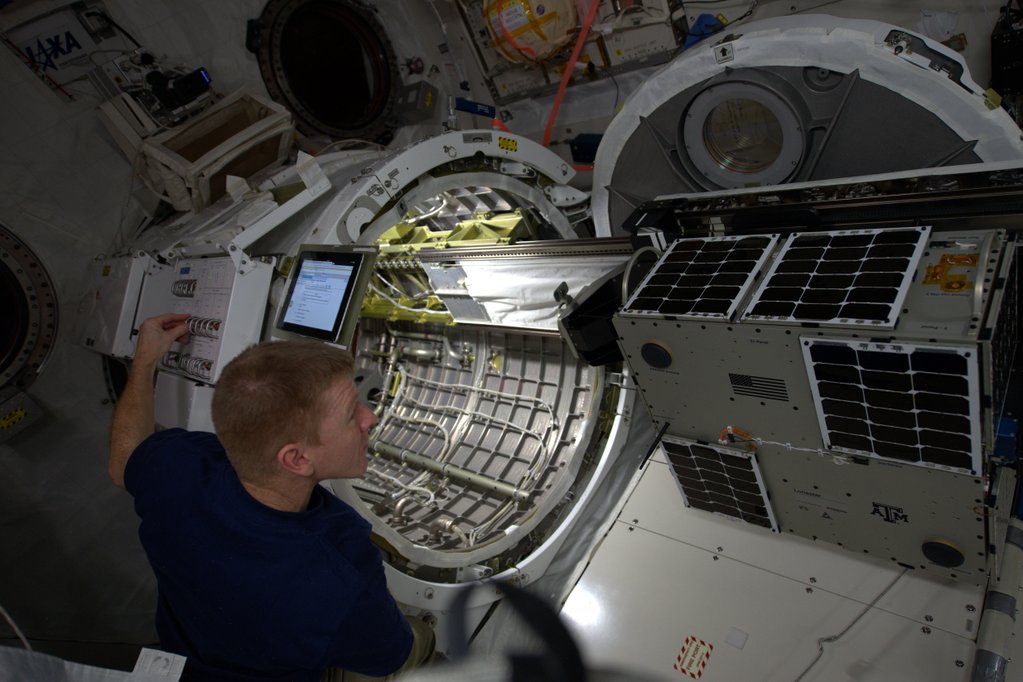
UK astronaut Tim Peake KG5BVI preparing AggieSat4 for deployment

UK astronaut Tim Peake KG5BVI preparing AggieSat4 for deployment

The deployment activities scheduled for Friday, January 29, 2016 include capturing CYCLOPS with the JEM Remote Manipulator System, maneuvering CYCLOPS to the deployment location, and final deployment of AggieSat4 from CYCLOPS

An example of the deployment mechanism can be seen below.

There are four switches, embedded on the CYCLOPS EAF, that inhibit AGS4 from turning. The first event that will occur after deployment will be the release of these inhibits. Once these inhibits are removed, the Electronic Power System (EPS) starts and initiates a 10 minute timer. After the timer ends the Command and Data Handling System starts and initiates a checkout of every system on AGS4. When complete, AGS4 will begin sending a signal to Earth with its Low Data Rate (LDR) radio, indicating that it is alive and well. The team expects to start receiving signals from AGS4 on Friday evening.

This animation shows how the Cyclops Deployment System launches satellites in the 50 to 100 kg class from the International Space Station.

Watch Animation of Station’s Cyclops Satellite Deployer

Thanks to Jan van Gils PE0SAT for this item.

ISS AggieSat4 Satellite Deployment – Amateur Radio Frequencies and Links
https://amsat-uk.org/2016/01/27/iss-satellite-deployment/

IARU Paper: APRS Harmonization and removal of OSCAR sub-band

IARU_Region_1_logoIARU Region 1 has released the papers for the Interim Meeting to be held in Vienna April 15-17, 2016.

Among the papers for the C5 VHF/UHF/Microwave Committee is one on harmonizing APRS.

VIE16_C5_41_1.pdf – 144 /435 MHz APRS Harmonisation

The paper covers global band planning considerations and among the recommendations says:

Emphasise that spaceborne APRS must be confined to globally coordinated amateur satellite sub bands. Therefore items that are ambiguous and generate confusion in national band plans such as ‘Space communications’ and ‘New Oscar Sub band’ should be removed as soon as possible in all Regions in accordance with IARU-AC and Satellite Coordination guidance

It is believed that ‘New Oscar Sub band’ refers to the USA’s ARRL 144 MHz band plan and ‘Space communications’  to the Australian WIA 144 MHz band plan. These band plans, as well as those for some other countries, show 144.300 – 144.500 MHz as being for Amateur Satellite use.

Direct link for C5 VHF/UHF/Microwave Papers
http://www.iaru-r1.org/index.php/documents/Documents/VHF/C5-papers-v2.zip/

Links for all committee papers and email addresses of Committee Chairs are at
http://www.iaru-r1.org/index.php/88-news/1518-interim-meeting-vienna-2017
[Although URL says 2017 the meeting is 2016]

ARRL 144 MHz Band Plan http://www.arrl.org/band-plan

WIA 144 MHz Band Plan http://www.wia.org.au/members/bandplans/data/documents/Australian%20Band%20Plan%202m%20150729.pdf

Chelmsford Talk: Amateur Radio Satellites

Steve Hedgecock M0SHQ sending Packet Radio to the ISS

Steve Hedgecock M0SHQ sending Packet Radio to the ISS

On Tuesday, February 2, Steve Hedgecock M0SHQ will give a presentation to the Chelmsford Amateur Radio Society (CARS) on amateur radio satellites, the talk is open to all.

The main part of the presentation will be on simple satellite operation using an FT-817 and hand held antennas. Steve will also cover amateur radio activity on the International Space Station (ISS) including using the ISS APRS digipeater and reception of ISS Slow Scan Television (SSTV).

The talk coincides with the mission of UK astronaut Tim Peake GB1SS on the space station. Some of you may have already heard Tim using the amateur radio station in the Columbus module to link up with school students as part of the ARISS program.

The meeting takes place at the Oaklands Museum, Moulsham Street, CM2 9AQ. The doors open at 7pm for a 7:30pm start, car parking and admittance are free, visitors are most welcome.

Map http://www.g0mwt.org.uk/meeting-map.pdf

Web http://g0mwt.org.uk/

CARS run short amateur radio training courses, to find out about the next course speak to the training manager Peter Davies M0PSD, contact details are at http://www.g0mwt.org.uk/training/

What is Amateur Radio ? http://www.essexham.co.uk/what-is-amateur-radio