UK Spectrum Strategy

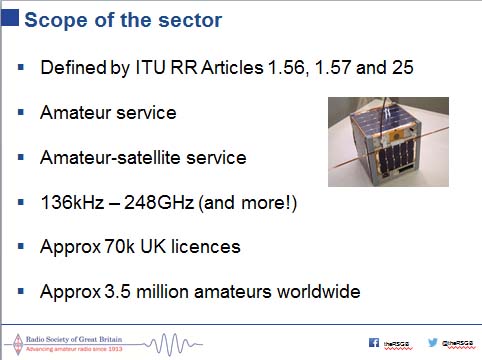
RSGB Amateur Radio SlideOn June 30, 2015, Graham Murchie, G4FSG, RSGB Chairman and Murray Niman, G6JYB, Chairman of the RSGB Spectrum Forum presented the case for amateur radio to the UK Spectrum Policy Forum (UKSPF). The Amateur-Satellite Service featured in this presentation.

The Forum has been established as a sounding board to UK Government and Ofcom on future approaches on spectrum with a view to maximising the social and economic value from the spectrum.

The UK Prime Minister David Cameron has stated the ambition to double “the economic benefits of spectrum to UK companies and consumers from roughly £50 billion today, to £100 billion in 2025″.

The UK Spectrum Policy Forum, open to all users of spectrum, is the main vehicle for harnessing user insights and informing these policy decisions.

Read the RSGB story at http://rsgb.org/main/blog/news/gb2rs/headlines/2015/07/06/uk-spectrum-strategy/

Download the presentation slides http://thersgb.org/archives/events/ukspf/150703-RSGB-UKSPF-presentation.pptx

UK Spectrum Policy Forum (UKSPF) https://www.techuk.org/about/uk-spectrum-policy-forum

Phase 4 Spacecraft Frequencies


At the Hamfest event at Friedrichshafen held during last weekend, more information was provided about the exciting new Phase 4 amateur satellites presently under construction.


p4a_coverage

P4A – This is a hosted payload on the geostationary spacecraft Es’hailSat 2. This spacecraft will be located at 26 degrees east. Launch is expected in late 2016 with operations commencing shortly thereafter. This spacecraft will carry two amateur radio linear transponders. One will consist of a 250 kHz wide linear analogue transponder and the other will be a transponder for experimental digital modulation with an 8 MHz bandwidth.


The proposed frequency plan for this spacecraft is:

Narrowband transponder:
Uplinks: 2400.050-2400.300 MHz
Downlinks: 10489.550- 10489.800 MHz

Wideband transponder:
Uplinks: 2401.500 – 2409.500 MHz
Downlinks: 10491.000 -10499.000 MHz

P4B – This is a hosted payload on a US geosynchronous spacecraft. This spacecraft is expected to be initially located over America. The transponder will use digital modulation schemes with FDMA up and TDMA down. In addition, there will be linear transponder facility. Ground station hardware is already well developed and the launch is expected to take place in mid 2017.

The proposed frequency plan for this spacecraft is:

Uplinks: 5655-5665 MHz
Downlinks: 10455-10465 MHz

Further, similar, High Earth Orbit, projects were also mentioned during the meeting. These will also use downlink frequencies in the 10 GHz band in the Amateur Satellite Service.

Geosynchronous Amateur Radio Satellites https://amsat-uk.org/satellites/geosynchronous/

AMSAT-UK
http://twitter.com/AmsatUK
http://facebook.com/AmsatUK

Geosynchronous payload inches closer to reality

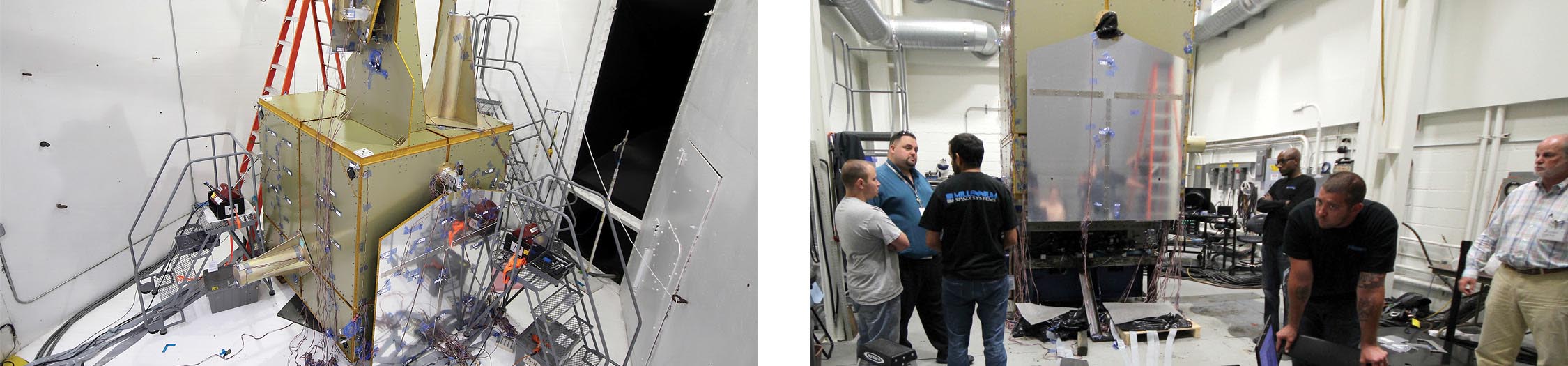
Millennium Space Systems AQUILA M8 Series Satellite Structure

Millennium Space Systems AQUILA M8 Series Satellite Structure

Colonel Fred Kennedy, USAF, Space Production Division and Program Manager for the Wide Field of View satellite (hereinafter WFOV) has accepted the proposal to allow Virginia Tech to place a hosted payload consisting of a Software Defined Radio designed and built by Rincon Research Corporation using support equipment and antennas designed by Virginia Tech and other volunteers to this effort.

The spacecraft hosted amateur payload will be included in the Aquila M8 bus by Millennium Space Systems who is the integrator for WFOV.  Our first role and immediate action item is to raise the $100,000 for Millennium to complete the study of the inclusion of this payload on Wide Field Of View.  Following successful completion of this study,  Virginia Tech will raise money to defray the cost of integration and launch of this payload.  After achieving orbit,  volunteers managed by Sonya Rowe and Zach Leffke of Virginia Tech will operate the payload for as long as it is over the US.  We at VT with the help of the ARRL will prepare partners in other regions to operate the spacecraft should it be moved in order to allow the WFOV to accomplish its primary mission and be prepared to take over operation of the hosted payload on its return to the area of the Contiguous United States (CONUS).

Colonel Kennedy told me how much he admires how unbelievably capable amateurs around the world have been in their many organizations to get spacecraft to orbit and wishes us the best of luck in the onerous task we will have of raising $5M to get this on board.

I will be making many details public now that Colonel Kennedy has told us we are a go if we raise the money.  I know this is a tall order but “A coward dies a thousand deaths and a brave person dies only once”.  I would rather go down trying than cower in a closet.  This is not intended as casting aspersions on any individual or organization just saying I must proceed hastily to succeed at all and I cannot afford caution.

Let’s GO!

Bob McGwier
Co-Founder and Technical Director, Federated Wireless, LLC
Research Professor Virginia Tech
Senior Member IEEE, Facebook: N4HYBob, ARS: N4HY
Faculty Advisor Virginia Tech Amateur Radio Assn. (K4KDJ)

Geosynchronous Amateur Radio Payload https://amsat-uk.org/satellites/geosynchronous/na-gso-sat/
International Space Colloquium at Guildford

AMSAT-UK FUNcube Mission Patch Rev4 20100609The AMSAT-UK International Space Colloquium will be held on July 24-26 at the Holiday Inn, Guildford, GU2 7XZ, UK.

Among the speakers will be:
Peter Guelzow DB2OS with an update on AMSAT-DL projects, including the Phase 4 satellite
Chris Brunskill, formerly of Surrey Space Centre (SSC), now working at the Space Catapult at the Harwell Campus. He will be presenting an extremely novel project aimed at schools and education
• It is hoped the BATC will be able to demonstrate live Digital TV reception from the International Space Station, using the Ham TV system
Drew Glasbrenner KO4MA, from AMSAT North America will be attending, and presenting the latest news of the FOX satellite(s) due for launch later this year, and also on their Phase 4 project

The Colloquium is open to all, admittance on the Saturday and Sunday is £10 each day. Further information is at https://amsat-uk.org/colloquium/

Samantha Cristoforetti IZ0UDF with ISS HamTV Transmitter

Astronaut Samantha Cristoforetti IZ0UDF with the HamTV transmitter in the ISS Columbus module

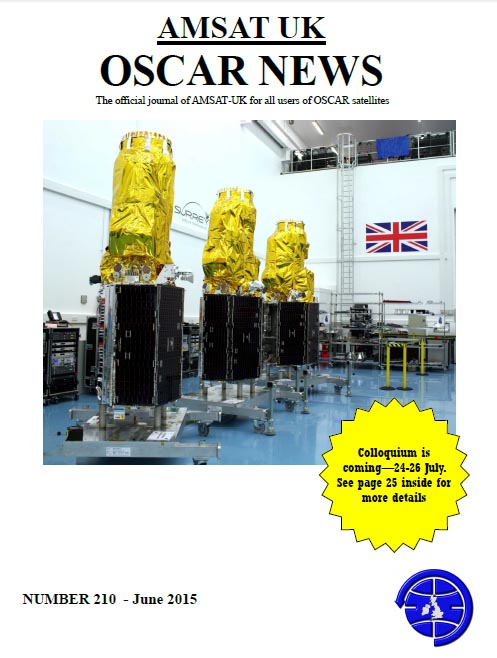
OSCAR News Issue 210

OSCAR News 210 front coverIssue 210 of the AMSAT-UK amateur radio satellite publication OSCAR News was released on June 4, 2015. E-members can download it here.

The paper edition is usually posted 2-3 weeks after publication of the electronic issue.

In this issue:
• UAE to build new space research centre
• Clive Wallis G3CWV – 15 Sep 1932 – 27 Mar 2015
• 40 years and counting: the team behind Voyager’s space odyssey
• United Nations/South Africa Symposium on Basic Space Technology
• 29 MHz – the forgotten frequency for amateur radio satellites
• Pairing SDR dongles with Windows 8.1 tablets
• The ESEO Mission report
• Recent Breakup of a DMSP Satellite
• Fox-1 Development, Launch, and Frequency Coordination Status at Dayton
• Geostationary Transponder News
• FUNcube on-orbit missions update
• Colloquium 2015
• The new FUNcube Project – Nayif-1

AMSAT-UK FUNcube Mission Patch

AMSAT-UK FUNcube Mission Patch

Membership of AMSAT-UK is open to anyone who has an interest in amateur radio satellites or space activities, including the International Space Station (ISS).

E-members of AMSAT-UK are able to download OSCAR News as a convenient PDF that can be read on laptops, tablets or smartphones anytime, anyplace, anywhere. Join as an E-member at Electronic (PDF) E-membership

There are two rates for the paper edition to cover the extra postage costs:
UK
Rest of the World (Overseas)

PDF sample copy of “Oscar News” here.

Join AMSAT-UK using PayPal, Debit or Credit card at
http://shop.amsat.org.uk/shop/category_9/Join-Amsat-UK.html

E-members can download their copies of OSCAR News here.

Martlesham FUNcube Development Workshop Report

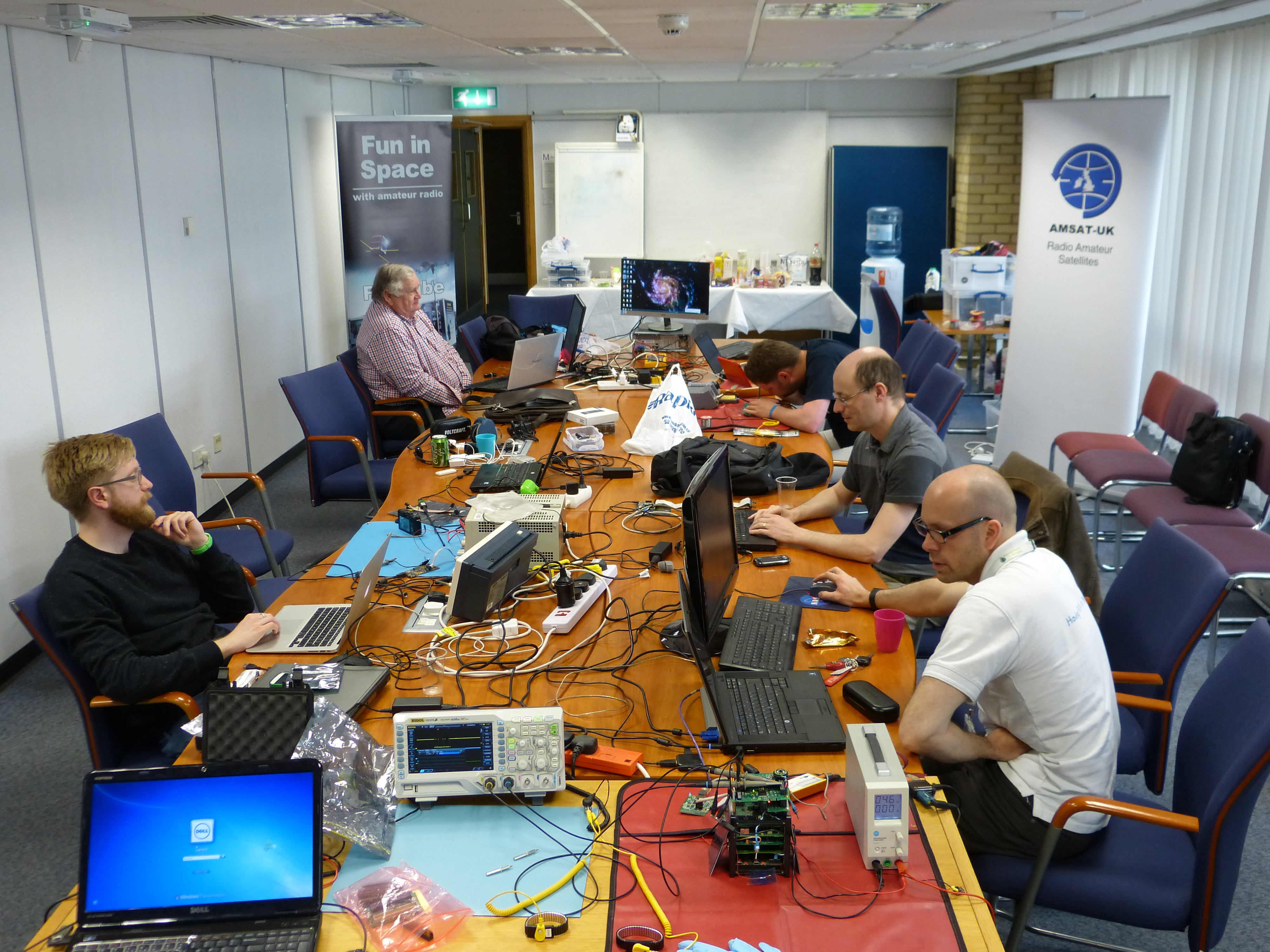
Martlesham FUNcube Development Workshop May 30-31, 2015

Martlesham FUNcube Development Workshop May 30-31, 2015

Having yorkie dog clothes is proving an enjoyable challenge for the AMSAT-UK teams involved. Both the Nayif-1 CubeSat and our payload on ESEO will provide similar 1k2 BPSK FUNcube compatible downlinks so the teams have quite a lot in common.

Martlesham FUNcube Workshop 2 - May 30-31 2015The two teams got together for two days at BT’s Adastral Research facilities at Martlesham over the weekend of May 30-31.

As will be more fully reported in the next edition of the “OSCAR News”, the work concentrated on updating the suite of existing FUNcube software for the forthcoming Nayif-1 spacecraft and also the first power on for the combined CCT/EPS (computer and power) board for ESEO with its ATMEL AT32 microprocessor.

Nayif-1 CubeSat
https://amsat-uk.org/satellites/communications/nayif-1/

ESEO https://amsat-uk.org/satellites/communications/eseo/

Join AMSAT-UK and receive the new issue of OSCAR News due out soon
https://amsat-uk.org/new-members/join-now/

AMSAT-UK
Web https://amsat-uk.org/
Twitter https://twitter.com/AmsatUK
Facebook https://facebook.com/AmsatUK
Flickr https://flickr.com/groups/AmsatUK
YouTube https://youtube.com/AmsatUK
Yahoo Group http://groups.yahoo.com/group/FUNcube
FUNcube http://FUNcube.org.uk/