UK 434 MHz CanSat Competition

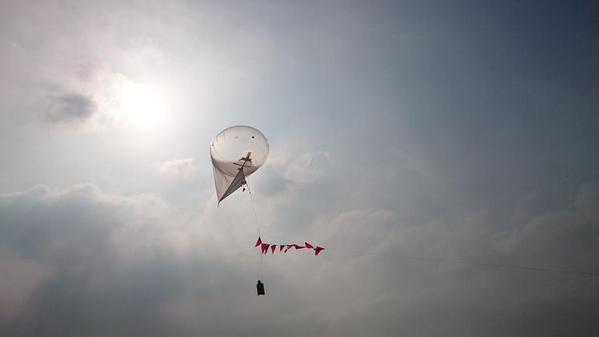
CanSat in Flight - Credit Ryan Laird

CanSat in flight – Credit Ryan Laird

On Friday, March 13 eight school teams from across the UK competed in the National CanSat Competition held at the National STEM Centre in York.
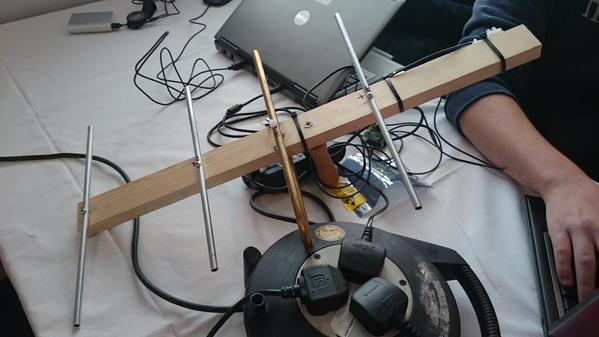
CanSat 434 MHz Tracking Antenna - Credit Ryan Laird

CanSat 434 MHz Tracking Antenna – Credit Ryan Laird

The CREST Gold Award accredited competition, now in its second year, involves students building a miniature simulation satellite, known as a CanSat, and launching it from 300 metres above an airfield.

The students had to build their own space experiments, fitting all the major subsystems including radio communications on 433/434 MHz and power into a 350 ml soda can.

They needed to write code to measure temperature, pressure and other chosen parameters on its journey parachuting to the ground. The winners of the competition will go on to the European finals, held in Portugal, in June.

Around 50 students and their teachers took part.

The pictures were taken by the Vice Chair of UKSEDS Ryan Laird @rjmlaird who attended the AMSAT-UK International Space Colloquium in 2007.

UK CanSat http://www.esero.org.uk/cansat
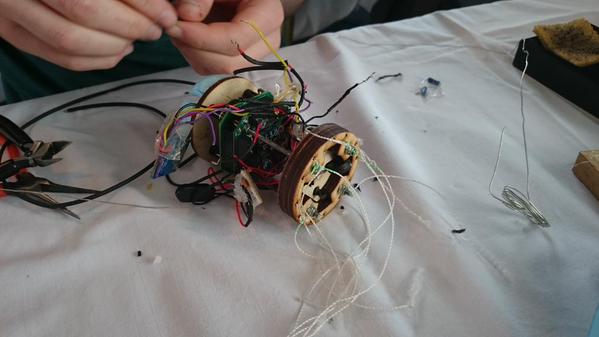
CanSat Electronics - Credit Ryan Laird

CanSat Electronics – Credit Ryan Laird

Listen to FUNcube-1 during Solar Eclipse

Solar Eclipse - March 20, 2015

Solar Eclipse – March 20, 2015

There will be a total solar eclipse on March 20, 2015 which tracks across the North Atlantic and eventually covers a lot of the Arctic.

Path of Solar Eclipse  March 20 2015

Path of Solar Eclipse March 20, 2015

It would seem that this will affect most spacecraft that are in a polar orbit to some extent as, at that sort of time, they would expect to be in sunlight at the time and location.

On FUNcube-1 (AO-73) we have a good power budget which means that we should be able to maintain our normal autonomous operation schedule for the day but, of course, if the spacecraft does go fully into darkness it should switch autonomously to transponder and low power telemetry.

It will be interesting to see what actually happens and we hope that as many listeners as possible will upload the data they receive between 0740 and 1150 UT on that morning. Our Whole Orbit Data will show the solar currents, battery voltage and external temps clearly during this period so we should get a clear understanding of the effects on board.

If anyone has some software that can model the satellite’s track and the expected impact of the solar eclipse it would be great to hear about it!

FUNcube-1 (AO-73) Telemetry:
• Dashboard App http://funcube.org.uk/working-documents/funcube-telemetry-dashboard/
• Data Warehouse Archive http://warehouse.funcube.org.uk/
• Whole orbit data will show the effect http://warehouse.funcube.org.uk/wod.html?satelliteId=2

This website has a good animation of the eclipse
http://www.timeanddate.com/eclipse/solar/2015-march-20

Information on the Solar Eclipse from Chelmsford Amateur Radio Society member Peter Meadows M0ZBU http://www.southgatearc.org/news/2015/march/partial_solar_eclipse_march_20.htm

Essex Partial Solar Eclipse Friday, March 20, 2015
http://www.petermeadows.com/Essex_Partial_Solar_Eclipse_Mar15.pdf

Radio hams will be at BBC Solar Eclipse event
https://amsat-uk.org/2015/03/02/radio-hams-will-be-at-bbc-solar-eclipse-event

RSGB respond to Ofcom 5G consultation

Ofcom-logo-col-tThe RSGB have responded to the Ofcom Call for Input on Spectrum above 6 GHz for future mobile communications (5G) consultation.

The range of frequencies Ofcom are considering included the Primary amateur and amateur-satellite allocation at 47-47.2 GHz.

Read the RSGB response at
http://rsgb.org/main/files/2015/03/RSGB_Spectrum-above-6GHz_response.pdf

Ofcom consultation on spectrum above 6 GHz
http://www.southgatearc.org/news/2015/january/ofcom_consultation_on_spectrum_above_6_ghz.htm

RSGB respond to Ofcom UHF review

Ofcom-logo-col-tThe RSGB has responded to the Ofcom call for inputs to the strategic review of the 420-470 MHz spectrum.

The review includes the key Amateur 430-440 MHz and Amateur-Satellite 435-438 MHz allocations.

The consultation had been due to close on February 19 but was extended to February 26 to give more time for responses.

Read the RSGB response http://rsgb.org/main/files/2015/02/RSGB_UHF-Review_response.pdf

Ofcom: 420-470 MHz Consultation
http://www.southgatearc.org/news/2014/december/ofcom_420_470_mhz_consultation.htm

Space Station SSTV and Packet Radio via SUWS WebSDR

ISS SSTV and Packet Radio signals on the SUWS WebSDR

ISS SSTV and Packet Radio signals on the SUWS WebSDR

Martin Ehrenfried G8JNJ reports excellent SSTV and Packet Radio signals from the International Space Station (ISS) using the online SUWS WebSDR.

144 MHz prototype helix antenna

144 MHz prototype helix antenna

The omni-direction helix antennas at the WebSDR were designed with high elevation satellites in mind. Conventional antennas concentrate the radiation pattern towards the horizon resulting in weaker signals when a satellite is above 15 degrees elevation. Comparisons with other WebSDRs show the SUWS antennas provide a 6 to 10dB better signal to noise ratio on similar passes.

Martin says: “I had been experimenting with single turn ‘twisted halo’ design, and decided to try stacking them to see if I could achieve more gain. Modelling suggested that a stretched 3 turn helix with a helix circumference of approx 1/2 wave length and an overall length of 1/2 wave at 70cm, and fed with a gamma match at the centre would offer reasonable gain, an omni-directional pattern and mixed polarisation.”

You can use the free online SUWS Web Software Defined Radio from your PC or Laptop to receive the ISS and the many amateur radio satellites transmitting in the 144-146 MHz or 435-438 MHz bands. It also provides reception of High Altitude Balloons in the 434 MHz band and coverage of the microwave 10368-10370 MHz band.

The SUWS WebSDR is located at Farnham not far from London, 51.3 N 1.15 W, listen to it at http://websdr.suws.org.uk/

Full details of the antennas are available at http://g8jnj.webs.com/currentprojects.htm

Brazilian radio amateur uses SUWS WebSDR to receive ISS SSTV
https://amsat-uk.org/2014/09/06/iss-sstv-on-suws-websdr/

ISS SSTV image 9/12 received by Martin Ehrenfried G8JNJ using the SUWS WebSDR on Dec 18, 2014

ISS SSTV image 9/12 received by Martin Ehrenfried G8JNJ using the SUWS WebSDR on Dec 18, 2014

SatNOGS give prize money to LSF

SatNOGS - Satellite Networked Open Ground Station

SatNOGS – Satellite Networked Open Ground Station

SatNOGS won the Hackaday grand prize of $196,418 for their satellite ground station, they plan to give the money to the Libre Space Foundation.

The Libre Space Foundation (LSF) is a non-profit foundation registered in Greece by the creators of the SatNOGS project. The aim of the foundation is to promote free and open source technology in space and support, develop and fund space projects.

Ground Stations are Just the Beginning: The SatNOGS Story
http://hackaday.com/2015/02/19/ground-stations-are-just-the-beginning-the-satnogs-story/

SatNOGS Win Hackaday Prize https://amsat-uk.org/2014/11/14/satnogs-win-hackaday-prize/

SatNOGS – Satellite Networked Open Ground Station https://satnogs.org/

Libre Space Foundation http://librespacefoundation.org/