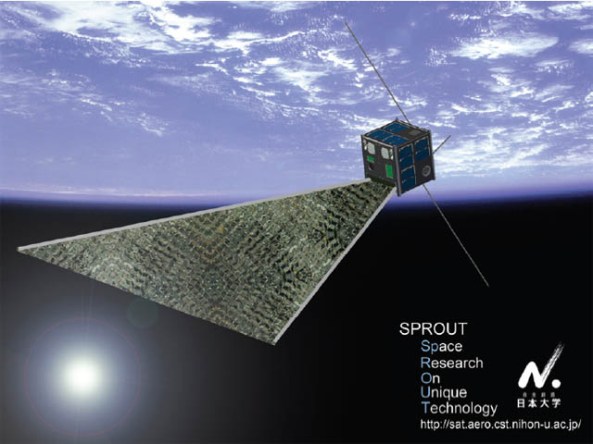
SPROUT Amateur Radio Slow Scan TV Satellite

SPROUT Amateur Radio SSTV Satellite

SPROUT, a 20 x 20 x 22 cm amateur radio nano-satellite with a mass of 7.1 kg, launched successfully with the L-band (1236.5 MHz/1257.5 MHz/1278.5 MHz) Synthetic Aperture Radar (SAR) satellite ALOS-2 on May 24, 2014 at 0305 UT. SPROUT is now in a 654 km, 97.9 degree inclination Sun Synchronous Orbit (SSO).

SPROUT Satellite - Credit Nihon-Univ. Miyazaki Laboratory

SPROUT Satellite – Credit Nihon-Univ. Miyazaki Laboratory

SPROUT (Space Research On Unique Technology) was built by students from Nihon University and its objectives are:

1. Operation of satellite by radio amateurs.

A FM Digitalker will enable the satellite to speak to amateurs around the world.

The Voice Message Box will record transmissions from radio amateurs and play them back.

Pre-loaded images from the Message Gallery can be transmitted using Slow Scan TV (SSTV).

Pictures of the Earth can be transmitted by SSTV and radio amateurs can receive it using free software such as MMSSTV. As part of the Earth mapping project the team ask radio amateurs to contribute pictures they have received from the satellite for display on the SPROUT website.

The satellite also has a packet radio Digipeater and Text Message Box function.

SPROUT in orbit2. Demonstration of the deployment of the combined membrane structure and verification of the design method of the structure SPROUT has a triangular membrane supported by two tubes like framework. They are folded and stored in the satellite before the launch. After the launch, the nitrogen gas is injected into the tubes in space, and they extend, so that the membrane deploys (called “combined membrane structure”).

3. Demonstration of attitude determination and control of a nanosatellite using the sun sensors, gyros, geomagnetic sensor and magnetic torquers.

It carries two UHF/VHF radio systems – one for Telemetry, Tracking & Control (TTC) using CW, 1200 bps AFSK and 9600 bps GMSK AX.25 packet and one for amateur operations using 1200 bps AFSK AX.25 packet.

SPROUT plans to launch from the Tanegashima Space Center into a 654 km Sun Synchronous Orbit (SSO) on May 24, 2014.

SPROUT 5 Days to Launch PictureCallsign: JQ1ZJQ
Size: 214x210x220 mm
Weight: 7.1 kg
Mode: 1200bps AFSK, 9600bps GMSK
CW downlink 437.525 MHz
FM packet downlink 437.525 MHz
Digi-peater uplink 437.600 MHz
Digi-talker downlink 437.600 MHz
SSTV downlink 437.600 MHz

SPROUT English website http://sat.aero.cst.nihon-u.ac.jp/sprout-e/

SPROUT Japanese website http://sat.aero.cst.nihon-u.ac.jp/sprout/

Nihon-Univ. Miyazaki Laboratory on Facebook
https://www.facebook.com/pages/Nihon-Univ-Miyazaki-Laboratory/406566642818860

Telemetry Software http://sat.aero.cst.nihon-u.ac.jp/sprout-e/2-Software-e.html

Telemetry format http://sat.aero.cst.nihon-u.ac.jp/sprout-e/2-Formats%20of%20telemetry-e.html

Keplerian elements (TLEs) from SPROUT launch data page
http://sat.aero.cst.nihon-u.ac.jp/sprout-e/2-Launch%20data-e.html

SPROUT
1 00000U 14001A 14144.15446759 .00000000 00000-0 00000-0 0 0013
2 00000 97.8740 241.6718 0035980 58.6810 194.6458 14.85960816 14

After launch TLE’s from the North American Aerospace Defence Command (NORAD) should also be available at http://celestrak.com/NORAD/elements/tle-new.txt

Adding new satellites to SatPC32, Gpredict and Nova
https://amsat-uk.org/2013/11/23/adding-new-satellites-to-satpc32/

Free Slow Scan TV (SSTV) software MMSSTV http://hamsoft.ca/pages/mmsstv.php

The JE9PEL website has information on other satellites on this launch
http://www.ne.jp/asahi/hamradio/je9pel/jaxalos2.htm

Read the Overview of the L-band SAR Onboard ALOS-2 here.

SPROUT satellite students at Nihon-Univ. Miyazaki Laboratory

SPROUT satellite students at Nihon-University Miyazaki Laboratory

Satellites at Amateur Radio Skills Workshop

Working the OSCAR Satellites - Graham Leggett G7JYD and Steve Hedgecock M0SHQ

Working the OSCAR Satellites – Graham Leggett G7JYD and Steve Hedgecock M0SHQ

Steve Hedgecock M0SHQ took along some rigs, antennas and software to the Chelmsford Amateur Radio Society (CARS) Skills Workshop held in Danbury, Essex on May 19.

He explained how to get started in listening to satellites, track them, and have contacts through them. Hopefully we’ll be seeing some new stations from Essex on the satellites in the near future.

Peter M0PXD and Christopher G0IPU running the construction and soldering workshop

Peter M0PXD and Christopher G0IPU running the construction and soldering workshop

The free Skills Workshops are held on the third Monday of each month and provide a great opportunity to chat, swap ideas, and get hands-on with something new. Find out more at http://www.hamskills.co.uk/

As well as the Skills Workshops the Chelmsford Amateur Radio Society run training courses for those wishing to get their amateur licence. To find out more speak to Clive G1EUC on
Tel: 01245-224577
Mob: 07860-418835
Email: training2014 at g0mwt.org.uk
Web: http://www.g0mwt.org.uk/training/

Follow CARS Training on Twitter @TrainWithCARS

What is Amateur Radio ? http://www.essexham.co.uk/what-is-amateur-radio

Watch a short overview of the Amateur Radio Skills Workshop, a new training initiative from the Chelmsford Amateur Radio Society (CARS)

How to work a FM satellite video https://amsat-uk.org/beginners/how-to-work-a-fm-satellite/

How to work a SSB satellite video https://amsat-uk.org/beginners/how-to-work-the-ssb-satellites/

RadCom article Getting started on satellites https://amsat-uk.org/beginners/radcom-getting-started-on-satellites/

ITAR restrictions on US radio amateurs to be eased

ITARThe International Traffic in Arms Regulations (ITAR) inexplicably applies to amateur radio satellites. It threatens US radio hams with jail terms or six figure fines if they cooperate with amateurs outside the USA on satellite projects. Cooperation includes talking about or publishing on the web certain information regarding amateur radio satellite systems.

Satellite Today reports that after 15 years of restrictions and intense scrutiny, the United States Department of State is reclassifying satellites and several related components so they will no longer be treated as weapons. The changes affect Category 15 of the U.S. Munitions List (USML), which covers spacecraft and related articles, by shifting most commercial, civil and scientific satellites and accompanying equipment to the Department of Commerce’s Commerce Control List (CCL).

“The Department [of State] has committed to reviewing during the six months after the publication of this rule whether further amendments to the USML controls on civil and commercial remote sensing satellites are warranted, and seeks additional public comment on this matter,” according to a statement released by the Federal Register.

This rule is effective November 10, 2014, except for Sec. 121.1, Category XV(d), which is effective June 27, 2014. Interested parties may submit comments on paragraphs (a)(7) and (e)(11) of USML Category XV and ITAR Sec. 124.15 by June 27, 2014.

Read the Satellite Today article http://www.satellitetoday.com/regional/2014/05/16/new-us-satellite-export-reforms-gets-positive-response-from-industry/

Federal Register – Amendment to the International Traffic in Arms Regulations: Revision of U.S. Munitions List Category XV https://www.federalregister.gov/articles/2014/05/13/2014-10806/amendment-to-the-international-traffic-in-arms-regulations-revision-of-us-munitions-list-category-xv

Among the projects affected by ITAR has been the New Zealand Amateur Radio satellite KiwiSAT. A 2009 IARU Region 3 report highlights that ITAR requirements made AMSAT-NA direct its members to cease cooperation with AMSAT-ZL in the development of KiwiSAT. http://www.iaru-r3.org/14r3c/docs/046.doc

ITAR impact on the Eagle project https://web.archive.org/web/20140327205527/http://www.amsat.org/amsat-new/eagle/

The 2005 amateur radio P3E IHU project killed by ITAR http://www.amsat-dl.org/p3e/bericht-ihu3-0205-e.pdf

Export Control Reform initiative http://export.gov/%5C/ecr/index.asp

April 2012 ITAR – Section 1248 Report Released
https://amsat-uk.org/2012/04/22/itar-1248-report-released/

April 2012 ITAR and Amateur Radio – Progress Report
https://amsat-uk.org/2012/04/29/itar-and-amateur-radio-progress-report/

Read the Section 1248 Space Export Control Report
http://www.defense.gov/home/features/2011/0111_nsss/docs/1248_Report_Space_Export_Control.pdf

2011 ITAR submission by the Radio Amateur Satellite Corporation (AMSAT)
http://www.amsat.org/amsat-new/images/fck_images/AMSAT%20ITAR%20Comments%20Final.pdf

2009 AMSAT files CJ requests with US State Department
http://www.southgatearc.org/news/august2009/amsat_files_cj_requests.htm

ITAR in ARRL Executive Committee Minutes https://amsat-uk.org/2012/04/19/itar-in-arrl-executive-committee-minutes/

ITAR impact on satellite launches http://www.spacequest.com/Articles/SSC03-II-1%20SpaceQuest.pdf

Ham Radio Skills Night – How to track and work amateur radio satellites

A typical amateur radio satellite

A typical amateur radio satellite

On  Monday, May 19, Steve Hedgecock M0SHQ will be explaining how to track and work the growing number of amateur radio satellites at the Ham Radio Skills Night run by the Chelmsford Amateur Radio Society. This free event is open to all, whether licensed or unlicensed.

These monthly sessions are a great opportunity to chat, swap ideas, and get hands-on with something new. As regular attendees know, what is covered on the evenings is decided by you.

Here is what’s planned for the May Skills Night:

• Working Satellites – How to track and work amateur radio satellites
• A live CW station – Operated by members of the Essex CW Club
• Soldering practical – Soldering plugs and connectors – Need help with a lead? Bring it along
• Hands-on with Storm Tracking kit
• The quiz will run again – just a bit of fun!
• Show-and-tell: All are welcome to bring along any items for show-and-tell
• Representatives from CARS, Essex CW Club, the Essex Repeater Group and Essex Ham will be on-hand, and happy to answer your questions

If you’re interested in coming along, the evening starts at 7pm, although you’re welcome to arrive any time between 7pm and 9pm. If you have anything you’d like to bring along to show to the others, that would be great.

Sarah M6PSIThe event is open to all and there’s no charge for attending the CARS Amateur Radio Skills workshops. Tea, coffee and biscuits will be available throughout the evening and an optional small donation to the tea fund and hall hire would be appreciated.

The skills night takes place at the Danbury Village Hall, Main Road, Danbury, Chelmsford, CM3 4NQ

More information http://www.hamskills.co.uk/

Essex Ham http://essexham.co.uk/

CARS run training courses for those wishing to get their amateur licence. To find out more speak to Clive G1EUC on
Tel: 01245-224577
Mob: 07860-418835
Email: training2014 at g0mwt.org.uk
Web: http://www.g0mwt.org.uk/training/

What is Amateur Radio ? http://www.essexham.co.uk/what-is-amateur-radio

AMSAT-India VO-52 completes nine years in orbit

HAMSAT VO-52

HAMSAT VO-52

On Monday, May 5, 2014 AMSAT-India’s VO-52 will have completed 9 years in orbit. During this time it has proved to be a valuable communications resource for the amateur radio community.

Mani, VU2WMY, posted this on the AMSAT Bulletin Board:

It gives us great pleasure to inform that ‘HAMSAT – VO-52’ is successfully completing 9 years of fruitful services on 4th May 2014 and entering into her 10th year of services on 5th May. HAMSAT was launched as a piggy back aboard PSLV-C6 on 5th May 2005 (5-5-5). We do hope that the contribution of ‘HAMSAT’ by India/ISRO to the ‘Global Amateur Radio Fraternity’ has served its purpose. It gives us great pleasure and satisfaction to note that ‘HAMSAT VO-52’ has remained as one of the most sought after and favorite ‘Linear Birds’ among the radio amateurs for her sensitivity, strong down link signals, stability and the ease to work.

Though expected to work for two years (mainly, considering the battery), HAMSAT VO-52 has really out lived and still doing strong. Latest telemetry indicates all the parameters and systems to be normal and satisfactory. We do hope that ‘HAMSAT’ would continue to provide her good services to ‘Amateur Radio fraternity’ for many more years.

On this happy occasion, we place on records our sincere thanks and appreciations to, Chairman ISRO, Scientific Secretary ISRO, Director ISRO Satellite, Mission Director, Operations Director, ‘HAMSAT’ project team at various ISRO centres, AMSAT-India and Williams Leijenaar PE1RAH  for their contribution in achieving this this milestone.

73 de
 
Mani [VU2WMY/KJ6LRS]
Secretary & Station-In-Charge
Upagrah Amateur Radio Club VU2URC
ISRO Satellite Centre

How to make contacts through the VO-52 satellite
https://amsat-uk.org/beginners/how-to-work-the-ssb-satellites/

Getting started on Amateur Radio satellites
https://amsat-uk.org/beginners/radcom-getting-started-on-satellites/

2005 – HAMSAT launch was 100% successful
http://www.southgatearc.org/news/may2005/hamsat_update2.htm

AMSAT-India http://www.amsatindia.org/

Ofcom: Statement on Spectrum Sharing

Ofcom-logo-col-tOfcom has published its Spectrum Management Strategy and Statement on Spectrum Sharing.

The Spectrum Management Strategy sets the strategic approach and priorities for managing radio spectrum.

As the intensity of spectrum use increases, with greater levels of sharing between different uses, managing the co-existence between services will become more important. Ofcom’s strategic approach relies on market mechanisms where possible and effective and on regulatory action where necessary. It also places increased emphasis on:

• exploring opportunities for new types of spectrum sharing;
• managing the co-existence of different services and by promoting technology improvements that minimise interference;
• providing more information on how spectrum is used in the UK. As part of this, Ofcom has published today an interactive spectrum map providing easy-to-access details on how different frequencies are used in the UK; and
• leading discussions on international spectrum issues.

Six priorities for spectrum management

Ofcom has identified six priority areas for future spectrum use. They are:
1. Future mobile data demands: Ofcom will consider the potential impact these demands have on other users of spectrum. Ofcom will also contribute to international decisions, examine in detail the case for using more spectrum for mobile data, support improvements in mobile coverage and monitor developments towards 5G technology.

2. The future of the 700MHz band and free-to-view TV: Ofcom is investigating the potential to rearrange the bands used for digital terrestrial TV. This could release more of this prime spectrum for mobile broadband use sometime after 2018, while ensuring that viewers would continue to benefit from digital terrestrial TV.

3. Public sector spectrum release: Ofcom will support the Government in achieving its target to release 500 MHz of spectrum from the public sector. A first step will be the release of spectrum at 2.3 and 3.4 GHz, currently held by the Ministry of Defence.

4. Programme Making and Special Events: Ofcom is working with PMSE stakeholders to understand their current and future spectrum demands for wireless microphones and cameras.

5.Machine-to-Machine applications: Ofcom has started work to understand the implications of the expected growth in M2M. Enabling licence exempt access to the 870-915 MHz band is a first step towards ensuring spectrum availability to support innovation in this area. The UK is among the first countries globally to release spectrum that can support M2M communications.

6.The emergency services: Ofcom will support the Government is assessing how best to deliver the wireless communications needs of the emergency services over the long term.

Encouraging the wider use of spectrum sharing

In the UK, half of all adults own a smartphone and one in four households has a tablet computer, fuelling a surge in demand for more data capacity. Meanwhile, research commissioned by Ofcom found that by 2022 over 350 million additional devices in the UK – including cars, crop sensors and washing machines – are also likely be connected to the internet, many using tiny slivers of spectrum.

To help meet this demand and building on our existing work to open up TV white spaces for use by a range of innovative services, Ofcom has identified three key areas where spectrum sharing can play an important role:

• for indoor use: by continuing to provide high speed wireless network connectivity to ensure that consumers can fully benefit from the increasing availability of superfast broadband;
• for outdoor use: by increasing the supply of spectrum for use by a growing number of small mobile broadband cells, which are being deployed to help meet the growth in demand for mobile data capacity driven by the increasing use of smartphones and tablets; and for
• the internet of things (IoT) use: by helping provide the spectrum needed to support growth and innovation in the emerging IoT sector, which is set to see hundreds of millions of devices become wirelessly interconnected by the end of the decade. These new services have the potential to provide benefits across a wide range of sectors, including healthcare, energy distribution, transport and agriculture.

Read the document The future role of spectrum sharing for mobile and wireless data services
http://stakeholders.ofcom.org.uk/binaries/consultations/spectrum-sharing/statement/spectrum_sharing.pdf

Ofcom Spectrum Management Strategy can be found at
http://stakeholders.ofcom.org.uk/consultations/spectrum-management-strategy/statement/

A Statement on Spectrum Sharing can be found at
http://stakeholders.ofcom.org.uk/consultations/spectrum-sharing/statement/

Ofcom: Interference to 2400 MHz from LTE
https://amsat-uk.org/2014/04/28/ofcom-interference-to-2400-mhz-from-lte/