New Frequencies for AMSAT-UK FUNcube-1

The AMSAT-UK FUNcube-1 satellite is due to launch on a DNEPR rocket from Yasny later this year.

This launch could carry around 11 amateur radio satellites including FUNcube-1 into space. As a result the International Amateur Radio Union (IARU) satellite advisory panel have had to carefully coordinate the planned operating frequencies in order to minimise the risk of interference between FUNcube-1 and other payloads on the same launch.

The IARU Amateur Satellite Frequency Coordination Panel have now confirmed the following frequencies for FUNcube-1 (these frequencies replace those previously announced)

Inverting linear transponder:
Uplink            435.150 – 435.130 MHz
Downlink        145.950 – 145.970 MHz

Telemetry:     145.935 MHz   BPSK

AMSAT-UK have announced that the power of the FUNcube-1 1200 bps BPSK telemetry beacon has been increased to 400 milliwatts. This should provide a strong signal for school students to receive using simple equipment.

Read the leaflet ‘Teach Space with a Real Satellite’ at http://tinyurl.com/TeachSpaceWithFUNcube

Gunter’s Space Page 2012 launches http://space.skyrocket.de/doc_chr/lau2012.htm

IARU Amateur Satellite Frequency Coordination Status http://www.amsat.org.uk/IARU

Sponsor Plaques Fitted at National Radio Centre

Dave Johnson G4DPZ with NRC Sponsor Plaques 2560

Dave Johnson G4DPZ with NRC Sponsor Plaques

Sponsor plaques have now been fitted in the reception to the RSGB National Radio Centre at Bletchley Park.

Dave Johnson G4DPZ is one of a number of individuals and organisations who either gave freely of their time or supplied equipment to make the National Radio Centre the premier exhibition that it is.

AMSAT-UK donated the WiMo X quads for 144 and 430 MHz along with pre amps and polarisation switches for the amateur radio satellite station. They are connected to a Kenwood TS-2000 loaned by Kenwood Electronics.

A full list of NRC sponsors can be seen at http://www.nationalradiocentre.com/nrc-sponsors.php

AMSAT-UK on Amateur Radio Satellites for World Amateur Radio Day http://www.uk.amsat.org/6516

AMSAT-UK on Satellites for World Amateur Radio Day

National Radio Centre - 1280Members of AMSAT-UK operated on the amateur radio satellites from the RSGB National Radio Centre at Bletchley Park to celebrate World Amateur Radio Day (WARD) on Wednesday, April 18, 2012.

WiMo Satellite Antennas at the NRC

WiMo Satellite Antennas at the National Radio Centre

World Amateur Radio Day commemorates the founding of the International Amateur Radio Union (IARU) on April 18, 1925. This year’s theme was “Amateur Radio Satellites: Celebrating 50 Years in Space” in remembrance of the launching of OSCAR 1 on December 12, 1961 and the launch of OSCAR 2 on June 2, 1962.

Those taking part in the event included Jim G3WGM, Dave G4DPZ, Ciaran M0XTD, Matthew SWL, Clive G3CWV, Carlos G0AKI and Elaine G4LFM. The satellites worked during the day included FO-29 and AO-7 and contacts were made with stations across Europe using the 144 and 430 MHz bands.

The equipment used comprised a Kenwood TS-2000 with WiMo X quads for 144 and 430 MHz, with pre amps and polarisation switches.

Watch Dave G4DPZ using the amateur radio satellite FO-29

Read the article ‘Getting started on amateur radio satellites’ by John Heath G7HIA at https://amsat-uk.org/wp-content/uploads/2011/05/satellites_radcom_mar07.pdf
Copyright 2007 Radio Society of Great Britain. For personal use only – no copying, reprinting or distribution without written permission from the RSGB.

Video – How to work the SSB amateur radio satellites https://amsat-uk.org/beginners/how-to-work-the-ssb-satellites/

Khartoum Students Receive CubeSats

KN-SAT1 students at ST2UOK Khartoum

KN-SAT1 students at ST2UOK Khartoum

Students at the University of Khartoum, Sudan have been eagerly listening for the new amateur radio satellites deployed by the Vega launcher on Monday, Feb 13.

The students are undertaking a CubeSat project KN-SAT1. As part of the project they recently completed the installation of a satellite groundstation at ST2UOK. This was used to track and receive telemetry data from the Vega satellites.

KN-SAT1 is the first CubeSat to be built in Sudan and an aim is to promote space engineering and space science education at other Sudanese educational institutes.

Watch the students receiving packets from Masat-1 14:00 UTC Feb 14, 2012

KN-Sat1 http://cubesat.uofk.edu/

Sudanese Amateur Radio and SWL History http://www.st2nh.com/sudanamateurradioandswlhistory

ST2NH Blog http://st2nh-blogger.blogspot.com/

AMSAT Fox-1 CubeSat selected for NASA ELaNa launch collaboration

AMSAT FOX

AMSAT FOX

Project ELaNa, NASA’s ‘Educational Launch of NanoSat’ managed by the  Launch Services Program at the Kennedy Space Center, announced on February 10 that the AMSAT Fox-1 CubeSat has been selected to join the program.

NASA will work with AMSAT in a collaborative agreement where NASA  will cover the integration and launch costs of satellites deemed to have merit in support of their strategic and educational goals.

Watch for full details to be published in the AMSAT Journal.

AMSAT teamed with the ARRL to write and deliver the 159 page educational proposal to NASA. Letters documenting the importance of AMSAT’s satellites in the education programs at the ARRL and also at the Clay Center for Science and Technology at the Dexter and Southfield schools in Brookline, MA, were important parts of our proposal.

AMSAT President Barry Baines, WD4ASW said,
“The ELaNA Launch opportunity marks AMSAT’s return to space after the conclusion of the successful ARISSat-1/KEDR flight. We need to get the flight Fox-1, along with an operational flight backup satellite, built, integrated, tested, and delivered. Our ability to provide a spacecraft and get it launched is dependent upon the active support of our donors who wish to see Fox-1 fly.”

AMSAT Vice-President of Engineering, Tony Monteiro, AA2TX noted this will provide a launch opportunity for AMSAT’s next generation of FM repeater satellites with features and operation beyond the experience of AO-51. AMSAT’s Fox-1 Engineering Team is making progress developing the advanced satellite that will provide these features:

Fox-1 is designed to operate in sunlight without batteries once the battery system fails. This applies lessons learned from AO-51 and ARISSat-1 operations.

In case of IHU failure Fox-1 will continue to operate its FM repeater in a basic, ‘zombie sat’ mode, so that the repeater remains on-the-air.

Fox-1 is designed as the immediate replacement for AO-51. Its U/V (Mode B) transponder will make it even easier to work with modest equipment.

From the ground user’s perspective, the same FM amateur radio equipment used for AO-51 may be used for Fox-1.

Extending the design, Fox-2 will benefit from the development work of Fox-1 by adding more sophisticated power management and Software Defined Transponder (SDX) communications systems.

The Fox-1 Project presents an opportunity to literally put your callsign on the Fox hardware. AMSAT is looking for major donations to help underwrite the cost of solar cells/panels, one of the more significant expenses of the project.

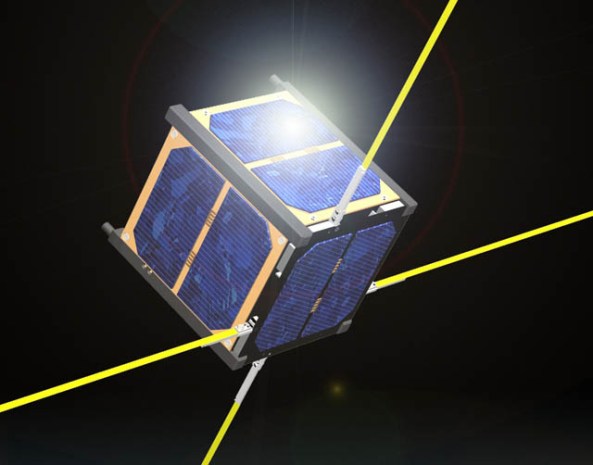
These solar cells are needed for the flight unit as well as for the a flight spare. As Fox-1 will have solar cells on all six sides of the spacecraft and given the relatively small surface area available on each side (at most 4″ by 4″ per side), AMSAT needs to invest in high efficiency solar cells to gain as much power as possible to operate the spacecraft.

Several opportunities to make your donation to keep amateur radio in space include:
• Call Martha at the AMSAT Office +1-888-FB AMSAT (1-888-322-6728)
• Paypal donation widget on the main page at: http://www.amsat.org
• Paypal donation widget for Project Fox at: http://www.amsat.org/amsat-new/fox/
• You can also go to the Paypal site and send your donation to martha@amsat.org
• The AMSAT Store: http://www.amsat-na.com/store/categories.php

Project Fox web site provide a good overview of the technical progress of the new satellite: http://www.amsat.org/amsat-new/fox/

Thanks to AMSAT President Barry Baines, WD4ASW, AMSAT Vice-President of Engineering, Tony Monteiro, AA2TX and AMSAT’s Project Fox Engineering team for the above information.
RS-39 Reception Video

Nittin VU3TYG has made available a video showing reception of the new RS-39 (Chibis-M) satellite that was deployed from the Progress M-13M cargo ship.

RS-39 has beacons on 435.315 and 435.215 MHz that can be received directly by schools and colleges for educational outreach purposes.

Watch Chibis-RS-39 Telemetry decoding

RS-39 (Chibis-M) http://www.uk.amsat.org/3910

RS-39 Telemetry Decoder http://www.uk.amsat.org/4029 

RS-39 Real Time Tracking Map http://chibis.cosmos.ru/cyclogr/prepare1/google/index.html
For Keps click on two gear wheels in top left-hand corner then click on Satellites.

Satscape Satellite Tracking Software http://www.satscape.info/home/?q=node/2

Free Sound Recorder http://www.sound-recorder.biz/freesoundrecorder.html