ArduSat Arduino CubeSat Technical Details

ArduSat is an open-source arduino-based nanosatellite. It will have an extensive sensor-suite onboard and will allow users to upload their own code and run their own experiments.

ArduSat will use a GomSpace NanoCom U482C which is a half-duplex UHF transceiver, capable of 3W, operating in the 435-438 MHz amateur radio satellite band. It implements Forward Error Correction (FEC) and Viterbi coding based on the CCSDS standards in order to improve reliability and throughput of the space link.

The project is raising donations through the Kickstarter site at http://nanosatisfi.com/

Watch Technical Details

Here are the links to the parts mentioned in the video:

Flight Control Computer: NanoMind 712C http://gomspace.com/index.php?p=products-a712c

Electrical Power Supply (EPS): NanoPower P31u http://gomspace.com/index.php?p=products-p31u

Solar Panels: NanoPower P100U-A http://gomspace.com/index.php?p=products-p100ua

Transceiver: NanoCom U482C http://gomspace.com/index.php?p=products-u482c

Structure: ISIS 1U CubeSat Structure http://www.cubesatshop.com/index.php?page=shop.product_details&flypage=flypage.tpl&product_id=1&category_id=1&option=com_virtuemart&Itemid=66

ISIS CubeSat Structure Brochure http://www.isispace.nl/brochures/ISIS_CubeSat%20Structures_Brochure_v.7.11.pdf

Facebook https://www.facebook.com/pages/NanoSatisfi/307866409295499

ArduSat Open Source CubeSat Next Phase in DIY Space Access http://www.uk.amsat.org/?p=8337

ArduSat Arduino CubeSat Update http://www.uk.amsat.org/?p=8284

NanoSatisfi was founded by Austrian-born Peter Platzer a former high-energy physicist (CERN), former Hedge Fund Quantitative Trader, avid HP-41 hacker and Arduino enthusiast, along with Belgian aerospace engineer Jeroen Cappaert KK6BLQ intern at NASA Ames Research Center, Canadian aerospace engineer Joel Spark KK6ANB intern at EADS Astrium and Hungarian Reka Kovacs intern at NASA Ames Research Center working on alternative methods of public outreach for space science. The four founders met at the International Space University in Strasbourg and thought that they could do something to provide affordable, open-source space exploration for everyone.

SwampSat on TV News

Dr Norman Fitz-Coy with SwampSat

Dr Norman Fitz-Coy with the SwampSat CubeSat

The amateur radio SwampSat satellite, built by students at the University of Florida (UF), featured in a TV news report.

SwampSat’s primary objective is to demonstrate a compact three-axis attitude control system that permits rapid retargeting and precision pointing (R2P2) capabilities for pico and nano satellites.

Its downlink will use 1200 bps AX25 packet radio on 437.385 MHz with 1 watt of RF.

The team are planning on a December 2012 launch on the SpaceX Falcon 9 into a 450 km orbit with an inclination of 45 degrees.

Watch SwampSat Video.mp4

Watch SwampSat – UF Research Report.mp4

SwampSat – Florida’s small satellite programs brings STEM jobs
https://www.facebook.com/media/set/?set=a.10150734814267248.435445.121264742247&type=3

UF shows off its small satellite http://www.gainesville.com/article/20120406/articles/120409715

Gator Amateur Radio Club http://www.gatorradio.org/

University of Florida Small Satellite Design Club (SSDC) http://www.ufsmallsat.com/

Space Shuttle STS-47 Endeavour Spacelab-J and Ashford School


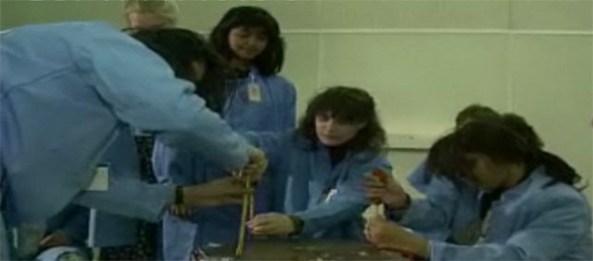
Girls from Ashford School in Kent with their Space Experiment

STS-47 was the 50th Space Shuttle mission of the program, as well as the second mission of Space Shuttle Endeavour. The mission mainly involved conducting experiments in life and material sciences.

Spacelab-J—a joint NASA and National Space Development Agency of Japan (NASDA) mission using a manned Spacelab module—conducted microgravity investigations in materials and life sciences. The international crew, consisting of the first Japanese astronaut to fly aboard the Shuttle, the first African-American woman to fly in space and, contrary to normal NASA policy, the first married couple to fly on the same space mission (Lee and Davis), was divided into red and blue teams for around the clock operations. Spacelab-J included 24 materials science and 20 life sciences experiments, of which 35 were sponsored by NASDA, 7 by NASA and 2 collaborative efforts.

Materials science investigations covered such fields as biotechnology, electronic materials, fluid dynamics and transport phenomena, glasses and ceramics, metals and alloys, and acceleration measurements. Life sciences included experiments on human health, cell separation and biology, developmental biology, animal and human physiology and behavior, space radiation, and biological rhythms. Test subjects included the crew, Japanese koi fish (carp), cultured animal and plant cells, chicken embryos, fruit flies, fungi and plant seeds, and frogs and frog eggs.

Twelve Get Away Special (GAS) canisters (10 with experiments, 2 with ballast) were carried in the payload bay. Middeck experiments were: Israeli Space Agency Investigation About Hornets (ISAIAH), Solid Surface Combustion Experiment (SSCE), Shuttle Amateur Radio Experiment (SAREX II), Air Force Maui Optical Site (AMOS), and Ultraviolet Plume Imager (UVPI).

Amongst the GAS Cansisters was G-102 Sponsored by the Boy Scouts of America’s Exploring Division in cooperation with the TRW Systems Integration Group, Fairfax, Va. The project was named Project POSTAR which was the first space experiment created entirely by members of the Boy Scouts of America.

Also on board were two experiments prepared by Ashford School in Kent which, at the time, was a girls-only school. The school in the UK who had won a competition run by Independent Television News (ITN). The experiments were contained in G-520. The first one injected a few grams of cobalt nitrate crystals to a sodium silicate to create a chemical garden in weightless condition. The growths, which were photographed 66 times as they developed, spread out in random directions twisting and in some cases forming spiral shapes. A second experiment to investigate how Liesegang rings formed in space failed to operate correctly due to friction in parts of the mechanism. On its return the experiment was exhibited in the London Science Museum..

Watch Space Shuttle STS-47 Endeavour Spacelab-J pt1-2 Post Flight Press 1992 NASA

Watch Space Shuttle STS-47 Endeavour Spacelab-J pt2-2 Post Flight Press 1992 NASA

1985 Video – Ashford School for Girls win ITN Space Experiment Competition
http://www.itnsource.com/shotlist//ITN/1985/03/05/AS050385011/

1991 Video – ITN report on the Ashford School for Girls Space Experiment
http://www.itnsource.com/shotlist//ITN/1991/11/17/BSP171191013/

1992 Video – ITN report on Ashford School Space Experiment exhibit at London Science Museum
http://www.itnsource.com/shotlist//ITN/1992/12/17/BSP171292029/

Amateur Radio Project Horus on Kids TV Show “Scope”

Earth from 35km, captured by Horus 7

Terry Baume VK5VZI and the amateur radio Project Horus Balloon 22 was filmed and featured on the Channel 10 Kids Science Program, Scope TV. This program aired on May 24, 2012. For more information on project Horus check out their website, http://projecthorus.org/.

Watch Amateur Radio Project Horus on Kids TV Show “Scope”

5th Grader’s Near Space Flight http://www.uk.amsat.org/?p=8184

Amateur Radio Project Horus on Kids TV Show "Scope"

Earth from 35km, captured by Horus 7

Terry Baume VK5VZI and the amateur radio Project Horus Balloon 22 was filmed and featured on the Channel 10 Kids Science Program, Scope TV. This program aired on May 24, 2012. For more information on project Horus check out their website, http://projecthorus.org/.

Watch Amateur Radio Project Horus on Kids TV Show “Scope”

5th Grader’s Near Space Flight http://www.uk.amsat.org/?p=8184

Open Source CubeSat Next Phase in DIY Space Access

Space Safety Magazine reports that in recent years it has become both easier and more conceivable for students and amateurs to run experiments in space. Non-governmental space organizations are on the rise, DIY spaceflight is all the rage, and it seems the web is full of videos filmed from atop weather balloons launching someone’s favorite figurine into the stratosphere.  A recent project even allows consumers to use purchase points from American Express towards funding student experiments aboard the International Space Station.

The magazine article focuses on NanoSatisfi who launched a Kickstarter initiative on June 15 for an open source CubeSat called ArduSat (although naming rights are available in return for a $10,000 donation).

NanoSatisfi was founded by Austrian-born Peter Platzer a former high-energy physicist (CERN), former Hedge Fund Quantitative Trader, avid HP-41 hacker and Arduino enthusiast, along with Belgian aerospace engineer Jeroen Cappaert intern at NASA Ames Research Center, Canadian aerospace engineer Joel Spark intern at EADS Astrium and Hungarian Reka Kovacs intern at NASA Ames Research Center working on alternative methods of public outreach for space science. The four founders met at the International Space University in Strasbourg and thought that they could do something to provide affordable, open-source space exploration for everyone.

Read the full Space Safety Magazine article Open Source Cubesat Next Phase in DIY Space Access

The New York Observer – Former Quantitative Trader Spurns Wall Street to Explore the Final Frontier
http://observer.com/2012/06/quantitative-trader-spurns-wall-street-in-push-to-explore-the-final-frontier/

ArduSat Arduino CubeSat Update http://www.uk.amsat.org/8284