IITMSat Satellite Project at AAS-AIAA Spaceflight Mechanics Meeting

Deepti Kannapan 23rd AAS-AIAA Spaceflight Mechanics Meeting 2013-02

Deepti Kannapan at the 23rd AAS-AIAA Spaceflight Mechanics Meeting

The 2013 Space Flight Mechanics Meeting, hosted by the American Astronautical Society (AAS) and co-hosted by American Institute of Aeronautics and Astronautics (AIAA) took place in Kauai, Hawaii, February 10-14, 2013.

At the meeting Deepti Kannapan presented her paper on a new attitude control algorithm developed as a part of her Dual Degree Project. This algorithm is being implemented in the IIT Madras Student Satellite (IITMSat) that is being developed by students at the Indian Institute of Technology Madras.

IITMSat Primary Mission Objectives:
• To design, fabricate, test and launch a small-satellite (15kg), that demonstrates all features of satellite functioning, and build a ground station for collection of data from the satellite
• To measure the energy spectrum of protons and electrons beneath the inner-Van Allen radiation belt boundary (600-800 km) to aid earthquake prediction studies
• Interpret the data received from the satellite and analyze the effects of solar flares, lightning storms and seismic activity on the radiation belts

23rd AAS-AIAA conference schedule http://www.space-flight.org/docs/2013_winter/FinalProgram.pdf

IITMSAT http://iitmsat.iitm.ac.in/

IITMSat on Facebook https://www.facebook.com/pages/iitmsat/372808989404716

Tiny Satellites’ Big Mission: Going Beyond Earth Orbit

Artist’s concept of the Interplanetary NanoSpacecraft Pathfinder In Relevant Environment (INSPIRE) CubeSat project – Image credit: NASA/JPL-Caltech

Artist’s concept of the Interplanetary NanoSpacecraft Pathfinder In Relevant Environment (INSPIRE) CubeSat project – Image credit: NASA/JPL-Caltech

TechNewsDaily contributor Rachel Kaufman interviewed James Cutler KF6RFX about two CubeSats that aim to travel into interplanetary space.

The two Interplanetary NanoSpacecraft Pathfinder In Relevant Environment (INSPIRE) satellites measure just 10x10x30 cm and each weigh under 4kg.

The dual INSPIRE CubeSats will demonstrate functionality, communication, navigation and payload hosting in interplanetary space. INSPIRE is a NASA JPL partnership with the University of Michigan, Ann Arbor; Cal Poly San Luis Obispo; and the University of Texas at Austin, in collaboration with Goldstone-Apple Valley Radio Telescope.

Read Rachel Kaufman’s article at
http://www.space.com/20022-tiny-cubesat-satellites-head-for-space.html

NASA Announces New CubeSat Space Mission Candidates
http://www.nasa.gov/centers/jpl/news/cubesat20130226.html

2012 – NanoTHOR: Low-Cost Launch of Nanosatellites to Deep Space
http://www.nasa.gov/directorates/spacetech/niac/2012_phase_I_fellows_hoyt.html

Article on LED Optical Morse Code Spacecraft ShindaiSat

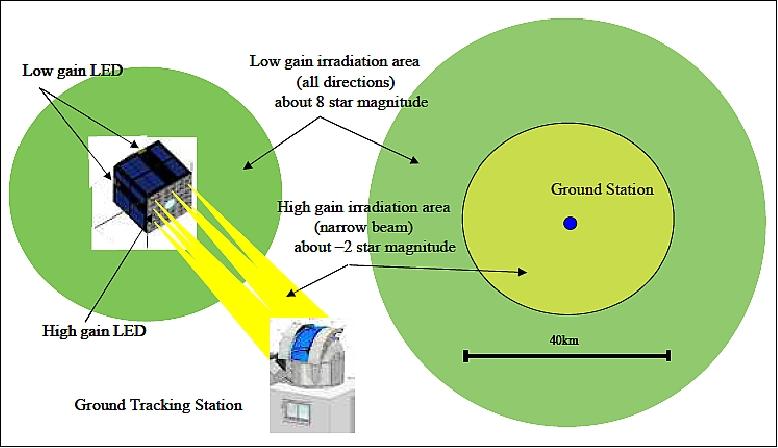
Illustration of high-gain and low-gain LED illumination scenario at the ground station - Image credit Shinshu University

Illustration of high-gain and low-gain LED illumination scenario at the ground station – Image credit Shinshu University

An English language article about ShindaiSat is available at

https://directory.eoportal.org/web/eoportal/satellite-missions/s/shindaisat

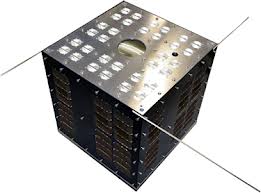
ShindaiSatShindaiSat is a 20 kg spacecraft approx 300 by 300 by 350 mm which is planning to use bright LEDs for Space to Earth optical communication using Morse code. It also carries an optical lens system for receiving modulated LED light from the ground station.

There will be an AX.25 packet radio telemetry beacon and a low power CW beacon. Downlink frequencies of 437.305 and 437.485 MHz have been coordinated by the IARU Amateur Satellite Frequency Coordination Panel.

The article says “A launch of ShindaiSat as a secondary payload is manifested for mid-2014 on the primary GPM (Global Precipitation Measurement) mission of NASA and JAXA. JAXA is providing the launch on the H2A vehicle from the Tanegashima Space Center, Japan.

Orbit: Non-sun-synchronous circular orbit, altitude = 407 km, inclination = 65º.”

ShindaiSat website in Google English

ARISS contact planned February 19, 2013 with school in Greece

The International Space Station

ARISS contact planned February 19, 2013 with school in Greece

An International Space Station school contact has been planned February 19 2013 with participants at 4th Dimotiko Scholeio Chaidariou, Chaidari (near Athens), Greece.             The event is scheduled to begin at approximately 14:06 UTC, which is 16:07 CEWT.

The contact will be a direct operated by J41ISS. Interested parties in Europe are invited to listen to dowlink signals on 145.800 MHz FM. The contact will be conducted in English.

The event will be webcast on several webstreaming servers: http://www.sv1eag.gr/ http://www.justin.tv/sv1eag#r=-rid-&s=em http://www.youtube.com/watch?v=6RFJbw5NeAc

School presentation:

Our school is located in Chaidari, a suburb in the north-west of Athens.             It was constructed in 1978, but it is now being renovated so as to be more energy efficient. It is a two-storey building with 16 classrooms, a Head office and a staff room. Continue reading

Astronaut / Radio Ham Chris Hadfield premieres song from space

Sheldon Cooper of Big Bang Theory wearing a 73 T-shirt - Image Warner Bros

Sheldon Cooper of Big Bang Theory wearing a 73 T-shirt – Image Warner Bros

While on-board the International Space Station (ISS) Canadian astronaut Chris Hadfield, KC5RNJ/VA3OOG, has been creating music in space .

He has been working with Ed Robertson who created the theme song for the popular comedy show The Big Bang Theory.

CBS News report: “We’ve been pals for a long time and it just seemed like a fun thing to do,” says Robertson of the song that is part of a planned album Chris Hadfield [VA3OOG] wants to record while in space. “Chris and his brother write songs and they’re really great, so he’s going to record a bunch of stuff up there.”

The result of the collaboration has been I.S.S. , Is Somebody Singing, which was premiered on Friday, February 8.


Watch the premiere of ‘I.S.S. (Is Somebody Singing)’

Watch Chris Hadfield VA3OOG – mixtape to the moon

I.S.S. (Is Somebody Singing) music score and lyrics
http://music.cbc.ca/#/Space/blogs/2013/2/Ed-Robertson-takes-us-behind-the-writing-of-ISS-Is-Somebody-Singing

John Heath G7HIA – Silent Key

Andy Thomas G0SFJ took of this picture of John Heath G7HIA at the Cosmonauts' steps leading to the Mir training module in Star City near Moscow. Over the years, many Cosmonauts have been photographed on these steps before their journeys into the Cosmos.

Andy Thomas G0SFJ took of this picture of John Heath G7HIA at the Cosmonauts’ steps leading to the Mir training module in Star City near Moscow. Over the years, many Cosmonauts have been photographed on these steps before their journeys into the Cosmos.

AMSAT-UK is very saddened by the passing of John Heath, G7HIA. He was a long standing member of AMSAT-UK, and contributed to the amateur space programme in many ways during his lifetime.

John was a regular attendee at the annual AMSAT-UK Colloquia for many years and he enjoyed meeting up with his friends who shared his passion for satellites.  Sadly his ill heath in recent years prevented his attendance.

In the days before his passing, John was in contact with AMSAT-UK; and made a significant financial contribution to the FUNcube project. He chose to do this by making the donation via the Radio Communication Foundation, which, as a registered charity will be able to claim any income tax paid by John as Gift Aid. The size of his donation is very considerable, and will be used at the discretion of the AMSAT-UK committee. Such is the extent of his generosity, that it may be feasible to consider the construction of a further complete CubeSat.

AMSAT-UK is very grateful for this donation.

John will be sadly missed by all members of AMSAT-UK who knew him during his life, and we send our condolences to his family.

RIP, John

Jim Heck G3WGM
Hon Sec AMSAT-UK

John Heath G7HIA with school pupils who took part in the International Space Station contact on April 4, 2003 from the UK National Space Centre

John Heath G7HIA with school pupils who took part in the International Space Station contact on April 4, 2003 from the UK National Space Centre

Clive Wallis G3CWV writes:

I was very saddened to learn of John’s passing.  We had exchanged many e-mails during the last few years. I didn’t know John very well, although we had met at the ASAT-UK Colloquium on several occasions. Topics we discussed by e-mail included processing Delphi 3C telemetry, OSCAR-11 spin rate, automatic Doppler tracking and ARISSat-1 decay.

John was very active in using our satellites and promoting their use to others.  For several years he was net controller of the Midlands two metre AMSAT net.  He also wrote the Space column for RSGB’s RadCom magazine for a number of years. He contributed many articles to OSCAR News, recently in the September 2012 issue about ARISSat-1 orbital decay. His last contribution to OSCAR News was a short item in the December issue, congratulating AMSAT-UK on their 200th issue of the magazine. He included a photograph of himself, Astronaut Ron Parise WA4SIR and Geoff Perry, founder of the Kettering Group of satellite observers. It was taken at the 1998 Colloquium.

During the course of our discussions John mentioned that he was having some unpleasant hospital treatment. He also told me about his working career, which I  thought may be of interest.

As a teenager he was interested in organic chemistry and went to work in industry, eventually in the R&D department at Bakelite in Tyseley, Birmingham. In the 1960’s/70’s he worked on the phenolic resins used to make copper clad PCB material, and did the first industrial synthesis on nonyl phenol by ion exchange. There were massive world stocks of Nonene at knock down prices so they were looking for a way to use it to make phenol/formaldehyde resins used in PCB manufacture.

His YL Pam at that time worked in a small hairdressing supplies business and he sometimes worked with her when they needed extra staff to cover late night opening. After his marriage to Pam, her firm decided to open a branch in Leicester and they were offered the opportunity to re-locate and run the new operation. Together they built up the business, diversifying into related activities with a skin care manufacturing  company (where his science background was invaluable), a beauty products wholesale business  and a  mail order operation. The business expanded from 6 people to a staff of nearly 200 on four sites.

John said that Amateur radio helped to keep him sane by giving him a totally different set of things to think about and emptied his head of business concerns for a few hours each week!

A few years ago Pam was diagnosed with a serious illness and confined to a wheel  chair. This caused them to  bring forward their retirement plans and they moved to Devon.

My condolences to Pam, family & friends.

RIP John, we will miss you.

Clive Wallis   G3CWV