John Heath G7HIA – Silent Key

Andy Thomas G0SFJ took of this picture of John Heath G7HIA at the Cosmonauts' steps leading to the Mir training module in Star City near Moscow. Over the years, many Cosmonauts have been photographed on these steps before their journeys into the Cosmos.

Andy Thomas G0SFJ took of this picture of John Heath G7HIA at the Cosmonauts’ steps leading to the Mir training module in Star City near Moscow. Over the years, many Cosmonauts have been photographed on these steps before their journeys into the Cosmos.

AMSAT-UK is very saddened by the passing of John Heath, G7HIA. He was a long standing member of AMSAT-UK, and contributed to the amateur space programme in many ways during his lifetime.

John was a regular attendee at the annual AMSAT-UK Colloquia for many years and he enjoyed meeting up with his friends who shared his passion for satellites.  Sadly his ill heath in recent years prevented his attendance.

In the days before his passing, John was in contact with AMSAT-UK; and made a significant financial contribution to the FUNcube project. He chose to do this by making the donation via the Radio Communication Foundation, which, as a registered charity will be able to claim any income tax paid by John as Gift Aid. The size of his donation is very considerable, and will be used at the discretion of the AMSAT-UK committee. Such is the extent of his generosity, that it may be feasible to consider the construction of a further complete CubeSat.

AMSAT-UK is very grateful for this donation.

John will be sadly missed by all members of AMSAT-UK who knew him during his life, and we send our condolences to his family.

RIP, John

Jim Heck G3WGM
Hon Sec AMSAT-UK

John Heath G7HIA with school pupils who took part in the International Space Station contact on April 4, 2003 from the UK National Space Centre

John Heath G7HIA with school pupils who took part in the International Space Station contact on April 4, 2003 from the UK National Space Centre

Clive Wallis G3CWV writes:

I was very saddened to learn of John’s passing.  We had exchanged many e-mails during the last few years. I didn’t know John very well, although we had met at the ASAT-UK Colloquium on several occasions. Topics we discussed by e-mail included processing Delphi 3C telemetry, OSCAR-11 spin rate, automatic Doppler tracking and ARISSat-1 decay.

John was very active in using our satellites and promoting their use to others.  For several years he was net controller of the Midlands two metre AMSAT net.  He also wrote the Space column for RSGB’s RadCom magazine for a number of years. He contributed many articles to OSCAR News, recently in the September 2012 issue about ARISSat-1 orbital decay. His last contribution to OSCAR News was a short item in the December issue, congratulating AMSAT-UK on their 200th issue of the magazine. He included a photograph of himself, Astronaut Ron Parise WA4SIR and Geoff Perry, founder of the Kettering Group of satellite observers. It was taken at the 1998 Colloquium.

During the course of our discussions John mentioned that he was having some unpleasant hospital treatment. He also told me about his working career, which I  thought may be of interest.

As a teenager he was interested in organic chemistry and went to work in industry, eventually in the R&D department at Bakelite in Tyseley, Birmingham. In the 1960’s/70’s he worked on the phenolic resins used to make copper clad PCB material, and did the first industrial synthesis on nonyl phenol by ion exchange. There were massive world stocks of Nonene at knock down prices so they were looking for a way to use it to make phenol/formaldehyde resins used in PCB manufacture.

His YL Pam at that time worked in a small hairdressing supplies business and he sometimes worked with her when they needed extra staff to cover late night opening. After his marriage to Pam, her firm decided to open a branch in Leicester and they were offered the opportunity to re-locate and run the new operation. Together they built up the business, diversifying into related activities with a skin care manufacturing  company (where his science background was invaluable), a beauty products wholesale business  and a  mail order operation. The business expanded from 6 people to a staff of nearly 200 on four sites.

John said that Amateur radio helped to keep him sane by giving him a totally different set of things to think about and emptied his head of business concerns for a few hours each week!

A few years ago Pam was diagnosed with a serious illness and confined to a wheel  chair. This caused them to  bring forward their retirement plans and they moved to Devon.

My condolences to Pam, family & friends.

RIP John, we will miss you.

Clive Wallis   G3CWV

AMSAT-UK at National Student Space Conference Bristol Feb 23-24

FUNcube-1 flight model - Image credit Wouter Weggelaar PA3WEG

FUNcube-1 flight model – Image credit Wouter Weggelaar PA3WEG

Jim Heck G3WGM, Honorary Secretary of AMSAT-UK and project lead on the FUNcube amateur radio satellite project, will be giving a presentation on FUNcube-1 to the UKSEDS National Student Space Conference (NSSC) that takes place in Bristol on February 23-24.

The NSSC is an annual event that brings together students, academics, and professionals from across the country to share knowledge of space, discuss the challenges facing the sector, and to create new links between groups. It features talks by leading space science and industry figures, and opportunities to take part in discussions and networking events.

UKSEDS National Student Space Conference Bristol 2013This year’s NSSC is hosted by Bristol SEDS, part of the Bristol CHAOS Physics society, at the University of Bristol School of Physics.

The impressive line up of speakers includes Alan Bond of Reaction Engines Ltd on the SKYLON Development Programme and John Thatcher of Astrium Satellites Ltd who’ll be talking about MIRI & the James Webb Space Telescope.

Further information on the conference is at http://ukseds.org/conference2013/

Two TV CubeSats from Ecuador

NEE-02 Krysaor - Image credit EXA

NEE-02 Krysaor – Image credit EXA

Ecuador is hoping to have two CubeSats in orbit this year.

Their first CubeSat NEE-01 Pegasus will carry a 720p HD camera to send live video from space using a 0.9 watt TV transmitter in the 910 MHz (33cm) band along with a beacon that will send a Morse Code ID, a SSTV image and Ecuador’s national anthem. It was originally planned to launch on a Dnepr from Yansy but is now expected to fly on a CZ-2D rocket from the Jiuquan Space Center on April 26, 2013 at 0413 UT.

Ecuadors second CubeSat NEE-02 Krysaor carries the same payloads in the 910 MHz band as NEE-1 Pegasus but has a slightly different solar panel configuration. As yet websites such as Gunter Space Page give no indication on which rocket NEE-02 Krysaor will fly.

Continue reading →

STRaND-1 Smartphone CubeSat to launch end of February

STRaND-1 and team - image credit SSTL

STRaND-1 and team – Image credit SSTL

The BBC report that the world’s first “smartphone-sat” STRaND-1 is ready to launch at the end of February. The satellite was built in Guildford by volunteers from the Surrey Space Centre (SSC) and Surrey Satellite Technology Limited (SSTL) in their spare time. It is planned to be launched on February 25 into a 785 km orbit by the Indian Space Research Organisation (ISRO) on the PSLV-CA (PSLV-C20) rocket.

Dr Chris Bridges working on STRaND

Dr Chris Bridges working on STRaND-1

The innovative STRaND-1 CubeSat will carry a Google Nexus One Android smartphone into space to demonstrate the feasibility of using cheap smartphone electronics to control a spacecraft.

Smartphones contain highly advanced technologies and incorporate several key features that are integral to a satellite – such as cameras, radio links, accelerometers and high performance computer processors – almost everything a spacecraft needs except the solar panels and propulsion.

There will be an amateur radio AX.25 packet radio downlink on 437.568 MHz using a data rates of 9k6 bps.

STRaND-1 flight ready February 2013 with Shaun Kenyon, Dr Peter Shaw, Dr Chris Bridges

STRaND-1 flight ready February 2013 with Shaun Kenyon, Dr Peter Shaw, Dr Chris Bridges

Further information on STRaND-1 at
http://www.amsat-uk.org/?p=12196

Watch the videos in the STRaND-1 video archive
http://www.amsat-uk.org/?p=12472

Read the BBC News story at
http://www.bbc.co.uk/news/science-environment-21361204

The world’s first smartphone in Space ‘STRaND-1’ ready for launch
http://www.sstl.co.uk/News-and-Events?story=2117

Dr Chris Bridges talked about STRaND-1 on the BBC Radio 4 show Material World broadcast on Thursday, February 7. A recording can be heard until February 14 at http://www.bbc.co.uk/programmes/b01qfj3l The STRaND-1 segment starts 08:55 into the recording.

STRaND-1 on Facebook https://www.facebook.com/nanosats

You can follow STRaND at https://twitter.com/SurreyNanosats

UKube-1 CubeSat Payload Animation

Artists impression of UKube-1 in orbit

Artists impression of UKube-1 in orbit – Credit Clyde Space

This video shows the UK Space Agency’s first CubeSat UKube-1 which is being built by Clyde Space. It is slated to launch in the 1st quarter of 2013 on a Soyuz-2 along with TechDemoSat-1.

UKube-1 will carry a set of AMSAT-UK FUNcube boards to provide an amateur radio 435/145 MHz linear transponder and a 1200 bps BPSK beacon for educational outreach.

On Saturday, January 26, UKube-1 was at Selex Edinburgh  for vibration testing. This test was to simulate the vibration seen during launch to verify the build quality. In the space game this is called giving the spacecraft a ‘shake’.

Continue reading →

Nigerian CubeSat – EregbuSAT


EregbuSAT CubeSat

EregbuSAT CubeSat Prototype

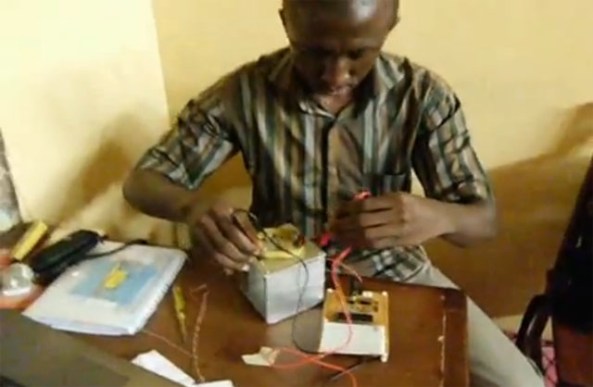
EregbuSAT is a CubeSat prototype that is being developed by the Postgraduate students of the African Regional Centre for Space Science and Technology Education in English (ARCSSTE-E) to simulate the communication (send and receive data) between a Satellite and its Ground Station.

When completed, it will provide an opportunity for future students in the Satellite Communication option of ARCSSTE-E Postgraduate Diploma program to experience operating a Satellite (send commands to Satellite using the prototype) during their short stay in Nigeria.

Continue reading →