Note overseas viewers may need to use a UK based Proxy Server.
The Isle of Man Government say they are “firmly ‘pro-space’ and together with a clear and simple tax regime, absence of Insurance Premium Tax and commitment to the development of space law and satellite registry, the Island offers the right environment for the space industry to flourish.” http://www.gov.im/lib/docs/iomfinance/factsheets/isleofmanspaceindustry.pdf
QST Editor and ARRL Publications Manager Steve Ford, WB8IMY will give a presentation to the AMSAT-UK International Space Colloquium at the Holiday Inn in Guildford on Saturday, July 26.
Steve will be traveling to the UK to talk about the satellite operations at the impressive ARRL Headquarters station in Newington, Connecticut.
He has written many amateur radio books including the ARRL Satellite Handbook, Get on the Air with HF Digital, VHF Digital Handbook and Remote Operating for Amateur Radio.
UK Astronaut Tim Peake KG5BVI reports that on July 1, 2014, the UK Space Education Office (ESERO-UK) is holding a free conference at the National Science Learning Centre in York.
It is ideal for primary teachers and teaching assistants who are interested in using space as a exciting context for learning.
The conference will introduce Tim’s upcoming mission to the ISS and how space can be used to enhance children’s learning across the primary school curriculum.
Tim is currently training for his 6 month mission, Expedition 46/47, to the ISS which is scheduled for November 2015. The UK communications regulator Ofcom has agreed in principle to issue the permanent Special Callsign of GB1SS to the ISS and it is expected Tim will use that callsign when operating the amateur radio station in the ESA Columbus module.
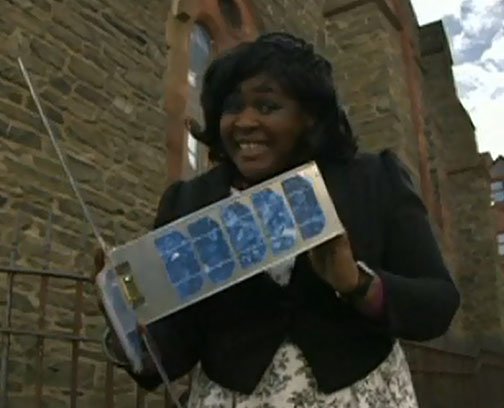
Wednesday, May 21, 2014, marked the six month anniversary of the launch of the tiny $50SAT / MO-76 PocketQube satellite which is just 5x5x7.5 cm and 210 grams.
Michael Kirkhart KD8QBA has released an update on this remarkable satellite:
We have finally completed the first pass cleanup of the telemetry data provided by all of you. We cannot thank you enough for this data, as it will help us understand how $50SAT/MO-76 has been operating. Keep it coming!
On the Dropbox, you will find a new directory (Telemetry-analysis/Battery-voltage-2014-06-04) containing our first set of processed data, which serves as an initial investigation into the performance of the on-board Li-ion battery. Included in this directory is a spreadsheet with all the battery voltage data we have up to now, in both tabular and graphical form; it consists of 1097 individual telemetry observations. For convenience sake, there is also a copy of the graph in PDF form. Over the past 6 months, the daily average battery voltage has been dropping. A best fit line through all the data has a slope of -0.670 mV per day. The drop, however, has not always been gradual. For instance, there is a large step change of about -60 mV sometime near February 20, 2014. We are not sure what happened here. Anybody out there know what might be going on?
Ignoring the two outliers on the graph, the current low battery voltage is 3521 mV. This has been observed at least 5 times, including twice by yours truly. This, of course, occurs when $50SAT/MO-76 happens to be at its lowest temperature, which has been -28 degrees C until yesterday evening, where I observed a temperature of -29 degrees C. While our depth of discharge on the battery is relatively low (our initial calculations were about 22 mA-hr), it is going through about a -28 degree C to 26 degree C (or possibly higher – this is our highest recorded temperature) and back down to -28 degrees C 14.5 times per day. Does this violate the conditions of the warranty?
As to whether or not the orbit is decaying, a comparison of the current TLEs with a set from early December 2013 show it is, although by a small amount.
Here are the TLEs from December 4, 2013 (element set 7):
2013-066W
1 39436U 13066W 13337.88841924 .00010097 00000-0 12132-2 0 70
2 39436 97.8019 50.2525 0031655 170.6351 189.5525 14.83797851 1855
Here are the TLEs from June 2, 2014 (element set 223):
EAGLE 2
1 39436U 13066W 14152.25170112 .00007510 00000-0 78254-3 0 2235
2 39436 97.7787 226.1156 0024706 303.1274 56.7439 14.89857855 28503
$50SAT Boards
The second to last element on line 2 is the mean motion, in units of orbits per day. From this number, the semi-major axis of the orbit can be computed. On December 4, 2013, it was 6,995.50 km, and on June 2, 2014, it was 6,976.51 km. This means the orbit has decayed by about 19 km during this time period. The orbit has also become slightly less elliptical. The forth element on line 2 is the eccentricity, which has an implied decimal point in front of it. On December 4, 2013, it was 0.0031655, and on June 2, 2014, it was 0.0024706. From this and the computed semi-major axis, the apogee and perigee altitudes are as follows:
December 4, 2013: apogee = 639.64 km, perigee = 595.36 km
June 2, 2014: apogee = 615.75 km, perigee = 581.27 km
The technical challenge we posed to the amateur community to successfully uplink to $50SAT/MO-76 has yet to be met. We have since realized some of the documentation, specifically the Silicon Labs Si4432 data sheet, was not clear on at least one of the needed details. To encourage the amateur radio community to answer our challenge, we will post some information that should be helpful in uplinking to $50SAT/MO-76; look for this sometime in the next few days.
$50SAT/MO-76 has made it onto YouTube! See a video of the excellent talk on $50SAT/MO-76 given by Howie DeFelice, AB2S, and a video of yours truly operating the AMSAT demo station during a $50SAT/MO-76 pass at the Dayton Hamvention.
73
Michael Kirkhart
KD8QBA
$50SAT/MO-76 team
Talk by Howie DeFelice AB2S at the May 14, 2014, PocketQube workshop
(thanks to Gustavo, LW2DTZ, for taking and posting this video)
$50SAT was a collaborative education project between Professor Bob Twiggs, KE6QMD, Morehead State University and three other radio amateurs, Howie DeFelice, AB2S, Michael Kirkhart, KD8QBA, and Stuart Robinson, GW7HPW. The transmitter power is just 100 mW on 437.505 MHz (+/-9 kHz Doppler shift) FM CW/RTTY. $50SAT uses the low cost Hope RFM22B single chip radio and PICAXE 40X2 processor.
Michael Kirkhart KD8QBA operates AMSAT demo station during $50SAT/MO-76 pass Friday, May 16
(thanks to Patrick Stoddard, WD9EWK, AMSAT-NA Vice President for Field Operations, for this video)
A space.com article reports a spaceport in the United Kingdom may be possible by 2018.
Pending a regulatory report to be published this July and a technical feasibility study that is underway with the country’s National Space Technology Programme (NSTP), it is possible that the country could host a spaceport within the next five years.
A new National Space Flight Coordination Group, chaired by the U.K. Space Agency, will oversee these reports and the future work for this U.K. spaceport. Government officials hope this will be the start of commercial spaceflight for the country.
Rob Coppinger reports the United Kingdom’s first Spaceport could be at Lossiemouth, which is already home to one of the largest Royal Air Force (RAF) bases in the country.
At 57.7°N Lossiemouth would be the most northerly Commercial Spaceport in the World. Lossiemouth is slightly further North than the Kodiak spaceport in Alaska which is at 57.4°N.
UK ESA astronaut Tim Peake took the opportunity to sit his Technician amateur radio exam at the end of April while he was in Houston for astronaut training. He has now been issued the amateur radio callsign KG5BVI.
UK astronaut Major Tim Peake KG5BVI
At the beginning of March Tim gave a presentation to the UKSEDS National Student Space Conference in Leicester. During the talk he expressed his enthusiasm about getting his amateur radio licence and operating from the International Space Station (ISS).
Tim is currently training for his 6 month mission, Expedition 46/47, to the ISS which is scheduled for November 2015. The UK communications regulator Ofcom has agreed in principle to issue the permanent Special Callsign of GB1SS to the ISS and it is expected Tim will use that callsign when operating the amateur radio station in the ESA Columbus module.
The USA Technician licence is the equivalent of the UK Foundation. The 35-question Technician exam covers topics such as radio theory, regulations and operating practices. 26 of the 35 questions need to be answered correctly to pass. Unlike the system in the UK there are no practical assessments for the USA exams just a single multiple choice exam paper. All the questions and answers for the US exams are available online and you can try a practice Technician exam at http://www.qrz.com/hamtest/
Technicians are allowed to use up to 1500 watts output on all the VHF, UHF and Microwave bands and 200 watts output on four HF bands. USA Technicians have full amateur privileges in the frequencies they are allocated, for example they can do set up beacons or repeaters, operate maritime mobile and design and build their own equipment.
You must be logged in to post a comment.