BBC – ESA seeks help to control robot spacecraft

Parrot AR Drone 2.0

Parrot AR Drone 2.0

BBC News report that the European Space Agency (ESA) is turning to owners of terrestrial robot aircraft to aid those that journey into space.

The agency has released an App that makes use of the cameras on the Parrot drone to simulate docking with a virtual space station.

The Parrot drone quadcopter has proved popular with many iPhone owners as it can be controlled via the 2.4 GHz WiFi signal from the handset.

Data generated by the agency’s App will be analyzed to help fine tune navigation software for its own drones.

Read the BBC story at http://www.bbc.co.uk/news/technology-21828807

ESA Smartphone App Turns Drone into Spacecraft
http://www.esa.int/Our_Activities/Technology/Smartphone_app_turns_home_drone_into_spacecraft

Middlesex Foundation Radio Hams success in UAV (Drone) competition
https://amsat-uk.org/2012/07/12/middlesex-radio-hams-success-in-uav-competition/

Watch Live Video of UK STRaND-1 Smartphone Satellite Launch

The STRaND-1 build and test phase took just 3 months

The STRaND-1 build and test phase took just 3 months

The UK smartphone satellite STRaND-1 is expected to launch from India on Monday, Feb. 25 at 12:25 GMT. You can follow the launch on Twitter or watch live video.

STRaND-1 and other CubeSats carrying amateur radio payloads are planned to launch on the ISRO PSLV-C20 rocket into a 785 km orbit.

STRaND-1 carries an amateur radio 9600 bps AX.25 packet radio downlink on 437.568 MHz. It is hoping to be the first ever satellite to carry a smartphone into space and is also believed be the first satellite to use a part produced with a 3D Printer.

On Twitter the Surrey Space Centre @SpaceAtSurrey tweeted:

Official launch hashtag of STRaND-1 spacecraft is #S1Launch. Post launch we will be using #STRaND1 hashtag. Launch time:12.25 GMT 25th Feb 2013 #UniOfSurrey #SSTL

Launch Authorisation Board (LAB) for PSLV – C20 @STRaND mission has cleared the launch on Monday, Feb 25, 2013. @university of surrey #S1Launch

Live video launch feeds for Monday’s PSLV launch http://www.webcast.gov.in/live/ and http://ibnlive.in.com/livetv/

Launch times can and do change at the last minute so follow Twitter for the latest information.

Follow Surrey Nanosats https://twitter.com/SurreyNanosats

Read more about STRaND-1 at http://www.amsat-uk.org/?page_id=12196

STRaND-1 telemetry format http://www.amsat-uk.org/?page_id=12875

STRaND-1 videos http://www.amsat-uk.org/?page_id=12472

Other satellites on the same launch http://www.amsat-uk.org/?p=12180

STRaND-1 on Facebook https://www.facebook.com/nanosats

Provisional initial track of STRaND-1

Provisional initial track of STRaND-1

Article on LED Optical Morse Code Spacecraft ShindaiSat

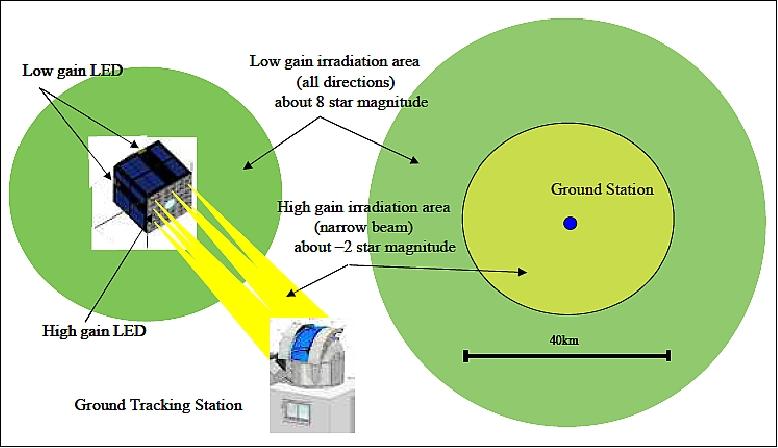
Illustration of high-gain and low-gain LED illumination scenario at the ground station - Image credit Shinshu University

Illustration of high-gain and low-gain LED illumination scenario at the ground station – Image credit Shinshu University

An English language article about ShindaiSat is available at

https://directory.eoportal.org/web/eoportal/satellite-missions/s/shindaisat

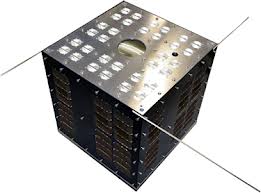
ShindaiSatShindaiSat is a 20 kg spacecraft approx 300 by 300 by 350 mm which is planning to use bright LEDs for Space to Earth optical communication using Morse code. It also carries an optical lens system for receiving modulated LED light from the ground station.

There will be an AX.25 packet radio telemetry beacon and a low power CW beacon. Downlink frequencies of 437.305 and 437.485 MHz have been coordinated by the IARU Amateur Satellite Frequency Coordination Panel.

The article says “A launch of ShindaiSat as a secondary payload is manifested for mid-2014 on the primary GPM (Global Precipitation Measurement) mission of NASA and JAXA. JAXA is providing the launch on the H2A vehicle from the Tanegashima Space Center, Japan.

Orbit: Non-sun-synchronous circular orbit, altitude = 407 km, inclination = 65º.”

ShindaiSat website in Google English

ShindaiSat to carry Optical LED Morse Code Beacon

ShindaiSatShindaiSat is a 20 kg spacecraft approx 300 by 300 by 350 mm which is planning to use bright LEDs for Space to Earth optical communication using Morse code.

There will be an AX.25 packet radio telemetry beacon and a low power CW beacon. Downlink frequencies of 437.305 and 437.485 MHz have been coordinated by the IARU Amateur Satellite Frequency Coordination Panel.

It is expected to launch into a 400km 65 degree orbit from Japan in 2013.

ShindaiSat website in Google English

UKube-1 to launch in June 2013


Artists impression of UKube-1 in orbit

Artists impression of UKube-1 in orbit – Credit Clyde Space

The Herald newspaper reports that the CubeSat UKube-1 will be launched in June, 2013.

The spacecraft is being built for the UK Space Agency (UKSA) by Clyde Space and the launch will take place from Baikonur in Kazakhstan on a Soyuz-2 along with TechDemoSat-1.

The newspaper reports that Clyde Space has announced plans for a base in the United States.

UKube-1 will carry a set of AMSAT-UK FUNcube boards to provide an amateur radio 435/145 MHz linear transponder and a 1200 bps BPSK beacon for educational outreach.

Continue reading

UK STRaND-1 CubeSat Video

Dr Chris Bridges and STRaND

Dr Chris Bridges and STRaND hardware

In this video Surrey Space Centre’s Dr. Peter Shaw talks us through the anatomy of the highly advanced UK CubeSat STRaND-1.

The innovative amateur radio STRaND-1 CubeSat aims to carry a NEXUS Android Smartphone into space to demonstrate the feasibility of using cheap Smartphone electronics to control a spacecraft.

A software-based speech synthesiser will be included to pay homage to the UOSAT family of satellites (OSCAR-9 and OSCAR-11) that were launched in the 1980′s.

STRaND-1 will carry an amateur radio payload with an AX.25 packet radio downlink on 437 MHz using data rates of 9k6 or 19k2 bps.

Continue reading