15-year-old radio ham receives ISS Apollo-Soyuz SSTV Award

ISS SSTV Apollo-Soyuz Award #0289 received by Sakshi Vagadia VU3EXP

ISS SSTV Apollo-Soyuz Award #0289 received by Sakshi Vagadia VU3EXP

Rajesh Vagadia VU2EXP reports that he and his15 year old daughter, Sakshi Vagadia VU3EXP, have each received ISS Apollo-Soyuz SSTV Awards for their reception of Slow Scan Television images transmitted using amateur radio from the International Space Station (ISS).

Sakshi Vagadia VU3EXP

Sakshi Vagadia VU3EXP

These special transmissions from the ISS during July 18-19, 2015 were made to commemorate the 40th anniversary of the Apollo-Soyuz mission, which was the first joint collaboration in space between the United States and the Soviet Union. The ARISS organisation has issued a special limited edition diploma to award those who received one of the SSTV images.

Rajesh writes: After getting ticket [amateur radio licence] few months back, It was first successful attempt by Sakshi VU3EXP to receive SSTV Image from International Space Station and get such memorable & precious Wallpaper (award). She received ISS SSTV image on July 18, 2015 @ 19:36:44 (UTC).

My ISS SSTV Image was received on July 19 @ 05:24:27 (UTC). It was my 5th successful attempt.

I highly appreciate ARISS International, Russian Cosmonauts, various Radio Clubs and ARISS SSTV Award Managers (incl. SQ3OOK) joint efforts to give such wonderful opportunity to we Ham community.

73 VU2EXP
Rajesh P. Vagadia
Rajkot – Gujarat
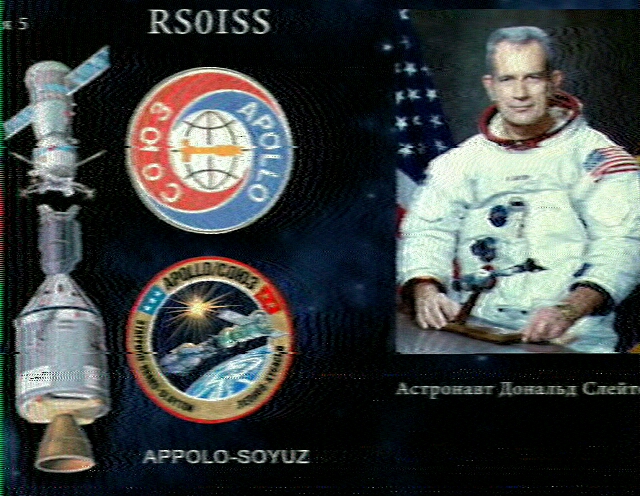
Image received by Sakshi Vagadia VU3EXP on July 18, 2015 at 1936 GMT

Image received by Sakshi Vagadia VU3EXP on July 18, 2015 at 1936 GMT

Amateur Radio on the International Space Station (ARISS) – Contact the ISS
http://www.ariss.org/contact-the-iss.html

ISS Slow Scan TV https://amsat-uk.org/beginners/iss-sstv/

Youngest radio ham in Gujarat state
https://amsat-uk.org/2015/05/04/youngest-radio-ham-in-gujarat-state/

What is Amateur Radio ? http://www.essexham.co.uk/what-is-amateur-radio
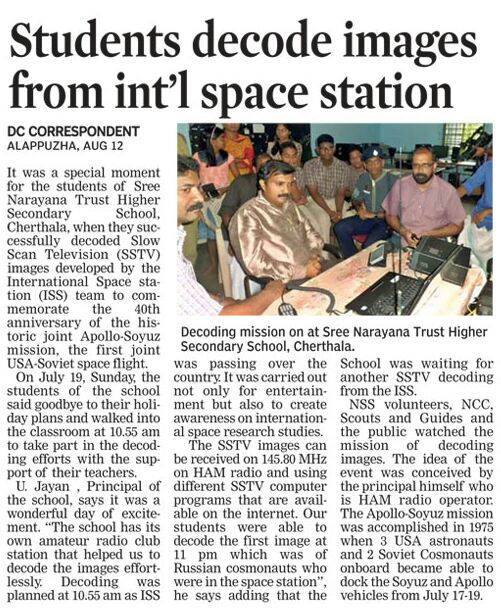
School students decode ISS images

ISS SSTV in the Deccan Chronicle

ISS SSTV in the Deccan Chronicle

Students at Sree Narayana Trust Higher Secondary School returned to the classroom during their holidays to receive amateur radio Slow Scan Television from the International Space Station.

The special ISS transmissions were made in July to commemorate the 40th anniversary of the Apollo-Soyuz mission.

The Deccan Chronicle newspaper reports that with the support of their teachers the students were able to decode the SSTV images on a frequency of 145.800 MHz FM.

The school has an amateur radio club, callsign VU2SQL, and the Principal is licenced radio amateur U.Jayan VU2JYU.
http://www.qrz.com/db/vu2sql

See the full article on the National Institute of Amateur Radio (NIAR) Facebook page at
https://www.facebook.com/NIAR.org/photos/a.272605179532734.63897.272263639566888/743023429157571/?type=1&theater

Examples of ISS SSTV images received by radio amateurs can be seen at
http://www.spaceflightsoftware.com/ARISS_SSTV/index.php

ISS Slow Scan TV https://amsat-uk.org/beginners/iss-sstv/

Apollo Soyuz SSTV Event Diploma

International Space Station - Image Credit NASA

International Space Station – Image Credit NASA

In commemoration of the Apollo Soyuz SSTV event, ARISS will be distributing a limited edition diploma to those who received one of the SSTV images transmitted from the International Space Station on July 18-19, 2015.

You can receive a commemorative diploma by filling in one of two application forms:
•  English version: http://ariss.pzk.org.pl/Apollo-Soyuz/en
• Russian language: http://ariss.pzk.org.pl/Apollo-Soyuz/ru

The deadline to apply for the diploma is the end of July 2015.

73, Frank Bauer, KA3HDO
ARISS International Chair

Amateur Radio on the International Space Station (ARISS) http://www.ariss-eu.org/

ISS SSTV July 18-19 on 145.800 MHz FM

ISS SSTV image 1 received by Murray Hely ZL3MH January 31, 2015

ISS SSTV image received by Murray Hely ZL3MH January 31, 2015

ARISS SSTV images will be transmitted this weekend from the amateur radio station in the ISS Russian Service Module to commemorate the 40th Anniversary of the Apollo-Soyuz Mission.

40 years ago this week, the historic joint Apollo-Soyuz mission was conducted.  Apollo-Soyuz (or Soyuz-Apollo in Russia) represented the first joint USA-Soviet mission and set the stage for follow-on Russia-USA space collaboration on the Space Shuttle, Mir Space Station and the International Space Station.

The Soyuz and Apollo vehicles were docked from July 17-19, 1975, during which time joint experiments and activities were accomplished with the 3 USA astronauts and 2 Soviet Cosmonauts on-board.  Apollo-Soyuz was the final mission of the Apollo program and the last USA human spaceflight mission until the first space shuttle mission in 1981.

To commemorate the 40th anniversary of this historic international event, the ARISS team has developed a series of 12 Slow Scan Television (SSTV) images that will be sent down for reception by schools, educational organizations and ham radio operators, worldwide.  The SSTV images are planned to start sometime Saturday morning, July 18 and run through Sunday July 19.  These dates are tentative and are subject to change.  The SSTV images can be received on 145.800 MHz FM and displayed using several different SSTV computer programs that are available on the internet.

We encourage you to submit your best received SSTV images to:
http://spaceflightsoftware.com/ARISS_SSTV/submit.php

The ARISS SSTV image gallery will post the best SSTV images received from this event at:
http://spaceflightsoftware.com/ARISS_SSTV/index.php

Also, as a special treat, on Saturday July 18 the ISS Cosmonauts will take time out to conduct an ARISS contact with students attending the Moon Day/Frontiers of Flight Museum event in Dallas Texas.  This Russian Cosmonaut-USA Student contact is planned to start around 16:55 UTC through the W6SRJ ground station located in Santa Rosa, California.  ARISS will use the 145.800 MHz FM voice frequency downlink (same as the SSTV downlink) for the Moon Day contact.

For more information on ARISS, please go to our web site http://www.ariss.org/

The ARISS international team would like to thank our ARISS-Russia colleague, Sergey Samburov, RV3DR, for his leadership on this historic commemoration.

Frank H. Bauer, KA3HDO
ARISS International Chair

Previous ISS SSTV transmissions have used the SSTV mode PD180 with a 3-minute off time between each image.

ISS Slow Scan TV information and links for tracking the ISS at https://amsat-uk.org/beginners/iss-sstv/

You can receive the SSTV transmissions online using the SUWS WebSDR remote receiver located near London along with the MMSSTV software https://amsat-uk.org/2014/08/15/suws-websdr-moves-to-new-site/

ISS Ham Radio SSTV Video

On the weekend of April 11/12 Randy Hall K7AGE used his Arrow dual band J-Pole antenna, FT-817, Signalink USB interface and MMSSTV software to capture some great amateur radio Slow Scan Television (SSTV) images from the International Space Station (ISS).

Watch SSTV Images from the International Space Station

ISS Slow Scan TV Active on Weekend of April 11 https://amsat-uk.org/2015/03/31/iss-sstv/

Using WebSDRs Worldwide for the ISS https://amsat-uk.org/2015/04/14/using-websdrs-for-iss/

ISS SSTV in the UK Press https://amsat-uk.org/2015/04/15/iss-sstv-in-the-press/

ISS SSTV in the Press

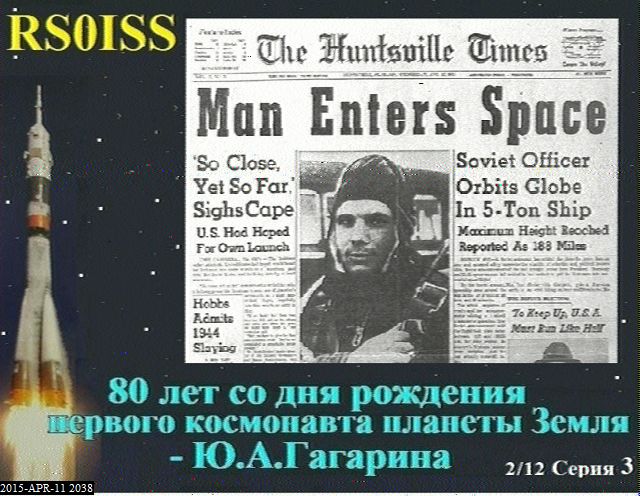
ISS SSTV Image 2 of 12 received by Andrew Garratt M0NRD April 11, 2015

ISS SSTV Image 2 of 12 received by Andrew Garratt M0NRD April 11, 2015

AMSAT-UK member Andrew Garratt M0NRD got some good publicity for Amateur Radio from the recent ISS Slow Scan Television transmissions.

The SSTV pictures were sent in celebration of Yuri Gagarin becoming the first human to reach space, on April 12, 1961. The Russian cosmonauts on board the station transmitted images from Gagarin’s life which were received by radio hams worldwide. Andrew said he hoped it would encourage more people to become interested in radio.

Read the full story at
https://web.archive.org/web/20160405015704/http://newarkadvertiser.co.uk/articles/news/A-message-from-space-picked-up-in-Newark

Local newspapers are generally only too glad to publish stories like this if someone takes the time to get in touch and tell them about it. Andrew made sure the newspaper was aware of his local clubs website URL and Facebook page enabling those reading the story to contact the club.

Follow M0NRD on Twitter http://twitter.com/nerdsville

ISS Slow Scan TV Active on Weekend of April 11 https://amsat-uk.org/2015/03/31/iss-sstv/

Note the ISS transmissions on 145.800 MHz FM use the 5 kHz deviation standard rather than the narrow 2.5 kHz used in Europe. If your transceiver has selectable FM filters try the wider filter.

The ISS Fan Club website will show you when the space station is in range http://www.issfanclub.com/

ISS SSTV information and links at https://amsat-uk.org/beginners/iss-sstv/

ARISS-SSTV Images http://ariss-sstv.blogspot.co.uk/

If you don’t have an amateur radio receiver you can still listen to the ISS by using an Online Radio, also known as a WebSDR. Select a Frequency of 145800.0 kHz and Mode FM:
• Farnham WebSDR when ISS is in range of London http://farnham-sdr.com/
• R4UAB WebSDR when ISS is over Russia

The RSGB produce a handy Media Guide and Template press release, see
http://rsgb.org/main/clubs/media-guide-for-affiliated-societies/

If you receive a full or partial picture from the Space Station your Local Newspaper may like to know http://www.southgatearc.org/news/2016/july/now-is-a-great-time-to-get-ham-radio-publicity.htm