Solar powered 434 MHz balloon reaches Syria

Track of the B-44 balloon taken on April 10, 214, two days after launch

Track of the B-44 balloon taken on April 10, 214, two days after launch

On Tuesday, April 8, 2014 radio amateur Leo Bodnar M0XER launched two foil “party” pico balloons from Silverstone with solar powered payloads transmitting on 434.500 MHz USB using the Contestia 8/1000 data mode. By Thursday, April 10 one of the balloons, B-44, was reported to be over Syria.
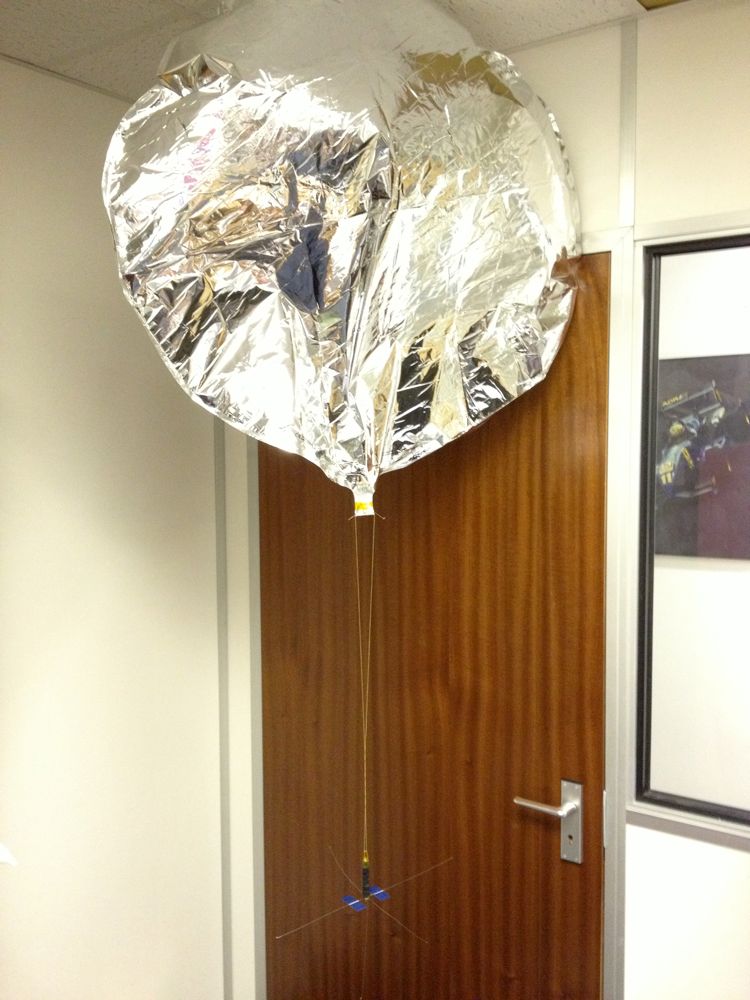
Typical pico balloon with tiny solar powered 434 MHz transmitter - Image credit Leo Bodnar M0XER

Typical pico balloon with tiny solar powered 434 MHz transmitter – Image credit Leo Bodnar M0XER

Depending on altitude the balloons could have a range of 300-500 km and remain aloft for several days.

Balloons: 90cm Qualatex foil party balloon
Payloads: 12 grams solar powered tracker
Telemetry: 434.500 MHz, USB, vertical polarisation, Contestia 8/1000
B-44 is 1500Hz higher than B-43 so it should be possible to see both in the same audio bandwidth.

These balloons use digital mode “Contestia 8/1000”. Unfortunately it is not possible to automatically configure this mode in dl-fldigi. Therefore please follow this procedure:
• Autoconfigure B-43 or B-44 flight as usual.  This will default to DOMX 16 mode.
• Select menu option  Op Mode -> Contestia ->  8/1000.  The bottom left corner of dl-fldigi should now read CTSTIA 8/1000
• Enable RxID button at the top right corner of dl-fldigi.

Downlink data contains two lines of telemetry every 4 minutes.Time between telemetry data is filled with beeps at 3 sec intervals.

Leo says “I appreciate help of everybody who joins in for tracking!”

Typical solar powered 434 MHz transmitter - Image credit Leo Bodnar M0XER

Typical solar powered 434 MHz transmitter – Image credit Leo Bodnar M0XER

Leo Bodnar M0XER balloons http://www.leobodnar.com/balloons/

You can see online real time tracks and frequencies of balloons at http://spacenear.us/tracker/

Download the dl-fldigi software from http://ukhas.org.uk/projects:dl-fldigi

Listen to balloons online (when in range of south-east UK) from anywhere in the world with the SUWS 434 MHz WebSDR (select USB) https://amsat-uk.org/2013/12/28/websdr-for-434-and-1296-mhz/

Beginners Guide to Tracking using dl-fldigi http://ukhas.org.uk/guides:tracking_guide

Check the #highaltitude IRC channel for chat about launches. A web client is available at
http://webchat.freenode.net/?channels=highaltitude

To get up-to-date information on balloon flights subscribe to the UKHAS Mailing List by sending a blank email to this address: ukhas+subscribe@googlegroups.com

Track of B-44 and B-45 balloons on April 19, 2014

Track of B-44 and B-45 balloons on April 19, 2014

434 MHz XABEN and other balloon launches go ahead today

High altitude balloon 434 MHz trackers made by Chris M6EDF

High altitude balloon 434 MHz trackers made by Chris M6EDF

Steve G8KHW planned to launch five balloons XABEN64-68 carrying 434 MHz payloads from Elsworth on Wednesday, March 12. The permit for them arrived at the last minute on Wednesday morning. Technically the flights need a permit despite being 100g balloons as they are on a line rather than mounted in the neck.

The balloons may have a range of 200-500 km so should be receivable on a SSB (USB) radio over much of the UK or can be received World-Wide using the SUWS WebSDR

Steve says: The plan is to launch 5 identical payloads on 5 identical 100g balloons as near identically filled as I can manage in order to see the sort of spread of burst altitudes. The balloons will be launched as quick as I can fill them and launch them – so its likely that all 5 balloons will be in the air at the same time.

With all those flights I’m going to need some help tracking them – so lots of listeners would be appreciated. Callsigns and Frequencies to follow on the UKHAS Mailing List – but all will be on 434 MHz with standard 50 Baud 470 Hz 7N1 RTTY.

SSDV picture from a PIE balloon - Image credit Dave Akerman M6RPI

SSDV picture from a PIE balloon – Image credit Dave Akerman M6RPI

XABEN64-68 Callsigns and Frequencies (USB):
– uX3 434.250
– uX0 434.350
– uX1 434.400
– uX2 434.450
// skipping 434.500 to avoid BALYOLO
– uX5 435.550

There should be a launch from Westcott, Buckinghamshire on Wednesday at 12.00 Callsign: BALYOLO Frequency 434.500 MHz.

Project Ascend are launching Wednesday at 0900 from Cockermouth,Cumbria. They say please listen out for us on 434.450 MHz USB,  Callsign HAB55331. Further information at http://projectascend.co.uk/

Dave Akerman M6RPI/M0RPI says he’s planning to launch at around 2pm on Thursday, it’ll be a regular payload up-burst-down, probably with 2 trackers. The launch will take place from the field behind Dave’s new house just north of Ross-On-Wye, so receivers in the west of England will be particularly welcome. No SSDV just 50 baud RTTY telemetry. There will be live video streaming of the launch and chase at http://www.batc.tv/streams/m0rpi_chase

The two payloads are BUZZ and ZURG.  Both 50 baud 7 bits no parity 2 stop bits, 480Hz shift. BUZZ is on 434.600 MHz and ZURG on 434.650 MHz.  Former is an rfm22b and latter an NTX2 so they will drift somewhat.

On Thursday, March 13 Adam Cudworth will be launching HABE 12 from Worcestershire on 434.200 MHz.

James Coxon M6JCX launching a PICO balloon on 434.301 MHz USB

James Coxon M6JCX launching a PICO balloon on 434.301 MHz USB

Check the IRC channel for chat about the launches on irc.freenode.net #highaltitude
A web client is available at http://webchat.freenode.net/?channels=highaltitude

Online real-time tracking of balloons
http://spacenear.us/tracker/

Listen to the balloons online using the Southampton University Wireless Society (SUWS) 434 MHz WebSDR located near Basingstoke (51.294N, 1.131W)
https://amsat-uk.org/2013/12/28/websdr-for-434-and-1296-mhz/

Beginners Guide to Tracking using dl-fldigi software
http://ukhas.org.uk/guides:tracking_guide

To get up-to-date information on balloon flights subscribe to the UKHAS Mailing List by sending a blank email to this address: ukhas+subscribe@googlegroups.com

How high-altitude balloon missions stay on track

Mark and Cassie with their STRATODEAN High Altitude Balloon

Mark and Cassie with their STRATODEAN High Altitude Balloon

In The Register Lester Haines interviews radio amateur Daniel Richman M0ZDR (ex-M6DRX) about the impressive Cambridge University Space Flight (CUSF) Landing Predictor.

Rob Anderson wrote the original landing predictor for High Altitude Balloons in 2008. Since then it’s been continually updated to improve performance, and now offers anyone wanting to send a balloon aloft the chance of seeing very quickly indeed just where it’ll burst and where they should head to recover their precious load.

Others who’ve worked on the predictor in the past five years are Fergus Noble M0NBL, Ed Moore M0TEK, Jon Sowman M0JSN and Adam Greig M0RND.

Read Fair winds and following servers: The art of flight prediction
http://www.theregister.co.uk/2013/12/18/lohan_flight_prediction/

CUSF Landing Predictor http://predict.habhub.org/

Daniel then M6DRX was one of three pupils at the Reading School who in 2010 built the Alien-1 high altitude balloon http://www.southgatearc.org/news/may2010/alien_1_launch.htm

To get up-to-date information on balloon flights subscribe to the UKHAS Mailing List by sending a blank email to this address: ukhas+subscribe@googlegroups.com

Introduction to High Altitude Ballooning

Phil Crump M0DNY

Phil Crump M0DNY

In this video Phil Crump M0DNY of the UK High Altitude Society (UKHAS) gives an introduction to High Altitude Ballooning (HAB). The presentation was given to the BATC Convention on October 26, 2013.

Watch Introduction to High Altitude Ballooning

Noel Matthews G8GTZ, Chair of the BATC, has announced the first 11 presentation videos from the CAT13 convention on ATV/DATV, held October 26, 2013, have been put up on the BATC video archive area.

They can be found in the http://batc.tv/ Film Archive by selecting the BATC CAT13 category.

The direct links are available via https://amsat-uk.org/2013/10/29/iss-hamtv-presentation-by-g3vzv/

UK High Altitude Society http://ukhas.org.uk/

To get up-to-date information on balloon flights subscribe to the UKHAS Mailing List by sending a blank email to this address:
ukhas+subscribe@googlegroups.com

Ofcom Amateur Radio Licence Review

Ash Gohil and Paul Jarvis G8RMM at 2013 RSGB Convention

Ash Gohil and Paul Jarvis G8RMM at 2013 RSGB Convention

One of the highlights of the RSGB Convention, October 12-13, was a talk by Ofcom’s Paul Jarvis G8RMM and Ash Gohil about the upcoming Amateur Radio Licence Review.

Read the Essex Ham report at
http://www.essexham.co.uk/news/ofcom-amateur-radio-licence-review.html

The RSGB are planning to offer three further Litmus Tests shortly on:
– Licence Progression
– /AM usage for unattended airborne usage (balloons, etc)
– Remote Operation.

The new Discussion Forums will be available at http://rsgbdata.net/litmus/viewforum.php?f=9

Other issues that people may want to discuss that came from Ofcom’s presentation on Sunday, or at the National Hamfest, should be posted to the “Suggestions for New Topics” Litmus Test, see
http://rsgbdata.net/litmus/viewforum.php?f=14

437.700 and 437.5966 MHz ham radio balloons heading for UK

SP3OSJ Pico Balloon

SP3OSJ Pico Balloon

Artur SP3OSJ has launched an amateur radio solar powered pico balloon on 437.700 MHz USB from Poland which should be over the UK on Sunday, October 13. Also on its way is another pico balloon SP3UOB on 437.5966 MHz USB.

The SP3OSJ balloon, launched at about 06:01 UT on Saturday morning, is on its way west from Poland with the predicted path going over Denmark then on to the United Kingdom.

Artur asks for other amateurs to assist by tracking the telemetry signal on approximately 437.700 MHz USB. It is running UKHAS RTTY 100 baud 7n2, 470 Hz shift – SP3OSJ (SP3OSJ/08 in dl-fldigi).

Tomasz also request amateurs to listen for his balloon on 437.5966 MHz USB.

The payload on the balloons weigh only a few tens of grams. They comprise a tiny 437 MHz transmitter running about 10 milliwatts and a GPS receiver. The SP3OSJ balloon is powered by a rechargeable battery and solar panel with should give an extended lifetime of several days.

SP3OSJ Pico Balloon Payload

SP3OSJ Pico Balloon Payload

SP3OSJ is flying at an altitude of between 3000 and 3500 metres and should have a radio range of around 150 km.

Real-time tracking of this and other balloons is available at http://spacenear.us/tracker/

Beginners Guide to Tracking using dl-fldigi http://ukhas.org.uk/guides:tracking_guide

To get details of upcoming UK balloon launches subscribe to the UKHAS Mailing List by sending a blank email to this address:
ukhas+subscribe@googlegroups.com