Manchester: Synergy-Space Meetup

Sotira Trifourki Synergy-SpaceOrganizer Sotira Trifourki reports on the planned Synergy-Space Meetups in the Manchester area.

She says: We are putting together a regular meetup group to start making the CubeSats and Space Telescope’s for our forthcoming missions to the Moon with Team SYNERGY MOON, you can find us here:
http://www.meetup.com/Synergy-Space/

Synergy Moon http://www.synergymoon.com/

TshepisoSAT / ZACUBE-1, six months on orbit

ZACUBE-1, FUNcube-1 and HiNCube in the deployment pod - Image credit Wouter Weggelaar PA3WEG

ZACUBE-1, FUNcube-1 and HiNCube in the deployment pod – Image credit Wouter Weggelaar PA3WEG

The South African CPUT TshepisoSAT team were invited to give a mission update at the SA AMSAT‘s Space Symposium on Saturday, May 24, 2014 at the Innovation Hub in Pretoria.

The event was well attended and even had representatives from SANSA in attendance. Presentations on other CubeSats included Denel Dynamics’ DynaCube, FUNcube-1 and SA AMSAT’s own KLETSkous project.

This paper gives a brief introduction to the F’SATI programme, the constructed CubeSat and mission. An outline of the milestones reached thus far with the Tshepiso nano-satellite are given, the outstanding activities that must still be completed and challenges faced. Some of the images captured by the satellite are also presented. Read TshepisoSAT, six months on orbit.
http://www.cput.ac.za/blogs/fsati/files/2014/05/Paper-SA-AMSAT-Space-Symposium-Pretoria-2014.pdf

CPUT F’SATI News http://www.cput.ac.za/blogs/fsati/blog/

Southern African Amateur Radio Satellite Association (SA AMSAT) http://www.amsatsa.org.za/

2014 FUNcube missions – May Update

UKube-1 ready for launch

UKube-1 ready for launch

The FUNcube team have received confirmation that UKube-1, which is hosting the FUNcube-2 payload, is now scheduled for a Soyuz-2-1b Fregat-M launch from Baikonur in Kazakhstan on Saturday, June 28 with the following day as a back-up.  The launch time has been quoted as 15:58:28 UT with separation some 9253 seconds later.

The team still understand that, immediately after deployment and activation, UKube-1 will commence transmitting a CW beacon and that this will be later followed by an AX25, 1200 bps BPSK beacon. Both beacons will be on 145.840 MHz. The FUNcube-2 payload, with its telemetry downlink for educational outreach, is expected to be tested later.

FUNcube-3 is the transponder only payload on the QB50 precursor CubeSat “QB50P1″. This mission is now scheduled to launch on June 19 on a Dnepr launch vehicle from Dombarovsky near Yasny. The launch time has been quoted as 19:11:11 UT but this has not yet been confirmed.  The initial beacon signals, from the main transceiver, are also expected to be AX.25, 1200 bps BPSK packets on 145.815 MHz.

Again more information will be provided as soon as it becomes available!
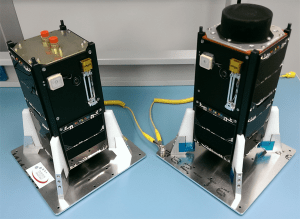
QB50p1 and QB50p2 - Image Credit ISIS

QB50p1 and QB50p2 – Image Credit ISIS

UKube-1 communications subsystem:
• 145.840 MHz Telemetry, CW, 1k2 BPSK
• 2401.0 MHz S Band Downlink
• 437.425-437.525 MHz UKSEDS myPocketQub Downlink
• 145.915 MHz FUNcube beacon
• FUNcube 400 mW inverting SSB/CW transponder
– 435.080-435.060 MHz Uplink LSB
– 145.930-145.950 MHz Downlink USB

QB50p1 communications subsystem:
• 145.815 MHz 1200 bps BPSK telemetry
• FUNcube inverting 400 mW SSB/CW transponder
– 435.035-435.065 MHz Uplink LSB
– 145.935-145.965 MHz Downlink USB

FUNcube website http://www.funcube.org.uk/

FUNcube Yahoo Group https://amsat-uk.org/funcube/yahoo-group/

FUNcube Forum http://forum.funcube.org.uk/

Ofcom 146-147 MHz Consultation Closes Monday

AMSAT-UK Logo

AMSAT-UK Logo

The key Ofcom public consultation to give radio amateurs temporary access to 146 to 147 MHz closes at the end of Monday, May 26.

You can let Ofcom know your view on this by filling in the simple online question form at
https://stakeholders.ofcom.org.uk/consultations/vhf-143-169mhz/howtorespond/form

The form asks four questions, the one of key importance to amateur radio is Question 4 which says:
“Do you agree with the proposal to make some spectrum not currently assigned to other applications available on a temporary for Amateur Radio use with these restrictions?”

You can just put No Comment in the other question boxes.

Ofcom 143 MHz to 169 MHz consultation page
http://stakeholders.ofcom.org.uk/consultations/vhf-143-169mhz/

Consultation document PDF
http://stakeholders.ofcom.org.uk/binaries/consultations/vhf-143-169mhz/summary/VHF_consultation.pdf

Ofcom Consultation: 146-147 MHz for Ham Radio use
https://amsat-uk.org/2014/03/24/ofcom-consultation-146-147-mhz-for-amateur-radio-use-in-uk/

Surrey EARS make newspaper front page

Surrey EARS in Surrey Advertiser May 16

Surrey EARS in Surrey Advertiser May 16, 2014

The Surrey Electronics and Amateur Radio Society (EARS) 434 MHz balloon flight was the top news story on the front page of the Surrey Advertiser newspaper.

On Sunday, May 4, the Surrey EARS team launched a High Altitude Balloon from Cambridgeshire carrying University of Surrey mascot Stevie Stag. The balloon had a flight time of around three hours, reached almost 100,000 feet and travelled just over 70 miles including a portion of the ascent right over the city of Cambridge. The transmissions from the balloon on 434 MHz were received in the UK, France, Netherlands and Germany.

After the launch EARS auctioned Stevie Stag, the only Stag to fly to the edge of space, on eBay to raise money for the mental health charity Mind.

Read the story Space traveling stag auctioned for more than £200
http://www.getsurrey.co.uk/news/local-news/university-surrey-mascot-stevie-stag-7115040

Watch Stevie Stag Goes to Space! High Altitude Balloon Flight Video

Surrey EARS on Facebook https://www.facebook.com/surreyEARS

Shin’en2 Satellite Linear Transponder Frequencies

Shin-En2 satellite

Shin’en2 satellite

The IARU Amateur Satellite Frequency Coordination Panel has announced frequencies for the Shin’en2 linear transponder.

Shin’en2 is a 17 kg satellite measuring 490×490×475 mm built by students at Kagoshima University in Japan which will carry a 145 to 435 MHz linear transponder into a deep space orbit.

The aims of the mission are:
• To establish communication technologies with a long range as far as moon.
• To establish a new technology of the ultra-light-weight satellite. Proposing a WSJT 29dBm UHF downlink and a 29dBm 20 kHz linear transponder and a CW beacon all on UHF with a VHF uplink for the transponder. Note it is now understood the transponder will not be operational

The orbit will be quite different from the previous satellites. Shin-En2 will have an elliptic orbit around the Sun and travel to a deep space orbit between Venus and Mars. Its inclination will be almost zero, which means Shin-En2 will stay in the Earth’s equatorial plane.

The distance from the Sun will be between 0.7 and 1.3 AU. An Astronomical Unit (AU) is 149,597,871 km.

Shin’en2 IARU coordinated frequencies:
• 437.505 MHz CW beacon
• 437.385 MHz WSJT telemetry

Originally it was planned to fly an inverting SSB/CW transponder but it is now understood the transponder will not be operational
– 145.940-145.960 MHz uplink LSB
– 435.280-435.260 MHz downlink USB

Shin’en2 is expected to launch in the 4th quarter of 2014 with another amateur radio satellite ARTSAT2:DESPATCH on a H-IIA rocket with the asteroid explorer Hayabusa 2 as the main payload.

Kagoshima University satellite development team
http://tinyurl.com/Kagoshima-Satellite

Shin’en2 English Website
http://www.eee.kagoshima-u.ac.jp/~fuku-lab/sinen,english.html

ARTSAT2:DESPATCH – Art and Ham Radio in Deep Space
https://amsat-uk.org/2013/11/03/art-and-ham-radio-in-deep-space/